Last summer when legislative Democrats killed a bipartisan deal on how to spend the state’s big budget surplus they offered what sounded like a good reason, namely that it spent one-time money on ongoing expenditures, setting up a future structural deficit.
But I had my doubts. I suspected that the real game was that they thought they had a chance at gaining complete control of state government in the November elections so that they could spend all of it on public schools — and never mind the structural deficit. They’d use the surplus to lock the state into the higher spending and pump in still more money in the following biennia. My main evidence for that suspicion was that the big teachers union, WEAC, opposed the deal worked out by Gov. Tony Evers and Assembly Speaker Robin Vos. Under that agreement a whopping $600 million. or a third of the $1.8 billion projected in the surplus at the time, would go to schools. But WEAC wants it all.
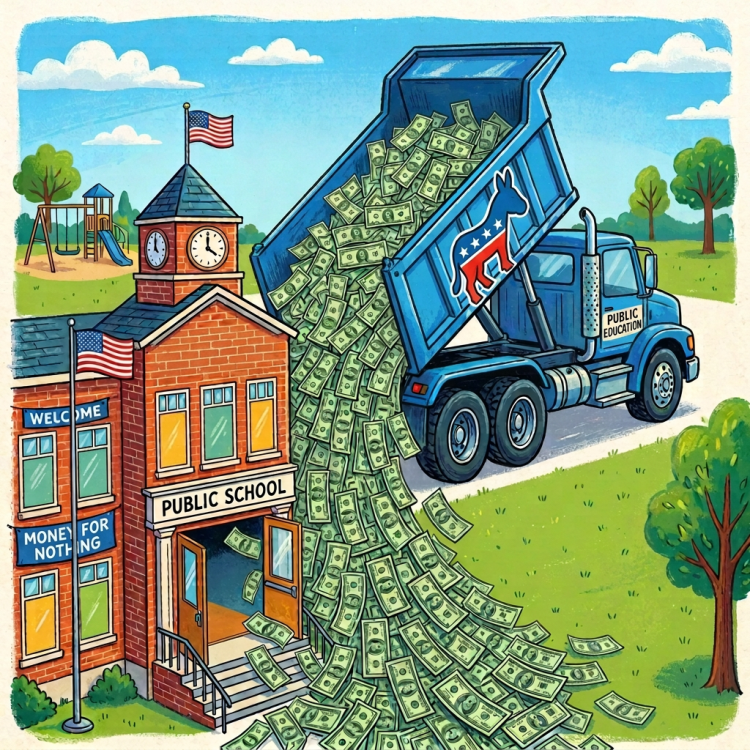
More evidence for that came out last week when the Department of Public Instruction, a wholly owned WEAC subsidiary, proposed a staggering $2.75 billion more on public schools — pretty much equal to the entire surplus.
This sets up an interesting problem for incoming Gov. David Crowley and the new legislative majorities. Democrats have promised to do something about education, property taxes, health care, child care and shared revenues for local governments. In addition, there are sky high expectations at the UW and they need to do something about the prison system. These are all big ticket items and they can’t afford to do them all effectively unless they want to increase income or sales taxes on the middle class — and by a lot.
In my blog earlier this week I laid out how they might be able to use the surplus responsibly on one-time capital expenditures and then come up with maybe $3 billion in new revenue over the next biennium. But there’s simply no way that even that substantial chunk of change is enough to do it all. Even with a big surplus and the possibility of raising significantly more revenue from things like legalizing marijuana, applying the sales tax to data centers and creating a new tax bracket for millionaires, there just isn’t going to be enough money.
And when it comes to education, Democrats continue to labor under the false notion that all the schools need is more money. They never propose any reforms or demand any improvements in outcomes. It’s always just more money. A lot more money.
In fact, there is no correlation between spending on education and educational outcomes. There are high spending states with bad results and there are low spending states with terrific outcomes.
For example, the nation’s highest per pupil spending is in New York ($31,918) and Washington DC ($31,529), but New York students’ test scores are only average while DC’s are below average. On the other hand, the two states with the lowest per pupil spending are Utah ($11,347) and Idaho ($11,060) and they have some of the highest test scores in the country. And lest you think that that’s just all about demographics, even Mississippi and Louisiana are making nationally recognized improvements in reading with very low spending.
So, what’s important is not how much you spend, but how you spend it. Modest but targeted investments in reading programs that have been proven to work in the early grades are our best bet. Instead, DPI/WEAC propose filling a dump truck with cash and pouring it willy-nilly on our schools. And when that doesn’t work they’ll claim that schools are still underfunded. They’ll demand another dump truck.
At the very least, any new money provided by the state needs to come with a requirement for responsible spending. Let me give you three examples of what’s going on instead:
- According to the nonpartisan and highly respected Wisconsin Policy Forum, the number of students in Wisconsin’s public schools has declined by 9.2% since 2016 while the number of staff has increased by 7%.
- A couple of years ago Madison passed a record $507 million capital program for its schools. Much of that was justified, but the biggest single item was roughly $100 million for a new Shabazz High School and Sherman Middle School. That building is at half capacity and projections are that its enrollment will decline. And we’re building a bigger school. Only now, after the fact, is the district doing an attendance area study that might have resulted in fewer school buildings, not bigger ones.
- Just recently, Hustisford made the hard, but necessary, decision to close its district and consolidate with a neighboring one. Superintendent Jill Underly decried the move. Does she really think that a district with only 236 students and a declining enrollment (it had over 400 at one time) should continue no matter how inefficient and expensive it is?
Democrats need to make hard choices and to set priorities. Because voters’ top concern is the cost of living, that means they need to focus on property tax relief first. They can still improve K-12 education, but they can do that with smart, targeted and fiscally responsible investments and much, much less than $2.75 billion.
Because they want to do so much, Democrats need to make sure that every dollar they spend leverages improvement.
And on another matter… check out this bipartisan effort to deal with the federal deficit: