
A Roundup of Other Moderate Voices
The Left Took the Bait
In a January 23rd oped appearing in the Wisconsin State Journal, syndicated columnist Froma Harrop writes that Trump sent ICE to Minneapolis precisely to stir up the kind of disorder he can play off of: “The worry for Democrats is that some of their prominent figures may help Trump by playing the “Abolish ICE” card again. That was very bad for them last time. Most Americans support immigration but want it kept legal. “Abolish ICE” sounds a lot like “Defund the police.” (“Abolish ICE” probably cost Wisconsin Lt. Gov. Mandela Barnes — and Democrats — a Senate seat in 2022. He lost to Republican Sen. Ron Johnson by a hair.) What if these armies of agents showed up and the town answered by pulling the shades and turning on the TV? Confrontation is Trump’s preferred setting, and confusion caused by a multitude of players blurs the lines.”
Who’s Left Out in Dem World?
In a January 20th oped in the New York Times, Zaid Jilani argues that the Democrats’ focus on identity politics is hurting them badly at the polls: “In the face of the G.O.P.’s white identity movement, progressive racial politics is becoming a liability. Many white people simply do not see a place for themselves in a Democratic Party that often feels organized not for the benefit of Americans as a whole but for a coalition of identity groups instead. Polls have consistently shown that large numbers of white people even believe they are discriminated against in America. Former Georgia State Representative LaDawn Jones, a Black liberal Democrat, noticed this problem in a 2017 blog post she wrote after reviewing the schedule for a Democratic National Committee meeting in Atlanta. She found that there were caucuses for pretty much every group except for one. “Excuse me D.N.C., where does a middle-aged white male who lives in an urban community get a chance to discuss his concerns for the country and work on a strategy to address those issues?” she asked.”
More Pro AI Evidence
In a January 19th oped in the New York Times, Dr. Robert Wachter, chair of the medical school at UCSF, writes about how AI is improving health care: “Sometimes I consult with ChatGPT; other times I turn to OpenEvidence, a specialized tool for physicians. I find A.I.’s input is virtually always useful. These tools provide immediate and comprehensive answers to complex questions far more effectively than a traditional textbook or a Google search. And they are available 24/7… Some people argue that A.I.’s imperfections mean that we shouldn’t use the technology in high-stakes fields like medicine, or that it should be tightly regulated before we do. But the biggest mistake now would be to overly restrict A.I. tools that could improve care by setting an impossibly high bar, one far higher than the one we set for ourselves as doctors. A.I. doesn’t have to be perfect to be better. It just has to be better.”
Building a Loyal Opposition in Portland
In a January 16th oped in the Wall Street Journal, Dennis Kneale wrote about efforts by moderates in Portland to push back against the dominant hard-left: “Many locals described the state as a victim of its own self-inflicted policy errors. They came from many backgrounds—business owners, a former candidate for governor, a former congressman, a Democrat operative, a Republican adviser, the CEO of the Oregon Historical Society and an expert on homelessness. Most said Oregonians need to stand up and push back against the Democratic supermajority that runs the state. Dan Lavey, a Republican strategist, told me that he used to be viewed as a RINO (Republican in name only), but these days, “I sound like Rush Limbaugh. I feel like a reactionary conservative in a way that I never was. And I think there’s a lot of liberals in Portland who are this way now.” Kristin Olson, a longtime Democrat, lawyer and host of the podcast “Rational in Portland,” worked downtown for two decades until she was assaulted last year while walking from her car to her office building. She never returned and moved to new space elsewhere.”
Don’t We Already Have Enough Socialism?
In an oped that appeared in the Wisconsin State Journal on January 11th, Jonah Goldberg comments on Zohran Mamdani’s call for still more redistribution: “Maybe it’s bad that the top 10% of American tax filers make nearly half of the income in America — and provide three-quarters of the income tax revenues. Maybe it’s good that the average wage earner will receive more in entitlements than they paid in. Maybe it’s right that the poorest 20% of Americans receive roughly $6 from the government for every dollar they pay in taxes. Perhaps we should be ashamed that we spend less than France on social welfare programs but more than Switzerland and the Netherlands. Reasonable people will differ.”
To Tame the Savageness of Man
In a January 9th oped, New York Times columnist David Brooks writes about how moderate, classical liberals are being squeezed out by angry, power mongers on the right and left, but he points out that moderate liberalism is still humanities’ best answer: “The left progressives and the right populists who seek to tear down the neoliberal order are being shortsighted — idiotic, frankly. Sure, the postwar order was sometimes used as a mask to disguise American and elite power grabs, but it really did restrain people. As Yale’s Oona Hathaway wrote in these pages this week, “from 1989 to 2014, battle-related deaths from cross-border conflicts averaged fewer than 15,000 a year. Beginning in 2014, the average has risen to over 100,000 a year.” A great wave of savagery has been released, foreign and domestic. If you think foreign policy ideals were discredited by the Iraq war, how do you like Trump’s world without them?”
Limousine Liberals Then and Now
In a January 4, 2026 piece in the Free Press, Charles Lane compares the leftist George Orwell’s insights about his own brethren to what’s happening today. Not much has changed: “What workers really want, Orwell argued, is “present society with the worst abuses left out, and with interest centering round the same things as at present—family life, the pub, football, and local politics.” Meanwhile, a typical socialist is “a prim little man with a white-collar job, and, above all . . . a social position which he has no intention of forfeiting.” It’s fair to say that George Orwell would have despised Zohran Mamdani. During the campaign, when he was not out stumping for a rent freeze, free bus rides, or decriminalizing “sex work,” New York’s new mayor could be found dining at Manhattan’s pricey Omen Azen. His 2025 wedding celebrations included a three-day bash at his family’s secure compound in Uganda. Yet today, many Democratic progressives have happily, eagerly anointed him as their new leader.”
Yeah, That’s About Right
In a December 16th oped in the New York Times, Bret Stephens sums up Donald Trump in one paragraph as well as anyone has: “Though I tend to think it’s usually a waste of space to devote a column to President Trump’s personality — what more is there to say about the character of this petty, hollow, squalid, overstuffed man? — sometimes the point bears stressing: We are led by the most loathsome human being ever to occupy the White House.”
Smash the Hegemony of the Professoriate
In a piece which appeared on December 14th in Wisconsin Right Now, UW-Milwaukee journalism instructor Jessica McBride wrote in support of a bill in the Wisconsin Legislature which would allow non-tenured faculty to participate in the governance of the university: “My program could hire Tom Brokaw or Walter Cronkite (if he was still alive) to teach broadcast journalism, and they would have no vote on which broadcast news classes we offer because they aren’t PhDs with tenure. Make that make sense.”
An Intelligent Take on Artificial Intelligence
In an oped printed in the December 12th edition of the Wisconsin State Journal, Kevin Frazier, who studies AI at Texas Law, wrote this: “Fear-mongering about the economic disruptions posed by AI is at odds with historical precedent and is unproductive. “Historically,” based on research by the Organization for Economic Cooperation and Development, “the income-generating effects of new technologies have proved more powerful than the labor-displacing effects: technological progress has been accompanied not only by higher output and productivity, but also by higher overall employment.” Speculative reports and exaggerated headlines deny this reality and undermine efforts to invest in transition programs. The progress forecasted by the OECD will only be paired with societal progress if we take the creation of economic bridges seriously. Let’s help people connect to the jobs of the future rather than rile them up in defense of the status quo.”
Immigrants Contribute
In a December 9th oped in the Wall Street Journal, conservative Harvard economist Roland Fryer calls for a realistic policy on immigration: “Immigration is among the most rigorously studied topics in the field, and decades of evidence contradict the premise that undocumented immigrants drive crime or meaningfully depress native wages. Immigrants, especially those here illegally, are less likely to commit crimes than native-born Americans. Meanwhile, the economic and social costs of mass deportation will extend far beyond the billions of dollars required to carry it out: The policy will hollow out key industries, erode trust in public institutions, and weaken the public safety it purports to restore.”
Not a Conservatism They Recognize
In a November 18th editorial, the Wall Street Journal praises Princeton President Robert P. George for resigning from the Heritage Foundation Board over the Foundation director’s defense of Tucker Carlson and Nick Fuentes: “A “conservatism” that plays footsie—or worse—with antisemitism and white identity politics, and those who traffic them, doesn’t merit the name… It’s a shame to see a valuable institution lose its way, but Heritage has.”
Mod Dems Acted Just in Time
In a syndicated column that appeared in the Wisconsin State Journal on November 16th, Froma Harrop writes that Democrats won the shutdown and ended it just in time: “At a certain point, the news started turning from the fight to extend the Obamacare subsidies to flights being canceled and the poor losing food assistance. With Thanksgiving approaching, the sight of family members sitting on suitcases in airports is not optimal. As many more Americans feel shutdown pain at the personal level, Democrats are harder pressed to avoid blame, even if the public liked certain items they were fighting for…. (The moderate Democratic senators who ended the shutdown) come from the swing states of Nevada, Virginia, Pennsylvania, New Hampshire and Maine. They are key to Democrats obtaining and keeping a majority in Congress. Without them, Democrats have no hope of obtaining real power. And without real power, their politics are just performance. The shutdown did succeed in putting the specter of lost health coverage front and center. That mission has been accomplished. Trump’s now railing that Obamacare is a “scam” to get the insurance companies filthy rich. Democrats should thank him for calling this revered benefit a “scam.””
Dems Still Won the Shutdown Skirmish
In a November 10th piece, New York Times columnist Ezra Klein dissects the pros and cons of the moderate Democrats deal to end the government shutdown and concludes: “The shutdown was a skirmish, not the real battle. Both sides were fighting for position, and Democrats, if you look at the polls, are ending up in a better one than they were when they started. They elevated their best issue — health care — and set the stage for voters to connect higher premiums with Republican rule. It’s not a win, but given how badly shutdowns often go for the opposition party, it’s better than a loss.”
Apex Predators
In his November 7th piece, New York Times columnist David Brooks takes a crack at understanding what drives authoritarians, like Trump, Putin and others: “Throughout this column I’ve been calling the authoritarians wolves. I mean it as an insult — predators who are ravaging the world. But the authoritarians take it as a compliment. They know they are wolves! But they believe the world needs wolves to protect the good, decent people from the ruthless fancy people who are their actual enemies. And here’s how authoritarianism feeds on itself: The more wolves there are in the world, the more each nation needs to find its own.”
Defeat in Victory?
In a November 5th Wall Street Journal column, Karl Rove says that Tuesday’s results were a clear rejection of Trump. But he warns Democrats: “Gotham’s new socialist mayor is a problem for Democrats. Republicans will make him the face of the Democratic Party nationally. Mr. Mamdani’s free-everything proposals thrill left-wingers, but middle America will reject his socialist nostrums and disdain for Israel. It was center-leaning messaging that got Democrats victories in New Jersey and Virginia Tuesday. If Mr. Mamdani dominates the news, Democrats miles away from Manhattan will have to separate themselves from him and his ideology… Liberal Democratic mayors in Minneapolis and Seattle apparently have held off challenges from their party’s ambitious socialist wing, but this intraparty battle is only beginning. If socialists become the Democratic Party’s face, many Democratic and independent voters may become open to an attractive GOP alternative.”
Who’s a Snowflake Now?
In an October 28th essay in the Free Press, Ryan Holliday writes about how the hard-right has now become the easily offended “snowflakes” they once criticized: “This political correctness is not just obnoxious, but it has had hugely damaging effects. People were canceled over silly things when the left was in power. Democrats were punished electorally, and that’s only the beginning of the consequences of the pendulum swing. The comedian Marc Maron has it mostly right in his new special when he says that the left effectively annoyed a portion of society into supporting fascism. Which is what brings me to my main point: Any writer these days, who hasn’t been radicalized or redpilled, can tell you who the snowflakes are now. The people who were not long ago the loudest in preaching free speech are today the quickest to silence anyone who uses it to disagree with them. The people who railed against cancel culture are now trying to use the machinery of the state to try to destroy anyone who dares to posthumously criticize Charlie Kirk and the stances he took—which, it should be continually pointed out, included proudly sending buses to the Capitol on January 6, 2021.”
The Old Girls Club
In an October 25th piece in Compact, Helen Andrews writes about the feminization of American society: “As a woman myself, I am grateful for the opportunities I have had to pursue a career in writing and editing. Thankfully, I don’t think solving the feminization problem requires us to shut any doors in women’s faces. We simply have to restore fair rules. Right now we have a nominally meritocratic system in which it is illegal for women to lose. Let’s make hiring meritocratic in substance and not just name, and we will see how it shakes out. Make it legal to have a masculine office culture again. Remove the HR lady’s veto power. I think people will be surprised to discover how much of our current feminization is attributable to institutional changes like the advent of HR, which were brought about by legal changes and which legal changes can reverse.”
Rich, But Poor in Votes
In an October 23rd piece in the New York Times by investigative reporter Brody Mullins, he reports that the party switch between the rich and poor is now complete and that it bodes ill for the Democrats: “If Democrats don’t reverse course, they may soon find themselves unable to win presidential elections. Increasingly, the party is made up of urban professionals who graduated from four-year universities and command relatively high salaries. Having more of these supporters has been a boon to the party’s finances, but electorally, the shift has been a disaster. The electoral power of high-income voters is limited: Not only are they a smaller demographic, but they are also concentrated in a handful of coastal states that do not decide presidential elections. By contrast, the lower-income voters lost by Democrats are dispersed across the battleground states that increasingly determine the Electoral College outcome. Under this system, no candidate can win the presidency today without galvanizing the working class.”
A Boost for Moderation
In an October 19th editorial, the once hard-left New York Times editorial board wrote a stirring and convincing defense of moderation: “America still has a political center. Polls show that most voters prefer capitalism to socialism and worry that the government is too big — and also think that corporations and the wealthy have too much power. Most voters oppose both the cruel immigration enforcement of the Trump administration and the lax Biden policies that led to a record immigration surge. Most favor robust policing to combat crime and recoil at police brutality. Most favor widespread abortion access and some restrictions late in pregnancy. Most oppose race-based affirmative action and support class-based affirmative action. Most support job protections for trans people and believethat trans girls should not play girls’ sports. Most want strong public schools and the flexibility to choose which school their children attend.”
Shared Values and Common Goals
In a column about the impact of the Internet and social media on politics in the October 14th New York Times, Thomas B. Edsall quotes Jack Goldstone, a professor of public policy at George Mason University: “Democracy relies on people with different views finding their way to reasonable compromises and consensus built on a core of shared values and common goals. If a population becomes sharply divided into different identity groups that see their opponents as enemies whose goals — nay, whose very existence — is a threat to their own values and goals, then democracy is likely to fade away in favor of competition to control the state in order to wield state power to vanquish those dangerous enemies.”
“Equity” is the Enemy
In his October 9th New York Times oped, David Brooks explores why the Democrats, once the party the public trusted on education, are now trailing Republicans in public confidence on that issue: “The number of Black students scoring below basic levels in math had fallen from 78 percent to 48 percent (during No Child Left Behind). Well, now that number is back up to 62 percent. My own conclusion is this: The equity approach is supposed to increase, well, equity. But by lowering accountability, rigor and standards, it produces more inequality. We’ve now had 12 years of terrible education statistics. You would have thought this would spark a flurry of reform activity. And it has, but in only one type of people: Republicans. When it comes to education policy, Republicans are now kicking Democrats in the butt.”
Emanuel Schools His Party
In an October 1st oped in the Wall Street Journal, Rahm Emanuel took a centrist view on education: “We’ve spent the past five years debating pronouns without noticing that too many students can’t tell you what a pronoun is. The U.S. has been more focused on whether a school is named for Abraham Lincoln than whether students can tell you why he is an American giant. We’ve become so obsessed with bathroom access that we’ve ignored classroom excellence. America has lost the plot. Democrats need to refocus on the fundamentals in the elementary years—when it comes to high school, we need to be pursuing fundamental reform.”
Kudos to Cruz
In its September 21st editorial, the Wall Street Journal lauds Sen. Ted Cruz for standing up to Trump and for free speech: “Most Republicans are afraid of uttering even a syllable of disapproval about the Trump Administration, so kudos to Ted Cruz for noticing the danger from Brendan Carr’s use of regulatory threats to stifle free speech. The Texas Senator used his podcast on Friday to criticize Mr. Carr, who runs the Federal Communications Commission, for his threats against Disney, its ABC network and its station affiliates if they didn’t punish Jimmy Kimmel. Disney then pulled the late-night host off the air “indefinitely.” Mr. Carr “says, ‘We can do this the easy way or we can do this the hard way,’” Mr. Cruz told his listeners, quoting Mr. Carr. “That’s right out of ‘Goodfellas.’ That’s right out of a mafioso coming into a bar going, ‘Nice bar you have here. It’d be a shame if something happened to it.’” The Senator added that he’s no fan of Mr. Kimmel, but he warned conservatives that government power abused in this way won’t hurt only the left. “What [Mr. Carr] said there is dangerous as hell,” Mr. Cruz continued. “It might feel good right now to threaten Jimmy Kimmel, but when it is used to silence every conservative in America, we will regret it.””
Fighting Fire With Fire Burns Down Everything
In his piece on September 19th, New York Times columnist David Brooks writes about our dominance by “the dark passions”: “As former Attorney General Eric Holder put it in 2018: “When they go low, we kick ’em. That’s what this new Democratic Party is about.” If Republicans soil our democracy with extreme gerrymandering in Texas, Gavin Newsom and the Democrats will soil our democracy in California. The problem with fighting fire with fire is that you’re throwing yourself into the cesspool of dark passions. Do we really think we won’t be corrupted by them? Do we really think the path to victory lies in becoming morally indistinguishable from Trump? Do we really think democracy will survive? Surveys consistently show that most Americans are exhausted by this moral race to the bottom and want an alternative; do we not trust the American people? I often hear Democrats say their party needs to fight harder. These are people who don’t really believe in democracy. Fighting is for fascists. Democracy is about persuasion.”
Lock Up the Bad Guys
In an editorial from the Boston Herald reprinted in the September 16th edition of the Wisconsin State Journal the Herald wrote: “The man charged with stabbing the 23-year-old Ukrainian refugee to death on a Charlotte train last month had already been arrested at least 14 times in North Carolina for crimes ranging from assault and firearms possession to felony robbery and larceny dating back to 2007, the New York Post reported. And yet he was out on the streets. This time, Brown was free on cashless bail after a magistrate released him with just a “written promise” to show up for court — despite his history of violence and mental illness.”
How the Democrats Lost the Working Class
In a guest essay in the New York Times published on September 14th, documentary producer David Paul Kuhn, whose “Hard Hat Riot” will soon premiere on PBS, writes about how the Democrats lost the working class: “At the Democratic convention (in 1972), George McGovern became the standard-bearer. The New Left had won the party. It was the first convention for eight out of 10 Democratic delegates. They were diverse by race and sex — but not class. They had twice the wealth and tenfold the graduate degrees of the typical American. With that, the budding party establishment shifted Democrats’ emphasis from social class to social identity.”
Independents Are Growing
In his September 3rd column in the Wall Street Journal, Karl Rove notes the surge in Republican voter registration and the decline in Democratic registrations, but cautions the GOP: “Take North Carolina, a presidential battleground and site of a key Senate race next year. Since the 2020 election, the number of Democratic registrants has dropped 310,917 to 2,312,083 while Republican registrations grew 65,370 to 2,296,926. But the number of unaffiliated voters today is 2,913,477, up 461,477 in five years. Neither party can win North Carolina merely by maximizing turnout among its base. The victor needs a substantial share of unaffiliated voters as well.,, The other 28 states in the L2 study show a similar pattern: Republicans up, Democrats down, and unaffiliated or independent registrations either up or, in a few cases, not declining as fast as the major parties. It’s reasonable to assume there’s a similar pattern in the 20 states that don’t register by party. The elections there will also hinge on how each party fares with independents.”
Moderates Own a Plurality
In an oped appearing in the August 29th New York Times, Kristen Soltis Anderson wrote: “For those looking for simple and expansive definitions of the center, there is plenty of data measuring self-described independents and moderates. And there are many of them: Some three in 10 Americans identify as moderate, with an additional 21 percent who say they are only “somewhat conservative” and 15 percent who are only “somewhat liberal.” If we define the center as those without a firm party affiliation, we get more than four in 10 Americans considering themselves independents (though most of those independents lean toward one of the major parties).”
Say What, Now?
In a memo published on August 22nd by Third Way, the centrist Democratic group details the way the language of hard-left activists hurts Democratic candidates and the party’s brand: “For a party that spends billions of dollars trying to find the perfect language to connect to voters, Democrats and their allies use an awful lot of words and phrases no ordinary person would ever dream of saying. The intent of this language is to include, broaden, empathize, accept, and embrace. The effect of this language is to sound like the extreme, divisive, elitist, and obfuscatory, enforcers of wokeness. To please the few, we have alienated the many—especially on culture issues, where our language sounds superior, haughty and arrogant. In reality, most Democrats do not run or govern on wildly out-of-touch social positions. But voters would be excused to believe we do because of the words that come out of our mouths—words which sound like we are hiding behind unfamiliar phrases to mask extreme intent.”
He Came Back So He Could Get Back
In an August 22nd editorial, the Wall Street Journal was highly critical of Trump’s ongoing retribution tour after he ordered the FBI to harass John Bolton: “President Trump promised voters during his campaign for a second term that he had bigger things on his mind than retribution against opponents. But it is increasingly clear that vengeance is a large part, maybe the largest part, of how he will define success in his second term.”
Stampede
In what their analysis, which appeared on August 20th, called “a stampede away from the Democratic Party,” the New York Times looked at voter registration data from the 30 states that allow voters to register by party. They found that Democratic registrations are down across all demographic groups, most notably men, young people and Hispanics, while registrations are up for Republicans: “Any hope that the drift away from the Democratic Party would end organically with Mr. Trump’s election has been dashed by the limited data so far in 2025. There are now roughly 160,000 fewer registered Democrats than on Election Day 2024, according to L2’s data, and 200,000 more Republicans.”
Trump: The Immigration Reformer?
In a piece which appeared in the Wisconsin State Journal on August 17th, syndicated columnist Froma Harrop suggests that Trump’s crackdown on illegal immigrants might actually result in reforms that allow for more legal immigration: “Hope comes in the form of changed perspective. Outside of agriculture, the existence of an illegal workforce is no longer openly tolerated. The chaos at the border is stopped. And a resulting labor shortage may force leaders to adopt a rational immigration program that legally admits the workers we need. Such changes would include legalizing the status of many otherwise law-abiding migrants now working without papers.”
Is Rahm the One?
In an August 15th piece, Wall Street Journal editorial writer Barton Swaim reports on the editorial board’s recent meeting with likely Democratic presidential candidate Rahm Emanuel: “The winner of the Democratic contest will have to confront the party’s attraction to socialism and an array of factions that would rather see Democrats lose than compromise: the climate lobby, advocates of open borders and transgenderism, and, above all, the anti-Israel left. I say “confront” rather than “embrace” on the assumption that the Democratic nominee will want to win the election. As of the summer of 2025, the only potential candidate prepared to confront rather than embrace his party’s ideological pathologies is Rahm Emanuel.”
It’s Education, Not Race
In his weekly column which appeared on August 14th, New York Times contributor David Brooks wrote about the “new segregation”: “In his 2019 book, “the academic gap between the affluent and less affluent is greater today than the achievement gap between white Americans and Black Americans in the final days of Jim Crow. I’d like to let that sink in. Nearly all of us were raised on the conviction that Jim Crow was rancid. We’ve effectively recreated it on class lines. So you may want to stand up and be part of the resistance to Trump. More power to you. I myself have called for this. But let’s be clear that resistance is treating the symptom, not the ailment. The ailment is the tide of global populism that has been rising across the developed world for years, if not decades. And the cause is that our societies have segregated into caste systems, in which almost all the opportunity, respect and power is concentrated within the educated caste and a large portion of the working class understandably wants to burn it all down.”
It’s Values, Stupid
In his August 12th oped, New York Times columnist Thomas B. Edsall details how the Democrats have delivered on economic issues and still manage to lose blue collar voters: “During the four years from January 2021 to January 2025 — the years of Biden’s presidency — the unemployment rate in the Texarkana metropolitan area fell to 4.2 percent from 6.8 percent, according to the Bureau of Labor Statistics. The metro region’s gross domestic product had experienced sluggish growth from 2010 ($5.04 billion) through 2020 ($5.8 billion). After Biden took office, however, the region’s G.D.P. shot up, reaching $7.2 billion in 2023, the most recent figure available at the Federal Reserve. If Democrats thought all these favorable developments would pay off on Election Day, they were grievously disappointed… In 2020, Texarkana, which is made up of Miller County, Ark., and Bowie County, Texas, voted overwhelmingly for Donald Trump — 72.3 percent to 27.7 percent for Biden, a 44.6-point margin. In 2024, despite the growth of green industry and economic improvement during the Biden years, Trump beat Kamala Harris in the Texarkana counties with 75.4 percent of the vote and 24.6 percent for Harris, an immense 50.8-point margin.”
The Ideology of Despair
In an August 6th oped in the Wall Street Journal, Robert Woodson writes about the damage done by identity politics: “Americans should renounce any schema in which one race is guilty and another innocent. That is the path to national ruin. Only if we disregard race in how we judge one another will we be able to address the real crisis in society: the spiritual and moral free-fall given to us by identity politics. As the mainstream media chatters about systemic racism, our young people are dying of bullets, drugs, and despair. Atlanta saw 47 people shot and five killed over four days in July. Homicide and suicide are leading causes of death for 15- to 19-year-olds, and teen drug overdose deaths are still way up from before the pandemic. When our young are bombarded with claims that they live in a fundamentally racist society and that they are powerless pawns of systemic forces beyond their control, how can we expect them to have hope, to believe in moral agency, to work with others with grace and compassion toward a better world?”
The Hypocracy of J.B. Pritzker
In an August 6th editorial, the Wall Street Journal points out the hypocrisy of Illinois Gov. J.B. Pritzker who is hosting Texas Democratic lawmakers who fled the state to delay a partisan gerrymander there: “Pritzker and his allies purport to be outraged by the new Texas map, which could yield the GOP from three to five new House seats. But ol’ JB knows how that’s done. Illinois has 17 House seats, and 14 of them are held by Democrats. Thanks to successive map-drawing by Democrats, with no GOP check, the state’s districts are among the most gerrymandered in the country. Democrats control 82.4% of the state’s House seats, though in 2024 they won only 52.8% of the House popular vote in those districts. The presidential election wasn’t really contested in the state, but President Trump still won 43.5% of the vote.”
Going Too Far
In a July 31st piece, Wall Street Journal columnist Peggy Noonan criticizes Trump for going too far in deporting undocumented workers who are otherwise law-abiding: “In these raids (of work places) the administration is making a grave moral and political mistake. The American people want criminals, thugs and abusers in the country illegally thrown out, full stop. But workers who are living constructive lives, who are contributing, who help keep America up and operating each day? No. The Trump White House is given so much credit for understanding America, but if they’re storming workplaces, they don’t understand America. We are about work. We respect it. We have an almost mystical attachment to the idea of it. We think “hard worker” means “good American.””
DEI Works… For White Liberals
A July 31st Associated Press story on a recent poll found that only 40% of Americans thought DEI actually worked to decrease discrimination and most of that was driven by white Democrats: “Black and Hispanic people are more likely than white people to think DEI efforts end up increasing discrimination against people like them. About 4 in 10 Black adults and about one-third of Hispanic adults say DEI increases discrimination against Black people, compared with about one-quarter of white adults. There is a similar split between white adults and Black and Hispanic adults on assessments of discrimination against Hispanic people. Among white people, it’s mostly Democrats who think DEI efforts reduce discrimination against Black and Hispanic people. Only about one-quarter of white independents and Republicans say the same.”
Fulfilled Predictions of Doom
Trump’s quickly changing moves on tariffs, immigration crackdowns, threats to fire the Fed chief and other mercurial behavior may finally be coming home to roost in the U.S. economy. Even the Wall Street Journal thinks so. Here’s only part of a scathing editorial from August 1st: “The much-advertised rebirth of U.S. manufacturing also hasn’t arrived. The economy shed 11,000 manufacturing jobs in July, following a loss of 26,000 in May and June. The ISM Manufacturing Index fell again in July to 48, the fifth straight month below 50. One labor market problem may be the crackdown on migrant workers. The foreign-born workforce has fallen by about a million since Mr. Trump took office. The National Foundation for American Policy, a nonpartisan think tank, says immigrants accounted for over half of the labor force increase in each of the last three decades. Fewer workers means fewer new jobs as employers conclude they can’t fill them.”
Unfulfilled Predictions of Doom
In a July 29th post, New York Times’ Never Trump conservative columnist Bret Stephens admits that some of Trump’s moves and policies have had positive effects: “Fulmination and moral hectoring are rarely persuasive, and neither are incessant predictions of doom that never quite materialize. Americans will listen to Democrats when they propose better solutions to common problems, not when they openly root for the administration to fail. I have lambasted the administration over and over again, both in its current and previous term. I’m sure I will again. But while it’s never fun to be fair to those you dislike, it’s also healthy. For criticism to be credible, it cannot be blind.”
Buttigieg Strikes a Moderate Tone
On July 28th NPR ran a lengthy interview with Pete Buttigieg, who is pretty clearly gearing up to run for president in 2028. Here’s some of what he had to say: “I think it’s certainly true that we can’t be wedded to the old ways or the status quo. It is wrong to burn down the Department of Education. But I actually think it’s also wrong to suppose that the Department of Education was just right in 2024. You could say the same thing about USAID. It is unconscionable that children were left to die by the abrupt destruction of USAID – unconscionable. But it’s also wrong to suppose that if Democrats come back to power, our project should be to just tape the pieces together just the way that they were. We should be unsentimental about the things that don’t work. We should be fearless in defending the things that do work. And yes, we should be naming the forces, entities, people, often corporations, who stand between a lot of Americans in a better, freer life… I think there’s a perception that Democrats became so focused on identity that we no longer had a message that could actually speak to people across the board, or that we were only for you if you fit into a certain identity bucket. And the tragedy of that is that I believe the right kind of democratic vision is one that lifts everybody up. It’s – pays specific attention to discrimination or mistreatment of people because they’re Black or because they’re women or LGBTQ or whatever reason that might be. But you don’t have to be in this particular combination of categories to benefit from what we have to offer.”
The Celebration of Victimhood
In an oped which ran in the Wisconsin State Journal on July 27th, social work Professor Nafees Alam wrote about the elevation of victimhood in American society. He starts by noting progress on multiple fronts, then he writes: “Yet today, the language of victimhood blankets everything from micro-aggressions to systemic inequalities that pale in comparison to historical injustices. We live in one of the most privileged civilizations in history, yet the dominant cultural narrative is one of grievance rather than gratitude. Why? And what does this obsession with victimhood reveal about our psychology and society? This paradox suggests a provocative idea: In modern culture, claiming victimhood seems more noble than celebrating victory.”
Voters: Republicans Bad, Democrats Worse
In a July 25th story, the Wall Street Journal reports on a new poll that found 63% of voters have a negative view of the Democratic Party compared to 33% with a favorable opinion, a 30 point deficit. By comparison, Republicans are also viewed negatively, but they’re only seven points under water. What’s really striking is that Democrats remain unpopular even while voters don’t like many of Trump’s policies: “On the whole, voters disapprove of the president’s handling of the economy, inflation, tariffs and foreign policy. And yet in each case, the new Journal poll found, voters nonetheless say they trust Republicans rather than Democrats to handle those same issues in Congress… “The Democratic brand is so bad that they don’t have the credibility to be a critic of Trump or the Republican Party,” said John Anzalone, a Democratic pollster who worked on the Journal survey with Republican Tony Fabrizio. “Until they reconnect with real voters and working people on who they’re for and what their economic message is, they’re going to have problems.””
Cause of Death
In a July 24th post, Wall Street Journal columnist Kimberly Strassel gives this take on the Democratic Party’s coming “autopsy” on the 2024 election, which leans heavily on blaming Joe Biden and Kamala Harris: “The progressive left remains a minority in the liberal movement, but its true believers nonetheless occupy all the positions of power, including the leadership of the DNC (and most Beltway press jobs). They won’t criticize their basic world view. If change is to come to the Democratic Party—and it will—expect it to come in the form of a charismatic outsider who shows a new way, not via a pro forma autopsy by an insular claque that has no real regrets over the course that actually lost them an election.”
Good Night, America
In a July 20th Wall Street Journal oped, Ben Sasse laments the loss of “The Late Show” even while he didn’t agree with Stephen Colbert’s liberal politics. He argues that it represents more evidence of the loss of a shared culture: “The Founders fully understood. When Publius wrote about the preconditions for a free society in Federalist 2, he declared Americans “one united people . . . speaking the same language, professing the same religion, attached to the same principles of government.” The Constitution requires a certain amount of unity, at least a minimal shared conception of the common good. The monoculture of the 20th century was by no means robust enough for what the Founders thought we must share, but as it fades to black and we’re increasingly siloed by algorithms and the digitization of daily life, it’s important to understand together that we’ll likely never again have a shared mass culture to unite us.”
Hard-Left Keeps Dems Out of Mainstream
In his July 16th column in the Wall Street Journal, Karl Rove suggests that Democrats are trapped into taking unpopular positions by their unpopular, but active, hard-left: “Grassroots activists are urging congressional Democrats at town halls to “fight dirtier” and “get in the mud.” Anger isn’t a strategy. It’s a tone that could turn off up-for-grabs voters. Anyone who hates President Trump is already energized. What he says and does will keep those partisans riled up. But others who are open to voting for Democrats in 2026 need much more, including a reasonable agenda that isn’t on the fringe. That enthusiasm in the party exists mainly on the left is a problem for Democrats hoping to convert swing voters. The national Fighting Oligarchy Tour of Sen. Bernie Sanders (I., Vt.) and Rep. Alexandria Ocasio-Cortez (D., N.Y.) brought out progressive true believers this spring, but made the Democratic Party appear even more distant from the mainstream.”
Baseball’s Makeup Game
In a July 14th oped in the Wall Street Journal, J.T. Young casts tonight’s All Star Game in Atlanta as MLB’s quiet apology to Georgia: “Criticisms of Georgia’s 2021 election law as racist and restrictive proved moot in the 2022 and 2024 election cycles. Early voting in Georgia surged in 2022 and hit a record high in 2024. The state set an overall vote record in 2024, topping even the 2020 election, when Georgia had relaxed voting rules because of the pandemic. Between 2020 and 2024, the number of black Georgians casting ballots increased by 800,000. The reform uproar accordingly fell silent. But none of the politicians apologized to Atlanta or to the Peach State. Fortunately, baseball is different—beautifully so. It is a game of tradition. In the spirit of that tradition, Major League Baseball is implicitly admitting that it blew its earlier call by bringing the All-Star Game back to Georgia. It’s a baseball apology, made in the baseball way: by saying nothing at all but offering a makeup call.”
Conformist Liberals
In his Friday column, published in the New York Times on July 10th, David Brooks writes about the decline of the literary novel, but drifts into some interesting observations about how the left has fallen into a rigid conformity: “In 2023, The British Journal of Social Psychology published a fascinating study by Adrian Luders, Dino Carpentras and Michael Quayle. They looked at a sample of the American electorate (mean age 34) and analyzed their opinions on issues like abortion, immigration, gun control and gay marriage. They found that left-leaning people tend to have more extreme and more orthodox and tightly clustered views on these issues. If you know what a left-leaning person thinks about immigration, you can predict what he thinks about abortion. Right-leaning people tend to have more diverse and discordant views. A right-leaning person’s view on immigration is less predictive of his views on gun control. There’s more conformity on the left… Conformity is fine in some professions, like being a congressional aide. You’re not being paid to have your own opinions. But it is not fine in the writing business. The whole point is to be an independent thinker, in the social theorist Irving Howe’s words, to stand “firm and alone.” Given the standards of their time, Edith Wharton, Mark Twain and James Baldwin had incredible guts, and their work is great because of their nonconformity and courage.”
Reestablishing Order
In it’s July 4th editorial, the Wall Street Journal hails the move by some states away from soft “restorative” measures to school discipline problems: “Peers of disruptive students are also robbed of learning time. “Given that high-poverty schools struggle the most with disciplinary challenges, keeping disruptive students in classrooms only widens the achievement gap,” Daniel Buck, a former teacher, wrote for the Fordham Institute last year. This is hardly racial justice. Many Democratic states are still pushing therapeutic practices, but at least districts don’t face the same pressure from the feds. President Trump issued an April executive order decrying “‘equity’ ideology” in school discipline and calling on Education Secretary Linda McMahon to produce a report on “model school discipline policies.” The order rejects the Obama-era practice—which the Biden Administration never disavowed—of investigating districts for civil-rights offenses based on statistical racial disparities in discipline data. This should ensure schools are free to enact discipline based on behavior, not race.”
It’s Not All Bad
In a July 4th editorial, the Wall Street Journal laid out in some detail the changes to the social safety net programs in Trump’s Big Beautiful Bill. They seem reasonable: “CBO, in an letter last month about the House bill, said 4.8 million won’t comply with the bill’s part-time work requirement. That should be a warning about the country’s social condition. The work requirement doesn’t apply to anyone who is disabled, pregnant or caring for a child younger than age 14. Volunteering 20 hours a week or enrolled in school? You can get Medicaid.”
Didn’t See That Coming
In a July 2nd editorial, the Wall Street Journal sided with the four liberal justices on the Wisconsin Supreme Court who voted to overturn our state’s 1849 abortion law: “Whatever the motivation for this act of judicial restraint, it is welcome. A majority of voters in Wisconsin, as in most of the country, favor abortion access with some restrictions. The Wisconsin court’s decision means that the state’s current abortion regulations remain in effect. These include a ban on abortion after 20 weeks, a parental-consent requirement for minors, and a 24-hour waiting period before an abortion is performed. The political battles over abortion won’t go away because basic principles of morality and human liberty are at stake. But Wisconsin seems to have come out in a place most voters can accept, which is a benefit of letting states and their voters decide rather than pre-empt them as Roe v. Wade did.”
Could Trump and Netanyahu Be Right?
In a June 26th piece, center-left New York Times columnist David Brooks reluctantly reaches the conclusion that Trump and Netanyahu were probably right to act as they did against Iran: “No, I’m not turning into a Bibi/Trump admirer. But I do miss the days when liberal hawks roamed the earth. There was a tradition — running from Franklin Roosevelt through Harry Truman, Senator Scoop Jackson and Hillary Clinton — made up of people who championed democracy and human rights, but who also understood that in a dangerous world, American power is a necessary force for stability, peace and civilization. As far as I can see, the liberal hawk tradition died in the wake of the failures of the Iraq war. I look at many of the Democratic responses to the American bombing of Iran and the following thought occurs to me: Many of these people instinctively assume that American power is the primary problem in the world. Many of these people seem to assume that if Trump does it, it must be bad, and no independent thinking is required. Truman and Ronald Reagan believed in using American power to ward off foreign threats. These people, on the other hand, talk as if their mission is to protect the world from the threat of American might. A party beholden to these prejudices is simply unfit to govern what is still the world’s leading superpower.”
Transgender’s Political Dystopia
In a June 26th piece in The Dispatch, reporter Jesse Singal writes about the dysfunction among LGBTQ activists and how they abandoned the winning playbook that secured marriage equality and instead embraced a radical transformation that left even Democratic voters behind (67 percent, for example, oppose trans women in sports): “I’ve been reporting on the youth gender medicine debate off and on for almost a decade. … In recent years, I’ve found, the activist groups and journalists advocating for youth gender medicine and for trans rights more broadly have exhibited a marked inability to make cogent arguments, a penchant for alienating allies, and a general level of dysfunction and divorce from political reality that is hard to fully grasp.”
Walk Back From Crazy
In a June 22nd discussion in the New York Times between Frank Bruni, Ross Douthat and Larry Summers about Trump’s attacks on Harvard, Bruni observed: “Trump’s assault on the school is only possible because there’s just too deep a divide, right now, between what the Ivy League became over the last two decades, in terms of its internal values and assumptions about the world, and the political and ideological perspectives of the nation as a whole. Harvard and the Ivies can thrive as liberal-leaning schools in a more conservative-leaning country, but they are unlikely to thrive as institutions that are seen as intensely ideological, hyper-progressive, while depending so substantially on government funding and public-private partnerships.”
And Summers said: “Yes, there is a need to walk back from crazy, as there was after the 1960s. My guess is this will happen. You will see versions of Stanford’s Hoover Institution on many campuses, more emphasis on nonideological science and a big walk back on identity politics.”
The Enduring Costs of Slavery
In a June 17th oped in the Wall Street Journal, Harvard economics professor Roland Fryer writes about the lasting costs of slavery in the regions that practiced it: “The heavier a region’s slave reliance in the 1800s, the worse its economic performance today. Within the U.S., for instance, low-slave states such as Maryland and Missouri out earn high-slave states like South Carolina and Louisiana even 1½ centuries later—differences that persist after controlling for education, urbanization and other confounding variables… Communities with the heaviest historical slave exports now report the lowest levels of trust—toward neighbors, other ethnic groups and their own governments. That distrust is no historical footnote; it remains a brake on social capital formation and growth.. the culture shaped by the slave trade, and stories handed down through generations, still affects how people perceive others, and institutions, today.”
Everything’s Not “Existential”
In a June 16th oped in the Wall Street Journal, clinical psychologist Andrew Hartz writes about the overuse of the term “existential.” He suggests that seeing everything in these terms is one of the logs on the fire of authoritarianism: “Often, people come to yearn for an omnipotent state as the means to protect them from all their fears. They imagine total state control to protect them from all the internal feelings they can’t tolerate. Anxieties like this can easily become fodder for authoritarianism. Politics won’t solve our deeper problems. Meaning and purpose have to be found on one’s own, and people must develop ways to manage the uncertainties and risks of life. This can be challenging, but it’s the only path toward fulfillment, wisdom and freedom—to say nothing of mental health.”
These Guys Sound Stupid
In a June 11th post in the Wall Street Journal, Karl Rove laments the extremist grandstanding on all sides of American politics: “Our rhetorical fall isn’t a matter of a few loudmouths at the top of the heap—both sides have real problems with their lesser lights. Bit players from each party’s fever-swamp element seem consumed with an insatiable desire for the attention that verbal extremism generates. In L.A. Sunday, Democratic Rep. Maxine Waters shouted at law enforcement, asking if they were going to shoot her, and tried to force her way into an immigration detention facility. Meantime, MAGA mouthpiece Steven Bannon last Thursday demanded Mr. Musk be investigated, his government contracts canceled and him deported, despite his U.S. citizenship. Blame this bipartisan craziness on social media, 24-hour news, the cultural moment, whatever. But these guys sound stupid to many Americans. The political actors in the drama of recent weeks were focused—intentionally or not—on appealing to their side’s truest of all true believers. Few of the principal players appear to care much about the vast pool of ordinary Republicans, Democrats and independents who don’t want politics to resemble a UFC match. No one really wins anything in these scraps except bragging rights for nailing this news cycle’s best towel slap.”
Who is Winning in California?
Democrats are excited to see California Gov. Gavin Newsom take on Trump. But here’s another perspective from Wall Street Journal writer Kimberley Strassel offered in a June 11th piece: “Democrats have a case to make on deportation, but they can’t seem to get out of their own way. Their need to bash on the president, and cater to their progressive base, continues to blind them to political realities. Clear majorities of Americans approve of Trump’s closing of the border and his efforts to deport unsavory characters, and they are put off by the scenes flowing from California. Had Democrats firmly condemned violent protests and quickly quelled the disorder, they could have pivoted to specific criticism of Trump’s deportation moves. But they can’t bring themselves to acknowledge anything he does is right. This is similar to the left’s misstep on Kilmar Abrego Garcia. Their desire to cast Trump as a cruel bully going after a model citizen and “Maryland father” blew up when the illegal migrant’s checkered history came out, and initially caused them to ignore the better point about due-process rights and the administration’s legal fumbling.”
Or is “Abundance” Bankrupt?
In a June 11th piece, syndicated columnist Froma Harrop tries to debunk Klein’s tome. She argues that the liberal cities where Klein claims housing production has been stagnant are land locked and so can’t grow into greenfields. She also points out that places Klein favors — like Houston and Austin — are also led by liberal Democrats. Bottom line: “”Abundance” operates on the assumption that liberals can be shamed for wanting to preserve landmarks, intimate Main Streets and tenements with old shops at the bottom. Pass the guilt by. Liberals, joined by their conservative neighbors, have every right to slow down the bulldozers.”
An Abundance of Advice for the Dems
In a June 8th column, New York Times writer Ezra Klein promotes his own book, Abundance, with some sharp observations about the problems of the Democratic Party: “(There is) a tendency to treat actual problems as secondary to campaign messaging. No matter how well a message polls, it’s not going to solve a problem unless it is right about what is causing the problem in the first place. And Democrats aren’t struggling primarily because they choose the wrong messages. They’re struggling because they fail to solve problems.”
Open and Shut Cases
Liberal democracy may be like a pulsing eye, opening and closing and struggling to recover. That’s the conclusion of a June 3rd piece in the New York Times by Polish historians Jaroslaw Kuisz and Karolina Wigura: “On Sunday MAGA won in Poland. After voters rejected Trumpist candidates in recent elections in Canada, Australia and Romania — enough to suggest an international anti-Trump bump — Polish voters went the other way. Mr. Nawrocki, a conservative historian and a former boxer, narrowly defeated Rafal Trzaskowski, the liberal mayor of Warsaw, who was backed by Prime Minister Donald Tusk in a runoff election. Just two short years after electing Mr. Tusk, Poland has once again swung right. Like the U.S. election in 2024, it was a bruising reminder that populism is resilient and sticky, and that liberal democracy has yet to find a reliable formula to defeat it… Now the last two years in Poland, like Joe Biden’s four years as president after Mr. Trump’s first term in the United States, seem like little more than a liberal intermezzo in which some institutions were restored and some democratic norms reasserted. But voters’ deep dissatisfaction and polarization had not simply disappeared; what looked like a restoration was just a narrow opening — and one that may be closing now.”
America is Home, It’s Also an Idea
In his May 29th offering, New York Times columnist David Brooks writes about America’s unique place in history as a country built around an idea, not just blood and soil: “There are two forms of nationalism. There is the aspirational nationalism of people, ranging from Abraham Lincoln to Ronald Reagan to Joe Biden, who emphasize that America is not only a land but was founded to embody and spread the ideals expressed in the Declaration of Independence and the Gettysburg Address. Then there is the ancestors and homeland nationalism, traditionally more common in Europe, of Donald Trump and Vance, the belief that America is just another collection of people whose job is to take care of our own… Trump and Vance have to rebut the idea that America is the embodiment of universal ideals. If America is an idea, then Black and brown people from all over the world can become Americans by coming here and believing that idea. If America is an idea, then Americans have a responsibility to promote democracy. We can’t betray democratic Ukraine in order to kowtow to a dictator like Vladimir Putin. If America is an idea, we have to care about human dignity and human rights. You can’t have a president go to Saudi Arabia, as Trump did this month, and effectively tell them we don’t care how you treat your people. If you want to dismember journalists you don’t like, we’re not going to worry about it… Trump’s own message on Truth Social commemorating Memorial Day is a manifestation of political tribalism. Here’s how it opened: “Happy Memorial Day to all, including the scum that spent the last four years trying to destroy our country.” The use of the word “scum” in that context is called dehumanization. It is a short step from dehumanization to all sorts of horrors. Somebody should remind Trump that you don’t love your country if you hate half its members.”
Enough With the Harvard Bashing, Already
In his May 27th column, Wall Street Journal writer Jason Riley — who is conservative even by the standards of that paper’s editorial page — took Trump to task for his ongoing attacks on Harvard: “The president is upset that Harvard and other elite institutions didn’t do enough to protect Jewish students on their campuses who were being harassed and intimidated by anti-Israel demonstrators. He’s likewise annoyed by the leftward political tilt of academia, where social-justice advocacy is dominant and competing perspectives are discouraged and seldom engaged. Those are fair criticisms, but they don’t give Mr. Trump license to trample over academic freedom and First Amendment rights, or to tell private universities whom they can hire and what they can teach.”
Self-defeating Petulance
In a May 23rd editorial, even the Wall Street Journal took the Trump Administration to task for trying to ban foreign students from attending Harvard: “Like most of U.S. higher education, Harvard needed a jolt to return to its mission of educating open minds. But that requires reform. The Trump Administration seems to think it needs to destroy Harvard to save it. This is the opposite of making America great.”
Biden’s Tragedy Became Ours
In a May 17th piece, New York Times columnist Maureen Dowd sums up the new book by Jake Tapper about Joe Biden’s decline: “And, saddest of all, the man known for his decency, empathy, humility and patriotic spirit was poisoned by power, losing the ability to see that, in clinging to his office, he was hurting the party and country he had served for over half a century. And hurting himself, ensuring a shellacking in the history books. It is the oldest story in tragedy: hubris. If presidents get reduced to their essence, Joe Biden’s is a chip on his shoulder.”
One More Step Towards Tyranny
In a May 13th piece in the Wall Street Journal, William Galston writes about Trump aide Stephen Miller’s musing that the administration might suspend habeas corpus: “Of all the measures the administration has proposed, this is the most dangerous. Habeas corpus is known as the “Great Writ” for good reason. For centuries, English monarchs jailed people without formally charging them, sometimes keeping them incarcerated indefinitely. The Assize of Clarendon, passed in 1166, set the foundation for a legal system that respects individual rights, and Parliament cemented it by enacting the Habeas Corpus Act of 1679. The writ became the core protection of liberty against arbitrary government power.”
The End of Progressive Cultural Dominance
In a May 14th oped in the Wall Street Journal, Prof. Eric Kaufman writes about the growing sense that progressive social and cultural dominance is in retreat: “The liberal left spearheaded liberation from social mores around divorce, sex and the traditional family. Attitudes toward interracial marriage, women’s equality and homosexuality liberalized, making society better. Conservatives lost virtually every battle in the culture, culminating most recently in the growing acceptance of gay marriage. The success of the cultural left created a sense of progressive inevitability,.. This confident historicist outlook could be discerned through phrases such as “the right side of history” or references to certain attitudes being out of date. The cultural left envisioned a grand narrative of progress whose next phase would move from individual rights to group rights, citizen rights to rights across borders, and gay rights to trans rights. But what Daniel Bell termed the left’s “chiliastic hopes” appear to have ended in stalemate and polarization. The attempt to push for next-level DEI policies such as segregated graduation ceremonies, mandatory diversity statements, critical race and gender ideology in schools, or males in female sports has produced an enduring antiwoke reaction. Immigration attitudes have turned restrictionist after decades of liberalization.”
A Republican Breaks With Trump?
In a May 12th oped in the New York Times, Republican Sen. Josh Hawley tip-toed up to it, but didn’t quite break with Donald Trump. He seems to be testing a lane that would distinguish him from others in the lead up to the 2028 presidential sweepstakes: “Polls show Democrats down in the dumps at their lowest approval level in decades, but we Republicans are having an identity crisis of our own, and you can see it in the tug of war over President Trump’s “one big, beautiful bill.” The nub of the conflict: Will Republicans be a majority party of working people, or a permanent minority speaking only for the C suite? Mr. Trump has promised working-class tax cuts and protection for working-class social insurance, such as Medicaid. But now a noisy contingent of corporatist Republicans — call it the party’s Wall Street wing — is urging Congress to ignore all that and get back to the old-time religion: corporate giveaways, preferences for capital and deep cuts to social insurance. This wing of the party wants Republicans to build our big, beautiful bill around slashing health insurance for the working poor. But that argument is both morally wrong and politically suicidal.”
Going On Offense
In his April 24th offering, New York Times columnist David Brooks writes about one rare thing that he admires about Donald Trump, his energy: “Trump’s offensive style takes advantage of the unique weaknesses of America’s existing leadership class. During his first term the social observer Chris Arnade joked that Trump’s opponents were the kinds of kids who sat in the front row of class while Trump’s supporters were the kids who sat at the back of the class. It’s a gross generalization but not entirely wrong. The people who succeeded in the current meritocracy tend not to be spirited in the way Trump is spirited. The system weeds such people out and rewards those who can compliantly jump through the hoops their elders have put in front of them. Members of the educated elite (guilty!) tend to operate by analysis, not instinct, which renders them slow-footed in comparison with the Trumps of the world. They tend to believe that if they say something or write something (ahem), they have done something. The system breeds a fear of failure that the more audacious Trump largely lacks. Such elites sometimes assume that if they can persuade themselves that they are morally superior, then that in itself constitutes victory; it’s all they need to do.”
Some Middle Ground
According to an April 21st story in the Milwaukee Journal Sentinel, Gov. Tony Evers and Speaker Robin Vos have been holding productive talks on a tax package: “If we want to get one signed this time after watching what occurred before, we can certainly draw a contrast, but I prefer to get a bill signed by the governor,” Vos told Wispolitics. “We are hoping to see if there’s some kind of middle ground between where the governor would like to reduce taxes and where we’d like to reduce taxes. But let’s hope we can find one.”
Standing Up to the Bully
In an April 17th story in the New York Times, independently-minded Republican Sen. Lisa Murkowski of Alaska has this to say about Donald Trump: “We are all afraid. It’s quite a statement. But we are in a time and a place where I certainly have not been here before. I’ll tell you, I’m oftentimes very anxious myself about using my voice, because retaliation is real. And that’s not right.”
Trump Will Defeat Trump
In the May edition of The Atlantic, David Brooks predicts that Trumpism will eventually destroy itself: “Yes, we have reached a point of traumatic rupture. A demagogue has come to power and is ripping everything down. But what’s likely to happen is that the demagogue will start making mistakes, because incompetence is built into the nihilistic project. Nihilists can only destroy, not build. Authoritarian nihilism is inherently stupid. I don’t mean that Trumpists have low IQs. I mean they do things that run directly against their own interests. They are pathologically self-destructive. When you create an administration in which one man has all the power and everybody else has to flatter his voracious ego, stupidity results. Authoritarians are also morally stupid. Humility, prudence, and honesty are not just nice virtues to have—they are practical tools that produce good outcomes. When you replace them with greed, lust, hypocrisy, and dishonesty, terrible things happen.”
We Already Tax the Rich
In an oped appearing in the Wisconsin State Journal on April 14th, Gordon Gray of the Pinpoint Policy Institute argued that calls to tax the rich have already been heeded: “According to the IRS, the top 1% earn 22% of total income but pay more than 40% of the nation’s income taxes. By contrast, the bottom 50% of earners collectively pay a negative share of income taxes, mainly due to refundable credits such as the earned income tax credit and the child tax credit. So those in favor of a progressive tax system have already won. That’s what the United States has today.”
Getting Dumber All the Time
In an April 10th essay, the New York Times’ David Brooks writes about the decline in the ability to read and write among both students and adults: “What happens when people lose the ability to reason or render good judgments? Ladies and gentlemen, I present to you Donald Trump’s tariff policy. I’ve covered a lot of policies over the decades, some of which I supported and some of which I opposed. But I have never seen a policy as stupid as this one. It is based on false assumptions. It rests on no coherent argument in its favor. It relies on no empirical evidence. It has almost no experts on its side — from left, right or center. It is jumble-headedness exemplified. Trump himself personifies stupidity’s essential feature — self-satisfaction, an inability to recognize the flaws in your thinking. And of course when the approach led to absolutely predictable mayhem, Trump, lacking any coherent plan, backtracked, flip-flopped, responding impulsively to the pressures of the moment as his team struggled to keep up. Producing something this stupid is not the work of a day; it is the achievement of a lifetime — relying on decades of incuriosity, decades of not cracking a book, decades of being impervious to evidence.”
Who We Were and May Be Again
In an inspiring April 8th post, New York Times columnist Bret Stephens writes about the character of America and how Donald Trump has debased it: “What all of this boils down to is the self-restraint and compassion of the temporarily powerful, the self-respect and absence of self-pity of the temporarily weak, and the shared conviction that strong and weak are united in a common democratic creed. It’s what people used to admire about our national character — mythologized to some extent, but based in something real: understatement and confidence, decency and expectation, the America of Huck and Jim, Bogart and Hepburn, Shepard and Glenn.”
Bad Times
The New York Times has ousted one of its best opinion writers. In her farewell column on April 3rd, Pamela Paul writes: “I did not want my positions to be unduly guided by what others might think, be they friends or strangers, office colleagues or online trolls, activist organizations or institutional powers. And the lure of affirmation can be just as potent as the fear of attack. I wasn’t looking to be loved or even liked. I had friends and family for that. I wanted to write what I believed to be the truth, based on facts and guided by fairness, but never driven by fear… In a world in which too many people are inclined to think of politics and morality as team sports, one side good and the other side evil, nuanced stories that complicate facile narratives demand to be told.”
Wall Street Journal Blasts RFK, Jr.
In a March 30th editorial, the Wall Street Journal, not quick to criticize Republicans, blasted HHS Secretary Robert Kennedy: “Robert F. Kennedy Jr. has been secretary of Health and Human Services for all of six weeks, but he’s already vindicating his critics. First he downplayed a measles outbreak in Texas. Then he reportedly hired a trial-lawyer ally to work on a government study of the link between vaccines and autism. Now he has pushed out a top Food and Drug Administration official because he helped accelerate approval of the Covid vaccines… Our worst fears of Mr. Kennedy are coming true.”
Even the Times Says It’s Time to Move Center
In a March 29th editorial, even the New York Times editorial board now agrees that Democrats need to move to the center, especially on social issues: “Even today, the party remains too focused on personal identity and on Americans’ differences — by race, gender, sexuality and religion — rather than our shared values. On these issues, progressives sometimes adopt a scolding, censorious posture. It is worth emphasizing that this posture has alienated growing numbers of Asian, Black and Latino voters. Democrats who won last year in places where Mr. Trump also won, such as Senator Ruben Gallego of Arizona and Senator Elissa Slotkin of Michigan, adopted a more moderate tone. They were hawkish about border security and law enforcement, criticizing their own party. They did not make the common Democratic mistake of trying to talk about only economic policy and refusing to engage with Americans’ concerns on difficult social issues.”
The Campus Leftist Bias is Real
In a March 29th oped in the New York Times, Greg Weiner, the President of Assumption University, tells his fellow college administrators that they need to be honest about their own biases: “I worked in Democratic politics before my second career in higher education. Many ideas commonly espoused on the academic left would have been considered bizarre in the Democratic mainstream, assuming they could be understood at all. As a sector, higher education is considerably left of the American public, a perspective often expressed in language that is less offensive than it is incomprehensible. We decry state censorship while ignoring a comparable threat to free expression on campuses: the crushing pressure inside many colleges and universities to conform with dominant political views… Colleges and universities should retreat from politics and renew our core mission of teaching, learning and discovery.”
They Had It Coming
In a March 23rd editorial, the Wall Street Journal points out that Columbia’s capitulation to Trump’s demands in exchange for his freeing up of $400 million in taxpayers’ money could have been predicted: “As for those who are appalled by any strings on federal money, what did they expect after events of recent decades? American universities were once widely respected as citadels of learning that were the best in the world. Taxpayers were content to leave them alone, even as the schools became ever more dependent on federal dollars. But over time too many universities have become intellectual monocultures that refuse to allow alternative points of view. The public saw conservative speakers shouted down on campus, if they were invited at all. Leftist critical theory and anti-Western, anti-American views often dominate curricula. Then last spring the schools erupted into a display of antisemitism that presidents and trustees seemed unable or unwilling to control or discipline. Traditional liberal elites shrank under pressure from the left. Americans can’t be expected to hand a blank financial check to schools that promote values that are inimical to their own.”
The Simple Mind of Donald Trump
In a March 13th piece, the New York Times’ David Brooks summarizes the way Trump thinks: “The new civilizational struggle is between hard and soft. Don’t overthink this. Trump is not playing four-dimensional chess and trying to pry Russia from its alliance with China. American foreign policy is now oriented to whatever gets Trump’s hormones surging. He has a lifelong thing for manly virility. In the MAGA mind, Vladimir Putin codes as hard; Western Europe codes as soft. Elon Musk codes as hard; U.S.A.I.D. codes as soft. WWE is hard; universities are soft. Struggles for dominance are hard; alliances are soft.”
Where They Are
In a March 6h column in the Wall Street Journal, Peggy Noonan laments how the Democrats responded to Trump’s speech and writes about the deeper problems which that represents: “Democrats have to understand where they are. They have completely lost their reputation as the party of the workingman. With their bad governance of the major cities and their airy, abstract obsessions with identity politics and gender ideology, they have driven away the working class, for whom life isn’t airy or abstract. Democrats must stop listening to the left of the left of their party. It tugs them too far away from the vast majority of Americans. They have been radical on the border, on crime, on boys in the girls’ locker room. They should take those issues off the table by admitting they got them wrong… If Democrats don’t wise up and sober up, Mr. Trump and the Republicans will know there is no major party to slow them, temper them, stop them. This wouldn’t be good. They need an opponent. The Democratic Party’s not reporting for duty is a dangerous thing.”
He is Several More Bricks in the Wall
In his March 6th post, New York Times columnist David Brooks dives into Donald Trump’s psyche: “Trump’s narcissism is the elephantiasis of egotism. It takes the form of “I alone can fix it.” Before Trump came on the scene, I didn’t appreciate the fact that the flip side of narcissism is isolationism. Trump first campaigned with the promise to build a wall. On Tuesday night he promised wall after wall. A tariff wall against Canada. A wall against Europe. A wall against the starving recipients of foreign aid. A wall down the middle of the chamber between Democrats and Republicans. Over the next four years, I predict, Trump will build a wall between everybody else and himself.”
Trump’s Tribute to Hypocrisy
The sharpest analysis of Trump’s speech from last night that we’ve seen comes from the New York Times’ Maureen Dowd’s post of March 5th: “He blithely ignores blatant contradictions in what he’s saying and doing. He praised police officers, saying they would get the respect “they so dearly deserve” and calling for the death penalty for anyone who murders a police officer. This, even though he sided with the insurrectionists, pardoning nearly 1,600 “patriots,” as he calls them, in the Jan. 6 attack on the Capitol, where police officers got hurt trying to fight off the violent Trump mob. He declared in the House chamber that “the days of rule by unelected bureaucrats are over,” ignoring the irony of Musk — the most powerful chainsaw-wielding unelected government official in history — basking in the first lady’s box. (At long last, wearing a suit.) Giving a shout-out to Robert F. Kennedy Jr., Trump said, “Our goal is to get toxins out of our environment.” But Trump has been eliminating regulations that would accomplish that. He wants to make deep cuts in the E.P.A., and two of his top appointees at the agency are former chemical executives.”
It’s Not Supposed To Be Like This
In a story which appeared in the Wisconsin State Journal on March 3rd, UW Political Science Prof. Howard Schweber had this observation about what’s happened to the Wisconsin Supreme Court: “Legal principles are supposed to be more stable, and it doesn’t matter which side you’re on for one or a number of these issues, even something as divisive as abortion rights. The fact that major legal and constitutional understandings can flip back and forth year to year because elections have consequences is really contrary to the basic notions of how a judiciary is supposed to work.”
Another Day of Infamy For America
In a February 28th post, center-right New York Times columnist Bret Stephens compares yesterday’s Trump-Zelensky meeting to FDR and Chuchill: “Volodymyr Zelensky, Ukraine’s embattled democratic leader, came to Washington prepared to sign away anything he could offer President Trump except his nation’s freedom, security and common sense. For that, he was rewarded with a lecture on manners from the most mendacious vulgarian and ungracious host ever to inhabit the White House. If Roosevelt had told Churchill to sue for peace on any terms with Adolf Hitler and to fork over Britain’s coal reserves to the United States in exchange for no American security guarantees, it might have approximated what Trump did to Zelensky… this was a day of American infamy.”
What is Populist About Trump?
In a February 13th piece, New York Times columnist David Brooks questions whether Donald Trump is a populist: “Trump really seems not to give a crap about the working class. Trump is not a populist. He campaigns as a populist, but once he has power, he is the betrayer of populism. What’s going on here is not a working-class revolt against the elites. All I see is one section of the educated elite going after another section of the educated elite. This is like a civil war in a fancy prep school in which the sleazy kids are going after the pretentious kids. Look at who is running this administration. The president is an Ivy League-educated real estate developer. The vice president is an Ivy League-educated former venture capitalist. Elon Musk, the emperor of DOGE, is an Ivy League-educated billionaire.”
Get Some New Players
In a piece which appeared in the Wisconsin State Journal on February 13th, syndicated columnist Froma Harrop offered three pieces of advice for Democrats: be quiet and let Trump’s own voters voice their opposition to things like cutting Obamacare, lighten up and use more mockery than outrage and, most importantly, get some new voices: “Rep. Alexandria Ocasio-Cortez of New York recently threw a tantrum on the House floor over a Republican bill that would ban biological men from female sports. Better to let Rep. Seth Moulton, a Democrat from the Boston suburbs, speak common sense on the matter. “I have two little girls,” he said. “I don’t want them getting run over on a playing field by a male or formerly male athlete, but as a Democrat, I’m supposed to be afraid to say that.” He shouldn’t be. Democratic primary voters had the good sense to replace the flamboyantly unlikable Reps. Cori Bush in Missouri and Jamaal Bowman in New York with smart progressives. And for all the attention paid Vermont socialist Bernie Sanders, it is notable that in 2024, Harris got more votes in Vermont than Sanders did the last time he ran for the Senate in 2018.”
Honesty v. Authenticity
In a February 9th piece, New York Times writer David French explores Trump’s appeal: “Populism may not place a high premium on honesty, but it is all about authenticity. Virtually every Trump voter I know loves that he speaks his mind and says what other people are thinking but are too afraid to say. Lots of people have lived rather messy lives, and they can see themselves in the politician who doesn’t hide his warts — and sometimes even in the politician who revels in his transgressions. They’re seen as real, while even the most honest politician can seem fake for coming across as too polished.”
Dems Struggle With Their Identity on Identity
In a February 8th story in the New York Times about the Democrats’ struggle with identity politics, a transgender woman says she thinks the party went too far: “Brianna Wu, a transgender woman and Democratic strategist who ran for Congress in 2018, said activists had overreached in recent years in pushing an extreme view of transgender rights. She blamed party leaders for embracing positions — like around participation in girls’ sports — that turn off voters, and said this had aided Republican efforts to roll back transgender rights more broadly. “It doesn’t help marginalized people to not be able to win elections,” Ms. Wu said. “The purpose of the Democratic Party is to win elections. We don’t need to be babysitting the emotional state of activists.””
The USAID Cuts in Perspective
In a February 6th Wall Street Journal column, Peggy Noonan explains why Donald Trump went after the USAID, but cautions he may go too far: “USAID produced a DEI musical in Ireland, funded LGBT activism in Guatemala. It spent $426,000 to help Indonesian coffee companies become more climate- and gender-friendly, $447,000 to promote the expansion of atheism in Nepal, and on and on. When you look at what they were pushing on the world you think: They’re not fighting anti-American feeling, they are causing anti-American feeling… But the Trump White House had better hope there are no catastrophic effects from shuttering USAID efforts that actually help people, contribute to our safety, and enhance our standing in the world. Monitoring and studying Ebola in Africa is one example.”
Identifying the Problem: It’s Identity
In a conversation among four opinion writers from the New York Times published on February 6th, center-right columnist Bret Stephens identified the Democrats’ fundamental problem: “Democrats don’t seem to realize how profoundly out of touch they are with that segment of America that they can’t identify through a collection of letters or neologisms: BIPOC, L.G.B.T.Q.I.+, A.A.P.I., the “unhoused,” the “undocumented” and so on. They have lost themselves in forms of identity politics that divide Americans into categories many don’t recognize or from which they feel excluded. And I don’t just mean white, male, Christian Americans. For example, ask many Hispanics what they think of the term “Latinx,” a nonsensical term in a gendered language like Spanish, and you might begin to grasp why more than 40 percent of Hispanic men voted for Trump. Similarly, ask many feminists what they think of the term “birthing people” or “persons with vaginas” and you might risk a well-deserved slap.”
Rule By Activist
A February 2nd piece in the Atlantic explains how the Democratic Party works — or more precisely why it doesn’t: “The bad news is that the official party’s influence is so meager, in part because the party has largely ceded it to a collection of progressive activist groups. These groups, funded by liberal donors, seldom have a broad base of support among the voting public but have managed to amass enormous influence over the party. They’ve done so by monopolizing the brand value of various causes. Climate groups, for instance, define what good climate policy means, and then they judge candidates based on how well they affirm those positions. The same holds true for abortion, racial justice, and other issues that many Democrats deem important. The groups are particularly effective at spreading their ideas through the media, especially (but not exclusively) through the work of progressive-leaning journalists, who lean on both the expertise that groups provide and their ability to drive news (by, say, scolding Democratic candidates who fall short of their standards of ideological purity).”
The Dumbest Trade War Ever
In a January 31st editorial, the Wall Street Journal called out Donald Trump’s trade war with our allies for what it is: dumb. They explained how trade benefits the auto industry especially as that has become really a North American industry. And they ended with this observation: “None of this is supposed to happen under the U.S.-Mexico-Canada trade agreement that Mr. Trump negotiated and signed in his first term. The U.S. willingness to ignore its treaty obligations, even with friends, won’t make other countries eager to do deals. Maybe Mr. Trump will claim victory and pull back if he wins some token concessions. But if a North American trade war persists, it will qualify as one of the dumbest in history.”
Stupid Is As Stupid Does
Prompted by the chaotic first moves of the Trump Administration, New York Times columnist David Brooks was inspired to write about stupidity. In a January 30th piece he wrote: “Stupidity is nearly impossible to oppose. Bonhoeffer notes, “Against stupidity we are defenseless.” Because stupid actions do not make sense, they invariably come as a surprise. Reasonable arguments fall on deaf ears. Counter-evidence is brushed aside. Facts are deemed irrelevant. Bonhoeffer continues, “In all this the stupid person, in contrast to the malicious one, is utterly self-satisfied and, being easily irritated, becomes dangerous by going on the attack.” The opposite of stupidity is not intelligence, it’s rationality. The psychologist Keith Stanovich defines rationality as the capacity to make decisions that help people achieve their objectives. People in the grip of the populist mind-set tend to be contemptuous of experience, prudence and expertise, helpful components of rationality. It turns out that this can make some populists willing to believe anything — conspiracy theories, folk tales and internet legends; that vaccines are harmful to children. They don’t live within a structured body of thought but within a rave party chaos of prejudices.”
Good Riddance, DEI
In a January 28th piece, New York Times columnist Bret Stephens celebrates the roll back of DEI in the military: “(DEI) asks the military to become a social justice organization that happens to fight wars. In other walks of life, adulterated standards can lead to mediocrity — bad teaching in classrooms, bad medical care. In combat, it can mean death. What’s happened in the military is only the most vivid example of the rot that sets into any institution that abandons merit for diversity, equality for equity, expectations for inclusion. In the whirlwind that has been the first few days of this administration, the long overdue ban on D.E.I. is, at least, a solid cause for hope.”
The Difference Between Disruption and Reform
In his January 23rd piece in the New York Times, columnist David Brooks says populists are good at exploiting resentment, but bad at actually addressing the causes of it: “The history of the world since at least the French Revolution is that rapid disruption makes governments cataclysmically worse. Trump, the anti-institutionalist, is creating an electoral monarchy, a system in which all power is personalized and held in his hands. That’s a recipe for distorted information flows, corruption, instability and administrative impotence. As we’ve seen over and over again down the centuries, there’s a big difference between people who operate in the spirit of disruption and those who operate in the spirit of reform. If I were running the Democratic Party (God help them), I would tell the American people that Donald Trump is right about a lot of things. He’s accurately identified problems on issues like inflation, the border and the fallout from cultural condescension that members of the educated class have been too insular to anticipate. But when it comes to building structures to address those problems — well, the man is just hapless and incompetent.”
Dems Need to Get Real on Immigration
In a piece published in the Wisconsin State Journal on January 24th, syndicated columnist Froma Harrop explains why moderate Democrats voted for the Laken Riley Act: “For their own political survival, more Democrats must get on board with proposals they previously denounced as cruel but really aren’t. It’s true that undocumented immigrants commit fewer crimes than the native-born. But as (Arizona’s Democratic Senator Ruben) Gallego notes, documented immigrants and their children are increasingly angry at the disorder caused by uncontrolled waves of migrants, especially to their communities. They complain of competition for jobs and housing, and crowding in the schools. Spare us the line about this being a nation of immigrants. That is true, but this is also a nation of laws. The line between legal entry and the unlawful kind needs to be drawn with a Magic Marker. Shoplifters on the wrong side of that line don’t belong here.”
Pardons Damage Faith in Justice
In a January 22nd AP story, a former U.S. Attorney appointed by Barack Obama talks about the damage done to confidence in our criminal justice system by the flurry of pardons from Trump and Biden: “The remarkable flex of executive authority in a 12-hour span also shows the men’s deeply rooted suspicion of one another, with both signaling to their supporters that the tall pillars of the criminal justice system — facts, evidence and law — could not be trusted as foundational principles in each other’s administrations. “It was a sad day for Lady Justice no matter which side of the political spectrum you’re on,” said John Fishwick Jr., a former U.S. attorney in Virginia during the Obama administration. “In alternative ways, both Biden and Trump were sending the same message. Trump was saying it was a corrupt system the last four years, and Biden was saying it’s about to be a corrupt system. And that’s a horrible message.”
Unpardonable
An AP story that appeared in the Wisconsin State Journal on January 21st, raised questions about the Pandora’s Box that Joe Biden opened with his creative use of pardons: “Biden, a Democrat, used the power in the broadest and most untested way possible: to pardon those who have not even been investigated. His decision lays the groundwork for an even more expansive use of pardons by Trump, a Republican, and future presidents. It’s unclear whether those pardoned by Biden would need to apply for the clemency. Acceptance could be seen as a tacit admission of guilt or wrongdoing, validating years of attacks by Trump and his supporters, even though those who were pardoned have not been formally accused of crimes.”
Understanding Incoherence
In a piece that appeared in the January 15th Wisconsin State Journal, Democratic strategist Matthew Yglesias writes about the party’s need to reach out to nontraditional media and to voters who don’t follow politics closely: “By becoming increasingly intolerant of dissent, Democrats created — on the elite level at least — a more ideologically coherent party able to legislate with narrow majorities. At the same time, this ideological rigidity served to alienate less attentive, less political voters.”
Darkness Closing In
Not depressed enough in the middle of January? Try reading New York Times columnist Ezra Klein’s January 12th take on what’s happening in the world: “Trump is now flanked by an alliance of oligarchs led by Elon Musk. The billionaire owners of The Washington Post and The Los Angeles Times killed presidential endorsements of Kamala Harris, ABC News (owned by Disney) gave Trump’s “future presidential foundation and museum” $15 million to settle a defamation lawsuit Trump brought, Mark Zuckerberg is refocusing Meta platforms around “free expression” and his company against D.E.I., and Amazon reportedly paid $40 million for Melania Trump’s documentary about herself. Tim Cook, Sundar Pichai and a slew of other chief executives have recently traveled to Mar-a-Lago to dine with Trump. This differs from 2017, when Trump was treated as an aberration to be endured or a malignancy to reject. The billionaires see that the rules have changed. They are signaling their willingness to abide by them… Any one of these challenges would be plenty on its own. Together they augur a new and frightening era. I find myself returning to a famous translation of a line from Antonio Gramsci: “The old world is dying, and the new world struggles to be born: Now is the time of monsters.””
Hope for San Francisco
In November American’s most famously liberal city elected a moderate Democrat to be its new mayor. Daniel Lurie takes office on January 8th. In an article about him in the January 1st edition of the Wall Street Journal, he’s described this way: “In recent years, no American metropolis has drawn more headlines about civic dysfunction than notably liberal San Francisco. Now, the storied city’s renaissance rests on Lurie, a moderate Democrat and Levi Strauss heir whose victory over incumbent London Breed and four other City Hall veterans marked the first time since 1911 that voters here chose a mayor with no government experience—a reflection of the appetite for change. Lurie, 47 years old, assumes office Jan. 8 with plans for swift action on the myriad problems that knocked San Francisco from its tech-boom heights. His initial agenda: declaring a fentanyl state of emergency; reinvigorating the depleted police force; and ordering his direct reports at City Hall back to the office full-time to set an example—and attack an office-vacancy rate topping 35%, the highest among major U.S. cities.”
DEI “Really Pisses People Off”
In a December 22nd piece, the Wall Street Journal’s Callum Borchers quotes Harvard sociologist Frank Dobbins: “Dobbin’s research with fellow sociologist Alexandra Kalev found that diversity-training programs commonly involve unconscious bias tests for employees—rapid-fire word-association exercises with white and Black faces, for example. The drills push people to confront evidence of the invisible bigots living inside their brains. Instead of feeling energized to improve, though, participants often respond with shame and anger. “They tend to walk away from it thinking they’ve been accused of something they’re not really guilty of, which is the whole history of the United States when it comes to race and gender,” says Dobbin. “It really pisses people off.””
It’s Not Just Joe
On December 13th, the Wall Street Journal ran a deep dive into the widespread voter unhappiness displayed all across developed, industrial nations this year. It was a bad year for incumbents and the implication would seem to be that it’s less about the leader himself as it is voters simply expressing frustration over how things are going. Here’s the list:
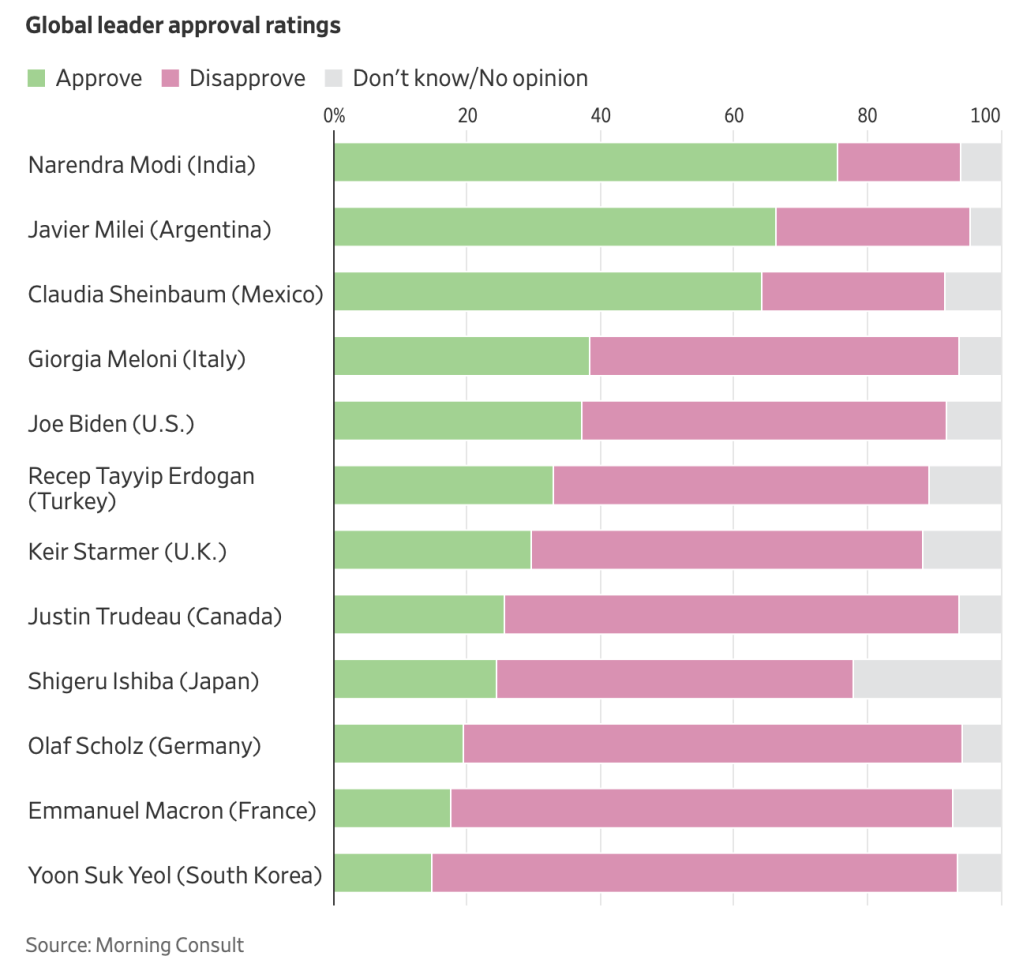
Hear Them Roar
In her December 12th column in the New York Times, Pamela Paul says that the dominant narrative of female victimhood needs a reality check: “By multiple measures, particularly with regard to academic and career achievement, American girls and women are thriving. (The opposite sex, alas, not so much.) After 50 years of legal gains and social progress, however incomplete, this is objectively the best time in history to be a woman in America. Yet our culture continues to portray womanhood as a problem that happens to girls rather than as something intrinsically powerful. Perhaps it’s time to consider a more encouraging message… when I had a daughter, I marveled at the number of newly available children’s books about girls and women struggling throughout history but was conflicted over reading them to her aloud. Why introduce a young child to the notion that girls were ever considered less than boys? The last thing I wanted to do was encourage a mind-set of grievance or inferiority. I wanted my daughter to grow up assuming she was tough, not needing to be told she wasn’t weak. To my eye, the barrage of “Girl power” posters and exhortations of “empowerment” unwittingly betray a certain defensiveness and desperation.”
Can the Dems Find Their Way Out of the Wilderness?
In a December 11th piece by New York Times contributor Thomas B. Edsall, he explores the deepness of the wilderness in which the Democratic Party now finds itself: “Polling suggests that Trump is ideologically closer to the median voter than Harris. Third Way, a centrist Democratic think tank, conducted a post-election survey asking voters to place themselves, Harris and Trump on a scale ranging from zero (very liberal) to 10 (very conservative). The mean response for Harris was 2.45, for Trump 7.78 and for all voters 5.63…. One theme that repeatedly emerges in the comments of political analysts is the need for the Democratic Party and its candidates to regain the center and to avoid the adoption of more extreme cultural and social policies that alienate the middle and working classes.”
Dems Are Not Their Left-Wing
In a November 28th piece in the Atlantic, two researchers found that all voters correctly perceived what issues were most important to Republican voters while they thought most Democratic voters were much further to the left than they actually are: “By far the most notable way that Democrats are misperceived relates to what our survey referred to as “LGBT/ transgender policy.” Although this was not a major priority for Democratic voters in reality—it ranked 14th—our survey respondents listed it as Democrats’ second-highest priority. This effect was especially dramatic among Republicans—56 percent listed the issue among Democrats’ top three priorities, compared with just 8 percent who listed inflation—but nearly every major demographic group made a version of the same mistake. What explains why Democrats’ priorities were so badly misunderstood while Republicans’ were not? Our research suggests that one reason is the Democratic Party’s relationship with its left wing.”
Unpardonable
In a December 2nd post in the New York Times, Bret Stephens summed up the feeling of a lot of Americans: “If Democrats want to understand one of the reasons the Republican Party is ascendant, they can look to President Biden’s pardon on Sunday for his son Hunter. In its rank mendacity, political hypocrisy, naked self-dealing and wretched example, it typifies so much of what so many Americans have come to detest about what the MAGA world calls “the swamp.””
Heroes of the Hard-Right
In a November 28th piece, New York Times columnist David Brooks writes about the “virtues” of the people around Donald Trump: “Trumpism represents an alternative value system. The people I regard as upright and admirable MAGA regards as morally disgraceful, and the people I regard as corrupt and selfish MAGA regards as heroic. The crucial distinction is that some of us have an institutional mind-set while the MAGA mind-set is anti-institutional… Today it really is true that the Pentagon is administratively a mess. It really is true the meritocracy needs to be fundamentally rethought. It really is true that Congress is dysfunctional and the immigration system is broken. But positive change will come from people who have developed a loving devotion to those institutions over years of experience, not people who despise them — the modern-day (WW II General) George Marshalls rather than the Pete Hegseths, Tulsi Gabbards and Robert F. Kennedy Jrs. What kind of person do we want our children to become — reformers who honor their commitments to serve and change the institutions they love or performative arsonists who vow to burn it all down?”
Why Identity Politics Failed
In a brilliant piece which appeared in the New York Times on November 14th, David Brooks describes why Kamala Harris performed worse than Joe Biden in 2020 with women and Black voters, even though she’s a Black woman: “Over the past few generations, a certain worldview that emphasizes racial, gender and ethnic identity has been prevalent in the circles where highly educated people congregate… Society is divided between the privileged (straight white males) and the marginalized (pretty much everyone else). History and politics are the struggle between oppressors and oppressed groups. In this model, people are seen as members of a group before they are seen as individuals… In this model, individual cognition is de-emphasized while collective consciousness is emphasized. Groups are assumed to be relatively homogeneous. People are seen as representatives of their community… But this mind-set has just crashed against the rocks of reality. This model assumes that people are primarily motivated by identity group solidarity. This model assumes that the struggle against oppressive systems and groups is the central subject of politics. This model has no room for what just happened. It turns out a lot of people don’t behave like ambassadors from this or that group.”
Dems Go Too Far on Trans Issues
In a November 14th piece, New York Times columnist Pamela Paul explains why the GOP tack on trans issues was so effective: “Clearly it helped paint Harris as a radical leftist, out of step with most of America. But as those of us who opposed Trump lick our wounds and take stock, it’s worth considering why these ads and rally cries resonated. It is not because most Americans are bigots or haters or anti-L.G.B.T.Q. people. But many voters, including liberals and Democrats, disagree with positions Harris and the Democratic Party have taken on transgender issues. Polls show that most voters, while largely supportive of existing legal rights and protections for transgender people, have complicated views on other policies that fall under the umbrella of what’s commonly referred to as trans rights. Trump’s charge that children are undergoing gender transition surgeries in school is obviously absurd. But his words may have struck a chord with those who disagree with school districts that have teachers and administrators hide from parents that their children have adopted new gender identities. As The Times reported last year, one mother of a 15-year-old only accidentally discovered her child’s public school had been covering up the fact that for six months, her child had been going by a new name and using the boys’ bathroom.”
The Trump Thumping
In a November 11th interview in the Wall Street Journal, centrist Democrat Ruy Tiexiera laments what’s happened to his party and says that their “thumping” last week was even greater than he had expected: “he Democrats have come to regard white working-class voters as “reactionary and racist,” Mr. Teixeira says. Those voters already defected to Mr. Trump in 2016, but what killed the Democrats this year was “losing nonwhite working-class voters hand over fist.” Mr. Teixeira notes that Barack Obama “carried the nonwhite working class or noncollege voters by 67 points. Harris has carried them with 33. That’s a halving of the margin among those who should have been the bulwark, the core, of the Democratic Party.”
“The outcome doesn’t surprise Mr. Teixeira: “It was clearly in the cards that they could lose.” What does surprise him is the extent of the loss and the “uniformity of the rightward movement across geographies and demographic groups.” The startling voter results back him up. Mr. Trump appears to have carried all the swing states. He improved his margins in red states and reduced the Democratic advantage in blue ones. He made particular advances among Hispanic voters, carrying traditionally Democratic Texas border counties including Starr, which had voted Democratic in every election since 1892. He also took Florida’s Miami-Dade, which hadn’t gone Republican since 1988, and heavily Puerto Rican Osceola, where Joe Biden led in 2020 by nearly 14 points. His improvement among black voters, especially men, helped close the gap in Detroit, Philadelphia and Milwaukee and push him over the top in their three key “blue wall” states. Mr. Trump could become the first Republican since 2004 to break 40% in California.”
Democrats: Correctness, Condescension and Cancellation
In a November 9th piece, New York Times columnist Maureen Dowd nailed what’s wrong with the Democrats: “Democratic candidates have often been avatars of elitism — Michael Dukakis, Al Gore, John Kerry, Hillary Clinton and second-term Barack Obama. The party embraced a worldview of hyper-political correctness, condescension and cancellation, and it supported diversity statements for job applicants and faculty lounge terminology like “Latinx,” and “BIPOC” (Black, Indigenous, People of Color).”
He Said It Best
Here’s the best analysis I’ve seen so far on the electoral blowout on Tuesday. It’s a November 6th piece in the New York Times by Bret Stephens: “The dismissiveness with which liberals treated these concerns was part of something else: dismissiveness toward the moral objections many Americans have to various progressive causes. Concerned about gender transitions for children or about biological males playing on girls’ sports teams? You’re a transphobe. Dismayed by tedious, mandatory and frequently counterproductive D.E.I. seminars that treat white skin as almost inherently problematic? You’re racist. Irritated by new terminology that is supposed to be more inclusive but feels as if it’s borrowing a page from “1984”? That’s doubleplusungood.
“The Democratic Party at its best stands for fairness and freedom. But the politics of today’s left is heavy on social engineering according to group identity. It also, increasingly, stands for the forcible imposition of bizarre cultural norms on hundreds of millions of Americans who want to live and let live but don’t like being told how to speak or what to think. Too many liberals forgot this, which explains how a figure like Trump, with his boisterous and transgressive disdain for liberal pieties, could be re-elected to the presidency.
“Today, the Democrats have become the party of priggishness, pontification and pomposity. It may make them feel righteous, but how’s that ever going to be a winning electoral look?”
The Hard-Left in Retreat
In a November 2nd piece, New York Times reporter Jeremy Peters explains how identity politics has taken a back seat to winning in the Democratic Party this year: “The question for those in the progressive wing of the party is whether they continue to pursue some of their more polarizing ideas about identity. “Even as these ideas start to be debated more openly, and some of their worst excesses are being rolled back, they continue to gain more influence in many contexts,” said Mr. Mounk, the scholar of identity politics. Whether Ms. Harris wins or loses next week, few expect full capitulation or retreat. “It’s clear now that they have failed to take over the Democratic Party,” said Mark Mellman, a Democratic strategist who is also president of the Democratic Majority for Israel, which has challenged and defeated progressive candidates like Mr. Bowman and Ms. Bush. “They thought this was going to be a much quicker process,” he added. “But I think they’re in it for the long term. The battle is going to continue.””
Things Are Getting Better, Not Worse
In an October 29th oped in the New York Times, Harvard psychology professor and author Steven Pinker explains why the news is so often bad: “The doomers can always find ammunition in the news. News, by its very nature, consists of things that happen, and it’s easier for things to go wrong suddenly — a war, a terrorist attack, a hurricane — than to go right suddenly. When things do go right, it usually means either that nothing happens (a country remains at peace, for example) or that improvements creep up a few percentage points every year and compound over time, transforming the world by stealth. As a result, one can get the impression that the state of the world keeps getting worse when, in fact, it keeps getting better.”
Not Progressive But Reasonable
In an interview in the New York Times appearing on October 26th, Pennsylvania Sen. John Fetterman was asked why he no longer calls himself a progressive: “Well, the label left me. I didn’t leave it. And what was originally progressive eight years ago has been co-opted by the mainstream. And [progressives] continued to adopt really extreme kinds of views. And that’s why I was like, Hey, I’m just a Democrat. And then there was a lot of, Is he going to be the next Manchin or Sinema or anything? No. That’s ridiculous. I’m not leaving my party. I just happen to have reasonable views.”
Carville Picks Kamala
In an October 23rd New York Times oped, James Carville predicts, with gusto, that Kamala Harris will beat Donald Trump: “We are constantly told that America is too divided, too hopelessly stricken by tribalism, to grasp the stakes. That is plain wrong. If the Cheneys and A.O.C. get that the Constitution and our democracy are on the ballot, every true conservative and every true progressive should get it too. A vast majority of Americans are rational, reasonable people of good will. I refuse to believe that the same country that has time and again overcome its mistakes to bend its future toward justice will make the same mistake twice. America overcame Mr. Trump in 2020. I know that we know we are better than this.”
Black, Brown and… Blue? Red?
The demographic tsunami was supposed to sweep Democrats to power. What happened? In an October 14th column, New York Times contributor David Leonhardt tries to explain: “The Democratic Party has spent years hoping that demography would equal destiny. As the country became more racially diverse, Democrats imagined that they would become the majority party thanks to support from Asian, Black and Hispanic voters. The politics of America, according to this vision, would start to resemble the liberal politics of California. It’s not working out that way. Instead, Americans of color have moved to the right over the past decade… For most Americans, race is a less significant political force than many progressives believe it is — and economic class is more significant.”
Explaining Polarization
As he has done so often, New York Times columnist David Brooks in an October 3rd piece, explains once again how economic policy of the last few decades has resulted in the deeply divided political culture we now have: “But sociologically, politically and culturally, this shift from brawn to brains has contributed to the vast chasms we see today. Places where highly educated information-age denizens gather are gleaming, while many other places are desolate. The people who have the kinds of abilities that make for school success are thriving; people with other kinds of abilities are not. This state of affairs has produced a seismic shift in how people in both parties think about public policy. The old bipartisan education-can-save-us mantra is falling into the background. A new bipartisan we-need-to-rebuild-manufacturing mantra is taking hold. Though his wife is a teacher, Joe Biden has not been an education president. He’s been an industrial policy president. He’s tried to use hundreds of billions of dollars to help America build things — through big infrastructure projects and in factories.”
And She’s Still Undecided Because…
There’s this from a September 28th story in the New York Times, quoting an undecided voter on Donald Trump: ““He’s divisive, he’s violent, he’s vile,” said Lesley McKenzie, 64, an executive assistant from Southfield, Mich. “He’s unbecoming to even sit or even to pass by the White House. I mean, it’s totally crazy.” She added: “He is like rolling in a pigsty. Every day he comes up with crazy things. I don’t think he’s all there. And if he is, oh my God.””
A Conservative With a Conscience
In a September 21st story in the New York Times, Liz Cheney talked about the need to rebuild after Trump: “The party itself really has rejected the Constitution in the name of supporting Trump,” she said. That “may well” necessitate a new party, she added, “because, again, so much of the Republican Party today has allowed itself to become a tool for this really unstable man. It certainly has moved away from standing for anything of substance, anything of policy. We’re going to have to have some entity that actually can be making the case for the kind of conservative causes that I believe in.”
Free Trade Reduces Poverty
Free trade gets a bad rap these days from both right and left. But it helped reduce worldwide poverty. There’s this from a September 22nd oped in the New York Times: “The sense of possibility (for eliminating poverty) in 2015 was based in part on money. At the time, developing economies were relatively flush. Free trade and globalization had led to record increases in foreign direct investment. Overseas development assistance, or foreign aid, had reached more than $96 billion in 2015. And debt relief efforts had canceled $130 billion in liabilities since 1999. In total, by 2014, the flow of financial resources into developing countries had risen to $225 billion, more than ever before. This high tide suggested it was possible to lift all boats. Unfortunately, that tide is now waning, and it looks unlikely to return any time soon. Competition among China, Russia and the United States and their allies has stymied international organizations and action. Populism has become a potent ideology, curtailing free trade, international agreements and more. Accordingly, assistance to developing countries decreased by $4 billion, or 2 percent, in 2022 from the previous year. Though preliminary data suggests it rebounded some in 2023, aid is still insufficient to achieve all of the goals.”
Republicans’ Own Worst Enemies
In a September 20th editorial, the Wall Street Journal called out the radical right Freedom Caucus: “(Speaker Mike) Johnson has tried to accommodate all sides of his unruly GOP conference, but he can’t placate the implacable. It won’t be his fault if Republicans lose the House in November, but the kamikazes will blame him anyway. A party that can’t manage to fulfill a basic obligation of government—passing a budget—doesn’t deserve the majority. GOP voters will keep getting the policy defeats their feckless “fighting” champions guarantee.”
The Cultural Shift Favors Harris
In a September 12th piece, New York Times columnist David Brooks writes about the cultural mood of the nation, how Trump once captured it and how Kamala Harris now seems better tuned in: “Harris was very compelling when portraying herself as an agent of cultural change. Her smiling equipoise is a statement of self-confident power against his sour fuming. Her “I care about you” is a stark foil to his narcissistic “I care about me.” Her good cheer and compassion contrasts with the atmosphere of bitterness and indignation that has enveloped us for a decade.”
Roots of Revolt
In a September 4th piece, New York Times columnist David Brooks sums up the reasons that Democrats do so poorly with blue collar voters: “Global populism is a revolt against these kinds of (income, educational, health and longevity) inequities — driven by the sense that the educated class has too much cultural, academic, political and economic power. The revolt is fueled when highly educated professionals condescend to or don’t even see the masses they are sitting on and when students at elite universities spending upward of $100,000 a year on them pretend to be the marginalized victims of oppression. Highly educated Democrats like Harris see themselves as increasing the size of government to help the downtrodden. But many Americans look at those efforts and they just see affluent people amassing more power for themselves in Washington. They conclude: This is what the educated elites always do. They promise to do stuff for us, but they end up serving only themselves… If you spend your life listening to what Democrats in the big cities say to one another, then you will misunderstand America.”
Post-Identity Politics
New York Times writer Jessica Bennett, in an August 31st column, argues that Kamala Harris is winning voters by staying away from identity politics: “She aspires to be the first post-gender POTUS. So many American voters loathe being asked to assess their candidates through the lens of gender and race, and they cringe at the performative nature of identity politics — including, yes, Mrs. Clinton and that ever-present glass ceiling, as well as the argument that her supporters were “voting with their vaginas” if they dared to feel inspired by it. The metaphor may have yielded feel-good empowerment for a while — and lots of clever merch — but we all know the outcome. And how many times can you declare “The future is female,” tattered sign in hand, before it starts to get awkward? Ms. Harris is a woman, and a Black woman, and a woman of Jamaican and South Asian descent, and the first woman to be vice president. But we know all that. Other people can talk about history; she’ll be too busy making it.”
Walk a Mile in Their Shoes
In an August 31st piece, the New York Times’ Nicholas Kristof chastises liberals for looking down at Trump voters: “Since the Obama presidency, Democrats have increasingly become the party of the educated, and the upshot has often been a whiff of condescension toward working-class voters, especially toward voters of faith. And in a country where 74 percent of Americans report a belief in God, according to Gallup, and only 38 percent over the age of 25 have a four-year college degree, condescension is a losing strategy. Michael Sandel, the eminent Harvard philosopher, condemns the scorn for people with less education as “the last acceptable prejudice” in America. He’s right: Elites sometimes indulge in open disdain for working-class voters that they would never acknowledge about other groups.”
Breaking the Identity Fever
In an August 28th story, the New York Times reports that Democrats have figured out that coveted Latino voters don’t want to be courted for their identity: “So it is especially notable that Democrats, four years after hemorrhaging Latino support, have not been offering a slew of overt appeals. Rather than ads filled with promises about immigration reform and Spanish phrases, Democrats have been focusing on economic messages, talking about the cost of housing and medication, or relentlessly hammering the promise of the American dream. In short, they are courting Latino voters by treating them like everyone else.”
The Left’s Selective Moral Outrage
New York Times columnist Bret Stephens, in an August 27th post, points out several places in the world where the hard-left chooses to ignore the same kind of behavior that it protests in Israel. Turkey is just one example: “Anti-Israel protesters sometimes respond to the criticism that they are singling out the Jewish state for unfair censure by noting that it receives billions in military aid from Washington. (This pretext doesn’t fly if protests are in Montreal or Melbourne.) But what about another Middle Eastern recipient of American largess, including the stationing of U.S. troops and nuclear weapons? That country is Turkey, on paper a secular democracy and a NATO ally. In reality, it’s an illiberal state run for decades by Recep Tayyip Erdogan, an antisemitic Islamist who has jailed scores of journalists while waging — sometimes with F-16 warplanes — a brutal war against his Kurdish opponents in Syria and Iraq. For good measure, Turkey has occupied, ethnically cleansed and colonized northern Cyprus for 50 years. Shouldn’t those who argue that occupation is always wrong trouble themselves to protest this one?”
She’s Not One of Them
In an August 27th piece, the New York Times’ Nate Cohn analyzes why Donald Trump’s lines of attack on Kamala Harris haven’t worked so far. With regard to issue-based attacks, he writes: “These have gotten more traction, but not much. In the last New York Times/Siena College polls, less than half of battleground state voters said Ms. Harris was “too liberal or progressive,” even though she ran a left-leaning presidential campaign five years ago. One reason “Comrade Kamala” hasn’t landed: Ms. Harris is not a hero of the activist left, like Elizabeth Warren or Bernie Sanders. She did embrace many progressive positions in 2019, but she did so to earn the support of the left — not because she’s its natural champion.”
Gravitas v. Flim Flam
In an August 23rd piece, the Wall Street Journal’s Peggy Noonan compares the Democratic to Republican conventions: “The Democratic Party has more substantial characters of recent American history to parade around on stage. The Clintons, the Obamas, Jesse Jackson, who, whatever your view of him, was there, on the balcony at the Lorraine Motel, when Martin Luther King was shot. This conveyed a party with a storied past, and if you join it you’re joining something real. The Republican Party, in its great toppling, has rejected its past. You lose something when you cast your history aside, and all you’ve got for prime time is Trump sons.”
Harris Hews to the Center
In an August 23rd column, New York Times writer Maureen Dowd writes that Kamala Harris, in her acceptance speech, leaned into the middle and eschewed identity politics: “She barely talked about gender and didn’t dwell on race, shrewdly positioning herself as a Black female nominee ditching identity politics… she is a welcome relief from the schoolmarm types often nominated by the Democrats, nominees who lectured rather than inspired.”
Gaza Is Not Much of an Issue
In an August 18th story, the New York Times notes that, beyond a small number of activists, the war in Gaza is not a top of mind issue for voters: “Next to inflation, housing costs and abortion, the war in Gaza is not as much of a driver for most Democratic voters, even young voters. New polling data to be released on Monday by the University of Chicago and GenForward found mixed feelings from voters under 40: Thirty-six percent of them disapproved of military aid to Israel, while 33 percent approved and 29 percent had no opinion. More important, the poll showed that the Gaza war ranked near the bottom of young voters’ concerns, well below immigration, economic growth and income inequality.”
Why the GOP Can’t Govern
In an August 18th piece, New York Times writer Ezra Klein quotes Rep. Adam Smith, the top Democrat on the House Armed Services Committee : “A Republican who I work very closely with has always said, ‘Adam, I’ll trade you our nuts for your nuts.’ And I’ve always said, ‘No deal.’ I don’t think we (Democrats) actually have nuts in Congress in that sense. I’ve worked with every single member of the squad on the National Defense Authorization Act. I know they’re not going to vote for it, but they offer ideas. For the Republicans, if government is trying to do something, they want to try and stop it. Just reflexively. It is something that’s bred into the Republican Party that makes it hard to maintain an organization that is supposed to be functioning in government.”
The Democrats’ Anti-Semitic Problem
In an August 17th piece, oped writer James Kirchick concludes that the hard-left’s opposition to Josh Shapiro had more to do with his Jewish identity than with his specific stances on the Middle East: “Mr. Shapiro is a thoroughly mainstream liberal Zionist whose views on the Middle East were virtually indistinguishable from those of his vice-presidential rivals, so the effort to single him out — Mr. Shapiro was the only vice-presidential contender to be targeted by an open and organized campaign against his selection — had to have been motivated by something else. What is it about Mr. Shapiro that led people to argue his placement on the ticket would “ruin” party unity? t’s hard to escape the impression that some of Mr. Shapiro’s left-wing detractors were riled because he is Jewish. If being pro-Israel was the problem, they would have protested all of the vice-presidential contenders… Whereas other minority identities are celebrated within the party, being a proudly pro-Israel Jew is becoming a hindrance.” And, bonus…
The Victimhood Hierarchy
In this piece, also from Kirchick, from Tablet back in 2015, he writes about how the hard-left ranks the validity of oppression based on the perceived depths of the oppression: “The discussion of vital issues today has been reduced to a game of Rock, Paper, Scissors, in which the validity of one’s argument is determined not by the strength of your reasoning but by the relative worth of the immutable qualities you bring to the table, be it skin color, sexual orientation, or genitalia (or, in the case of pre-operative transsexuals, wished-for genitalia). In the game of Race, Gender, Sexuality, black beats white, woman beats man, trans beats cisgender, and gay (or, preferably, “queer”) beats straight.”
Will There Be Trouble in Chicago?
In an August 16th piece, Wall Street Journal writer Kimberly Strassel warns Democrats that there might be trouble at their convention in Chicago next week: “The Coalition to March on the DNC boasts 150 groups, including Black Lives Matter and Students for Justice in Palestine. It is already coordinating buses of protesters into Chicago. It’s asking for donations for “medical kits” and other supplies to “ensure that the March on DNC coalition” can “withstand the repression” of the Chicago police. Among other groups coming are outfits like Samidoun and Behind Enemy Lines, which agitate for “direct action” that goes well beyond marching. A recent Behind Enemy Lines post reads: “Now that the butchers of Gaza are coming to Chicago, it’s time to take this political battle into high gear,” which involves “getting in the streets to actually shut down Genocide Joe and Killer Kamala.” One protest is planned for outside the Israeli consulate, and its poster reads: “Make It Great, like ’68!”—a reference to the violence outside that year’s Democratic convention in Chicago.”
Trump: False, Obtuse, Lunatic
In an August 12th post, conservative Wall Street Journal editorial board member Gerard Baker wrote that in his press conference last week Donald Trump looked like “a loser”: “By my calculation, about one-third of Mr. Trump’s remarks fell into three categories: false, obtuse or lunatic. I’m not even talking here about the usual grotesque hyperbolic assertions or baffling verbal manufactures, the finest of which last week was surely the description of “people dying financially because they can’t buy bacon.” We need to be clear about the problem. It isn’t, as some have suggested, that Mr. Trump has been wrong-footed by the Democrats’ switch from Mr. Biden to Ms. Harris. Nor is it a reflection of accelerated degeneration. The Trump of the past few weeks has looked and sounded more or less exactly like the Trump of nine years ago. This is the problem.”
Understanding Trump
In her August 10th piece, New York Times columnist Maureen Dowd offers some fresh insight into Donald Trump. He measures his worth strictly by the numbers, which is why he is driven to make them up when they don’t come out in his favor: “And that’s why he couldn’t admit he lost the election. If Joe Biden put more numbers on the board, Trump was worthless. The master huckster’s whole identity revolves around having higher numbers, even if they’re fake. (He always pretended his skyscrapers had more stories than they did.) So, of course, seeing Kamala’s crowds and polls soaring drives him nuts.”
Harris On the Upswing
A New York Times/Siena poll released on August 10th finds Kamala Harris with an identical four point lead (50-46) in Wisconsin, Michigan and Pennsylvania. Perhaps more significantly she’s winning with demographic groups that tend to favor Trump: “In the three battlegrounds, Ms. Harris is in a stronger position than Mr. Biden was in May with most demographic groups, including white voters without a college degree. She is faring better with key parts of the Democratic Party’s coalition that had begun to erode under Mr. Biden, most notably Black and young voters. But she also appears to be holding on to older voters, who were some of the president’s most ardent supporters.” (My emphasis added.)
Enough With Identity Already
In an August 8th column, New York Times writer Pamela Paul refuses to get excited about Kamala Harris’ identity as a Black woman: “But I don’t particularly care that the Democratic candidate is a woman. I care about having the best, most electable Democratic candidate possible, and I suspect many Americans, male and female, feel the same. As my colleague Jeremy Peters reported last week, voters are looking for electability, not representation. “In interviews, Harris supporters of all races said they were concerned that if she talked more directly about her race, she risked feeding the backlash that has been building over diversity,” he wrote… Most Americans don’t put nearly as much importance on identity as Democratic leaders seem to think they do. According to Pew, 64 percent of Americans — and 57 percent of women, even 43 percent of Democrats — said electing a female president during their lifetime was not important or didn’t matter. Rather than focusing on what Harris means to women, South Asian Americans or Black people, we should focus on what she might mean to all Americans.”
Trump Flails
In an August 7th editorial, the Wall Street Journal observes how the new Democratic ticket has unnerved Donald Trump: “Mr. Trump has his passionate followers who don’t want to hear a discouraging word. Yet the political reality is that he has a ceiling of support that is below 50% because so many Americans dislike him. And now that he is in the news every day campaigning, he is reminding those voters why they didn’t vote to re-elect him in 2020. Ms. Harris in particular seems to have unnerved him as he scrambles but fails to find an attack line that works. He’s said she “doesn’t like Jewish people,” though her husband is Jewish. He’s attacked her racial identity, which alienates swing voters. He calls her “low IQ” and “dumb,” as if the school-yard insult will persuade anyone.”
Ezra Klein Nails It
In an August 2nd interview with Minnesota Gov. Tim Walz, the New York Times’ Ezra Klein (who often mostly interviews himself) had this observation embedded in one of his lengthy question set ups: “One of the most dangerous emotions that Democrats sometimes let slip — the negative side of, I think, the liberal personality — can be a kind of contempt, a kind of smugness. This is why Hillary Clinton’s comment on deplorables was so damaging.”
The Insult is the Point
In a piece published in the Wisconsin State on August 1st, Jonah Goldberg tries to explain why Donald Trump and J.D. Vance say what they do: “Vance’s rollout has been rocky precisely because he’s an unvarnished MAGA candidate, who thinks offending or scaring people is a sign of masculinity and strength…. in Trump World, the ridicule is the point.”
They Could’ve Had a Contender
In a July 31st post, Never Trump conservative Madison blogger David Blaska calls on his party to follow the Democrats’ lead and switch out their nominee: “Once upon a time, a nation founded in liberty enjoyed Presidents who appealed to the better angels of our nature, invoked shining cities on a hill, welcomed morning in America, promised we had nothing to fear but fear itself, and asked not what Big Brother can do for us. In other words, we don’t recall Reagan calling Mondale “a lunatic.” Candidates who do so describe themselves. Like that V-8 commercial of yore, Republicans coulda’ had a Nikki Haley! Accomplished, female, and youthful — here is a candidate who can think on her high heels. She could do to Kamala Harris on a debate stage what she did to late-night gizmo pitchman Vivek Ramaswamy: Squish him like a bug. Instead, the Republican party is stuck with a deluded and bitter old man who thinks he won the 2020 election and blames Nancy Pelosi for the Proud Boys he set loose on the Capitol. Instead of the usual post-convention bounce, the Republican nominee has lost the 6-point lead he enjoyed a week ago against Joe Biden. The latest New York Times/Siena poll has Kamala Harris trailing only by a single point: 48%to 47%.”
Can Harris Go to Her Right?
In a July 29th piece, New York Times writer Patrick Healy says he’ll be watching to see if Kamala Harris starts moving to capture the center: “Biden, Barack Obama and Bill Clinton won the presidency because they made real attempts — through policy ideas, speeches, campaign travel and, sometimes, criticism of their party or allies — to show that they had a measure of independence, thought for themselves and, yes, were looking out for all Americans, not just team blue. Both Bushes broke with some in the G.O.P. too (most notably on taxes and then immigration.) Now that Harris has fired up the base faster than perhaps even she expected, what will she do to go beyond that base?”
Did Trump Pick the Wrong Vance?
If J.D. Vance was expecting the conservative Wall Street Journal editorial board to defend him over his comments degrading childless people and politicians he would be disappointed. In a July 27th editorial the paper slammed him and had a suggestion: “If Mr. Vance doesn’t want to apologize, perhaps he could start showing up on stage with his wife, Usha. Her speech at the GOP convention was understated and warm, and she is clearly accomplished professionally. She might help persuade swing voters that Mr. Vance respects women more than his comments have made it seem.”
Or Maybe She Can
In her July 25th offering, Wall Street Journal columnist Peggy Noonan sizes up Kamala Harris: “I had long thought Kamala Harris couldn’t beat Donald Trump. That’s wrong. She can. We’re a 50/50 country, each side gets 40 going in, you fight for the rest but it can always go either way. As people who speak the technical language of politics say, Mr. Trump has a high floor but a low ceiling. But beyond that, something’s happening. Ms. Harris has not, in five years on the national stage, shown competence. She is showing it now, and that is big news. Her rollout this week demonstrated talent and hinted she may be a real political athlete.”
The Report Card on Harris
In his July 25th column, New York Times writer David Brooks offered a fair and balanced assessment of Kamala Harris as both a politician and a public official. His reviews are mixed. Here’s one conclusion I found especially noteworthy: “Her larger problem of course is that she’s a member of the progressive educated elite from the San Francisco Bay Area. Her father was a Stanford professor and her mother was a cancer researcher. She has lived her life in a very unusual slice of America. This is not an ideal background if your job is to win over working-class voters in western Pennsylvania, small-town Michigan and suburban Georgia.”
Serious Criticism of Harris
There’s a lot of silliness coming out of Donald Trump and the Republicans when it comes to Kamala Harris. She has an odd laugh. Really? But in a restrained July 23rd editorial, the Wall Street Journal laid out her policy positions that are a proper and fair starting point for critiquing her: “A fair conclusion from all of this is that Ms. Harris is a standard California progressive on most issues, often to the left of Mr. Biden. Perhaps as she reintroduces herself to the public in the coming weeks, she will modify some of those views. She would be wise to do so if she wants to win. Given the rush by Democrats to anoint Ms. Harris as their nominee, the press has a particular obligation to tell the public about who she is and what she really thinks. Does she believe California is a model for the country?”
Out of the Frying Pan…
In a July 22nd post, New York Times political analyst and number cruncher Nate Cohn sizes up apparent Democratic nominee Kamala Harris: “Many Democrats have coalesced behind Ms. Harris, but she doesn’t start the campaign as the kind of broadly acceptable candidate Democrats have put forward to great success during the Trump era… a majority of voters have long had an unfavorable view of her. She has trailed Mr. Trump in nearly every national and battleground state poll conducted so far this year. In the most recent New York Times/Siena College poll of Pennsylvania, just 42 percent of likely voters said they viewed Ms. Harris favorably — well short of the 51 percent who had a favorable view of Mr. Biden in the state ahead of the 2020 election. It’s even lower than the 46 percent who said the same for Mr. Trump in the recent poll. With numbers like these, a Harris-Trump matchup doesn’t look much like the 2020 presidential election, when Mr. Biden prevailed as a moderate candidate who was liked by a majority of voters.”
Stages of Biden Grief
In a July 19th post, Wall Street Journal editor James Taranto gave an apt description of what Democrats are going through right now: “The Democrats, meanwhile, seem to be going through Elisabeth Kübler Ross’s five stages of grief. They’ve passed through denial to bargaining; news reports during the RNC’s final day claimed that party leaders were trying furiously to persuade Joe Biden to drop out of the race and expected to succeed as early as the weekend. One expects that by the time of their convention, one month from now, they’ll have progressed to somewhere between anger and depression. If 2016 and 2020 are any indication, acceptance won’t come even after November—no matter which party loses.”
The New, Unified GOP
In an analysis written for the New York Times on July 17th, the authors wrote: “It is a party-wide evolution that would have been difficult to envision eight years ago, when Mr. Trump first burst onto the Republican stage, or as recently as this spring, when the party was recovering from a bruising primary contest and the serial humiliations of a dysfunctional House majority that struggled to select its own leadership. Then, Mr. Trump was a liability and not the party’s great unifier. Now, the shift in mood was striking: It has been decades since those at any Republican convention felt quite so confident — even optimistic — that they had the right candidate, the right causes and the right moment.”
A Chance to Change
In a July 14th editorial, the Wall Street Journal sees the assassination attempt as an opportunity for Donald Trump to pivot to a more unifying message: “His opportunity now is to present himself as someone who can rise above the attack on his life and unite the country. He will make a mistake if he blames Democrats for the assassination attempt. He will win over more Americans if he tells his followers that they need to fight peacefully and within the system. If the Trump campaign is smart, and thinking about the country as well as the election, it will make the theme of Milwaukee a call to political unity and the better angels of American nature. That leaves plenty of room for criticizing Democrats and their failed policies. But the country wants civil disagreement and discourse, not civil war.”
Predictable Disaster or Uncertain Hope
In her July 3rd essay, Wall Street Journal columnist Peggy Noonan wrote: “The elected officeholders of the Democratic Party should take responsibility and press the president to leave. You can’t scream, “Democracy is on the line,” and put up a neurologically compromised candidate to fight for it. They haven’t moved for two reasons. One has to do with their own prospects: You don’t want to be the one who kills the king, you want to be the one who warmly mourns the king and takes his mantle after someone else kills him. The other is fear of who would replace him on the ticket, and how exactly that would happen. These are understandable fears. But the answer isn’t to hide in a dumb fatalism, a listless acceptance of fate. It makes no sense to say, “Joe Biden is likely going to lose so we should do nothing because doing something is unpredictable.” Unpredictable is better than doomed.”
An Expert on Biden’s Decline
In a letter to the editor in the Wisconsin State Journal on July 3rd, retired nurse Susan Kennedy lays out the problems Joe Biden is suffering from: “The appropriate concern is not dwelling on the past but asking what is Biden capable of in the next four years? Those will be four critical years, starting with the baseline of Biden’s debate performance and ending at his being 86. As a retired nurse who has witnessed the ravages of aging, memory and cognition loss in patients, I have no doubt that Biden should drop out of the race. Aging is more exponential from age 81 to 86 than, for instance, from 65 to 70. It does not compare, and Biden has risk factors such as a history of aneurysms that may already have impacted him. Memory and cognition wax and wane, as we are witnessing.”
The Numbers Don’t Lie
In a July 3rd piece, New York Times number cruncher Nate Silver says that the riskiest thing for Democrats is to do nothing about Biden. He sees a risk that Biden’s unpopularity will pull down more popular Democrats in Senate and House races: “You don’t need another pundit telling you that Mr. Biden should quit the race, although I’m among those who emphatically think he should. But Democrats should be more open to what polls are telling them — and again, not just Biden-Trump polls. There is a silver lining for Democrats to be found in these surveys. Voters in these polls like Democratic candidates for Congress just fine. More than fine, actually: It’s Mr. Biden who is the problem.”
It’s About Beating Trump
In a July 1st commentary in Politico, Never Trump Republican Charlie Sykes had this advice for Democrats: “But the real crisis is not Joe Biden’s age or infirmity, but what they mean for the future of American democracy. The prime directive of 2024 isn’t the reelection of Joe Biden; it is preventing Trump’s return to power and the parade of horribles that he will bring in his wake. For Democrats, then, Thursday’s debate should have been a moment of startling clarity: If the party does not make a change, Trump will win this election. If they really believe that Trump represents an existential threat to our constitutional order, they need to act like it now.”
Our Kind of Democrat
In a July 1st profile of moderate Democratic Rep. Marie Gluesenkamp Perez of Washington State, the New York Times reports: “Gluesenkamp Perez has inserted herself into a debate that is convulsing the Democratic Party. Today the greatest fault line in American politics is not race, gender or geography — it is educational attainment. In 1960, John F. Kennedy won 52 percent of voters with only high-school diplomas, but lost college-educated voters with only 39 percent. By the time Joe Biden ran for president 60 years later, that trend had reversed: Biden won 56 percent of voters with college degrees, and lost voters with only high-school educations with just 41 percent. “There’s a point at which that inversion becomes so great that Democrats can no longer win national majorities,” says Jonathan Cowan, the president of Third Way, a center-left policy institute. (In 2020, Americans without college degrees made up three out of five voters.) “So that means that Democrats as a whole need to be constantly on the lookout for people who can break the faculty-lounge stranglehold.””
The Perils of Orthodoxy
In her June 27th piece, New York Times columnist Pamela Paul takes the hard-left to task for dismissing anyone left of center who disagree with them as a reactionary: “The goal of progressives may be solidarity, but their means of achieving it are by shutting alternative ideas down rather than modeling tolerance. Leah Hunt-Hendrix, a co-author of a recent book called “Solidarity,” said those liberals who critique illiberalismon the left are “falling into the right’s divide-and-conquer strategy.” But liberal people can disagree without being called traitors. Liberals can even agree with conservatives on certain issues because those positions aren’t inherently conservative. Shouldn’t the goal be to decrease polarization rather than egg it on? Shouldn’t Democrats aim for a big tent, especially at a time when registered party members are declining and the number of independents is on the rise? It would be to our detriment if policies on which a broad swath of Americans agree are deliberately tanked by a left wing that has moved as far to the left as Republicans have moved to the right. Those who denounce militant fealty within the Republican Party shouldn’t enforce similar purity tests in their own ranks.”
But You’ve Been in Charge All This Time
In a June 24th editorial, the Wall Street Journal pointed up the irony of hard-left Chicago Mayor Brandon Johnson blaming his own city — which Democrats have led for decades — for being responsible for several indicators of Black Chicagoans’ falling behind: “The mayor’s office blames systemic racism for issues including vacant lots, policing failures, industrial pollution, and a homeownership gap. Chicago also has the highest black unemployment rate (12.7%) among the country’s 15 largest cities in 2022 and the widest black-white employment gap. The rate for black workers is more than four times as high as for white workers. That’s a tragedy, and it’s one that Mr. Johnson’s equity-addled Democratic Party owns. Chicago has been a deep blue city for decades, and the real roots of the problem lie in the city’s rotten education system. Mr. Johnson is beholden to his benefactors at the Chicago Teachers Union who have sinecures at failure factories known as public schools even as they demand more money.”
It’s About The Story, Not Your Story
The Wall Street Journal’s Peggy Noonan is a ponderous writer who struggles to get to the point and sounds like a 1950’s New England girls prep school principal when she does. So, it was ironic to read Noonan’s discourse on journalism in her June 20th column about how news stories need to get to the point. But she finally did get to her own point, sort of, at the very end when she wrote: “They were obsessed with who’s in the newsroom when their readers are obsessed with what comes out of the newsroom. It is good and worthy and necessary to have reporters and editors who come from different experiences, different classes, different cultural assumptions. But current ways of encouraging diversity seem to yield a great sameness in terms of class and viewpoint, and in any case diversity is a mission within a mission, it isn’t the mission itself, which is: Get the story, tell the story.”
Hey, Hey, Ho, Ho, To Protests I Will Never Go!
In a June 20th piece, New York Times columnist Pamela Paul shared her views (in perfect agreement with my own) on protests: “I’ve never been much of a tribalist or a joiner, and have no use for conformity of thought or dress. Unless it’s Halloween or a costume party, I don’t like playing dress-up. Nor do I want to be part of a group where people might think I accidentally left my pussy hat at home. When I see a bunch of white kids wearing kaffiyehs I can’t help wonder whatever happened to the whole anti-cultural appropriation thing. When someone drones on about “solidarity,” all I hear is, “Get in line.” When there’s no room for dissent from the dissent, there’s no room for me.”
Is It Over Already?
In a June 17th analysis, Patrick Healy of the New York Times writes: “The spring campaign season ends this week, and the political landscape is tough for President Biden: He isn’t winning over enough voters in the battleground states. In the springtime of re-election years, many voters decide whether they’re open or closed to another term for the guy in office. Call it the incumbent threshold decision. In previous cycles, many voters gave up on Donald Trump, George H.W. Bush and Jimmy Carter by this time during re-election — those incumbents never held sustained leads in the polls after that.”
Left Coast Confessions
In a piece by New York Times columnist and Oregonian Nicholas Kristof, he chastises his fellow West Coast liberals for their management of local issues and how that reflects on Democrats and liberals everywhere. He gives a concrete example: ““The inability of progressives, particularly in the Portland metro area, to deal with the nitty-gritty of governing and to get something done is just staggering,” Representative Earl Blumenauer, a Democrat who has been representing and championing Portland for more than half a century, told me. “People are much more interested in ideology than in actual results.” Consider a volunteer group called the Portland Freedom Fund that was set up to pay bail for people of color… In 2022, the Portland Freedom Fund helped a Black man named Mohamed Adan who had been arrested after allegedly stranglinghis former girlfriend, holding a gun to her head and then — in violation of a restraining order — cutting off his G.P.S. monitor and entering her building. “He told me that he would kill me,” the former girlfriend, Rachael Abraham, warned. The Freedom Fund paid Adan’s bail, and he walked out of jail. A week later, Adan allegedly removed his G.P.S. monitor again and entered Abraham’s home. The police found Abraham’s body drenched in blood with a large knife nearby; three children were also in the house.”
The Crazy and Sensible From J.D. Vance
On June 13th the New York Times carried a lengthy interview of J.D. Vance conducted by their columnist Ross Douthat. In it, Vance endorses the use of slates of fake electors after the 2020 election and argues that more states should have done that. But, aside from inanities like that, Vance does make some interesting points, such as: “I think most of us who are generally socially aware have a voice in our head that says: “You shouldn’t say this; you should try to say that. Maybe you believe this, but you should try to put it a little bit more diplomatically.” And in 2020 that voice had become absolutely tyrannical. There was nothing you were allowed to say. Offending someone was an act of violence. I think a lot of us just said: “We’re done with this. We’re not playing this game, and we refuse to be policed in what we think and what we say.””
There is a Sensible Center on Immigration
In a column that appeared in the Wisconsin State Journal on June 13th, Jonah Goldberg argues that both Republicans and Democrats miss where the bulk of American are at on immigration: “Despite America’s struggles with immigration past and present, this country is not anti-immigrant. As of 2022, the United States had roughly 46 million foreign-born residents, more than half of them citizens, accounting for about 14% of the population. (China’s immigrants, by contrast, amount to about 0.04% of its population.) No country in the world is better at absorbing and assimilating people, and we should take deep patriotic pride in that… As a rule, normal Americans are far more sensible and decent on this issue than our leaders. Increasing numbers of Latinos want stronger enforcement of the border and immigration laws, which is a sign that the loudest voices on both sides are detached from reality.”
Time To Go, Joe
In a June 11th column, New York Times writers Bret Stephens says that the most courageous thing Joe Biden could do is to drop out of the race: “Biden is sleepwalking to defeat against a felonious adversary who three years ago incited violence to overturn an election. He has the lowest approval rating of his time in office: 37.6 percent, according to a polling average. Jimmy Carter and George H.W. Bush were in similar territory at similar points in their one-term presidencies… It all leaves the president with one option that can be a win for America and, ultimately, his place in history. He can still choose not to run, to cede the field to a Democrat who can win — paging Josh Shapiro or Gretchen Whitmer — and do the hard and brave things it will take to secure security and peace for the free world. There’s still time, if only just. It would be a courageous, honorable and transformative legacy.”
I Am Liberal. I Am Very Liberal. I Am the Most Liberal.
In his June 6th column, New York Times writer David Brooks asks why graduates of elite universities have moved so much further to the left than the rest of the country, even those who have the same amount of education but didn’t go to Ivy League schools: “Imagine you graduated from a prestigious liberal arts college with a degree in history and you get a job as a teacher at an elite Manhattan private school. You’re a sincere progressive down to your bones. Unfortunately, your job is to take the children of rich financiers and polish them up so they can get into Stanford. In other words, your literal job is to reinforce privilege. This sort of cognitive dissonance often has a radicalizing effect. When your identity is based on siding with the marginalized, but you work at Horace Mann or Princeton, you have to work really hard to make yourself and others believe you are really progressive. You’re bound to drift further and further to the left to prove you are standing up to the man.”
The Last Conservative at Harvard
In a May 31st piece, the Wall Street Journal reported on a long interview with Harvard government Prof. Harvey Mansfield, who is retiring at 92: “How does Mr. Mansfield define the difference between a progressive and a liberal? A progressive has a “loathing for his country. It goes beyond embarrassment to real dislike of America, and in a way, therefore, of themselves, because after all they’re Americans.” Theirs is a kind of “fanatical penitentialism.” The liberal, by contrast, believes America is imperfect but remediable “or even worthy of pride—in the things, for example, that have been done contrary to white supremacy, as they see it.” Driven by his own loathing of progressives, Mr. Mansfield harbors some sympathy with America’s liberals. He believes that any solution to the ideological mess in American universities will likely come from “dismayed liberals.” And whereas there has been a great deal of successful conservative pushback in recent times… he doesn’t believe that people of his persuasion are up to fighting the academic culture wars on their own. “Conservatives believe in propriety,” he says. “We don’t demonstrate in the streets and occupy campuses. There are no conservative tantrums.” (For that reason, he says, “Donald Trump is not a conservative. Propriety is something he violates, or seeks to impress people by violating.”)”
The Verdict: Nothing Changes
In a May 30th piece, New York Times columnist Frank Bruni makes the case that the guilty verdicts against Donald Trump will move no one: “Big chunks of the electorate are immovable these days, anyway. They’ve picked their tribe, perfected their tribalism and decided that whatever their leaders’ rough spots or rap sheets, the ideologues and crooks on the other side are worse. That’s why true swing voters are scarce and ticket splitting rare (though there are reports this year of its resurgence). And that’s part of why Trump probably isn’t finished.” And then Bruni delivered the line of the year so far. He says it was all, “much ado about rutting.”
We Once Did What Israel is Doing
In a May 28th essay, New York Times columnist Bret Stephens reminds us that existential wars, like those being fought by Israel and Ukraine, really are hell: “During the siege of Vicksburg in 1863, hunger “yielded to starvation as dogs, cats, and even rats vanished from the city,” Ron Chernow noted in his biography of Ulysses Grant. The Union did not send food convoys to relieve the suffering of innocent Southerners. In World War II, Allied bombers killed an estimated 10,000 civilians in the Netherlands, 60,000 in France, 60,000 in Italy and hundreds of thousands of Germans. All this was part of a declared Anglo-American policy to undermine “the morale of the German people to the point where their capacity for armed resistance is fatally weakened.” We pursued an identical policy against Japan, where bombardment killed, according to some estimates, nearly one million civilians.”
Lessons From Venezuela
In a May 28th piece in Persuasion, Quico Toro, a Venezuelan journalist who went to school in the United States, compares leftist dictator Hugo Chavez to aspiring right-wing dictator Donald Trump: “I remember looking at the Venezuelans who supported Chávez in 1999 with the same kind of blank incomprehension I now feel for Trump supporters. There’s a self-destructive atavism at work in both cases, a blind determination to wreck institutions the elite tell you ought to be cherished because you’re in no mood to be preached to about what is and what isn’t worth cherishing. As a young reporter in Venezuela, the hardest part for me was to accept that, to Chávez’s supporters, what they were voting against was just as objectionable as Chávez was to me. More objectionable. Where I saw a flawed-but-functioning democratic regime that at least guaranteed basic rights and liberties, they saw an elite stitch-up to rob them of their birthright. Try to explain to them that without those rights and liberties there’d be nothing to protect them, and all you’d achieve was to convince them that you, too, were part of that elite conspiracy. It became literally impossible for Venezuelans to talk to each other about our political differences. And once civil discourse had become impossible, the damage was done—even if it would take the ultimate consequences of that damage 25 years to play out.”
The Trouble With Being Moderate
In an editorial reprinted in the Wisconsin State Journal on May 23rd, the Idaho Statesman encourages Republican moderates to retake their party from the hard-right. But the paper put its finger on the challenge for moderates everywhere: “Moderates are at a natural disadvantage in races like these. It takes a lot of work and political engagement to figure out which candidate you want to back in these tiny races that often have next-to no publicity or campaign advertising. Extremist political junkies, whose lives often revolve around politics to an unhealthy degree, often find it easier to organize in such a low-information environment than do moderates who are mostly focused on their jobs and families, and whose positions are more nuanced and not as easily reduced to sound bites and slogans.”
Voters Want Radical Change Back to Normal
In a May 13th post, New York Times columnist David Brooks tries to understand why majorities of Americans say they want both radical change and a return to normal: “When they hear “systems,” I assume voters are thinking of the network of institutions run by America’s elite — corporations, governing agencies, higher education, the news media and so on. If voters believe one thing about Donald Trump it’s that he’s against these systems and these systems are against him… In other words, the evidence suggests that the swing voter wants reactionary change, not revolutionary change. The mood suggested by the evidence is angry nostalgia. That would be my explanation for why Trump is so convincingly ahead in most of the swing states.”
Go to the Center, Old Man
In a May 12th oped, veteran Democratic pollster Mark Penn makes the case that Pres. Biden can only win by moving to the middle: “President Biden appears behind in all the swing states and his campaign appears all-too-focused on firming up his political base on the left with his new shift on Israel, a $7 trillion budget, massive tax increases and failing to connect on the basic issues of inflation, immigration and energy. By pitching too much to the base, he is leaving behind the centrist swing voters who shift between parties from election to election and, I believe, will be the key factor deciding the 2024 race… If Mr. Biden wants to serve another four years, he has to stop being dragged to the left and chart a different course closer to the center that appeals to those voters who favor bipartisan compromises to our core issues, fiscal discipline and a strong America.”
Only One Side
In a May 8th column in the New York Times, Thomas Friedman chastises campus protesters for being critical of the Israeli response to the Hamas attacks without acknowledging the brutality of Hamas: “Hamas was ready to sacrifice thousands of Gazan civilians to win the support of the next global generation on TikTok. And it worked. But one reason it worked was a lack of critical thinking by too many in that generation — the result of a campus culture that has become way too much about what to think and not how to think.”
The Counter-Productive Gaza Protests
In a May 7th piece presented as an open letter to campus protesters, New York Times columnist Bret Stephens lays out how they have alienated people they should want to persuade: “For every student who became ardently pro-Palestinian during the protests, another one, perhaps a Jewish student with previously indifferent feelings about Israel, finally saw the connection between antisemitism and anti-Zionism. For every professor who’s shown up to your encampment to lend support, you’ve lost a fair-minded liberal with your Maoist-style sloganeering and your arrogant disdain for the genuine fears of some of your Jewish peers. And for every commencement ceremony whose cancellation you’ve effectively forced, or which you intend to spoil, thousands of apolitical students — who didn’t get to have a proper high school graduation thanks to Covid — have taken an intense and permanent distaste to you and everything you stand for… Those 1968 protests you’re trying to emulate? What they mainly helped achieve was the election of Richard Nixon followed by nearly 40 straight years of right-of-center governance in the United States.”
The Reason to Attack Rafah
In a May 6th editorial, the Wall Street Journal crisply lays out why Israel is moving ahead with its offensive in Rafah: “Rafah hosts Hamas’s leaders, four terrorist battalions, hostages and border crossing with Egypt, from which it controls incoming aid and smuggles in military supplies. It is the crucial city for the terrorist group’s future. Only when Rafah is in danger of falling will Hamas be ready to hand over its remaining hostages.”
What They’re Against
In a May 2nd piece, Wall Street Journal columnist Peggy Noonan writes about her afternoon spent observing the protests at Columbia: “What struck me, beyond the chanting and bull horns, is that the demonstrators didn’t seem to want to make progress on questions you’d think would engage them. If they cared about the pummeling of Gaza, about overall U.S. policy in the Mideast, or the destructive impact of Benjamin Netanyahu’s leadership in Israel, half of New York City would march alongside them. But they don’t want allies. Nor did they seem interested in marching in compassion for the people of Gaza. They weren’t a compassionate group. They weren’t for anything, they were against something: the Israeli state, which they’d like to see disappear, and those who support it.”
When Drama Has No Other Point
In a May 3rd post, New York Times columnist John McWhorter reflects on the Gaza protests and how they mirror the turn taken by the civil rights movement of the late 1960’s: “This new idea — that gesture and performance were, in themselves, a form of action — worried the Rev. Dr. Martin Luther King Jr., who regarded some of the group’s demonstrations as “expressions of rivalry and rage, without constructive purpose,” according to the historian Taylor Branch. Did this focus on performance bear fruit? Here’s something: Name some significant civil rights victories between 1968 and the election of Barack Obama. It’s a lot harder than naming the victories up until that point. Of course, protest requires theatrics, as King knew… But it’s perilously easy for the drama to become the point, for the protest to be less about changing the world than performing a self.”
Beware the Backlash
In a May 2nd column, New York Times commentator David Brooks writes that protests, like those going on now on college campuses, tend to fuel backlashes that are more powerful in the opposite direction: “But protests have unexpected political consequences. In the 1960s, for example, millions of young people were moved to protest the war in Vietnam, and history has vindicated their position. But Republicans were quick to use the excesses of the student protest movement to their advantage. In 1966, Ronald Reagan vowed “to clean up the mess at Berkeley” and was elected governor of California. In 1968, Richard Nixon celebrated the “forgotten Americans — the nonshouters; the nondemonstrators” and was elected to the presidency. Far from leading to a new progressive era, the uprisings of the era were followed by what was arguably the most conservative period in American history… If you were covering the protests of the late 1960s you would have learned a lot more about the coming decades by interviewing George W. Bush than you would have by interviewing one of the era’s protest celebrities like Abbie Hoffman. Hoffman was more photogenic in the moment, but Bush, and all those turned off by the protests, would turn out to be more consequential.”
Protest or Lawlessness?
New York Times columnist David French wrote in an April 28th post about what’s happening on college campuses with regard to the Gaza protests: “But what we’re seeing on a number of campuses isn’t free expression, nor is it civil disobedience. It’s outright lawlessness. No matter the frustration of campus activists or their desire to be heard, true civil disobedience shouldn’t violate the rights of others. Indefinitely occupying a quad violates the rights of other speakers to use the same space. Relentless, loud protest violates the rights of students to sleep or study in peace. And when protests become truly threatening or intimidating, they can violate the civil rights of other students, especially if those students are targeted on the basis of their race, sex, color or national origin. The end result of lawlessness is chaos and injustice. Other students can’t speak. Other students can’t learn. Teachers and administrators can’t do their jobs.”
Only One Perspective
In an April 27th piece, New York Times columnist Ross Douthat took a look at the reading lists for Columbia undergraduates. Here’s what he concludes: “To understand the world before 1900, Columbia students read a range of texts and authors that are important to understanding America and the West in their entirety — Greek and Roman, religious and secular, capitalist and Marxist. To engage with the contemporary world, the world they are being prepared to influence and lead, they read texts that are only really important to understanding the perspective of the contemporary left.”
The Age of Grievance
In an April 25th column, Pamela Paul of the New York Times reviews a book by her Times colleague Frank Bruni, The Age of Grievance. Paul writes: “We are living in a golden age of aggrievement. No matter who you are or what your politics, whatever your ethnic origin, economic circumstance, family history or mental health status, chances are you have ample reason to be ticked off. If you’re on the left, you have been oppressed, denied, marginalized, silenced, erased, pained, underrepresented, underresourced, traumatized, harmed and hurt. If you’re on the right, you’ve been ignored, overlooked, demeaned, underestimated, shouted down, maligned, caricatured and despised — in Trumpspeak: wronged and betrayed… But as Ricky Gervais says, “Just because you’re offended doesn’t mean you’re right.” Being oppressed doesn’t necessarily make you good, any more than might is right. Having been victimized doesn’t give you a pass.”
How the Hard-Left Could Elect Trump
In an April 24th piece, New York Times writer David Brooks says he is becoming less optimistic about a Biden victory in November: “I think what we’re seeing at Columbia and on other elite campuses is a precursor to what we’re going to see at the Democratic convention in Chicago. In 1968 the clashes between the New Left activists and Mayor Richard Daley’s cops were an early marker of the differences between the more-educated and less-educated classes. They were part of the trend that sent working-class voters to the G.O.P. If there are similar clashes in Chicago this August, the chaos will reinforce Trump’s core law-and-order message. It will make Biden look weak and hapless. Phrases like “from the river to the sea” will be 2024’s version of “defund the police” — a slogan that appeals to activists but alienates lots of other voters.”
The Isolationist Caucus
In an April 21st editorial, the Wall Street Journal chastised the 14 House Republicans who voted against the aid packages for Ukraine, Israel and our allies in the Pacific region: “The unavoidable meaning of the votes is that these Members don’t believe the U.S. should support allies threatened by authoritarians on the march. Like Republicans in the 1930s who slept while Hitler and Tojo advanced, these Republicans apparently think America can sit out these fights in splendid isolation. But history suggests that if they prevail, American sons and daughters would eventually have to fight. Better to help allies who want to help themselves. The isolationist caucus lost this round, but this GOP tendency is dangerous.”
The Right Side of History
An April 21st New York Times article explains how Speaker Mike Johnson listened to American intelligence reports and changed his mind about aid to Ukraine: “And finally, when his plan to work with Democrats to clear the way for aiding Ukraine met with an outpouring of venom from ultraconservatives already threatening to depose him, Mr. Johnson, an evangelical Christian, knelt and prayed for guidance. “I want to be on the right side of history,” Representative Michael McCaul of Texas, the chairman of the Foreign Affairs Committee, recalled the speaker telling him.”
Condescending Urban Elites
In an article posted on April 15th in the Nation, two writers from the Rural Urban Bridge Initiative discuss the frustration many rural residents feel about how they are viewed by both parties: “As rural economies imploded, Democrats and Republicans alike stood idly by. But liberals added insult to injury by looking down on the “dank backwaters” of rural America or glibly insisting that people abandon their communities and go where the jobs are. Rural Americans are angry because we’ve spent decades at jobs making homes warmer and food cheaper for our suburban and urban neighbors, only to be economically discarded and culturally vilified as racist rubes. As one Iowa Republican put it, “It was a huge insult to say that you support Trump because you’re racist. A lot of them here voted for Obama. Democrats see us as uneducated, simple thinkers who’ve got guns. It’s a huge boon for the Republican Party.””
NPR Has Become What You Think It Has Become
In a courageous article in The Free Press on April 9th, NPR editor Uri Berliner confirms what those of us who used to love NPR think: NPR has a hard-left bias. “There’s an unspoken consensus about the stories we should pursue and how they should be framed. It’s frictionless—one story after another about instances of supposed racism, transphobia, signs of the climate apocalypse, Israel doing something bad, and the dire threat of Republican policies. It’s almost like an assembly line.”
Careful What You Wish For
In an April 8th editorial, the Wall Street Journal points up the dangerous precedent Pres. Joe Biden is setting by finding ways to get around the Supreme Court on forgiving student debt: “Mr. Biden is setting an awful precedent that Donald Trump will no doubt exploit. If courts say he can’t re-purpose defense money to build a wall on the southern border, he could simply use another means to do so. The right will cheer him on as the left is Mr. Biden. The rule of law and taxpayers are the losers.”
Humorless Liberals
In an April 6th column, New York Times writer Ross Douthat tries to explain why the left is so unhappy: “The left-wing temperament is, by nature, unhappier than the moderate and conservative alternatives. The refusal of contentment is essential to radical politics; the desire to take the givens of the world and make something better out of them is always going to be linked to less relaxed gratitude, than to more of a discontented itch.”
In Defense of Liberalism
In his March 28th column in the New York Times, David Brooks reviews the new book, “The Age of Revolutions” by Fareed Zakaria. He finds it to be a stirring defense of liberalism: “There’s glory in striving to add another chapter to the great liberal story — building a society that is technologically innovative, commercially daring, with expanding opportunities for all; building a society in which culture is celebrated, families thrive, a society in which the great diversity of individuals can experience a sense of common purpose and have the space and energy to pursue their own adventures in living.”
Uphill Climb for Donkeys
In a March 27th piece, Wall Street Journal columnist and Republican strategist Karl Rove wrote a pretty objective summary of the Senate races this fall. The bottom line is that the Democrats have to defend 23 seats while the Republicans have to hold onto only 11. Democrats are sure to lose Joe Manchin’s seat as he is retiring and Trump won West Virginia by 36 points. Democrats are vulnerable or there are open seats in Maryland, Montana, Ohio, Pennsylvania, Wisconsin, Michigan, Nevada and Arizona. They’d have to sweep all of those and pick up one more, probably in Texas or Florida (a long shot,) to retain control of the Senate. Right now I’d count on West Virginia and Maryland going to the GOP and that alone would be enough for the Senate to flip.
The Exhausting Activists
In a March 22nd piece, New York Times columnist David French writes about a small, obsessed political class that alienates normal human beings: “I’m reminded of one of the most illuminating studies I’ve ever read. It came from the Hidden Tribes of America project, which was put together by a group called More in Common. It surveyed 8,000 Americans to try to explore their attitudes and conflicts beyond the red-blue divide, and one of its central conclusions is critical to understanding the modern moment: Only a minority of Americans are truly active in political debates, and they’re exhausting and alienating the rest of the country.”
Why the Dems Are Losing Hispanics
In a March 19th piece, Wall Street Journal columnist Jason Riley writes about the rapidly increasing defection of Hispanic voters from the Democratic Party. He quotes center-left author Ruy Teixeira: “Mr. Teixeira believes that Democratic activists have made a mistake in encouraging Latinos to see themselves as “brown people who are oppressed in the United States, who live in this dystopian hellhole” and suffer nonstop discrimination. “That’s not the way Hispanics—working-class people particularly—think about the world. They think about, ‘I’m here to get ahead in life. I’m here to make a good life for my family. I want communities with safe streets and plenty of opportunity. I’m an American.’ ”
Got a Problem? Blame Capitalism
In an insightful essay in American Purpose on March 20th, Jeremiah Johnson explores why it has become trendy to blame capitalism for everything: “There is no politics or economic system that can solve all your problems, or spare your life from instances of suffering, discomfort or pain. Dealing with that is part of being human. It always has been and always will be. The only way to move past those things is to work hard, to strive, to struggle. But if you can blame the system, it’s not your fault. You’re not lazy, you’re a victim. You’re released from the burden of having to struggle—you just need someone to overthrow that damn capitalism.”
Same Old, Same Old v. Same Old, Same Old
In the wake of an anti-climactic Super Tuesday a New York Times analysis on March 9th summed it up pretty well: “The contest between President Biden and former President Donald J. Trump is the rare election without a major party candidate who can be presented as a fresh face and a new tomorrow. Neither man is poised to tap into all of the enthusiasm and excitement that comes with unknown possibilities. Instead, Americans are getting a rerun, a race between a president and a former president, both older than 90 percent of Americans — Mr. Biden is 81 and Mr. Trump is 77 — and viewed unfavorably by a majority of them.”
The Wrong Fights
In a March 6th column, New York Times writer Nicholas Kristof calls out both sides for their obsession over the culture wars in our schools: “We get distracted by these culture wars, but what we should focus on is that only 32 percent of America’s fourth graders are proficient at reading, according to a national test referred to as “the nation’s report card.” Likewise, American children’s math skills are dismal by global standards. In the PISA international math test for 15-year-olds, American students rank far behind the leaders (Singapore, Macau, Taiwan, Hong Kong, Japan and South Korea) and also well behind peer countries like Canada, the Netherlands, Britain and Poland… We are setting up too many of our kids for failure — and instead of focusing on that crisis, we adults are screaming at one another over whether to ban books that, at this rate, far too many kids won’t even be able to read.”
Fix the Damn Roads
In a March 3rd post, New York Times columnist Frank Bruni wrote about Democratic politicians who win in red and purple states by being practical: “They focus intently on the practical instead of the philosophical, emphasizing issues of broad relevance and not venturing needlessly onto the most divisive terrain. “When people wake up in the morning, they don’t think about their party,” (Kentucky Governor Andy) Beshear told me. “They think about their jobs. They think about the schools their children are going to. They think about the roads and bridges they’re traveling on and whether they’re safe.” The first of Gretchen Whitmer’s two successful campaigns for governor of Michigan is perhaps remembered best for her pledge to “fix the damn roads,” which was not only a concrete promise but also a kind of branding: She was more invested in results than theatrics. She cared less about preening than about potholes. She was blunt to the point of cursing.”
GOP Turns Back To Its Old Self
In his February 29th column in the New York Times, David Brooks traces the history of the Republican Party and concludes that its turn toward nativist isolationism is just a return to what the party was before Eisenhower: “If any event could have brought back the Eisenhower-Reagan trajectory, it was the Russian invasion of Ukraine. And for a few months it seemed to. But isolationism is still on the march. As Thomas B. Edsall noted in The Times recently, between March 2022 and December 2023, the share of Republicans who say America provides “too much support” for Ukraine rose to 48 percent from 9 percent. The message is eerily the same as it was in the late 1930s when the isolationists refused to confront the Nazis: America is too morally bankrupt, broke and corrupt to lead. We need to take care of our own.”
Voters Reject Border Grandstanding
In a February 15th editorial, the Wall Street Journal slammed Republicans for their symbolic impeachment of Alejandro Mayorkas while they reject a solid border deal that gives them much of what they said they wanted: “Voters know Mr. Mayorkas’s impeachment won’t do a lick of good at the border. Watching the GOP House, they see nothing but grandstanding, internal fighting, and an inability to put together a majority for anything but gestures. Mr. Suozzi exploited that record to further erode the tenuous GOP majority.”
Passing on the Super Bowl
After Pres. Biden punted on his chance to do the traditional Super Bowl interview, Democratic strategist James Carville observed: “It’s the biggest television audience, not even close, and you get a chance to do a 20, 25-minute interview on that day, and you don’t do it, that’s a kind of sign that the staff or yourself doesn’t have much confidence in you, there’s no other way to read this,” Carville said in a recent interview on CNN’s “Smerconish.”
More on Biden’s Competency
More nonpartisan and sensible commentary on Biden’s age issues can be found in New York Times columnist David French’s piece from February 11th: “I can know that Biden would be far better than Trump and still be concerned that he’s not up to the challenge of governing for four more years. “Better than Trump” doesn’t mean that he’d continue to respond to profound foreign and domestic challenges with clarity and energy. “Better than Trump” doesn’t mean we can count on him finishing a second term. “Better than Trump” doesn’t even necessarily mean that he can beat Trump in November.”
Age Matters
For a sensible and balanced view of all the angst surrounding Joe Biden’s age issues, try Ross Douthat’s take in the February 10th New York Times: “The impression the president gives in public is not senility so much as extreme frailty, like a lightbulb that still burns so long as you keep it on a dimmer. But to strain the simile a bit, the entire issue in a re-election campaign is not whether your filaments shed light; it’s whether voters should take this one opportunity to change out the bulb. Every flicker is evidence that a change is necessary, and if you force Biden into a normal campaign-season role, frequent flickering (if not a burning-out) is what you’re going to get.”
A Return to Merit?
In a February 5th piece, New York Times writer David Leonhardt reports on Dartmouth’s decision to return to standardized admission tests. He writes that other schools are watching Dartmouth and may soon follow: “Three Dartmouth economists and a sociologist then dug into the numbers. One of their main findings did not surprise them: Test scores were a better predictor than high school grades — or student essays and teacher recommendations — of how well students would fare at Dartmouth. The evidence of this relationship is large and growing, as I explained in a recent Times article.”
Balancing Trans Activism
In a lengthy and courageous February 2nd piece, New York Times columnist Pamela Paul challenges transgender activists who insist that children suffering from gender dysphoria must be treated when they want gender changing interventions: “Right-wing demagogues are not the only ones who have inflamed this debate. Transgender activists have pushed their own ideological extremism, especially by pressing for a treatment orthodoxy that has faced increased scrutiny in recent years. Under that model of care, clinicians are expected to affirm a young person’s assertion of gender identity and even provide medical treatment before, or even without, exploring other possible sources of distress.”
The Strained Never Trump Coalition
In his February 2nd column in the New York Times, Ezra Klein writes about the uneasy alliance in the Democratic Party between moderates who just want to protect our institutions against Donald Trump and progressives who want fundamental change: “The Trump era has stretched the Democratic Party into an awkward shape. It has become both the party of progressivism and of preservation, the party that promises both to defend American institutions and to reform them. It has not lost its yen for policy change. Biden’s first term has been impressive, legislatively speaking, and the bills he and the Democrats passed are the most ambitious effort to change America’s built environment since the construction of the Interstate System of highways, if not before. But his re-election campaign began not by describing what he has transformed but by describing what he is still seeking to safeguard… Before it is anything else, the national Democratic Party, for the ninth year running, is the not-Trump coalition. It is that first and everything else second.”
Wacko Land
In a January 31st editorial, the Wall Street Journal mocked the hard-right Trumpist trolls who see a conspiracy involving the NFL, the Kansas City Chiefs, Taylor Swift, Joe Biden, George Soros and God knows who else: “A question, though, for the trolls: If they believe defeating Mr. Trump is so easy that Mr. Biden can do it merely by getting an endorsement from a singer who backed him in 2020, doesn’t that suggest the GOP might be making a mistake by nominating such a weak candidate?”
The Center-Left Asserts Itself
Every week more commentators notice the same thing: center-left moderates are increasingly willingly to take on the hard-left. Here’s New York Times columnist Ross Douthat’s take on that trend from his January 31st offering: “Liberalism in 2024 is still in all kinds of trouble, but the truly epochal defeat seems less likely than it did back then. In part this is because of adaptations within the center-left. Blue-state Covid restrictions were unwound a bit faster than I expected — in part because of the political peril they created for Democratic politicians. Many of those same politicians have found ways to get some distance from their party’s activists, especially in swing states like Pennsylvania. And ideological fervor on the left seems to have passed its peak, yielding a more contested environment inside elite institutions and a modest left-wing retreat in the culture as a whole.”
Split Decisions
In an oped that appeared in the January 21st Wisconsin State Journal, former centrist Republican Congressman Scott Klug writes about the importance of ticket splitting voters: “44% of American voters self-identify as centrists, according to a Brookings study. That’s an enormous block of voters who are bewildered by the current political climate where the extremes pass for the norm.”
Iowa Is The GOP
In a January 16th piece, Wall Street Journal columnist William Galston sees the Iowa caucus results as confirming the death of the Reagan Republican Party: “For most of the half-century since Republicans instituted their Iowa caucuses in 1976, results from the Hawkeye State did less to predict the outcome of the party’s nomination contest than the New Hampshire primary did. Iowa Republicans, it appeared, were too old, too white, too rural, too insular, too religious and too socially conservative to represent the national party. But as Mr. Trump has reshaped the Republican Party, Iowa has moved closer to the mainstream, and New Hampshire has become more of an outlier. If so, last night’s Iowa caucus may symbolize Mr. Trump’s complete takeover of a party that thought his nomination was inconceivable eight years ago.”
Understanding Trump Voters
In recent weeks and months there has been a good deal of writing from a centrist or liberal perspective which attempts to understand what’s motivating Trump voters. In the January 15th New York Times guest columnist Roger Lowenstein writes: “It is one thing to loathe Mr. Trump and hope for his defeat. It is another to wish away his successes or, as has become common, to ascribe his popularity to voter prejudices or weaknesses of character. The leitmotif in such arguments is that blue voters are rational political actors voting on merit while Trump is appealing primarily, if not exclusively, to irrational semi-citizens devoid of even self-interested calculation. That might be. But it can’t be ignored that they might also have experienced the pointed rise, after adjusting for inflation, in median household incomes — how the typical family lives — during the Trump years prior to the pandemic: 10.5 percent from 2016 to 2019. And inequality contracted noticeably. Thus, the 2020 Federal Reserve Survey of Consumer Finances on (roughly) the Trump era: “In grouping families by wealth, families at the top of the distribution experienced a sharp decline in average income (following particularly outsized gains over the 2010-16 period), whereas families in the lower and middle portions of the wealth distribution all saw modest gains…” Given that real wages were up about 1 percent through November, the cumulative change in household median income, adjusted for inflation, over Mr. Biden’s first three years is likely to be in the range of mildly negative to very mildly positive. In other words, in the all-important category of improving living standards, the country did not make progress.”
A Balanced View of DEI
New York Times columnist David French defends classical liberal values while also standing up for the broad goals of diversity, equity and inclusion in a January 14th piece: “Outside the reactionary right, there is a cohort of Americans, on both right and left, who want to eradicate illegal discrimination and remedy the effects of centuries of American injustice yet also have grave concerns about the way in which some D.E.I. efforts are undermining American constitutional values, especially on college campuses… One does not correct the consequences of those terrible constitutional violations by inflicting a new set of violations on different American communities in a different American era. A consistent defense of the Constitution is good for us all, including for advocates of D.E.I. The same Constitution that blocks D.E.I.’s excesses protects its supporters from the vengeful right-wing politicians and activists who are now attempting to impose speech codes of their own.”
Immigration Could Put Trump Back in Power
In a January 11th column, New York Times writer and Never Trumper Bret Stephens sets aside his disdain for him and tries to coldly analyze Trump’s appeal. He sees immigration as Trump’s strongest suit: “Many of Trump’s opponents refuse to see virtually unchecked migration as a problem for the West at all. Some of them see it as an opportunity to demonstrate their humanitarianism. Others look at it as an inexhaustible source of cheap labor. They also have the habit of denouncing those who disagree with them as racists. But enforcing control at the border — whether through a wall, a fence, or some other mechanism — isn’t racism. It’s a basic requirement of statehood and peoplehood, which any nation has an obligation to protect and cherish.”
It Could Be Worse
In his January 10th column in the New York Times, Thomas B. Edsall quotes Steven Pinker about putting things in context: “One can always think one is in an unprecedented crisis by listing the worst things happening in the country at the time. But this is a nonrandom sample, and selecting the worst developments in a given year will always make it seem as if a catastrophe is imminent. It’s good to remember the apparently existential crises of decades that you and I lived through, including:
“The 1960s, with the assassination of three of the country’s most beloved figures, including the president; urban riots in which dozens of people were killed and neighborhoods burned in a single night; an unpopular war that killed 10 times as many Americans as died in Iraq and Afghanistan; fears of annihilation in an all-out nuclear war; a generation that rejected the reigning social and sexual mores, many of whom called for a violent Communist or anarchist revolution; a segregationist third-party candidate who won five states.
“The 1970s, with five terrorist bombings a day in many years, the resignations of both the vice president and the president, double-digit inflation and unemployment, two energy crises that were thought might end industrial civilization, America held hostage in Iran, a sitting president almost unseated by his own party, etc.
“The 1980s, with violent crime and homelessness reaching all-time highs, new fears of nuclear escalation, a crack cocaine crisis.”
It’s Not All About Race
In his January 8th piece, New York Times columnist John McWhorter makes the case that the knee-jerk reaction on the left that Harvard President Claudine Gay was fired because she was a Black woman is wrong and just the latest example of a worldview that sees everything in oppressor/oppressed dichotomies: “To put it succinctly: Opposing D.E.I., in part or in whole, does not make one racist. We can agree that the legacy of racism requires addressing and yet disagree about how best to do it. Of course in the pure sense, to be opposed to “diversity,” opposed to “equity” and opposed to “inclusion” would fairly be called racism. But it is coy to pretend these dictionary meanings are what D.E.I. refers to in modern practice, which is a more specific philosophy. D.E.I. programs today often insist that we alter traditional conceptions of merit, “decenter” whiteness to the point of elevating nonwhiteness as a qualification in itself, conceive of people as groups in balkanized opposition, demand that all faculty members declare fealty to this modus operandi regardless of their field or personal opinions, and harbor a rigidly intolerant attitude toward dissent.”
It’s a Trumpy World After All
In a January 6th piece, New York Times columnist Ross Douthat explains his conversion from believing that Donald Trump was to blame for the surge in hard-right populism to a belief that Trump is a symptom of his times: “But above all my shift reflected a reading of our times as increasingly and ineradicably populist, permanently Trumpy in some sense, with inescapable conflicts between insider and outsider factions, institutionalists and rebels — conflicts that seemed likely to worsen the more that insider power plays cement the populist belief that the outsiders would never be allowed to truly govern.”
The Rift on the Left
In a January 3rd column, New York Times writer Ross Douthat surmises that Harvard forced out Claudine Gay not to appease conservatives, but to try to hold onto a big chunk of its liberal support: “For the Ivies and their imitators, the great danger is a fracture within the liberal meritocracy. In this scenario, some important portion of the credentialed upper class — Silicon Valley money, pro-Israel Democrats, Wall Street moderates or just affluent professionals migrating to the South and West — becomes so alienated by contemporary progressivism, by D.E.I. and all its works, that it ceases to regard the famous schools of a declining Northeast as the natural destination for its sons and daughters or the natural repository for its generous donations.”
Claudine Gay and the Decline of Merit
In a January 2, 2024 piece, New York Times columnist Bret Stephens writes about the fall of Harvard President Claudine Gay: “The point may now be moot, but the important question for Harvard was never whether Gay should step down. It was why she was brought on in the first place, after one of the shortest presidential searches in Harvard’s recent history. How did someone with a scholarly record as thin as hers — she has not written a single book, has published only 11 journal articles in the past 26 years and made no seminal contributions to her field — reach the pinnacle of American academia? The answer, I think, is this: Where there used to be a pinnacle, there’s now a crater. It was created when the social-justice model of higher education, currently centered on diversity, equity and inclusion efforts — and heavily invested in the administrative side of the university — blew up the excellence model, centered on the ideal of intellectual merit and chiefly concerned with knowledge, discovery and the free and vigorous contest of ideas.”
The Hard-Left and Right Come Together
In a piece that appeared in the December 28th edition of the Wisconsin State Journal, syndicated columnist Jonah Goldberg writes about how the left and right extremes of American politics are coming together in the spirit of intolerance and grievance, much the way the right and left do in Europe: “The left and right may see huge differences between left-wing identity politics and right-wing identity politics. But it’s still identity politics, and the notion that individuals should be judged by what groups they belong to is profoundly illiberal.”
The Evidence Mounts Against Claudine Gay
In a December 21st piece, New York Times columnist and noted academic John McWhorter calls for the ouster of Harvard President Claudine Gay, not over her comments about anti-semitism, but over the growing revelations of plagiarism and the weakness of her academic record: “It has always been inconvenient that Harvard’s first Black president has only published 11 academic articles in her career and not one book (other than one with three co-editors). Some of her predecessors, like Lawrence Bacow, Drew Gilpin Faust and Lawrence Summers, have had vastly more voluminous academic records. The discrepancy gives the appearance that Dr. Gay was not chosen because of her academic or scholarly qualifications, which Harvard is thought to prize, but rather because of her race.”
Biden’s Chances Sink
In a December 19th column for the Wall Street Journal, moderate Democrat William Galston provides the most cogent and sobering analysis I’ve seen of Joe Biden’s challenges: “Mr. Biden had no presidential record to defend four years ago. He was a vessel into which a diverse coalition poured its hopes, many of which haven’t been met. The Biden coalition is fraying. Rekindling the enthusiasm that led it to vote in record numbers won’t be easy.”
MAGA Men Have Sold Their Souls
In a December 17th piece, New York Times columnist David French writes about how Rudy Giuliani and others like him have fallen from once respected leaders to footmen for Donald Trump: “One of the persistent debates in American life centers on how strictly we should judge the sins of our national past. Were those people who owned slaves or broke faith with Native Americans or passed the Chinese Exclusion Act merely products of their time? MAGA Men and MAGA Women will not have that excuse. They know there is a different way. Before Trump, many of them — whatever their flaws — lived very different lives. And few of them more so than Giuliani. His trial and verdict write another page in the volume of truth that tells the real story of MAGA America. Every voter should know exactly who Trump is and what his movement is like. But if a MAGA Man remembers, he does not care. Whoever he once was is gone. He serves a new master now.”
A Liberal Speaks the Truth
In a December 14th column, Wall Street Journal columnist Peggy Noonan quotes liberal CNN commentator Fareed Zakaria: “The performance (of three Ivy League presidents at a congressional hearing) was understandable if you understand that our elite universities “have gone from being centers of excellence to institutions pushing political agendas.” Those agendas, “clustered around diversity and inclusion,” began in good faith, “but those good intentions have morphed into a dogmatic ideology and turned these universities into places where the pervasive goals are political and social engineering, not academic merit.”
The Insanity of Blaming Voters For Who They Are
In an oped published in the December 15th Wisconsin State Journal, syndicated columnist Froma Harrop writes about the liberal penchant for alienating white men: “An effective way of handing elections to right-wing Republicans is to label large blocs of voters as wrong by virtue of their gender, race, ethnicity, age. Those are physical characteristics, not walking opinions. Yet this self-destructive habit is routinely practiced by some on the left, especially the feminist left. They casually cite “white men” as the reason reproductive rights are under attack.”
End the Speech Codes
In a December 13th oped in the New York Times, James Kirchick makes a case for eliminating campus speech codes altogether: “If the problem with campus speech codes is the selectivity with which universities penalize various forms of bigotry, the solution is not to expand the university’s power to punish expression. It’s to abolish speech codes entirely.”
In Praise of Pragmatists
In a December 7th post on his own site, Garrison Keillor writes about how he admired Sandra Day O’Connor’s humble background and pragmatic conservatism and how he misses contact with people who aren’t other writers or professionals of some sort: “I read fundraising mail from progressives about empowering all voices from diverse backgrounds and identities to create spaces of healing and inspire a sense of authentic belonging in our journey toward equity, diversity, and inclusivity, eliminating oppression and developing effective tools for social justice, and O My God do I miss hearing farmers talk about the weather, my aunts talking about my grandfather driving a team of horses pulling a cultivator, holding the reins in one hand and a book in the other.”
In Defense of Liberalism
In a December 1st post in The Dispatch, Jonah Goldberg defends classical liberalism: “What do I mean by liberalism? Pretty much the same thing the anti- and post-liberals mean. The only difference is that I like liberalism, and I don’t describe it in the tendentious and invidious ways its enemies do. So, in short, liberalism is a system of political order that recognizes the sovereignty of the individual as well as a slew of rights that flow from that sovereignty: property rights, free speech, free association, freedom to worship, etc. The right to a fair trial is a liberal idea. It’s also a deeply moral idea. Democracy is partly a liberal precept, but it’s also a tool for preserving liberalism. A liberal polity without democracy will eventually descend into authoritarianism, oligarchy, or some form of kakistocracy.”
Democrats Led Astray By a Small Minority
In a column appearing in the November 30th Wisconsin State Journal, Jonah Goldberg reviews a new book by center-left thinker Ruy Teixeira. Goldberg writes: “The elites who push the agenda of the Democratic Party actually believe that Biden is a fairly conservative, old-school centrist Democrat, while even most Democratic voters do not. But don’t go by just one poll. In their new book “Where Have All the Democrats Gone,” the liberal intellectuals Ruy Teixeira and John Judis argue that the Democratic Party has been led astray by what they call a “shadow party” of very progressive activists that can’t see through the bubble they live in.”
When “Liberal” Means Something Else
In a November 16th post, New York Times columnist Pamela Paul writes about the differences between classical liberals, political liberals and so-called progressives: “Some aspects of contemporary progressivism look less like actual progress and more like a step in reverse. Whereas liberals hold to a vision of racial integration, progressives have increasingly supported forms of racial distinction and separation, and demanded equity in outcome rather than equality of opportunity. Whereas most liberals want to advance equality between the sexes, many progressives seem fixated on reframing gender stereotypes as “gender identity” and denying sex differenceswherever they confer rights or protections expressly for women. And whereas liberals tend to aspire toward a universalist ideal, in which diverse people come together across shared interests, progressives seem increasingly wedded to an identitarian approach that emphasizes tribalism over the attainment of common ground.”
Abortion Up, Affirmative Action Down
In a November 15th essay, New York Times contributor Thomas B. Edsall writes about the disparate responses to recent Supreme Court decisions on abortion and affirmative action. While Democrats are hitting hard on the Dobbs decision and winning on the abortion issue, their response to the erosion of affirmative action has been muted: “Do the dissimilar responses to the court decisions ending two key components of the liberal agenda, as it was conceived in the 1960s and 1970s, suggest that one of them — the granting of preferences to minorities in order to level differences in admissions outcomes — has run its course? On the surface, the answer to that question is straightforward: A majority of American voters support racial equality as a goal, but they oppose targets or quotas that grant preferential treatment to any specific group.”
Culture Wars Aren’t Winning Votes
In his November 9th piece, New York Times columnist David Brooks tells Democrats to calm down about Joe Biden. “Dull but effective government can win, and circus politics is failing. The Trumpian G.O.P. has built its political strategy around culture war theatrics — be they anti-trans or anti-woke. That culture war strategy may get you hits on right-wing media, but it has flopped for Ron DeSantis, flopped for Vivek Ramaswamy, and it flopped Tuesday night on the ballot. Gov. Andy Beshear, a Democrat, did so well in Kentucky in part because he stayed close to the practicalities, focusing on boring old governance issues like jobs, health care costs and investment in infrastructure. He also demonstrated a Christian faith that was the opposite of Christian nationalism. As he told E.J. Dionne Jr. of The Washington Post, “For me, faith is about uniting all people. It says all children are children of God. And if you’re truly living out your faith, you’re not playing into these anger and hatred games.””
Justice and Power
In a November 7th oped in the Wall Street Journal, Judge Matthew Solomson argues that social justice has come to mean always siding with the less powerful, regardless of the actual actions or motivations of either side: “Truth and rightness don’t depend on race, color, nationality, sex, religion, net worth or power. Murdering innocents is always wrong; so is cheering it on. That is the view we are sworn to bring to the courtroom. Maintaining it is critical to the rule of law. Though advocates of the new justice now target Jews and Israel, their eyes are trained on upending the fundamental principles of a free and fair society. Ignoring how our educational institutions are training young Americans not only turns a blind eye to the moral perversity among those who celebrate terrorism. It also fills our country with injustice.”
Over Built and Uber Liberal
In a November 4th post, New York Times columnist Ross Douthat suggests that universities might be able to save the humanities if they find a way to work with moderate and conservative donors and Republican legislators. He cites two trends that have brought so many of them to fiscal crisis: “The first trend hitting its limit is the big higher-ed expansion — more buildings, more amenities, more administrators — that was made possible by a glut of students, in the millennial generation and from overseas, and also by easy credit and low interest rates. The second trend is the ideological transformation within the liberal university and the liberal arts — the shift from an environment where left-of-center ideas predominated but with a certain degree of diversity and free debate, to the Trump-era environment of default progressivism and D.E.I. loyalty oaths in hiring. These two trends have created a situation where colleges are overbuilt for an age of declining birthrates and increasing global tensions, and much more out of step with crucial financial sources of support: for private schools, their donors; for public universities, Republican state legislators.”
The Problem For Democrats is Their Elites
In a November 2nd column, New York Times opinion writer Pamela Paul observes that, amid Republican in-fighting and disarray, the Democrats should be soaring. She says they’re not taking advantage of their good fortune because of the predilections of their elites: “When it comes to economics Democrats have too often pursued the interests of their own elites and donors. Since the 1990s, the party has pursued policies that worsen the economic plight of Americans who are not well off. President Bill Clinton, for example, supported NAFTA and China’s entry into the World Trade Organization, which undermined American manufacturing; the administration also endorsed the Banking Act of 1999, which accelerated the financialization of the American economy. While Barack Obama conveyed a populist message on the campaign trail, as president he became captive to neoliberal Washington. Much of the Democratic Party’s agenda has been set by what Judis and Teixeira (authors of a new book on the Democrats’ predicament) call the “shadow party,” a mix of donors from Wall Street, Hollywood and Silicon Valley, wealthy foundations, activist groups, the media, lobbyists and scholars. Democratic leaders seem too willing to settle for a kind of cheap progressivism — a carbon-neutral, virtue-signaling, box-checking update on what was once called limousine liberalism. But the Democratic Party cannot win and America cannot flourish if it doesn’t prioritize the economic well-being of the American majority over the financial interests and cultural fixations of an elite minority.”
A Sterling Defense of School Choice
In an October 28th guest column in the Wisconsin State Journal, Gissel Vera, a Marquette University law student, defends Wisconsin’s school choice program against attacks by liberals: “The parental school choice program in Milwaukee changed my life. But it is now under attack, putting thousands of Black and brown students at risk of losing their access to education for the sake of what some seem to see as “liberal causes.” Kirk Bangstand, the owner of Minocqua Brewing Company, is funding the effort to eradicate Wisconsin’s school choice programs through his super PAC. The brewpub has “Black Lives Matter” plastered on its website. This is ironic because school choice allows students like me who are Black or brown and low-income to access a quality education. It seems that people of color only matter when it helps the company sell a beer, not when we are fighting for our right to a good education.”
Blue Dogs Still Have Some Bark
An October 26th story in the Wall Street Journal reports that Kentucky’s Democratic Gov. Any Beshear holds a 16 point lead over his Republican challenger in a state Donald Trump won by 26 points in 2020. It’s evidence that moderate Democrats can still find a way to win in deeply red states: “Succeeding as Democrats in Republican Kentucky is the Beshear family business. Mr. Beshear’s 79-year-old father, Steve, first won public office in 1973 and served two terms as governor, 2007-15. “Beshear and his father have cracked the code of the Republican trend in this state,” says Al Cross, director of the Institute for Rural Journalism and Community Issues. “They have understood how to position themselves as centrist Democrats of the Blue Dog type.””
Scary Liberals
The hard-left’s attempts to ban Halloween in some New Jersey school districts has earned the mockery of the state’s Democratic Governor. According to an October 25th story in the New York Times: “On Tuesday afternoon, Philip D. Murphy stepped right into the fray, writing on X, formerly known as Twitter: “Seriously? We can’t let kids celebrate Halloween? Give me a break.”
All Six Wis Republicans Voted for Jordan
In a recent piece, center-right blogger John Torinus expresses surprise that all six Republican House members voted for the far-right Jim Jordan for Speaker: “Mainstream Republicans need to marginalize the extremist wing of their party as a new Speaker is sought. They need a centrist to be nominated whom centrist Democrats can vote for in the name of good governance. Enough already for the far right and far left wings of the two parties running the country. Most Americans are sick of the go-nowhere-hyper-partisanship that does more to tear the country apart than build it up as a beacon for democracy across the world.”
Utility is For Competition Only When It’s Not Against It
In an October 23rd column, Urban Milwaukee editor Bruce Murphy reports on the 45 lobbyists hired by utilities to support a bill that would squelch competition in the building of power lines in Wisconsin. He points out that one of those companies, ATC, lobbied against the very same legislation when it was proposed in another state: “And a law that ends competition for building new transmission lines is likely to lead to higher rates. Take it from ATC, which opposed a bill restricting competition in Minnesota that would have excluded it from bidding on the contract. The bill “would stifle competition in the development and construction of electric transmission facilities leading to higher costs for electricity users in Minnesota,” ATC lobbyist John Garvin wrote in a memo to Minnesota lawmakers in 2012, as Patrick Marley reported. Now the company has flip-flopped and wants to restrict competition in Wisconsin. That’s because the company learned “over time” that “the federal process failed to deliver competitive projects” and “the best way to actually get transmission built and serving customers was through the traditional state regulatory process,” Garvin explained.”
No Place To Go
In his October 24th column, New York Times columnist Jamelle Bouie writes about younger generations’ move to the center — it’s not happening as fast as previous generations who have always become more conservative as they age. He notes that one reason could be that the stability that middle-aged parents and mortgage-holders desire is no longer supplied by the Republicans: “For the past 15 years, neither the Republican Party nor political conservatism has stood for stability and a steady hand. Just the opposite: From the Tea Party onward, it has stood for chaos, disruption and instability.”
Understanding the Middle East
For those of us who are befuddled by the complexity of the situation in the Middle East, I think Thomas L. Friedman’s October 21st column in the New York Times is pretty straightforward. Friedman worries that a delicate situation will explode into a broader regional conflict involving world powers: “The hour is late. I have never written a column this urgent before because I have never been more worried about how this situation could spin out of control in ways that could damage Israel irreparably, damage U.S. interests irreparably, damage Palestinians irreparably, threaten Jews everywhere and destabilize the whole world.”
The Failure of Elite Education
In an October 17th oped, Ezekiel Emanuel, an ethics professor at Penn, laments the failings of elite universities in giving their students the tools to distinguish right from wrong: “When a coalition of 34 student organizations at Harvard can say that they “hold the Israeli regime entirely responsible for all unfolding violence” and students at other elite universities blame Israel alone for the attack Hamas carried out on Israelis on Oct. 7 or even praise the massacre, something is deeply wrong at America’s colleges and universities. Students spouting ideological catchphrases have revealed their moral obliviousness and the deficiency of their educations. But the deeper problem is not them. It is what they are being taught — or, more specifically, what they are not being taught.”
The Cruelty of the Hard-Left
In an October 12th post, New York Times columnist Michelle Goldberg offers a balanced perspective on what’s going on in the Middle East, but she nails what last week’s atrocities have revealed about the left: “Perhaps such hideous dogmatism shouldn’t be surprising. The left has always attracted certain people who relish the struggle against oppression primarily for the way it licenses their own cruelty; they are one reason movements on the left so reliably produce embittered apostates. Plenty of leftists have long fetishized revolutionary violence in poor countries, perhaps as a way of coping with their own ineffectuality. Che Guevara didn’t become a dorm room icon only for his motorcycle and rakish beret.”
Unions and the “Oppressors”
In an October 16th post, Wall Street Journal columnist Allysia Finley writes about the over-the-top pro-Hamas statements from hard-left union leaders: “Union and progressive activists are so blinded by their disdain for capitalism that they can’t bring themselves to acknowledge the role of economic freedom in creating Israel’s prosperity. Instead, they spin an intellectually bankrupt narrative about colonialism. Their obsession with grievance and ideology leads them to rationalize the worst of humanity.”
It Wasn’t a Jail Break
In a piece that appeared in the October 12th Wisconsin State Journal, Jonah Goldberg writes about the hard-left trope that Hamas’ brutal attacks on Israelis were just a “jail break” justified by that country’s treatment of Palestinians: “It is fine to criticize various Israeli policies. But this prison-break talking point is deeply problematic. If Gaza is a prison, it’s in part because it is run by a prison gang in the form of Hamas, which brutalizes and exploits Palestinian inmates. Also, if the moment inmates escape from a prison they go on a murder, kidnapping and rape spree, many reasonable people might assume the prison exists for good reason.”
Taxpayers Hate This Stuff
In an October 10th post, Urban Milwaukee editor Bruce Murphy offers nine obstacles to a Brewer stadium deal, not the least of which is that taxpayers everywhere hate giving money to billionaire team owners: “In New York state polls showed the subsidy for the Buffalo Bills stadium was opposed by 63% to 24%. In Tennessee 61% of state residents opposed a subsidy for the Titans NFL team. In Albuquerque, New Mexico, a proposal to spend $50 million in public money on a $70 million stadium for the city’s minor league soccer team was rejected by 65 percent of voters. As a result, “the vast majority of stadium projects across North American professional sport receive public financing without any form of citizen vote,” as one study found.”
The Social Justice Fallacy
In an October 6th piece, the Wall Street Journal’s James Riley reviews the Black economist Thomas Sowell’s new book “The Social Justice Fallacy.” He writes: “For Mr. Sowell, the tremendous variety of geographic, cultural and demographic differences among groups makes anything approximating an even distribution of preferences, habits and skills close to impossible. The progressive left holds up as a norm a state the world has never seen, and regards as an anomaly something seen in societies all over the world and down through history. “There’s this sort of mysticism that disparities must show that someone’s done something wrong” to a lagging group, Mr. Sowell says. The social-justice vision “starts off by reducing the search for causation to a search for blame. And for so much of what happens, there is no blame.” To illustrate the point, the book’s chapter on racial fallacies cites recent census data on poverty. “Statistical differences between races are not automatically due to race—either in the sense of being caused by genetics or being a result of racial discrimination,” Mr. Sowell writes. Liberals argue that higher black poverty rates are mainly a product of slavery, Jim Crow and of lingering “systemic racism.” Yet there are pockets of the U.S. populated almost exclusively by white people who experience no racism and who nevertheless earn significantly less than blacks.”
What’s Become of the Democrats
In a lengthy piece on October 6th, New York Times columnist David Brooks lays out his case for sticking with Joe Biden and, along the way, cogently analyzes what’s become of the Democratic Party: “According to a Morning Consult poll, Americans rate the Democratic Party as a whole as the more ideologically extreme party by a nine-point margin… Here are the hard, unpleasant facts: The Republicans have a likely nominee who is facing 91 charges. The Republicans in Congress are so controlled by a group of performative narcissists, the whole House has been reduced to chaos. And yet they are still leading the Democrats in these sorts of polling measures. This is about something deeper than Joe Biden’s age. More and more people are telling pollsters that the Republicans, not the Democrats, care about people like me… Over the last half-century, the Democrats have become increasingly the party of the well-educated metropolitan class.”
Turning on Kendi
In an important October 5th column, New York times writer Pamela Paul takes down Ibram X. Kendi, the father of “anti-racism.” It’s important because it appears in the Times, the font of all elite liberal thought. She writes: “Many major universities, corporations, nonprofit groups and influential donors thought buying into Kendi’s strident, simplistic formula — that racism is the cause of all racial disparities and that anyone who disagrees is a racist — could eradicate racial strife and absolve them of any role they may have played in it. This reductionist line of thinking runs squarely against the enlightened principles on which many of those institutions were founded — free inquiry, freedom of speech, a diversity of perspectives. As one Boston University professor wrote last week in The Wall Street Journal, that academia backs Kendi’s mission amounts to a “violation of scholarly ideals and liberal principles,” ones that betray “the norms necessary for intellectual life and human flourishing.””
Go to College Get Eight More Years of Life
In an October 3rd oped in the New York Times, two Princeton economists explore the growing life expectancy gap between Americans with and without college degrees. The latest data suggests that you get eight more years of life with a college degree: “What the economic statistics obscure in the averages is that there is not one but two Americas — and a clear line demarcating the division is educational attainment. Americans with four-year college degrees are flourishing economically, while those without are struggling. Worse still, as we discovered in new research, the America of those without college degrees has been scarred by death and a staggeringly shorter life span.”
Trouble in Anti-Racist Paradise
In a September 21st essay, Wall Street Journal columnist James Freeman comments on a Boston Globe report on the dysfunction at Prof. Ibram X. Kendi’s Center for Anti-Racist Research: “Workplaces managed and staffed by progressive leftists can be extremely unpleasant. One standard operating risk at any grievance factory is that employees are so busy griping about each other that they have too little time for the mission-critical work of griping about America. Let’s hope that something even worse hasn’t been going on at one of the country’s flagship institutions of racial resentment.”
Past Peak?
In a September 16th essay, New York Times columnist Ross Douthat asks if woke is in retreat or has just become entrenched. In it he explores faculty diversity statements required at many universities. “The counterargument is that diversity is an apolitical concept — who could be against it? But imagine that nearly half of America’s large universities, in response to ideological pressure groups, began asking job candidates to produce a statement affirming American patriotism — just as an apolitical concept, folks, something we can all agree is good. And then further imagine that it became clear that some answers — “I think dissent is patriotic,” or even “I love America because it’s a nation of immigrants” — were often penalized as insufficiently patriotically correct. Most liberals would regard this as rank McCarthyism — or arguably even worse than McCarthyism, since the McCarthy-era loyalty oaths at, for instance, the University of California required only a generic affirmation of loyalty to the U.S. Constitution, not a statement of positive ideological belief.”
Pence is Late, But Right About Populism
In a September 13th oped that appeared in the Wisconsin State Journal, Jonah Goldberg writes that Mike Pence has put his finger on what’s gone wrong in the GOP, but only after riding that wave for as long as he could. He quotes a recent speech by the former Vice President: “”Today,” Pence said, “a populist movement is rising in the Republican Party. This growing faction would substitute our faith in limited government and traditional values for an agenda stitched together by little else than personal grievances and performative outrage.””
The Marriage Dividend
In a September 13th column, New York Times writer Nicholas Kristof explores the cost of broken families and the reluctance of liberals to confront it: “We are often reluctant to acknowledge one of the significant drivers of child poverty — the widespread breakdown of family — for fear that to do so would be patronizing or racist. It’s an issue largely for working-class whites, Blacks and Hispanics, albeit mostprevalent among African Americans. But just as you can’t have a serious conversation about poverty without discussing race, you also can’t engage unless you consider single-parent households.”
Hypocrisy Knows No Bounds
A September 6th story in the New York Times points up the hypocrisy of Republicans who claim that new Justice Janet Protasiewicz has prejudged cases coming before the Court: “In years past, conservative justices have argued that personal views they had previously stated did not mean they were required to recuse themselves from relevant cases. For example, Justice Brian Hagedorn once compared homosexuality to bestiality, called Planned Parenthood “a wicked organization” and wrote that “Christianity is the correct religion, and that insofar as others contradict it, they are wrong.” He has said those statements would not warrant his recusal on cases about abortion, gay rights or religion.”
Kickoff
As the college football season gets underway, New York Times writer Billy Witz offers a September 1st analysis of all the churn: “College athletics have always held themselves apart from professional sports that way, leaning into their tie to higher education. And yet, as football and some other college sports more closely resemble a professional model, their link to the educational mission of nonprofit, largely public universities is increasingly tangential. College athletics, though, differs from the professional model in at least one way. Professional sports leagues in North America are essentially socialist structures for billionaires, with various forms of revenue sharing, spending caps or taxes, and the milking of public funds so that no team can be mismanaged into bankruptcy. (See the Oakland Athletics.) College athletics looks more and more like an unregulated capitalist free-for-all.”
Ignorance Is Not Bliss
In an August 31st piece, New York Times columnist David French lamented the civic illiteracy of Americans and how that leaves them unprepared to deal with demagogues: “The bottom line is this: When a political class still broadly believes in policing dishonesty, the nation can manage the negative effects of widespread civic ignorance. When the political class corrects itself, the people will tend to follow. But when key members of the political class abandon any pretense of knowledge or truth, a poorly informed public is simply unequipped to hold them to account… A democracy needs an informed public and a basically honest political class. It can muddle through without one or the other, but when it loses both, the democratic experiment is in peril. A public that knows little except that it despises its opponents will be vulnerable to even the most bizarre conspiracy theories, as we saw after the 2020 election. And when leaders ruthlessly exploit that ignorance and animosity, the Republic can fracture. How long can we endure the consequences of millions of Americans believing the most fantastical lies?”
The Rise of the Center-Left
In an August 31st editorial, the Wall Street Journal lauds British Labour for abandoning redistributional policies and embracing growth as the best way to improve the lot of workers: “As good as this is for Labour, it’s better for British democracy. Labour will eventually win an election, perhaps as soon as next year. Better for the country if Labour is a moderate center-left party that views economic growth, not income redistribution, as the engine of working-class opportunity. The same goes for America’s center-left Democrats. The U.S. economy would be stronger today, and President Biden would be more popular, had he not subcontracted his economic agenda to his party’s Bernie Sanders and Elizabeth Warren wing.”
Rich Men North of Richmond
In an August 30th piece, liberal New York Times columnist Nicholas Kristof laments liberal disdain for Oliver Anthony’s surprise hit of the summer “Rich Men North of Richmond.” Kristof writes: “Liberals are properly attentive to racial injustice, but have a blind spot about class, driven in part by unfair stereotypes that members of the white working class are invariably bigots. In fact, you can’t think seriously about inequality in America without contemplating race, but that’s also true of class. And as the Harvard professor Michael Sandel has noted, one of the last acceptable prejudices is disdain for the less educated… It’s partly this condescension that has driven many working-class voters, initially white voters and more recently brown and Black ones as well, into the arms of conservative politicians who would shaft them even more. If we’re going to achieve a more progressive agenda, then we need to win elections — and that means respecting workers rather than scorning them, insulting their faith and casually dismissing them as bigots. If we believe in empathy, let’s show some.”
The Party of Elites
In his weekly column on August 16th, the New York Times’ Thomas B. Edsall quoted a political scientist: “The ongoing development of the Democratic Party as a party not of labor but of socioeconomic elites, and the ongoing development of the Republican Party as a party not of business but of working-class social conservatives, represents a major, perhaps the major, American political development of the 21st century.” Researcher Eitan Hersch went on, “This is one of the most important developments in recent American political history because we seem to be in the midst of a realignment, and that doesn’t happen every day or even every decade.” Finally, Edsall notes the loss of support for Democrats among even those of color: “Over the past three presidential elections, according to a detailed Catalist analysis of recent elections, Democratic margins among Black voters without college degrees have steadily fallen: Barack Obama 97 to 3 percent, or a 94-point advantage in 2012; Hillary Clinton 93 to 6 percent, or an 87-point advantage in 2016; and Biden 90 to 8 percent, or an 82-point edge in 2020. The same pattern was true for Hispanic voters without degrees: Obama 70 to 27 percent, or 43 points; Clinton 68 to 27 percent, or 41 points; and Biden 60 to 38 percent, or 22 points.”
Small Donors Contribute to Extreme Positions
In a column that ran in the August 20th Wisconsin State Journal, Jonah Goldberg laments the increased importance of small donors to campaigns. He makes a case that these intensely partisan actors respond to outrage, which in turn makes fundraisers amp up anger. Goldberg writes: “Most Americans don’t vote in primaries, religiously watch cable news or make small donations. But the tiny slice of Americans who do all three have captured the primary process, and because most candidates worry more about primary challenges than general election ones, this sliver has outsized influence over politics generally.”
The Cost of College
On August 10th the Wall Street Journal ran a lengthy examination of what has driven up college costs: “The nation’s best-known public universities have been on an unfettered spending spree. Over the past two decades, they erected new skylines comprising snazzy academic buildings and dorms. They poured money into big-time sports programs and hired layers of administrators. Then they passed the bill along to students.”
Just Conservative, Not Rogue
In an August 4th post, New York Times columnist David French wrote: “If you ask folks on the left to describe the contemporary Supreme Court, you may hear one or more common words used to describe it: “rogue” or “extremist” or “illegitimate” or “broken.” But when I look at the court, I see something quite different: the last federal bastion of the pre-Trump right. The court is definitely not liberal. But it’s equally clear that it is not MAGA. Even as it has inevitably rendered decisions that outrage progressives, it has also blocked much of the Trumpian populist project, and it has done important work to preserve the fundamental institutions of American democracy.” French also points out: “The six conservative justices are not an undifferentiated bloc. In the most recent term, Roberts, Barrett and Brett Kavanaugh were most frequently in the court’s majority. But the liberals Elena Kagan and Sonia Sotomayor were more frequently in the majority than the conservatives Samuel Alito and Clarence Thomas.”
Why Republicans Should Worry
Last week Karl Rove laid out the reasons for the Democrats to worry about a No Labels candidate. In a July 26th piece in the Wall Street Journal, Rove explores why the third party could be a threat to Trump: “If 10% of Republicans defect, Mr. Trump wouldn’t flip Arizona, Georgia and Wisconsin, states he must carry to regain the White House, let alone snag Michigan or Pennsylvania. He could also lose North Carolina. He won it last time by 74,483 votes out of 5.5 million cast, carrying North Carolina Republicans (37% of the state’s electorate) by a 96% to 4% margin. If 10% of Republicans had stayed home or voted third-party, that would have reduced Mr. Trump’s numbers by 122,650, costing him the state. Things get worse if you factor in any decline among independents, who are 30% of North Carolina’s voters. They backed Mr. Biden 50% to 46% in 2020.”
Does DEI Even Work?
In a July 27th guest column in the New York Times, Christopher Rufo challenges the notion that diversity, equity and inclusion programs meet their intended outcomes: “The criticism of such programs might begin with a simple question: Even on its own terms, does D.E.I. actually work? And the answer, according to the best available evidence, appears to be no. Researchers at Harvard and Tel Aviv University studied 30 years of diversity training data from more than 800 U.S. companies and concluded that mandatory diversity training programs had practically no effect on employee attitudes — and sometimes activated bias and feelings of racial hostility. There is no reason to believe that similar programs on university campuses have better outcomes.”
Conservatives For Immigration
In a July 24th editorial, the Wall Street Journal makes a case for immigration as an answer to the worker shortage. They quote a study by Northwestern economics professor Madeline Zavodny : “The working-age U.S. population has peaked absent additional immigration. New international migrants are the only potential source of growth in the U.S. working-age population over the remainder of the next two decades.” Then the Journal goes on to opine: “Amid Donald Trump’s talk about a wall and Joe Biden’s chaos at the southern border, it’s hard to imagine any solutions from Congress before 2025. But Ms. Zavodny identifies labor-force trends that will have damaging consequences if they aren’t addressed. Someone needs to make the case that admitting foreign workers is good for Americans.”
How Much of a Threat is No Labels?
In a July 19th post in the Cook Political Report, Amy Walter analyzes just how much of a threat No Labels presents to Joe Biden. It’s not clear, but she concludes: “The bigger problem for Biden isn’t if a third-party candidate is on the ballot, it’s if Donald Trump is not. The reality today is that Biden’s road to re-election depends on the support of voters who are currently “meh” on him, but are deeply against Trump. In the last two elections, Trump has faced a clear ceiling in Wisconsin, Michigan, Pennsylvania and Arizona. Another GOP candidate may not face those same limits.”
Will He Be Heard?
On July 24th the New York Times ran a story on Will Hurd, the former Texas congressman who once shared a rental car and a long trip with Beto O’Rourke and who now is running a long-shot campaign for the Republican presidential nomination: ““Have I changed my opinion that more unites us than divides us? No,” Mr. Hurd said, recalling the lessons he took from his trip with Mr. O’Rourke. “People were craving something different — craving it.” Mr. Hurd, 45, wants to show voters that he brings something different to the race. A Black Republican who has represented a majority Latino district and wants to broaden his party’s appeal, he is not, as he puts it, about “banning books” or “harassing my friends in the L.G.B.T.Q. community.””
Why Democrats Should Worry
In a July 19th post, Wall Street Journal columnist and Republican strategist Karl Rove suggests that Democrats worry about a No Labels candidacy for good reason: “Consider 2020’s three closest states. Mr. Trump lost Arizona by 0.31% of the total vote while Republican congressional candidates prevailed by a collective 0.28%, a 0.59 point better than his margin. Mr. Trump lost Georgia by 0.24% while GOP congressional candidates won by 2%, a swing of 2.24 points. He lost Wisconsin by 0.63% while GOP congressional candidates won by 2.93%, running 3.56 points better than the former president. If Mr. Biden had failed to sway Republican-leaning ticket splitters and received the same percentage in these states as Democratic U.S. House candidates, he would have lost all three states and the election. A No Labels ticket with a Reagan-style Republican on it might grab enough of these right-leaning swing voters to move close states like these out of the Democratic column.”
Take the Quiz
How much are you plugged into the latest politically correct language? The New York Times, in a July 19th article, provides a handy quiz. Columnist John McWhorter, a linguist, had an interesting comment in the discussion tagged onto the end: “This top-down approach to language is perhaps inevitable, as the people most committed to this kind of change tend to be more educated, given to thinking about groups and actions in the abstract – as opposed to those who may be too busy living an existence to be concerned about the labels for it. In any case, where we are headed is that a certain sliver of our population will control a rich jargon of prescribed terms, of little import to most people.”
Is She Available For Madison Superintendent?
The July 7th Wall Street Journal carries a profile of British educator Katharine Birbalsingh: “As she sums up her argument in our interview, it is that “black children fail because of what white liberals do and think.” Children, she says, “need lots of discipline. And when I say discipline, I don’t just mean they need to be able to sit on a chair.” They need to be able “to work hard both in the classroom and outside, to engage with the learning and really want to listen to the teacher, to be interested in the subject matter, to be able to strategize for their lives and have goals.” They need to understand “how their behavior now will affect their futures, and the kinds of people they will be.””
Even Black Americans Aren’t High on Affirmative Action
An analysis in the July 6th Washington Post found that while Americans overall supported the Supreme Court ruling on affirmative action in college admissions by a two-to-one margin, even Black Americans supported it: “What’s particularly striking about the Economist/YouGov poll is how Black Americans responded. Indeed, more of them actually approved of the decision (more than 4 in 10) than disapproved (fewer than 4 in 10). And more Black Americans “strongly” approved (31 percent) than disapproved (26 percent). If you dig a little deeper, you begin to see why that might be: the lack of a perceived personal connection to the policy. The YouGov poll also asked people whether they felt affirmative action had had an impact on them. Just 19 percent of Black Americans felt that it had, and just 11 percent of those who felt that way said it had affected them “positively.””
Liberal Think
In a July 6th essay, retired Harvard professor Ruth Wisse describes the ideological conformity that has taken over at the school.: “Almost immediately after the Supreme Court announced its ruling for the plaintiffs in Students for Fair Admissions v. Harvard, I received (an) email about the decision from Harvard’s president-elect, Claudine Gay, a message of shared grief: “Today is a hard day, and if you are feeling the gravity of that, I want you to know you’re not alone.” (And then) a personal message from a former student: “Today is a great day in the life of the country.” The difference was that the student was writing to someone he knew shared his opinion, while the president assumed that everyone shared hers. In that difference lies the corruption at the heart of higher education. Like many universities, Harvard has been striving for a uniformity of prestamped opinions that its incoming president assumes. But Students for Fair Admissions invites us to hope for a pause if not a turning point in that demand for uniformity… The assumptions of liberals that their positions are obviously true and beneficial is one reason I stopped thinking of myself as a liberal.”
Next: Legacy Admissions
If you thought affirmative action was bad, legacy admissions to exclusive colleges are worse. That’s the conclusion of Wall Street Journal columnist William Galston in his July 4th essay: “The unequal treatment extends well beyond donors. Three economists… examined four kinds of nonracial preferences—for recruited athletes, and for children of Harvard graduates, financial donors and members of faculty and staff. The researchers found that more than 43% of white applicants admitted to Harvard between 2014-19 fell into one or more of these categories. Nearly three quarters of them would have been rejected if they had been subjected to the same standards as other white applicants.”
Whose the Liberal Now?
A piece in the June 30th Wall Street Journal profiles Tony Lyons, the editor of Skyhorse Publishing which takes on canceled authors: ““If you’re stifling dissent,” he says, “then it’s not just freedom of speech that we’re losing, it’s democracy that we’re losing.” Mr. Lyons grew up in a liberal household on Manhattan’s Upper West Side. He recalls with pride that discussion and dissent were dinnertime staples. “I’m still the same kind of free speech Democrat that I would’ve been 30 years ago,” he says. “But other Democrats have changed.””
Disaster Avoided
The Supreme Court, in a decision announced June 27th, ruled against the “independent state legislatures” doctrine, which could have allowed legislatures an absolute free hand at partisan gerrymandering, even where it violated their own state’s laws. Taken to its extreme the theory may have even allowed legislatures to award electoral votes as they see fit, ignoring the popular vote. The ruling in Moore v. Harper was 6-3, with Chief Justice John Roberts and conservatives Bret Kavanaugh and Amy Coney Barrett joining the three liberals.
Sound Advice
Several years ago Garrison Keillor was cancelled and so he doesn’t get invited to give commencement speeches anymore. Anyway, he’s ready. In his most recent post he reveals what he would have said: “I would’ve told the Class of 2023 to be wary of the advice of commencement speakers to aim high and be the best you can be, which has led many people to spend a pile of dough on a fancy college degree who could’ve gotten a more useful education by driving a cab in New York for a few years. My college education taught me how to write intelligently about books I never read, a talent that leads in the wrong direction. I wish that instead I had interviewed my parents and written their life story. Knowing where you come from is a good thing before you start out to achieve greatness. Someday you’ll wish you had done this so why not do it now? Drive cab by day, write family history at night. I guarantee that inspiration will strike.”
Smugness Doesn’t Win Elections
In a June 17th piece, New York Times columnist Nicholas Kristof chastises his fellow liberals for their hubris: “I worry that the liberal penchant for renaming things is counterproductive. When we employ terms like “Latinx” and “A.A.P.I.” or we fret that it is offensive to refer to “the French” or “the college-educated” or we cite “people with uteruses” rather than “women,” the result is meant to be inclusive but actually leaves many Americans feeling bewildered and excluded. The way to win elections is to engage voters rather than wag fingers at them… My guess is that we liberals will continue to do silly things from time to time and that our silliness will be directly proportional to our smugness.”
Reparations Perpetuate Victimhood
In a June 16th guest column in the Wall Street Journal, Stanford Hoover Institute fellow Shelby Steele writes about his opposition to reparations: “We shifted the overriding focus of racial protest in America from rights and laws to identity. Today racial preferences are used everywhere in American life. Identity is celebrated almost as profusely as freedom once was. It all follows a simple formula: Add a history of victimization to the identity of any group, and you will have created entitlement. Today’s black identity is a victim-focused identity designed to entitle blacks in American life… The obvious problem with this is that it baits us into a life of chasing down privileges like affirmative action. In broader America, this only makes us sufferers for want of privileges. Reparation can never be more than a dream of privilege.”
Who Owns Who?
In what could be its harshest criticism of him to date the Wall Street Journal editorial page excoriated Donald Trump on June 13th: “GOP primary voters can benefit from reading the latest Trump indictment and asking what it means for a second Trump term. The facts alleged show that Mr. Trump has again played into the hands of his enemies. His actions were reckless, arrogant and remarkably self-destructive. This is the same Donald Trump they will get if they nominate him for a third time… If Republicans nominate Donald Trump again they won’t “own the libs”, as the faddish saying goes. The libs will own them.”
Only Himself to Blame
Alan Dershowitz, who has defended Donald Trump in other circumstances, wrote a lengthy analysis of the Trump indictment in the June 11th Wall Street Journal. Among his observations: “Mr. Smith had a lot of help from Mr. Trump. Had the former president cooperated with investigators and immediately returned all the classified material in his possession, as Messrs. Biden and Pence did, charges would have been unlikely. But Mr. Trump did what he always does. He attacked Mr. Smith and resisted his efforts. That provoked investigators to double down, which in turn led Mr. Trump to engage in the allegedly obstructive conduct that forms the basis for several counts in the indictment.”
A High Barr
In its June 9th editorial the New York Times quotes Donald Trump’s own Attorney General, Bill Barr, regarding his indictment for taking numerous classified documents: “This says more about Trump than it does the Department of Justice,” Mr. Barr said on “CBS Mornings” on Tuesday. “He’s so egotistical that he has this penchant for conducting risky, reckless acts to show that he can sort of get away with it.” He added, “There’s no excuse for what he did here.”
Three Strikes, You’re Out
In her June 1st column, Wall Street Journal writer Peggy Noonan says that a third nomination for Donald Trump would end the Republican Party altogether: “If the party chooses Trump in 2024 it will mean it has changed its essential nature and meaning, and that it is split in a way that can’t be resolved by time. Republicans of the suburbs, of the more educated and affluent places, won’t agree to be the official Trump Forever Party. They just won’t. They will leave. Some will go third-party and try to build something there. Some will blend into the Democratic Party and hope they can improve things there. Trump supporters will stay on in a smaller, less competent party. But they will, as time passes, get tired of losing and also drift on somewhere.”
Nothing Like the Original
In a piece that appeared in the May 25th Wisconsin State Journal never-Trump Republican columnist Jonah Goldberg writes that what a lot of Republicans want from Trump is less the policy than the show. “The Republican Party now has a sizable number of voters who like the worst stuff about Trump. They want the entertainment, the policy stuff is incidental. They enjoy watching Trump take the low road, and even those voters who might wince at some of Trump’s antics, still recoil at anyone making hay of it. I’m not saying all of Trump’s most loyal voters are bad or deplorable people. But what a lot of them want from politics is bad and deplorable.”
Never Trump
In a May 21st piece in the Wisconsin State Journal local conservative commentator David Blaska says he’ll never vote for Donald Trump again. The January 6th insurrection and Trump’s slew of legal troubles have pushed him over the top. “It’s time for former Gov. Tommy Thompson, U.S. Sen. Ron Johnson and former Gov. Scott Walker to lead this party out of the conspiracy chat rooms and into the sunlight. They should say, with Assembly Speaker Robin Vos, former House Speaker Paul Ryan and U.S. Rep. Mike Gallagher of Green Bay, that, “We lose with Trump.””
Lies, Damned Lies and Donald Trump
In a May 11th post Wall Street Journal columnist Peggy Noonan explains why Donald Trump’s endless lies don’t ever come back to bite him: “Observers shake their heads despairingly: “He lies and people believe him.” I think it’s worse than that. He lies and a lot of supporters can tell it’s a lie—they know from their own memory it’s a lie, that, say, Jan. 6 wasn’t a “beautiful day” of “patriots” full of “love”—but they don’t mind. They admire his sheer ability to spin it out. You’re tickled by his boldness, his fearlessness, and when the lie drives the media and the stuffed shirts mad, you’re delighted. He’s subverting the elites and the corrupt power structures they’ve erected. And the great thing is you’re in on the joke, on the mischief. You get to take part.”
Nothing’s Simple
In a May 9th post New York Times columnist John McWhorter writes about the complexities of the Jordan Neely case. While he acknowledges that placing Neely in a chock hold for 15 minutes was unnecessary, he feels that the outrage from the left doesn’t allow for the real concerns of New York’s subway riders: “At the same time, the conversation among political leaders in the news and on social media has largely ignored the experience of legions of subway-riding New Yorkers. It implies that Neely was merely a desperate human being who should not have been detained in any way short of the intervention of a trained professional — an opportunity vanishingly unavailable in a subway car at any given moment.”
More Free Than Ever
In an April 24th essay in American Purpose Francis Fukuyama argues that Americans are more free than they’ve ever been: “There is plenty to criticize on the woke left, but this new type of conservative is not talking about rolling back particular policies; they are challenging the very premises of the liberal state and toying with outright authoritarianism. They are not simply deluded by lies about the 2020 election, but willing to accept nondemocratic outcomes to get their way. The new illiberal conservatives talk about an “existential” crisis in American life: how the United States as traditionally understood will simply disappear under pressure from the woke left, which then justifies extreme measures in response. It is hard to think of a time when the United States has been more free than it is in 2023. The much-feared tyranny of the woke left exists only in certain limited sectors of U.S. society — universities, Hollywood, and other cultural spaces, and it only touches on certain issues related to race, ethnicity, gender and sexual identity. It can be bad in these spaces, but most Americans don’t live there.”
Guns Really Do Kill People
In an April 22nd post New York Times columnist Nicholas Kristoff writes that guns in the home are more dangerous than they’re worth: “Above all, we must challenge the misperception that a gun in the home makes people safer. Yes, on rare occasions, a gun can avert a crime. But researchers have found repeatedly that a gun in the house makes people more likely to be murdered, not less. “People living in homes with firearms have higher risks for dying by homicide,” according to a 2022 study in the Annals of Internal Medicine.”
Rumors of Their Demise
New York Times columnist Ross Douthat, in an April 21st post, argues that the Democrats last had the GOP on the ropes in the early Obama era and that the party is as competitive as ever: “Prophecies about the demise of the Republican Party… were plausible only in the very early Obama era, following the genuine landslide defeats the G.O.P. suffered in 2006 and 2008. Since then, the story has been one of G.O.P. resilience across multiple different incarnations, whether in rabble-rousing libertarian or cautious-establishment or Trumpian-populist form. The Republican Party has championed unpopular causes, it has picked widely hated nominees, it has pioneered new forms of self-sabotage and political malpractice. Yet it has won unexpected victories and rebounded swiftly from its defeats, and it looks as competitive today as at any point since 2008.”
American-Style Capitalism Works
In an April 20th piece, New York Times columnist David Brooks recites figures showing that, far from being in decline, American capitalism is far outpacing Western Europe and Japan and holding its own against China. Moreover, poverty is in decline: “Over the past many decades, Americans have experimented with ways to provide more security without smothering the capitalist turbo that produces growth and social mobility. This has been the great project of the center-left and the center-right. It has worked and it continues to work. Between 1990 and 2019, American social spending rose from 14 percent of G.D.P. to 18 percent. In part because of this government support, poverty hit an all-time low in 2021, according to the Census Bureau.”
A Few Bad Men
In a piece that appeared in the Wisconsin State Journal on April 20th, columnist Jonah Goldberg observes that crime is very specific to individuals and places: “These numbers confirm what has been known by criminologists and sociologists for decades — a very small number of people commit a very large number of crimes. Marvin Wolfgang’s seminal study, “Crime in a Birth Cohort” of 10,000 young Philadelphia men born in 1945, found that about 6% of juvenile boys accounted for nearly half of all juvenile crime. A follow-up study found that 7% committed 61% of crimes. Similar findings have been found in studies across Europe. And this dynamic holds not just for juvenile or petty offenses. One Swedish study found that 1% of the population was responsible for 63% of violent crime convictions.”
Narratives on Crime
In an April 18th column, New York Times contributor Bret Stephens ponders how left and right can look at the same set of circumstances and reach different conclusions: “Maybe there’s a lesson in this, simple and old-fashioned as it may seem. When bad guys walk free and brave cops have to fear for their jobs for doing their jobs, crime tends to go up. And when the national conversation about the Adam Toledo tragedy revolves around the officer’s split-second, life-or-death decision instead of the question “What is a 13-year-old child doing with a 21-year-old criminal firing a gun at 2:30 a.m.?” then we are deeply confused about the nature of our problems, to say nothing of the way to a solution.” Toledo was shot by a cop who believed he was still armed when, in fact, Toledo had thrown his gun over a fence in the second before the officer fired.
The Great Education Divide
In an April 17th New York Times guest essay, Doug Sosnik writes about how a college degree is becoming the most reliable factor in predicting the partisan identification of a voter: “According to an analysis by the Federal Reserve Bank of St. Louis, since 1989, families headed by college graduates have increased their wealth by 83 percent. For households headed by someone without a college degree, there was relatively little or no increase in wealth. Culturally, a person’s educational attainment increasingly correlates with their views on a wide range of issues like abortion, attitudes about L.G.B.T.Q. rights and the relationship between government and organized religion. It also extends to cultural consumption (movies, TV, books), social media choices and the sources of information that shape voters’ understanding of facts.”
Free Speech Makes a Comeback
David French, in a New York Times column on April 16th, writes that free speech rights are being reasserted on campuses across the country: “This isn’t a column about doom, however, but rather about hope. There is no question that the worst are still “full of passionate intensity,” and we do live in a precarious place in our national life. But there are also some signs that the center is fighting back on some of the most elite campuses in the country, that some of the “best” still do, in fact, possess the necessary convictions. I litigated free speech issues on college campuses for almost 20 years, and I’ve never seen such widespread, institutional academic support for free expression.”
The Red-Blue Dynamo
In an April 13th essay, New York Times columnist David Brooks asks why blue states are losing population to red states. He concludes that some combination of conservative economic policies and liberal social policies might be the best mix for a strong economy: “If you look at these success stories, you see they are actually the product of a red-blue mash-up. Republicans at the state level provide the general business climate, but Democrats at the local level influence the schools, provide many social services and create a civic atmosphere that welcomes diversity and attracts highly educated workers. Very often the conservative state authorities are at war with the more liberal city authorities over things like minimum wage laws and L.G.B.T.Q. rights. But at least for right now, the red-blue mash-up seems to work.”
Cheap Hawks
In an April 11th post, New York Times columnist Bret Stephens ponders why newly hawkish liberals (at least over Ukraine) are still so skeptical of defense spending while newly dovish Republicans want to keep spending on a military that don’t want to use. He also points out that the Defense Department is the poster child for how Democrats think government should work: ““The military is the epitome of big government, with egalitarian wages, socialized medicine and the best government-run child-care system in the country,” wrote the Swarthmore College political scientist Dominic Tierney in The Atlantic in September. He might have added that defense spending is about as pure an application of a domestic industrial policy — with thousands of good-paying, high-skilled manufacturing jobs — as any other high-tech sector.”
Cheer Up
In an April 7th post Garrison Keillor writes about the virtues of cheerfulness, something that has gone out or style and is often seen as a mark of ignorance or perhaps dementia: ““Show me a hero and I’ll write you a tragedy,” said Scott Fitzgerald, who was disappointed that World War I ended before he could go to France and get shot. So instead he became the golden boy of 1920 and a couple decades later dropped dead, an expired celeb, at 44. And ever after him, American writers tried to be Euro and affected a heroic hopelessness, a traumatized turgidity tinged with suicidal sensitivity, which was an act, like wearing a black beret and leading an ocelot on a leash. They ignored the millions of Europeans who made their way through Ellis Island to escape that very same hopelessness, hoping to find a sunny street of bungalows with well-kept yards and friendly neighbors. Something like south Minneapolis.”
The GOP Abortion Death Spiral
In an April 7th piece and in the wake of the Republicans’ big loss in the nominally nonpartisan Wisconsin Supreme Court race, New York Times columnist Michelle Goldberg writes: “Having made the criminalization of abortion a central axis of their political project for decades, Republicans have no obvious way out of their electoral predicament. A decisive majority of Americans — 64 percent, according to a recent Public Religion Research Institute survey — believe that abortion should be legal in most cases. A decisive majority of Republicans — 63 percent, according to the same survey — believe that it should not. When abortion bans were merely theoretical, anti-abortion passion was often a boon to Republicans, powering the grass-roots organizing of the religious right. Now that the end of Roe has awakened a previously complacent pro-choice majority, anti-abortion passion has become a liability, but the Republican Party can’t jettison it without tearing itself apart.”
Cuts Both Ways
An April 3rd story in the New York Times reports on the growing backlash against Florida Gov. Ron DeSantis’ bill to curb press freedoms. Conservative news outlets, which have supported DeSantis, are coming to understand how liberal groups might use the law to shut them down. Said one conservative lawyer who specializes in First Amendment cases, “When you fashion a weapon you think can hurt your enemies, you shouldn’t be surprised when it hurts you, too.”
Bravery and Cowardice
In a March 31st post on his site, Garrison Keilor writes about the contrast between the bravery of the police officers who stopped the shooter in Nashville and politicians who will do nothing to control guns: “When you look at the body camera video of Nashville cops, guns drawn, dashing into the school, throwing doors open, shouting, “Shots fired, shots fired, move!” and a line of cops moving swiftly down the hall and up the stairs and shooting the attacker, you see men doing as they were trained to do, pursue a killer and take the killer out. From first call to completion of mission: 14 minutes. An expert operation carried out by dedicated public servants. And when you watch members of Congress tiptoe away from their duty to deal with the danger those men faced, you see cowardice in a pure form…. I am also waiting for the progressives on the Minneapolis City Council and Congresswoman Ilhan Omar to express full public remorse for their “defund the police” idiocy after the George Floyd killing by patrolman Chauvin in 2020 and the riots that terribly damaged the city. It still hasn’t recovered. If any of them look at the six-minute video of Nashville cops storming the school, running toward an active shooter, her gun going off, cops prepared to take a bullet to save terrified innocent people, I’d be very interested to hear their thoughts about defunding.”
Listen, Kids
In a March 30th piece New York Times columnist Pamela Paul makes an argument that the real losers in the shout-downs of campus guest speakers aren’t the lecturers but the students. She recounts what happened when, as a student, she went to a lecture by Justice Antonin Scalia at Brown: “Once Scalia finished and we the righteous had a chance to speak truth to the evil one, we would rip apart his so-called originalism, his hypocrisies, his imperiousness. We were champing at the bit to have our say. And then he wiped the floor with us. In answer to our indignant questions, he calmly cited rebutting cases. We fulminated and he reasoned, and when we seethed he lobbed back with charm. Within the hermetic bubble of my liberal upbringing and education, it had never occurred to me that even when finally presented with The Truth, someone from the other side could prevail. I’d been certain we would humiliate him. Instead, I left humbled.”
Affirmative Action For Class, Not Race
A March 29th piece in the New York Times profiles Richard Kahlenberg, a liberal who has long advocated for replacing race-based affirmative action with a leg up for the working class. His ideas are likely to become more viable later this year when the Supreme Court is expected to strike down affirmative action as we have known it. The story begins: “For the college class he teaches on inequality, Richard D. Kahlenberg likes to ask his students about a popular yard sign. “In This House We Believe: Black Lives Matter, Women’s Rights Are Human Rights, No Human Is Illegal, Science Is Real,” it says. His students usually dismiss the sign as performative. But what bothers Mr. Kahlenberg is not the virtue signaling. “It says nothing about class,” he tells them. “Nothing about labor rights. Nothing about housing. Nothing that would actually cost upper-middle-class white liberals a dime.””
Liberals Won, Why Are They So Miserable?
In a March 29th piece New York Times center-right columnist Ross Douthat explores liberal unhappiness in a world they created: “Thus in many ways the transformations of the last few decades are ones that liberals sought: The America of today is more socially-liberal on almost every issue than the America of George W. Bush, more secular, less heteronormative, more diverse in terms of both race and personal identity, more influenced by radical ideas that once belonged to the fringe of academia. Unfortunately in finding its heart’s desire the left also seems to have found a certain kind of despair. It turns out that there isn’t some obvious ground for purpose and solidarity and ultimate meaning once you’ve deconstructed all the sources you consider tainted. And it’s at the vanguard of that deconstruction, among the very-liberal young, that you find the greatest unhappiness — the very success of the progressive project devouring contentment.”
Not Worth the Trouble
A March 26th guest column in the Wall Street Journal by author Mary Eberstadt recounts why she backed out of a lecture at Furman, where students and faculty were gearing up, not to listen and engage with her ideas, but to shout here down: “(My) book makes the case that social upheavals since the 1960s have led to compounded fractures on generations and that the implosion of family, real-life community and religion has weakened many people’s sense of identity. It further argues that the rise in mental and emotional problems, increasingly visible on campuses and on the streets, is a result. The students revulsed by free speech these days aren’t victims of that analysis but poster children for it.”
Don’t Love Him, Don’t Hate Him
In a March 23rd story the AP reports that Pres. Joe Biden’s approval ratings remain stubbornly low. The one bright spot for Biden is that voters don’t seem deeply dug into their disapproval of him: “The president notched an approval rating of 38% in the new poll, after 45% said they approved in February and 41% in January. His ratings hit their lowest point of his presidency last July, at 36%, as the full weight of rising gasoline, food and other costs began to hit U.S. households. In recent months, approval of Biden had been hovering above 40%. Interviews with poll respondents suggest the public has mixed feelings about Biden, who is expected to announce a reelection bid by this summer. When it comes to the president, people generally do not swing between the extremes of absolute loyalty and aggressive loathing that have been a feature of this era’s divided politics.”
Book Ban Bonanza
The American Library Association reports that the country set a dubious record last year with almost 2,600 books that were targeted for banning. In a March 22nd news release the ALA wrote: “A book challenge is a demand to remove a book from a library’s collection so that no one else can read it. Overwhelmingly, we’re seeing these challenges come from organized censorship groups that target local library board meetings to demand removal of a long list of books they share on social media. Each attempt to ban a book by one of these groups represents a direct attack on every person’s constitutionally protected right to freely choose what books to read and what ideas to explore. The choice of what to read must be left to the reader or, in the case of children, to parents. That choice does not belong to self-appointed book police.”
TikTok and the First Amendment
In a March 24th guest essay in the New York Times, Jameel Jaffer, a lawyer and free speech advocate, argues that bans on TikTok have not cleared First Amendment hurdles: “The legitimacy of our democracy depends on the free trade in information and ideas, including across international borders. Except in the most extreme circumstances, citizens should be able to engage freely with the communications platforms of their choice. Perhaps there are contexts in which a ban on a social media platform could be reconciled with democratic values. It’s conceivable that the U.S. government will eventually be able to establish the necessity of a ban on TikTok, even if it hasn’t done so yet. But the First Amendment would require the government to carry a heavy burden of justification. This is an important feature of our system, and not a bug.”
Iraq Reconsidered (Or Not)
Twenty years after the U.S. invasion of Iraq there has been a lot of reflection on that event. In a March 21st piece New York Times center-right columnist Bret Stephens concludes that he does not regret supporting the invasion: “If there was one indisputably real W.M.D. in Iraq, it was Hussein himself. Until his downfall, he put everyone and everything he encountered at risk. Readers will want to know whether, knowing what I know now, I would still have supported the decision to invade. Not for the reasons given at the time. Not in the way we did it. But on the baseline question of whether Iraq, the Middle East and the world are better off for having gotten rid of a dangerous tyrant, my answer remains yes.”
Locking Up the Bad Guys
Like a lot of big cities, Seattle had had enough of crime. So they elected a new prosecutor, Ann Davison, who has focussed on the 168 most prolific criminals in the city. She made it a point of harassing them and getting them locked up for even relatively minor infractions. And, according to a March 21st editorial in the Wall Street Journal, their number of offenses per person dropped by two-thirds.
A Fair Definition of Woke
“Woke” has become a pejorative slung at the left by conservatives (and often by me). In his March 18th piece, New York Times center-right columnist Ross Douthat tries to offer a fair description of what the word describes: “I personally like the term “Great Awokening,” which evokes the new progressivism’s roots in Protestantism — but obviously secular progressives find it condescending. I appreciate how the British writer Dan Hitchens acknowledges the difficulty of definitions by calling the new left-wing politics “the Thing” — but that’s unlikely to catch on with true believing Thingitarians. So let me try a different exercise — instead of a pithy term or definition, let me write a sketch of the “woke” worldview, elaborating its internal logic as if I myself believed in it. (To the incautious reader: These are not my actual beliefs.)”
DeSantis Embraces Isolationism
In a March 15th editorial, the Wall Street Journal took Ron DeSantis to task for suggesting that the U.S. had no national interest in supporting Ukraine: “But he may regret describing the war in Ukraine as a mere “territorial dispute.” This is flirting with GOP isolationism that has emerged from time to time in history and has usually been an electoral cul-de-sac. The party’s isolationism in the 1930s consigned it to decades in the wilderness, and that naivete was on national display when Japan attacked Pearl Harbor. The electoral stigma wasn’t removed until Dwight Eisenhower, the victor of D-Day, rescued the GOP from Republican Robert Taft’s unwillingness to support the North Atlantic Treaty Organization.”
Does Urban Decline Mean Democratic Party Decline?
In a March 15th piece, New York Times columnist Thomas B. Edsall writes about the retreat from major metro areas by high-earners. That started around 2015, accelerated during the pandemic and has continued. He writes: “If left unchecked, this process would result in a municipal fiscal crisis. N.Y.C. experienced such a crisis in the 1970s, Detroit more recently. Such a development would be a tragedy. Politically, it would be devastating for the Democratic Party, which already faces voter anger over manifestations of urban dysfunction: homeless encampments, rising homicide rates, rampant crime and a sense of disorder on city streets and in city schools.”
Can You Do Well By Doing “Good”?
A common argument on the hard-left is that companies should pursue progressive policies in part because they produce greater profits. A smaller number of companies try to pander to the hard-right. In a March 10th article in the Wall Street Journal, Mike Edleson and and Andy Puzder put that theory to the test: “The results are compelling. The market was down overall (from the last half of 2021 to early 2023), by 1.8% for the S&P 500 and 3.2% for the Russell 1000. ESG (environment, social and governance) funds performed worse, with most losing 2.5% to 6.3%. A simple index composed of only neutral companies gained 2.9%, significantly outperforming both broad-market and ESG indexes in up and down markets. Notably, the benchmarks include the outperforming neutral companies—indicating that the politically active companies further underperformed.”
The Plight of Men
In a March 10th conversation in the New York Times with author Richard Reeves, Ezra Klein felt it necessary to explain himself for taking up the issue of the plight of men and boys: “I often think in politics you face this implicit sense that compassion or concern is zero sum, that to care about one group or one issue (in this case, men) is to care less about another (in this case, women). I just don’t believe that. I actually think there’s evidence this is not true. But compassion, it’s not measured out in teaspoons from a cup. It’s quite the opposite. I think it’s much more of a habit, something we get better at, something we have more capacity for the more we practice it.”
Why are Liberals So Unhappy?
In a March 9th oped in the New York Times, David Brooks tries to understand why studies show that liberals are much less happy than conservatives. He has three theories. Liberals tend to over-react, to see every bad thing as not just bad, but as the end of the world. Second, liberal culture demands maximum denunciation of the other side. You are not allowed to see, much less say, anything good about Ron DeSantis, for example. And finally, liberals are over-sensitive: “This was the sense many people had that they were constantly being assaulted by offensive and unsafe speech, the concerns that led to safe spaces, trigger warnings, cancellations, etc. But, as Jill Filipovic argued recently on her own Substack: “I am increasingly convinced that there are tremendously negative long-term consequences, especially to young people, coming from this reliance on the language of harm and accusations that things one finds offensive are ‘deeply problematic’ or even violent. Just about everything researchers understand about resilience and mental well-being suggests that people who feel like they are the chief architects of their own life” are “vastly better off than people whose default position is victimization.”
Speak Rural To Me
In an opinion piece in the March 9th New York Times, David Firestone wrote about new Congresswoman Marie Gluesenkamp Perez, who won a rural seat in Washington state: “She didn’t win her nail-biter of a race in a conservative district with a typical Democratic appeal. To court rural and working-class voters who had supported a Republican in the district since 2011, she had to speak to them in a way that her party’s left wing usually does not — to acknowledge their economic fears, their sense of being left out of the political conversation, their disdain for ideological posturing from both sides of the spectrum.”
Not Oscar Material
In a March 7th review of the film Tar, Wall Street Journal columnist Jason Riley writes: “The world depicted in “Tár” is one of left-wing elites engaging largely with their peers. They all listen to National Public Radio, read the New Yorker and seek validation in the pages of the New York Times. The film amounts to a fascinating dramatization of liberals eating their own. The villains aren’t political conservatives so much as fellow liberals who are further left and find the Lydias among them insufficiently progressive. To its credit, however, the movie never devolves into a preachy polemic. It gives this complicated subject matter the nuanced treatment it deserves.”
Send College Students to Prison
In a March 5th guest column in the Wall Street Journal Brooke Allen writes about her experiences teaching in a maximum security prison. “In many ways, it is the Platonic ideal of teaching, what teaching once was. No faculty meetings, no soul-deadening committee work, no bloated and overbearing administration. No electronics, no students whining about grades. Quite a few of our students are serving life sentences and will never be able to make use of their hard-won college credits. No student debt, no ideological intolerance, no religious tests—whoops, I mean mandatory “diversity” statements. And in our courteous, laughter-filled classroom there is none of the “toxic environment” that my friends in the academy complain about, and that I experienced during my own college teaching career.”
Mirror Image
In a February 22nd post in the New York Times Thomas B. Edsall quotes academic Michael Podhorzer’s analyses:“Throughout the first half of the 20th century,” he writes in his class reversal essay, “Democrats were solidly the party of the bottom of the income distribution, and Republicans were solidly the party of the top half of the income distribution.” In 1958, Podhorzer points out, “more than half of the members of the Democratic caucus represented the two least affluent quintiles of districts. Today, that is nearly the case for members of the Republican caucus.”
Beyond Victimhood
In a February 6th piece in the Wall Street Journal William Schambra and Bob Woodson write that Black history has taken on an emphasis on victimhood when there are many inspiring stories of Black agency. “To build an even better future, we must reckon with our past failures but also learn from and build on our past successes. Take as an example the Underground Railroad in Ohio. It was organized by three black barbers and had nearly as many “operators” as all other states combined—more than 1,500 active workers during its estimated peak. This staggering figure is best approached as a minimum, since hundreds more contributed to the cause of emancipation without ever being positively identified or named by historians. But though they’ve been forgotten, and the history of their cause ignored by today’s activists, these workers aided the cause of liberty far more than today’s loudest protesters could ever dream to.”
Will Power
On February 3rd the Wall Street Journal ran a lengthy interview with columnist George Will. Here’s one of the more interesting passages: “Progressives really do think, he says, that “consciousness is to be transmitted by the government. And they’re working on it, starting with kindergarten. The academic culture, from the Harvard graduate school of education to kindergarten in Flagstaff, Ariz., is the same now, coast to coast, as far as I can tell.” A core mission of K-12 education, in the progressive view of things, is to inculcate the values of diversity and equity. This Marxian project of consciousness-formation is “all over the country now,” he says. “Think of the DEI statements you’re supposed to make. It’s the threshold step in being considered for a faculty position. You express support for, enthusiastic support for, a political agenda. It’s quite explicit.””
Detonating the Linguistic Landmines
New York Times columnist Pamela Paul wrote a clever piece on February 3rd in which she weaved in 45 commonly used words that would have been banned by Stanford University. Here’s a sample. The words in bold are, apparently, deemed offensive. “Yet when in life is it more appropriate for people to take risks than in college — to test out ideas and encounter other points of view? College students should be encouraged to use their voices and colleges to let them be heard. It’s nearly impossible to do this while mastering speech codes, especially when the master lists employ a kind of tribal knowledge known only to their guru creators. A normal person of any age may have trouble submitting, let alone remembering that “African American” is not just discouraged but verboten, that he or she can’t refer to a professor’s “walk-in” hours or call for a brown bag lunch, powwow or stand-up meeting with their peers. “You can’t say that” should not be the common refrain.”
Readers Experiencing Irritation
Nicholas Kristof, in a February 1st New York Times column, laments the endless language games played by college-educated white liberals. “While this new terminology is meant to be inclusive, it bewilders and alienates millions of Americans. It creates an in-group of educated elites fluent in terms like BIPOC and A.A.P.I. and a larger out-group of baffled and offended voters, expanding the gulf between well-educated liberals and the 62 percent majority of Americans who lack a bachelor’s degree — which is why Republicans like Ron DeSantis have seized upon all things woke.”
The Uneasy Alliance
In a February 1st column in the New York Times Thomas Edsall writes about the new Democratic Party coalition made up of very liberal, college-educated, affluent whites and more moderate, less affluent Black voters. He quotes Harvard political science professor Ryan Enos: “My sense is that much of the college-educated liberal political rhetoric is focused on social signaling to satisfy their own psychological needs and improve their social standing with other college-educated liberals, rather than policies that would actually reduce racial gaps in economic well-being, civil rights protections and other quality of life issues.”
In Defense of Going Slow
A February 1st post in Persuasion by authors Greg Berman and Aubrey Fox makes the case for gradualism. “There are numerous advantages to gradual reform, in contrast to utopianism and comprehensive planning. Instead of pursuing broad, revolutionary change in a single master stroke, incrementalism focuses on addressing concrete problems in a piecemeal fashion. Following the scientific method, incremental reform allows for new ideas to be tested, evaluated, and honed over time. Crucially, gradualists know how little they know. Anyone trying to understand a given problem these days is necessarily missing crucial information because there is simply too much information to process effectively. Gradualists acknowledge that, inevitably, errors happen. Building on this insight, an iterative, incremental process allows for each successive generation of reformers to learn from, and improve upon, their predecessors’ efforts.”
The Late, Great Hitchens
In a January 27th post Persuasion contributor Matt Johnson writes about the apostasy of Christopher Hitchens. “He also opposed identity politics, because he didn’t think our social and civic lives should be reduced to rigid categories based on melanin, X chromosomes, and sexuality. He recognized that the Enlightenment values of individual rights, freedom of expression and conscience, humanism, pluralism, and democracy are universal—they provide the most stable, just, and rational foundation for any civil society, whether they’re observed in America or Europe or Iraq. And yes, he argued that these values are for export. Hitchens believed in universal human rights.”
Wisconsin at the Center
In a January 25th story a New York Times reporter starts with this lede: “In 10 weeks, Wisconsin will hold an election that carries bigger policy stakes than any other contest in America in 2023.” Reid Epstein, a former Milwaukee Journal Sentinel reporter, writes that our Supreme Court race has already earned national attention and that interest groups will pour cash into the campaigns easily making it the most expensive state court race anywhere on record.
The DEI Scam
In a January 17th guest column in the New York Times, author Jesse Stingl makes the case that most corporate diversity, equity and inclusion trainings, now a $3.5 billion industry, cause more harm than good. “D.E.I. trainings are designed to help organizations become more welcoming to members of traditionally marginalized groups. Advocates make bold promises: Diversity workshops can foster better intergroup relations, improve the retention of minority employees, close recruitment gaps and so on. The only problem? There’s little evidence that many of these initiatives work. And the specific type of diversity training that is currently in vogue — mandatory trainings that blame dominant groups for D.E.I. problems — may well have a net-negative effect on the outcomes managers claim to care about.”
The Reasons For Reason
In a recent article in Persuasion Steven Pinker writes: “Here’s another candidate for a mythology zone: the sacred creeds of academic and intellectual elites. These include the belief that we are born blank slates, that sex is a social construction, that every difference in the social statistics of ethnic groups is caused by racism, that the source of all problems in the developing world is European and American imperialism, and that repressed abuse and trauma are ubiquitous. Many observers have been taken aback by the repression of dissent from these beliefs in contemporary universities—the deplatformings, the cancelings, the heckler’s vetoes, the defenestrations, the multi-signatory denunciations, the memory-holing of journal articles. Universities, after all, are supposed to be the place in which propositions are interrogated and challenged and complexified and deconstructed, not criminalized. Yet these beliefs are treated not as empirical hypotheses but as axioms that decent members of the community may not challenge.”
Rise of the Independents
According to a recent story on Gallup’s website more Americans then ever describe themselves as independent. “When Gallup began conducting its interviews exclusively by telephone in 1988, there were similar proportions of Democrats, Republicans and independents in the U.S. In the early 1990s, independents began to outnumber Republicans and Democrats, but that advantage faded in the early 2000s. However, since 2009, independent identification has grown and reached levels not seen before. Now, political independents (41%) greatly outnumber Republican (28%) and Democratic (28%) identifiers.”
A Real Debate
In a January 13th Wall Street Journal guest column Harvard Professor James Hankins had a suggestion for how House Republicans could address real issues beyond their obviously partisan investigations. “I don’t mean that members of the House should themselves debate these questions. Anybody who has watched congressmen “debate” before cameras in empty chambers knows that such an exercise would have no effect. I mean that the House should sponsor in its own chamber formal evening debates, Oxford Union style, on questions of public concern such as “What should be done about climate change?” or “How can government best support the middle and lower classes?” or “How can government strengthen the family?” or “Should government regulate social media, and if so, how?””
The Dignity of Reticence
In a January 12th column in the Wall Street Journal Peggy Noonan makes a thoughtful observation about Prince Harry and his eagerness to tell “his truth”.
“Once there was a reigning personal style of public reticence about private pain. You didn’t share it with everybody, and you didn’t use it for advantage or as a weapon: I have known pain, you must bow before me. The forces of modernity have washed away the old boundary between public and private. It isn’t good. It’s making us less human even as we claim to be more sensitive.”
What’s a Moderate Republican To Do?
In a January 11th conversation in the New York Times center-right columnists and disaffected Republicans David Brooks and Bret Stephens discuss the future of the party. It’s filled with interesting observations. Here’s one from Brooks: “Values, identity and social status issues will be more salient. I think the core driver of politics across the Western democracies is this: In society after society, highly educated professionals have formed a Brahmin class. The top of the ladder go to competitive colleges, marry each other, send their kids to elite schools and live in the same neighborhoods. This class dominates the media, the academy, Hollywood, tech and the corporate sector. Many people on the middle and bottom have risen up to say, we don’t want to be ruled by those guys. To hell with their economic, cultural and political power. We’ll vote for anybody who can smash their machine. The Republican Party is the party of this protest movement.”
It’s An Upside Down World
In a January 9th post, Wall Street Journal columnist Gerald Baker wrote about how the parties have switched roles. “Not very long ago, college-educated professionals voted for Republicans in vast numbers, while blue-collar workers picked Democrats. Now a college degree is the most reliable indicator of Democratic preference; the proletariat is dependably Republican. Liberals used to be passionate defenders of free speech; now progressives seek to shut down dissent wherever they find it. The left once regarded domestic intelligence agencies as a threat to democracy and individual freedom; now they embrace them as essential weapons against their domestic adversaries, whom they accuse of “misinformation” and “sedition.” Democrats were traditionally suspicious of and hostile to big business. Now, on issue after issue—climate alarmism, “diversity,” the virtues of a borderless world—they are tightly aligned.”
What’s Better Left Unsaid
In a January 7th column in the New York Times Patti Davis, Ronald Reagan’s daughter, had some thoughtful observations about Prince Harry’s tell all book. She thinks it was a mistake for him to tell it all: “Of course, people generally don’t respond well to being embarrassed and exposed in public. And in the ensuing years, I’ve learned something about truth: It’s way more complicated than it seems when we’re young. There isn’t just one truth, our truth — the other people who inhabit our story have their truths as well.”
Column of the Year?
In what has to be a leading candidate for my essay of the year, Wall Street Journal editorial writer Barton Swaim nailed it on December 9th when he wrote: “That one party is the educated party—that its members see themselves, in some respects accurately, as more cultured and informed than their opponents—has generated an intellectual pathology that is obvious to everyone but themselves. Adherents of the smart-people party have lost the capacity for self-criticism. Which on its face makes sense. If your views are by definition intelligent, those of your critics must be dumb. Who needs self-reflection?” And he goes on to point out that conservatives can’t live in a conservative bubble. “The conservative voter who follows nothing but right-wing accounts on social media still sees CNN as a captive audience at airports. He advises his college-age children as they negotiate campus environments in which they’re expected to state their “pronouns” and declare themselves “allies” of the “LGBTQ2SIA+ community.” However scornful of left-wing opinion he may be, his employer still subjects him to diversity training. He attends a concert by the local symphony orchestra and has to listen to a four-minute lecture about systemic racism or climate change before the music starts. He can’t watch a pro football game without enduring little pronouncements of wokeness. The right-winger may get 100% of his news from Republican-leaning news sites but still has to be vigilant as his 5-year-old browses the children’s section of the local public library.”
A Welcome Look at Complexity
An AP story that appeared in the December 1st edition of the Wisconsin State Journal examined the contradictions and complexities of the far right. To quote the story: “He’s a complicated man. While even he admits he might accurately be called a right-wing extremist, he calls peaceful Black protesters “righteous” for taking to the streets after Floyd’s murder. He doubts there was fraud in the midterm elections. He drives a Tesla. He loves AC/DC and makes his own organic yogurt. In an area where Islam is sometimes viewed with open hostility, he’s a conservative Christian who says he’d back the area’s small Muslim community if they wanted to open a mosque here.”
It’s Not Working
Despite their continued emphasis on race-resentment politics, Democrats continue to lose market share with voters of color. As Jason Riley reported in a November 15th piece in the Wall Street Journal, “According to exit polls, every major racial and ethnic minority group voted more Republican this year than in 2018. Compared with four years ago, “Hispanic and Asian support for the GOP jumped 10 and 17 points respectively, while Black voters shifted about 4 points to the right,” Politico reports. Among black and Hispanic men, Republican gains in recent elections have been even more pronounced.”
Optimism
In a November 10th column David Brooks makes a case that the populist fever has broken. “Performative populism has begun to ebb. Twitter doesn’t have the hold on the media class it had two years ago. Peak wokeness has passed. There seem to be fewer cancellations recently, and less intellectual intimidation. I was a skeptic of the Jan. 6 committee at first, but I now recognize it’s played an important cultural role. That committee forced America to look into the abyss, to see the nihilistic violence that lay at the heart of Trumpian populism.”
More Evidence As If It Were Needed
One of our recurring themes is the growing rift between affluent, mostly white liberal Democrats and everybody else, including other Democrats. In a November 5th editorial the Wall Street Journal offered still more evidence of that, this time on crime. They refer here to a recent Pew Research poll. “The kicker is the huge racial disconnect in the Democratic Party. As Pew puts it, “Differences by race are especially pronounced among Democratic registered voters. While 82% of Black Democratic voters say violent crime is very important to their vote this year, only a third of White Democratic voters say the same.””
A Little Balance Would Be Good
In a November 3rd editorial, the Wall Street Journal made a valid point about Pres. Joe Biden’s speech the other night on the threats to democracy. His speech would have been more effective if he had pointed out statements by his fellow Democrats that have also contributed to an erosion of faith in our democracy. The Journal skirts on the edge of false equivalency here, but its point is well-taken.
The Educational Divide
In a November 3rd post, New York Times columnist David Brooks writes again, but especially powerfully this time, about the chasm that has opened between college educated and non-college Americans. “America has riven itself into two different cultures. It’s very hard for the party based in one culture to reach out and win voters in the other culture — or even to understand what people in the other culture are thinking.”
Disaffected Dems
Wall Street Journal columnist William Galston posted a piece on November 1st discussing a poll that found almost half of American voters looking for something between the two major parties. But the poll showed that there are lot more searching Democrats than Republicans. “The PRRI-Brookings survey makes clear that a center option is more attractive to Democrats than to Republicans. This makes sense: Fully half of Democrats identify as moderate or conservative, while just one quarter of Republicans call themselves moderate or liberal. If an independent candidacy doesn’t win outright in 2024 but draws more support from Democrats than Republicans, it could end up returning Donald Trump to the Oval Office.”
Overplaying Their Hand on Abortion
A key paragraph from a November 1st New York Times story on close gubernatorial races: ““It’s really weird that a lot of the Democrats are so worried about abortion and they’re not worried about anything else, like the economy or the border or the prices of prescriptions,” said Melanie Long, 46, of Kingman, Ariz. She said that she had an abortion when she was 17 and would like the procedure to remain legal early in pregnancies but that she planned to vote a straight Republican ticket.”
Keeping the Wave Behind the Levee
In an October 26th essay, New York Times columnist Thomas B. Edsall offers three reasons why Democrats may lose in November but not be swamped by a red wave. First, there’s polarization. Democrats will stick with Democrats regardless of the latest news on inflation or crime. Republicans wouldn’t vote for a Democrat even in the best of times. Second, he offers gerrymandering. Each party has locked in their seats in states they control. There just aren’t many competitive House seats to swing one way or the other. And, finally, there’s education. College educated voters tend to over-perform in off year elections and they are overwhelmingly Democratic.
How Does This End?
In an October 26th New York Times column, Ross Douthat imagines an eventual truce in the culture wars. Along the way he offers an analysis of how each side tries to use what should be universal classical liberal values to its own advantage. “There is a well-traveled online quotation that encapsulates the suspicions involved here, formulated by a composer named Frank Wilhoit commenting on a political-science blog in 2018. To quote Wilhoit, what social conservatives fear is that progressivism in power “consists of exactly one proposition, to wit: There must be in-groups whom the law protects but does not bind, alongside out-groups whom the law binds but does not protect.” In other words, under progressive rule, abortion clinics get the law’s protection while racial-justice protesters aren’t bound by its requirements; meanwhile religious conservatives get to fear F.B.I. agents on their doorsteps while crimes against their own institutions go conspicuously unsolved.”
Biden’s Mistakes
Ross Douthat, in an October 22nd column, lists Joe Biden’s tactical mistakes which have placed his party in peril of slaughter in November. Douthat’s point is that Biden has found himself — or allowed himself to become — captured by his party’s activist hard-left. “Part of Biden’s appeal as a candidate was his longstanding record as a social moderate — an old-school, center-left Catholic rather than a zealous progressive. His presidency has offered multiple opportunities to actually inhabit the moderate persona. On transgender issues, for instance, the increasing qualms of European countries about puberty blockers offered potential cover for Biden to call for greater caution around the use of medical interventions for gender-dysphoric teenagers. Instead, his White House has chosen to effectively deny that any real debate exists, positioning the administration to the left of Sweden.”
Some Optimism
In an October 21st post, New York Times center-right columnist Ross Douthat offers several observations about the state of liberal democracy, among them: “This liberal order, even in decay, is unlikely to be simply defeated by an external rival, because no international alternative to liberal-democratic politics currently enjoys the requisite mixture of legitimacy, competence and dynamism. There is more divergence in the world’s power centers than might have been expected 20 years ago, more resurfacing of civilizational distinctives, more cracks in the Pax Americana. But there is also a convergence in decadence — slowing growth even in the world’s rising powers, declining fertility in most places and serious blundering by the regimes in Moscow and Beijing. The world is multipolar but it is not yet postliberal, because no clearly superior technique for mastering the currents of modernity has yet surfaced — not in Russia or China, not under Islamism or Bolsonarismo or Hindutva.”
Our Own Worst Enemies
In an October 21st guest essay in the New York Times, Alec MacGillis dissects the Ohio Senate campaign of Democrat Tim Ryan. He concludes that Ryan is running exactly the campaign that could win Midwestern states and districts back for Democrats, but he’s swimming upstream of trends in his own party. For example, MacGillis reports that when Ryan took on Chinese manufacturing advantages in a TV ad he was assailed by Asian Americans, but when his opponent, Republican J.D. Vance, did the same thing with much more crude language, he didn’t get the same criticism. Ryan’s attack was clearly directly at the Chinese government and not at the Chinese people much less Asian Americans, but it points up the hyper-sensitivity to identity on the America left.
Why Democrats are Fading Fast
In an October 20th piece, New York Times columnist David Brooks offers a half dozen convincing reasons for the Democrats’ nosedive this autumn. His final reason: “The Republicans may just have a clearer narrative. The Trumpified G.O.P. deserves to be a marginalized and disgraced force in American life. But I’ve been watching the campaign speeches by people like Kari Lake, the Republican candidate for governor in Arizona. G.O.P. candidates are telling a very clear class/culture/status war narrative in which common-sense Americans are being assaulted by elite progressives who let the homeless take over the streets, teach sex ed to 5-year-olds, manufacture fake news, run woke corporations, open the border and refuse to do anything about fentanyl deaths and the sorts of things that affect regular people. In other words, candidates like Lake wrap a dozen different issues into one coherent class war story. And it seems to be working. In late July she was trailing her opponent by seven points. Now she’s up by about half a point.”
Why Hispanics Are Moving to the GOP
In an October 19th piece in the Wall Street Journal, former Texas Sen. Phil Gramm writes about the reasons that Democrats are losing support among Hispanics. “Like the Germans, Italians and Greeks before them, many second-and third- generation don’t speak the language of their forbears. In the past 50 years, median income for Hispanic households has grown 17% faster than for the population as a whole. Today Hispanics, in their labor-force participation and income distribution, look more like Republicans than Democrats. And a strong case can be made that the same forces driving the political realignment of middle-income workers generally is increasingly moving Hispanic voters as well.”
This is What Disaster Looks Like
In an October 14th column in the Washington Post, George Will reports that veteran Washington State Democratic Sen. Patty Murray is in a close race in a state that went for Joe Biden by 19 points. If she loses it will likely cap a night that will have already have been a bloodbath for her party. Don’t rule it out.
Are Democrats Losing Latinos?
In his October 12th essay in the New York Times Thomas B. Edsall tries to parse out the complicated Hispanic vote. That group has been moving toward the Republicans, but it’s not clear if that movement will be sustained. Hispanics have been held in the Democrats’ orbit by identity and tradition. But as they become more affluent and move further from their immigrant roots, policy and value differences with the Democrats may accelerate their movement toward the GOP. He quotes one researcher: “Democrats commonly categorize Latinos as people of color, no doubt partly because progressive Latinos see the group that way and encourage others to do so as well. Certainly, we both once took that perspective for granted. Yet in our survey, only one in four Hispanics saw the group as people of color. In contrast, the majority rejected this designation. They preferred to see Hispanics as a group integrating into the American mainstream, one not overly bound by racial constraints but instead able to get ahead through hard work.”
The Virtues of Liberalism
In an October 11th column Wall Street Journal editor Gerald Baker discusses the virtues and pitfalls of an open society. “But setting aside the moral case for liberty, its essential practical virtue has always been accountability. When you can audit, scrutinize, interrogate and ultimately remove the people who govern you, history and logic tells us you should get better government. Exposing failure and venality and punishing it creates incentives for success and probity.”
In So Many Words
In his October 5th New York Times column Thomas B. Edsall provides an especially pithy explanation of what’s going on with blue collar voters. “Case and Deaton (two researchers) contend that the ballots cast for Donald Trump by members of the white working class “are surely not for a president who will dismantle safety nets but against a Democratic Party that represents an alliance between minorities — whom working-class whites see as displacing them and challenging their once solid if unperceived privilege — and an educated elite that has benefited from globalization and from a soaring stock market, which was fueled by the rising profitability of those same firms that were increasingly denying jobs to the working class.””
Unintended Consequences
A September 18th story in the New York Times highlights one of the pitfalls of the plan to forgive college debt: for-profit colleges and their high pressure sales tactics. “By offering more-generous educational subsidies, the government may be creating a perverse incentive for both schools and borrowers, who could begin to pay even less attention to the actual price tag of their education — and taxpayers could be left footing more of the bill. “If people are taking out the same or more amount of debt and repaying less of it, then it’s just taxpayers bearing the brunt of it,” said Daniel Zibel, the chief counsel at the National Student Legal Defense Network, an advocacy group.”
We Didn’t Mean That Kind of Diversity
In a September 17th column, New York Times commentator Pamela Paul wrote that the new British government is made up of an inner circle that for the first time in history contains not a single white male. This is not good enough for the left because they are all conservatives. “A similar diversity of political opinion among minorities exists in the United States, and it bewilders the left. An increasing number of Latinos are running as and voting for Republican candidates. Donald Trump got more votes from ethnic minorities in 2020 than he did in 2016. Black men’s support for Trump increased by six percentage points the second time around. And that was after the murder of George Floyd, an event assumed to have galvanized many minority voters on the left.”
Summing It All Up
In an excellent, if lengthy, piece in the September 17th New York Times, David Leonhardt sums up the many threats to American democracy. “The makeup of the federal government reflects public opinion less closely than it once did. And the chance of a true constitutional crisis — in which the rightful winner of an election cannot take office — has risen substantially. That combination shows that American democracy has never faced a threat quite like the current one.”
On the Merits
In a guest essay in the New York Times, Asra Nomani, who immigrated from India as a four-year old and became a successful academic, wrote: “Merit should never have become a battlefront in the culture wars. I understand the impulse to declare the system rigged when so many children, particularly Black and Hispanic children, have fallen behind academically. But the answer to racial disparities in math and reading scores and advanced academic enrollment is not to blame the game and rerig it to favor outcomes that please certain political constituencies but do little to make life better for struggling children. The solution is to channel more resources into disenfranchised communities — from the Black urban poor to the white rural poor in West Virginia, where I grew up. The solution is not to give up on merit.”
No Labels
In a September 1st piece, New York Times columnist David Brooks writes about group called No Labels, which has launched a sophisticated effort to nominate centrist candidates for president and vice president if the two major parties nominate extremists.
Buying Votes With Loan Forgiveness
In a column that appeared in the Wisconsin State Journal on September 1st Jonah Goldberg slams Pres. Joe Biden’s college loan forgiveness program. “The Democratic Party, having only recently disabused itself of the idea it can simply ride the demographic growth of nonwhite voters to a permanent majority, now sees its future as the party of the college educated, including white college graduates, who’ve emerged as an indispensable bloc for Democrats. That’s why progressives talk about young people the same way they talk about women and minorities — as if simple membership in one category compels partisan allegiance. Sen. Bernie Sanders, I-Vt., for instance, has claimed that the “entire” millennial generation is saddled with a “lifetime of debt for the ‘crime’ of doing the right thing.” This is populist claptrap, a crude attempt to fuel generational warfare.”
Is History History?
In an August 30th piece, New York Times columnist Bret Stephens weighs in on the mini-controversy involving UW historian and president of the American Historical Association, who tried to make the case against “presentism” in his profession.
Objective Journalism Advances
An August 26th AP story reports on the move by CNN to shed its liberal image and move back toward objective journalism. We can only hope that they are successful in the marketplace, demonstrating that there is an audience for straight-ahead reporting.
Moderates Rule
In an August 26th oped in the Wisconsin State Journal Boston College Prof. David Hopkins claims that moderates, while a shrinking group on both sides of the aisle, are more powerful than ever.
Progress Upon Progress on Climate Change
In an August 17th essay in the New York Times, David Wallace Wells, who has written extensively on climate change, offers an optimistic take on the impacts of the Democrats’ $370 million climate plan. He sees it as accelerating changes that were already underway in the private sector. “But already today the United States has reduced emissions 20 percent from 2005 levels, and was projected to reduce them further even without the benefit of the (climate change bill). As recently as a few weeks ago, before the bill was revived, it might have felt like the United States was permanently stalled on climate action, but in fact the country was already moving to decarbonize, if not fast enough.”
Red Wave But a Ripple?
In an August 11th editorial the Wall Street Journal warns that results from Midwest primaries on Tuesday hold warning signs for the GOP this fall. “If Democratic Gov. Tony Evers can turn the race into a rehashing of Mr. Trump’s grievances, GOP swing voters might stay swung. Republican nominees will have the same problem in Arizona and Michigan.”
RoJo Race Gets National Take
In an August 7th column New York Times writer Michelle Cottle breaks down the Ron Johnson – Mandela Barnes matchup for national readers. “But the bigger, more existential question for Wisconsin voters remains: Do they want to spend another six years being repped by a conspiracy-peddling, vaccine-trashing, climate change-mocking, election-doubting, Social-Security-and-Medicare-threatening MAGA mad dog?”
Blue About Act Blue
If you’re like me you’re on every Democrat’s fundraising list. Getting tired of the endless, breathless demands for money? You’re not alone. Here’s part of a story on the subject from the August 1st New York Times: “National Democratic and progressive groups together burned through the surge of liberal organizing under Mr. Trump, treating impassioned newcomers like cash cows, gig workers and stamp machines to be exploited, not a grass-roots base to be tended. Worse, research by academics and political professionals alike suggests many of the tactics they pushed to engage voters proved ineffective.”
Censorship on Right and Left
In a column in the July 24th New York Times, Pamela Paul argues that censorship in the publishing industry has become rampant. “Over the course of his long career, John Sargent, who was chief executive of Macmillan until last year and is widely respected in the industry for his staunch defense of freedom of expression, witnessed the growing forces of censorship — outside the industry, with overt book-banning efforts on the political right, but also within the industry, through self-censorship and fear of public outcry from those on the far left. “It’s happening on both sides,” Sargent told me recently. “It’s just a different mechanism. On the right, it’s going through institutions and school boards, and on the left, it’s using social media as a tool of activism. It’s aggressively protesting to increase the pain threshold, until there’s censorship going the other way.” For those on the illiberal left to conduct their own campaigns of censorship while bemoaning the book-burning impulses of the right is to violate the core tenets of liberalism. We’re better than this.”
They’re Just Not That Into You
In a column posted in the July 21st Wisconsin State Journal Johan Goldberg makes the argument that Joe Biden is failing not because he’s not progressive enough, but because his party’s agenda is unpopular with American voters. “Obviously, if he were racking up more legislative wins, Biden would be less unpopular. But one of the primary reasons he’s failing is that his agenda, and his rhetoric, caters to a progressive base that speaks for a minority of voters… The harsh truth for progressives: most voters just aren’t that into you.”
Shut My Mouth
It was 50 years ago this week that George Carlin was arrested in Milwaukee for saying the “seven words you can’t say on TV” at his Summefest show. Wall Street Journal columnist Andy Kessler wrote a perceptive piece about it on July 17th. “Maybe Carlin’s gift to the world wasn’t identifying the hypocrisy of having words you can’t say on TV but pointing out that shutting down words or ideas or thoughts is destructive to a free society. He’d probably be aghast at the state of social-media censorship today. If the price of our freedom is that someone may take offense, Carlin surely would think that’s worth the cost. I’d agree.”
Going to a Better Place
On July 15th the Wall Street Journal reported that one of our favorite center-left thinkers, Ruy Teixeira, was moving from the liberal Center for American Progress to the more conservative American Enterprise Institute. The reason is the inability of CAP — and the same has been reported of other groups on the left — to function. Instead they’re caught up in internal angst over all kinds of identity politics issues that their young staff members obsess over.
Blue Collar Whites Aren’t One Thing
In recent elections Democrats have taken it on the chin for not understanding that “the Hispanic vote” isn’t a monolith. The same is true for blue collar voters. In an excellent June 24th piece in Politico, Lisa Pruitt explains the difference between working (“settled”) blue collar voters and “hard living” blue collars who live off government assistance. She suggests that the resentment employed blue collar people have against those who don’t work goes well beyond race. “Settled white workers tend to see themselves living a version of the American dream grounded primarily — if not entirely — in their own agency. They believe they can survive, even thrive, if they just work hard enough. And some of them are doing just that. Because they lean into the grit of the individual, they tend to downplay structural obstacles to their quest to make a living, e.g., poor schools and even crummy job markets, just as they downplay structural benefits. They also discount “white privilege” because giving skin color credit for what they have achieved devalues the significance of their work. This mindset is also the reason that when Obama said in 2012, “if you’ve got a business, you didn’t build that,” the remark landed so badly among the settled working class. They’re not accustomed to sharing credit for what they have — perhaps especially when they don’t have much.”
The Parties Aren’t Popular
Here’s an interesting observation from Jonah Goldberg’s June 23rd column: “There’s a reason more Americans identify as independents (42%) than as Republicans (28%) or Democrats (28%), and why 60% of voters now want a new major party to provide an alternative.” His point is that both parties misread elections as mandates for their most extreme positions when, in fact, voters are just picking the lesser of two evils.
It’s Been Bad Before, But Not This Bad
“Murder, robbery, rape, adultery, and incest will be openly taught and practiced, the air will be rent with the cries of distress, the soil will be soaked with blood, and the nation black with crimes.” What would be the source of those horrors? The elevation of Thomas Jefferson to the presidency. That was an actual quote from supporters of his opponent, Pres. John Adams, as they fought to retain the job for him when the Electoral College was deadlocked and the election was thrown into the House. Columnist Steve Chapman recalls that event in a June 21st post and goes on to write that even then Adams peacefully surrendered the office when the House, after 36 ballots, went with Jefferson. The same can’t be said for Donald Trump.
Latino Voters Move Away From Democrats
In this Wall Street Journal video the paper’s demographics analyst describes how Latino voters shifted dramatically toward the GOP between 2016 and 2020 in both rural and urban areas. He says that Democratic positions on the economy, crime and social issues are driving Latino voters away and that Republicans have a chance to solidify themselves as the party of working class Americans, not just white blue collar voters.
What Can Be Done About Guns
In a May 30th oped in the Milwaukee Journal Sentinel researchers at the Medical College of Wisconsin suggest a half-dozen modest, common sense and research-supported actions that could help reduce gun deaths. But even most of these mild approaches, like universal background checks and red flag laws, are opposed by the extremist gun lobby.
Understanding the Morality Wars
In a rambling and unnecessarily long May 20th piece that is still worth reading, New York Times columnist David Brooks tries to dissect the culture wars, which he suggests are rooted in different world views on morality. He nails it early on: “Many progressives have developed an inability to see how good and wise people could be on the other side, a lazy tendency to assume that anybody who’s not a social progressive must be a racist or a misogynist, a tendency to think the culture wars are merely a distraction Republican politicians kick up to divert attention from the real issues, like economics — as if the moral health of society was some trivial sideshow.”
Even the Times Opposes Student Debt Cancellation
In a May 14th editorial, the New York Times detailed why across the board student debt cancelation is a bad idea. “Canceling this debt, even in the limited amounts that the White House is considering, would set a bad precedent and do nothing to change the fact that future students will graduate with yet more debt — along with the blind hope of another, future amnesty. Such a move is legally dubious, economically unsound, politically fraught and educationally problematic.”
Transfer of Wealth to the Wealthy
From a story in the May 15th Wisconsin State Journal: “Data from the U.S. Census Bureau suggest that earnings are positively tied to levels of education and that the relationship holds for both rural and urban areas. Across the nation, regardless of the rural- urban breakdown, people with less than a high school degree earn a median of about $25,744 whereas those with a high school degree (or GED) earn a median of $31,548, an associate degree $35,664, bache-lor’s degree $47,529 and a graduate or professional degree earn $59,867. The increasing returns to higher education also play out differently in rural and urban areas. For example, the median earnings for those with a bachelor’s degree in all nonmetropolitan counties across the U.S. is $44,579, below the return in metropolitan counties at $52,614. Thus, it looks like the education premium is stronger in urban areas than rural areas.” So, paying off student debt will be a massive transfer of wealth from the less-well-off to the better off and from rural areas to urban areas.
Will Dems Overplay Their Hand on Abortion?
In a May 10th oped in the Wall Street Journal, William Galston details the nuanced public opinion on abortion and fears that Democrats will message the issue only for the most extreme elements of their liberal base. “Forty-two percent of Democrats and 54% of liberals agree with the proposition that “abortion should always be legal” and that “there should be no restrictions on abortion,” a stance that three-quarters of Americans reject. When activists morphed the reasonable demand for criminal-justice reform into “Defund the police,” Democrats lost control of the issue. It could happen again. For Democrats, shifting the focus of the midterm elections away from inflation, crime, and immigration toward abortion and Republican extremism should be a no-brainer—if they can avoid becoming the party of abortion on demand.”
Dems Focus on Trivia
In a May 12th editorial, the St. Louis Post-Dispatch chastised Democrats for obsessing over politically correct language while Republicans aim at substance. “While Republicans savor their likely Roe v. Wade victory, the progressive left is doubling down on the small stuff, and therein lies the problem. They have muddled the English language with endless debate over which politically correct words to use — “homeless” or “unhoused”? — to the point that people now feel obligated to list pronoun preferences on their email signatures. Never mind the confusion of referring to a single individual as “they,” the relentless focus on Orwellian properspeak is alienating moderates and providing fuel for Republicans to mock the left mercilessly.”
Down on the Farm
In a May 2nd oped in the New York Times, Maine State Sen. Chloe Maxmin, a liberal Democrat, and her campaign manager detail how they won two races in a rural district. Their approach: expand the universe of voters you try to reach, talk values more than policy, compromise on some issues and, most importantly, listen. They write: “While (Democrats’ poor performance in rural America) ought to prompt real soul-searching within the party, some political scientists and many mainstream Democrats have taken them as proof not that their own strategies must change, but rather that rural Republicans are too ignorant to vote in their own best interest. It’s a counterproductive, condescending story that serves only to drive the wedge between Democrats and rural communities deeper yet.”
Even the Wall Street Journal Blasts Gableman
In a May 1st editorial, titled The Republican Plot to Lose Wisconsin in 2022, the Wall Street Journal took Wisconsin Republicans to task for continuing to question Joe Biden’s victory here in 2020. The Journal wrote: “Republicans have valid gripes about how the 2020 election was run. But it isn’t hard to figure out what flipped Wisconsin. Many voters, Republicans included, didn’t want four more years of Mr. Trump’s antics. In some suburban wards, 10.5% of Mr. Biden’s voters picked the GOP for Congress. This beats the evidence of vote fraud detected by everyone who has looked. Mr. Trump lost Wisconsin in 2020 on his own, and if Republicans keep chasing ghosts, he will also help them lose in 2022.”
The Magnificent Seven
In an April 29th post, New York Times columnist David Brooks identifies seven areas in which Democrats need to change their thinking: inflation, crime, education, immigration, identity politics, deficit spending and underlying values. He concludes: “The Democrats’ largest problem is this: We are living in an age of fear, insecurity and disorder on an array of fronts. The Republicans have traditionally been known as the party of toughness and order. Democrats are going to have to find a posture that is tough on disorder, and tough on the causes of disorder.”
Following Macron?
In an April 26th column in the Wall Street Journal, Wm. Galston muses about prospects for a new centrist party in America, similar to what Emmanuel Macron has created in France. Galston details the unpopularity of both Joe Biden and Donald Trump and their parties and notes that 58% of Americans say they would vote for an independent centrist.
She Speaks the Truth
“I am so over Michael Gableman. He’s not right,” said state Sen. Kathy Bernier, a Lake Hallie Republican who leads the Senate Elections Committee. “I can speculate as to why he didn’t run for Supreme Court again (in 2018) and the speculation would be he’s incompetent, in my opinion,” she said. “You would never see that in a real investigator, that they go on to speculate on things. They deal with facts. He is an absolute joke.” Those comments came in an April 22nd Milwaukee Journal Sentinel story reporting on how Gableman used the personal appearance of an elections worker to speculate, without any further evidence, that she must be a Democrat.
Immigration Can’t Be Left to Fester
In an April 19th column in the Wall Street Journal, William Galston urges Joe Biden to take command of the warring factions in his own party and administration over immigration: “No one will solve this problem for Mr. Biden. He must take charge of his administration and make the tough calls. Endangered Democrats have done the political math and have concluded that the costs of inaction exceed the costs of angering progressive immigration activists. The president should stop looking for a no-cost way out of this morass and do what needs to be done.”
Recipe for Success
At the close of his April 16th column, New York Times contributor Ross Douthat offers the same prescription that we’ve been advocating here at YSDA since our inception. It’s worth a longer-than-usual quote: “To the extent that there’s a Democratic path back to greater parity in the Senate and Electoral College without structural reform, it probably requires the development of an explicit faction within the party dedicated to winning back two kinds of voters — culturally conservative Latinos and working-class whites — who were part of Barack Obama’s coalition but have drifted rightward since.
“That faction would have two missions: To hew to a poll-tested agenda on economic policy (not just the business-friendly agenda supported by many centrist Democrats) and to constantly find ways to distinguish itself from organized progressivism — the foundations, the activists, the academics — on cultural and social issues. And crucially, not in the tactical style favored by analysts like Shor, but in the language of principle: Rightward-drifting voters would need to know that this faction actually believes in its own moderation, its own attacks on progressive shibboleths, and that its members will remain a thorn in progressivism’s side even once they reach Washington.
“Right now the Democrats have scattered politicians, from West Virginia to New York City, who somewhat fit this mold. But they don’t have an agenda for them to coalesce around, a group of donors ready to fund them, a set of intellectuals ready to embrace them as their own.
“Necessity, however, is the mother of invention, and necessity may impose itself upon the Democratic Party soon enough.”
Save the Children
In an April 14th editorial, the Wisconsin State Journal calls on Congress to pass a stand alone bill reestablishing the expanded child tax credit, which expired at the beginning of the year. The State Journal advises Pres. Biden to work with Sen. Joe Manchin on a better focussed credit aimed at lower income households. The expired credit benefited families earning up to $400,000.
A Strange Tribe
The April 12th edition of the New York Times carried a verbatim report on a focus group of eight conservative men, a demographic group that the Times usually treats either as a hostile invading force or like a lost jungle tribe. When asked what they were proud of, here’s one member’s answers: “Christopher: Instilling values in my kids and seeing them live their lives not feeling like they’re victims. They’re not oppressed. They have a great work ethic. They have great character traits, all of them. I couldn’t think of a greater thing as a father and as a husband, knowing that we instilled that into our kids. Because that’s my idea of how society should be. They’re not self-entitled. They believe in the value of work and not this sense of victimization.” Christopher is a 51-year old Black man.
Free Inquiry
In an April 10th oped in the Wall Street Journal, David Bernstein writes about the need for balanced curricula in our schools: “Teaching multiple perspectives and the “1619” and “1776” versions of American history would be the best way to encourage open inquiry. Students could read Ibram X. Kendi’s bestseller “How to Be an Antiracist” alongside one of the many articles or books by writers like Messrs. Loury, McWhorter and Patterson. Kids would hear theories about “systems of oppression,” but they would also hear about the role that class and cultural differences play in disparity. In short, they would receive multiple narratives and explanations about why America is the way it is today and decide for themselves what to think and do about it. I want my kids to get a good education. That means exposing them to ideas that some on the right want banned and other ideas that some on the left actively demonize. That’s a true American education.”
Kinzinger Nails It
In a video posted on April 4th, Rep. Adam Kinzinger (R-IL) calls to task his fellow Republicans for focussing on hot button culture wars issues while ignoring the Ukraine, the economy and other real world problems. Kinzinger, who voted to impeach Donald Trump and accepted an assignment on the House committee looking into the Insurrection, isn’t running again. It’s not so much that his voice was being heard much anyway, but his departure probably means that the GOP goes further down the rathole, if that were possible.
Another City Goes Sane
This piece posted on March 25th in the Wall Street Journal documents how Seattle has finally pulled back from the edge. New mayor Bruce Harrell has vowed to hire more cops, get the homeless to shelter off the streets and just generally make his city “less grumpy.”
How the Left is Killing Dems’ Chances
In a March 23rd piece in the New York Times, Thomas B. Edsall documents how hard-left positions have become welded to the image of the Democratic Party: “Ruy Teixeira, a co-editor of The Liberal Patriot, argues in an email that “the cultural left has managed to associate the Democratic Party with a series of views on crime, immigration, policing, free speech and, of course, race and gender that are quite far from those of the median voter. That’s a success for the cultural left, but the hard reality is that it’s an electoral liability for the Democratic Party.” Teixeira went on: “The current Democratic brand suffers from multiple deficiencies that make it somewhere between uncompelling and toxic to wide swaths of American voters who might potentially be their allies.””
Standing Up For Free Speech
In a March 18th editorial, the New York Times stood up for free speech. That may seem unremarkable until you remember that this is the same editorial page that sacked its own editor a couple of years ago simply for running a guest column by conservative Republican Sen. Tom Cotton. Anyway, better late than never. After lamenting the attacks on free speech, the paper asks: “How has this happened? In large part, it’s because the political left and the right are caught in a destructive loop of condemnation and recrimination around cancel culture. Many on the left refuse to acknowledge that cancel culture exists at all, believing that those who complain about it are offering cover for bigots to peddle hate speech. Many on the right, for all their braying about cancel culture, have embraced an even more extreme version of censoriousness as a bulwark against a rapidly changing society, with laws that would ban books, stifle teachers and discourage open discussion in classrooms.”
The Weakness of Autocracy
In a March 17th column, New York Times commentator David Brooks lists the weaknesses of autocracy, brought into focus by Vladimir Putin’s many miscalculations in his invasion of Ukraine.
Putin? Who’s Putin?
In a March 9th column in the Wall Street Journal, William Galstan takes Republicans and conservative commentators to task for their embarrassing groveling to Vladimir Putin before his brutal invasion of Ukraine. He writes: “(Tucker) Carlson had urged Mr. Putin’s critics to ask themselves: ‘Has Putin ever called me a racist? Has he ever threatened to get me fired for disagreeing with him?’ I can think of a few other relevant questions Mr. Carlson might have posed: Did Mr. Putin ever throw his enemies in jail on trumped-up charges? Did he ever poison them? Did he ever crush the liberties of his people? Did he ever invade his neighbors? Did he ever level cities without regard for civilian populations? The answer to all these questions, of course, is yes. The answer was also yes years before the invasion of Ukraine.”
Speaking Up for Free Speech
On the March 7th New York Times opinion page, University of Virginia senior Emma Camp writes about the self-censorship she finds prevalent on her campus and others. She writes: “I went to college to learn from my professors and peers. I welcomed an environment that champions intellectual diversity and rigorous disagreement. Instead, my college experience has been defined by strict ideological conformity. Students of all political persuasions hold back — in class discussions, in friendly conversations, on social media — from saying what we really think. Even as a liberal who has attended abortion rights protests and written about standing up to racism, I sometimes feel afraid to fully speak my mind.”
Democrats Misread the Electorate
In a February 25th post in the Wall Street Journal, Elaine Kamarck and William Galston warn that the Democrats aren’t doing what is needed to win back some portion of blue collar voters. They write: “Yet beguiled by three comforting myths—that people of color think and vote alike, that economics trumps culture, and that a progressive majority is emerging—Democrats have failed to respond to the threat posed by the new Republican coalition.”
The Democratic Party’s Job #1
In an unusually insightful column even by his high standards, David Brooks laid out the fundamental problem for the Democrats in a February 25th post in the New York Times. He wrote: “So for the next three years Democrats need to wake up with one overriding political thought: What are we doing to appeal to all working-class voters in those five (key swing) states (including Wisconsin)? Are we doing anything today that might alienate these voters? Are the Democrats winning the contest for these voters right now? No.”
Far-Left Alienates Even the Left
In a February 23rd post in the Wall Street Journal, Daniel Henninger writes that mainstream Democrats should have distanced themselves from the hard-left long ago, and now it’s too late for November. He writes: “The recall vote in San Francisco was a portent, summed up in this remark to the Washington Post by a recall organizer: “I’ve always thought of myself as a progressive—until now, recently, when I’m looking at this situation,” said Siva Raj. “I’m shocked—like, how can progressives be for something like this? This is not me. These are not the values that I buy anymore.””
A Gold Medal For Grim
Did you watch any of the winter Olympics? I didn’t, but one of our favorite columnists, Wall Street Journal writer and UW Madison grad Jason Gay, did. He reports in his February 18th piece that it was sad, grim and infuriating. Gosh, sorry we missed that. The Journal’s editorial had it right. “Let’s not do this again.. not in a police state.”
What the Heck Went Wrong?
The 1990’s seemed to promise the final victory of classical liberalism. Then the promise was broken. In a February 18th column, David Brooks explains what went wrong. Echoing Jonah Goldberg’s argument in Suicide of the West, Brooks argues that democracy is unnatural and requires constant work. He writes, “The real problem is in the seedbeds of democracy, the institutions that are supposed to mold a citizenry and make us qualified to practice democracy. To restore those seedbeds, we first have to relearn the wisdom of the founders: We are not as virtuous as we think we are. Americans are no better than anyone else. Democracy is not natural; it is an artificial accomplishment that takes enormous work.”
Lesson Learned?
All three San Francisco school board members who were up for recall elections on Tuesday, February 15th, were trounced, losing by at least three-to-one. The issues were about their decision to keep schools closed, at the insistence of the teachers union, even while they took the time to rename four dozen schools for allegedly being named after racists or otherwise politically incorrect people. These people included George Washington, Abraham Lincoln and California’s own liberal senator and former SF mayor Dianne Feinstein. This in in the most liberal of cities where only 6% of the population is registered as Republican. For those who want to dismiss Democrats’ problems in the education realm, this should be a wake-up call.
Crime and the Democrats
In a February 15th post, center-left Wall Street Journal columnist William Galston writes about the bind Joe Biden is in between his supporters in police unions and hard-left activists. Galston writes: “After the civil disorder of the late 1960s and early 1970s, Democrats were tagged as antipolice and soft on crime, charges it took them decades to overcome. Now the party’s response to George Floyd’s murder has brought those charges back to center stage. Calls to reduce funding for police may have cost Democrats as many as 12 House seats in 2020, and a recent poll showed that only 36% of Americans approve of the way President Biden is handling crime.”
Should We Blame Bill Clinton?
In his usual, interesting Wednesday column in the New York Times, Thomas B. Edsall suggests that free trade, and specifically NAFTA which was championed by Pres. Bill Clinton, may be at the root of right-wing populism today. He writes: “Before NAFTA, the… Democratic Party support for protectionist policies had been the glue binding millions of white working-class voters to the party, overcoming the appeal of the Republican Party on racial and cultural issues. Democratic support for the free trade agreement effectively broke that bond.” Then Edsall quotes an academic researcher: “For many white Democrats in the 1980s, economic issues such as trade policy were key to their party loyalty because on social issues such as guns, affirmative action and abortion they sided with the G.O.P.”
McConnell Steps Up
Credit Senate Republican Leader Mitch McConnell for calling out the RNC for its ridiculous assertion that the Insurrection was just normal political discourse. According to a story in the February 8th New York Times, here’s what McConnell said: “We saw it happen. It was a violent insurrection for the purpose of trying to prevent the peaceful transfer of power after a legitimately certified election, from one administration to the next. That’s what it was.”
The Practical Leftist
In the February 7th New York Times, Michelle Goldberg writes about the intellectual-activist Todd Gitlin, who died last week. Gitlin was a 1960’s student radical who became more pragmatic with time, and then suffered the same withering criticism he had visited upon his elders when he was young. “But there was a cost to needlessly alienating potential allies and fueling right-wing backlash,” she writes. “Gitlin argued for left-wing pragmatism because he wanted the left to succeed, even if some people on the left heard it as patronizing centrism. As he once wrote of Occupy Wall Street, “I worry with this movement, not just about it.””
Our Pronouns Ourselves
If you’re like me you may find yourself perplexed and vaguely annoyed by pronoun rituals without quite understanding where the discomfort originates. An evolutionary biologist takes a stab at defining the problem in an oped in the February 5th Wall Street Journal. “The effort to resist gender ideology is reality’s last stand,” writes Colin Wright. “We simply can’t ignore fundamental realities of our biology and expect positive outcomes for society. Pronoun rituals are extremely effective at normalizing and institutionalizing the abolition of biological sex in favor of gender identity. These rituals take advantage of people’s confusion and compassion to achieve compliance. But the time for politeness has long passed. The only proper response to the question “What are your pronouns?” is to reject the premise and refuse to answer.”
Diversity of Experience for the Court
In a February 1st post, New York Times columnist Jamelle Bouie writes about what has been considered “qualified” for the Supreme Court throughout the nation’s history. He suggests that we’ve fallen into a pattern of defining qualifications too narrowly and only in terms of having graduated from the right law schools and having had experience as a Federal court judge. He writes: “It is something we’ve lost in our current norms regarding the court, where members come from a handful of the same law schools, have some of the same kinds of experience and largely avoid any public-facing political work before donning the robes of a Supreme Court justice.”
Dark Money Hypocrisy
Democrats have decried dark money — contributions made to shadowy nonprofit groups that spend freely on campaigns, but don’t need to disclose where their money is coming from. So, it’s kind of embarrassing when it turns out that dark money groups supporting Democrats have recently spent about twice as much as those backing Republicans, according to a January 30th story in the New York Times.
Bottoming Out
In a surprisingly sympathetic January 19th post, Wall Street Journal columnist and Republican strategist Karl Rove claims that things will get better for Pres. Joe Biden this year, though he says it will be too little and too late for the mid-terms. Here’s Rove’s take on what has gone wrong: “The problem is that Americans are generally not fond of transformation, except for a few exceptional moments in our history. This isn’t one of them. Most times, Americans like changes to be incremental and, if they’re really significant, approved by commanding congressional margins and strong bipartisan support. Mr. Biden had neither.”
The Way Back
In a January 19th column, Bret Stephens of the New York Times advises Pres. Joe Biden on how to recover from a less than stellar first year in office. His first recommendation is a senior staff shake up. “Why did the infrastructure bill languish for months in an intramural Democratic Party squabble?” he ask. “How did President Biden give his fire-breathing speech on voting rights in Georgia without first checking whether Kyrsten Sinema was going to cut him off at the knees? Why couldn’t the administration work out a deal with Joe Manchin on Build Back Better — and where was the political wisdom in having White House Press Secretary Jen Psaki publicly accuse him of breaking his word? Why has the president spent the year making overconfident predictions on everything from Afghanistan to migration to inflation? How was the coronavirus home test fiasco allowed to happen?”
Biden’s Disastrous Georgia Speech
In a January 13th column, Wall Street Journal columnist Peggy Noonan took Pres. Joe Biden to task for his heavily partisan speech last week in support of his party’s voting rights bill. “The speech itself was aggressive, intemperate, not only offensive but meant to offend,” she wrote. “It seemed prepared by people who think there is only the Democratic Party in America, that’s it, everyone else is an outsider who can be disparaged. It was a mistake on so many levels.”
Educational Snobbery
In a January 11th column for the Wall Street Journal, William Galston worries that elites with advanced degrees see themselves as not just better at their jobs, but as better people more deserving to lead. “Being better educated doesn’t make you a better person, nor does it qualify you to rule over those with less education. America’s founding creed teaches that all are created equal, not in talent, but in dignity and worth,” writes Galston.
Gender and Free Speech
In his January 12th column, Thomas B. Edsall discusses gender differences in American politics. Here’s one especially troubling conclusion for those of us who care deeply about free speech: “Male students (in a survey of college freshmen) preferred protecting free speech over an inclusive and diverse society by a decisive 61 to 39. Female students took the opposite position, favoring an inclusive, diverse society over free speech by 64 to 35.”
Fueling the Backlash
In his regular Wednesday offering on January 5th, New York Times columnist Thomas B. Edsall worries about a backlash fueled by a big increase in philanthropic giving to organizations that promote a leftist view toward race. Edsall writes “There are Democratic strategists who worry about unintended political consequences that could flow from this surge in philanthropic giving. Rob Stein, one of the founders of the Democracy Alliance, an organization of major donors on the left, argued in a phone interview that while most foundation spending is on programs that have widespread support, “when progressive philanthropists fund groups that promote extreme views like ‘defunding the police’ or that sanction ‘cancel culture,’ they are exacerbating intraparty conflict and stoking interparty backlash.” The danger, according to Stein, is that “some progressive politicians and funders are contributing to divisiveness within their ranks and giving fodder to the right.””
Setting Up For a Crisis
In a January 4, 2022 guest essay in the New York Times Noah Millman warns of the grave danger of Republicans stealing the 2024 presidential election. “Republican legislatures in several states have revised their election statutes to give themselves more authority over the conduct of elections in their states, reducing the authorities of state secretaries of state, governors and county election officials in the process. From the perspective of anyone who isn’t a Republican, those moves look like preparation to commit fraud and to do so with legal impunity.”
What’s Great About America
In a December 30th column in the Wall Street Journal, Peggy Noonan recounts the reflections of an immigrant from Jordan who takes inventory of the ten things he loves most about his new country. Freedom, lack of corruption, orderliness and a tolerance for the weird are on his list.
The Great Over Reach
In a December 28th column, Jonah Goldberg recounts the successes of the Biden administration, which doesn’t feel very successful because they failed in their over-ambitious Build Back Better agenda. Goldberg writes: “Biden is a victim of surely one of the worst messaging screw-ups in recent political history. He got $1.9 trillion in spending at the beginning of his presidency for COVID relief. He successfully managed to do what Trump couldn’t — pass a $1.2 trillion infrastructure bill, with bipartisan support. Over $3 trillion in spending — nearly twice the Obama stimulus and Obamacare price tags, combined — is plenty for your first year in office. Biden could have — and should have — declared victory and swiftly pivoted to centrist initiatives and rhetoric that would help Democrats hold on to moderates and independents in the 2022 midterms. Instead, he opted to pander to the slice of the Democratic base that opposed him in the primaries.”
Standing Up For Yourself
In a Christmas Eve post, columnist George Will makes the case for individualism, and argues that it will prevail against attacks from right and left. Will writes: “The impulse, presented as a moral imperative, to view the nation’s past and present exclusively through the narrow lens of race became in 2021 so pervasive and fierce that it resembled something perishable: a fad.”
Ex-Out Latinx
In a December 19th oped in the Wall Street Journal, Charlotte Allen, who is Hispanic, takes on the trendy term “Lantinx.” Allen writes, “Actual Latinos shun the word “Latinx.” According to a November 2021 poll by Bendixen & Amandi International, only 2% of Americans of Latin descent refer to themselves that way. Some 68% prefer “Hispanic” to “Latino” and “Latina.” And 40% are offended by “Latinx,” which means it’s a mistake for a politician to use the word, at least around Latino constituents.”
The Streets of London (Breed)
San Francisco’s liberal mayor, London Breed, has had enough. According to a December 17th story in the New York Times: “Earlier this week, Ms. Breed acknowledged that many of her progressive constituents would push back on her efforts, but she said, “We can’t keep doing the same thing and expecting a different result.” She said San Francisco was a compassionate place, one that prided itself on second chances. “But we are not a city where anything goes,” she said.”
Is Trump Fading?
In a December 15th piece, Never Trump Republican Jonah Goldberg makes the case that the former president is losing his hold on the party. “Trump still polls well among Republicans, but according to a Pew survey in October, about half don’t want to see him run again. In November, the Des Moines Register’s widely respected Iowa Poll found that 61% of Iowa Republicans said they are more aligned with the party than with Trump, while only 26% said they were more aligned with Trump than with the party.”
Without a Mandate
In a November 24th column in the Washington Post, George Will compares the sweeping agendas of three Democratic presidents and points out that FDR and LBJ worked from big electoral victories: “Biden’s agenda for swollen government resembles Franklin D. Roosevelt’s in 1933 and Lyndon B. Johnson’s in 1965. The stark differences are the popular-vote margins that put the three into the presidency: FDR, 17 percentage points; LBJ, 23 points; Biden, 4.5 points. So, in 1933, there were 59 Democratic senators (out of 96) and 313 Democratic representatives. In 1965, there were 68 Democratic senators and 295 Democratic representatives.” Biden’s Senate is 50-50 and Democrats hold the House majority by just three seats. And he goes on: “Today, according to David Shor, a Democratic consultant, “If you look inside the Democratic Party, there are three times more moderate or conservative nonwhite people than very liberal white people, but very liberal white people are infinitely more represented.””
They Need to Get Out More
Former Montana Sen. Steve Bullock wrote an oped in the December 3rd New York Times advising Democrats to get out of major metros and reconnect with rural voters. Too often he said, “The national Democratic brand (is typecast) as: coastal, overly educated, elitist, judgmental, socialist — a bundle of identity groups and interests lacking any shared principles. The problem isn’t the candidates we nominate. It’s the perception of the party we belong to.”
It’s the Economy, Democrats
In a December 2nd New York Times interview, Democratic pollster Brian Stryker warned Democrats that they’re being perceived by voters as captivated by social issues when their real concern is the economy: “The No. 1 issue for women right now is the economy, and the No. 1 issue for Black voters is the economy, and the No. 1 issue for Latino voters is the economy. I’m not advocating for us ignoring social issues, but when we think broadly about voters, they actually all want us talking about the economy and doing things to help them out economically.”
Crime and the Democrats
In a November 23rd post, New York Times columnist Bret Stephens keys off Sunday’s tragedy at the Waukesha holiday parade to warn Democrats that they’ve earned a soft on crime reputation that will haunt them. Stephens notes that the accused perpetrator had a long criminal record and was free on a small bail amount. He also writes about the mess in San Francisco where flash mobs recently ransacked stores. He concludes, “And who has been helped the most by all this, politically speaking? Donald Trump and his mini-mes. The country won’t be safe from them until a more serious Democratic Party can set itself free from ideas that embarrass it and endanger us all.”
Biden Is Taking on the Big Issues
In his November 18th column in the New York Times, David Brooks writes that, despite bad approval numbers, Joe Biden has been a success because he has addressed the big issue of our time: the growing imbalance in wealth and income. “Presidents are judged by history, not the distraction and exhaustion of the moment. Did the person in the Oval Office address the core problem of the moment? The Biden administration passes that test. Sure, there have been failures — the shameful Afghanistan withdrawal, failing to renounce the excesses of the cultural left. But this administration will be judged by whether it reduced inequality, spread opportunity, created the material basis for greater national unity. It is doing that.”
Republicans Hit New Low
After only two Republicans voted to censure Rep. Paul Gosar (R-AZ), Heather Cox Richardson wrote this in her November 17th blog: “”Threatening and showing the killing of a member of this House,” Majority Leader Steny Hoyer (D-MD) said to the Republicans. “Can’t that appall you? Even that act? Do you have no shame?” Indeed, censuring Gosar should have been an easy vote for Republicans. He is a problematic colleague: he has embraced white nationalist and neo-Nazi culture, and six of his nine siblings have cut ads urging voters not to support him. (He retorted that they are “leftists” of whom “Stalin would be proud.”) One of his brothers said on television today: “My brother is unhinged. He needs to be more than censured. He needs to be expelled. And if it is determined that criminal charges need to be filed, then they need to be filed.””
How Inflation & CRT Are Similar
In his November 17th column, Jonah Goldberg argues that inflation and Critical Race Theory are both big problems for Democrats. They’re similar in that the Democrats didn’t invent either, but they’re still being tagged with them. And their attempts to say that neither problem is real only make things worse. “Trying to talk people out of their concerns only makes them angrier,” he writes. “Whether the Virginia schools were technically teaching CRT misses the point. Parents, exposed to what their kids were learning to an unprecedented degree thanks to COVID-related school closures, knew they didn’t like what they were seeing. The label was incidental and attempts to tell parents they didn’t know what they were talking about came across as condescending.”
Gloomy Forecast
In his November 17th column, Thomas B. Edsall explores just how bad Democratic losses are likely to be in next year’s mid-term elections. Since WW II the average loss in House seats for the party that controls the White House is 27. Most observers think the Democrats will be lucky if they get away with that. Edsall writes, “Mark Wattenber, of the University of California – Irvine, cited data from the General Social Survey showing a sharp rise in the percentage of Democrats describing themselves as liberal or slightly liberal, up from 47 percent in 2016 to 62 percent this year: “The left-wing movement of the Democrats is probably going to hurt with the 2022 electorate that will likely be skewed toward older more conservative voters.”
Dems Can’t Hide From CRT
In a November 11th post, Wall Street Journal columnist Peggy Noonan calls on moderate Democrats to speak out clearly against Critical Race Theory. “Back to the Democrats. This ideology is of the left. You are the party of the left, not the right. If you do not kick away from the woke educational agenda you will own it. Republican operatives who don’t have a clue about the implications of woke ideology, or why it is so damaging, or how to answer it in the schools, will deftly hang it around your neck. Parents will demand you take a stand, for or against, and if against what will you do about it—tell the unions that fund and support you to knock it off? Do that. You’ll look like you have some seriousness, some guts. You’ll look like you care about parents. And it would actually be sincere: I’ve never, ever met a moderate Democrat who personally approved of the woke education regime.”
Dems Need to Come Back to Center
Left-center columnist and Democrat William Galston wrote an incisive piece in the November 9th Wall Street Journal: “The bottom line: It is time for Democrats to get serious about the problems they have created for themselves in their decadeslong drift toward a cultural progressivism that repels the voters they need to build a national majority.”
Listen to Black People on Policing
In a November 9th guest column in the New York Times, Nekima Levy Armstrong, a Minneapolis civil rights lawyer, explains why she joined most other Black residents in voting down a referendum that would have dismantled the police department there. “The proposal would have almost certainly created a cascade of unintended consequences that would have harmed Black residents by reducing the number of police officers and the quality of oversight without creating an effective alternative. Supporters of the measure held no public hearings about it and made little effort to listen to Black residents’ concerns or the opinions of experts. The main issue that many Black people were worried about — the significant increase in gun violence, carjackings and homicides here in the past year or so — was largely ignored.”
Losing the Farm
A November 7th analysis in the New York Times digs into just how badly Democrats are performing in rural America. To quote the story: “The politically urgent problem for Democrats is that rural America has moved faster and further from them in the last 20 years than urban America has moved away from Republicans. From 1999 to 2019, cities swung 14 percentage points toward the Democrats, according to a 2020 Pew Research Center report. At the same time, rural areas shifted by 19 percentage points toward the Republicans. The suburbs remained essentially tied.”
Republicans Will Win Any Culture War
In a November 4th column, New York Times columnist David Brooks writes about how Democratic elites are dominating cultural institutions but failing at politics. “You can’t win a culture war by raising the minimum wage,” he writes. “In fact, if politics are going to be all culture war — as Republicans have tried to make them — I suspect Democrats can’t win it at all. Democrats need a positive moral vision that would start by rejecting the idea that we are locked into incessant conflict along class, cultural, racial and ideological lines. It would reject all the appurtenances of the culture warrior pose — the us/them thinking, exaggerating the malevolence of the other half of the country, relying on crude essentialist stereotypes to categorize yourself and others.”
Dems Can’t Hide
New York Times columnist Ross Douthat, in a November 3rd post, makes the case that Democrats can no longer afford to sidestep deeply unpopular ideas on their left flank. “The immediate future of the Democratic Party depends on its leaders separating themselves, to some extent, from academic jargon and progressive zeal.”
The School Issue Isn’t Going Away
In a November 3rd post, New York Times columnist Bret Stephens argues that Democrats’ dismissal of parental worries over Critical Race Theory are both wrong and politically damaging. “That’s no reason to ban teaching (CRT) or any other way of looking at the world,” he writes. “But it is dishonest to argue that it is anything less than ideologically radical, intensely racialized and deliberately polarizing. It is even more dishonest to suggest that it exists only in academic cloisters. We live in an era of ubiquitous race-based “affinity groups,” incessant allegations of white supremacy, and pervasive censorship and self-censorship in everything from words that can be said and documentaries that can be watched, to jokes that can be laughed at.”
Say What?
A well-balanced story in the November 1st New York Times explores white liberals’ rapidly changing social justice language, which they embrace more than the groups they are expressing solidarity with, which befuddles even themsevles sometimes, and which can lead to a potent backlash. To quote part of the story: “Symbolic progress placates people who are pushing for change, and it also invites backlash from those who want to maintain the status quo,” said Dr. Deo, of Southwestern Law School. “So you might end up worse off than where you started.”
In God We Trust
In an October 31st post in The Dispatch, David French writes about “A Christian Defense for Classical American Liberalism.” He makes the case that liberalism is the best secular form of government in which to realize the Christian teachings about the role and potential of mankind. French writes: “By seeking to strip away classical liberalism’s restraints on the power of the government over the individual, more-authoritarian post-liberals fail to acknowledge and control for the profound spiritual truth that rulers are just as fallen and just as prone to sin as those they seek to rule. In fact, our modern class of post-liberals consistently demonstrate why they are so dangerous. Through their all-too-common cruelty, cancelations, and profound intolerance, they demonstrate day-by-day that their governance would be anything but benign.”
End the Guilt Trip
In an October 29th essay in the New York Times, John McWhorter ask guilty white liberals to spare the guilt and just get on with making progress. “What’s more, I don’t completely trust white guilt,” he wrote. “It lends itself too easily to virtue signaling, which overlaps only partially, and sometimes not at all, with helping people. I recall a brilliant, accomplished, kind white academic of a certain age who genially told me… “John, I get what you mean, but I reserve my right to be guilty.” I got what he meant, too, and did not take it ill. But still, note that word “right.” Feeling guilty lent him something personally fulfilling and signaled that he was one of the good guys without obligating him further. The problem is that one can harbor that feeling while not actually doing anything to bring about change on the ground.”
The Arrogant and Isolated Hard-Left
In an October 28th piece, New York Times columnist David Brooks writes about hard-left elites, out of touch with most Americans, but imposing their views on them. “Modern progressivism is in danger of becoming dominated by a relatively small group of people who went to the same colleges, live in the same neighborhoods and have trouble seeing beyond their subculture’s point of view,” he writes. “When people sense that those with cultural power are imposing ideologies on their own families, you can expect the reaction will be swift and fierce.”
Maybe We’re Not As Paranoid As We Think
In an October 20th piece for Persuasion, University of Nottingham Prof. Hugo Drochon reports that his research shows that conspiracy theories are on the wane. “Take Covid-19 theories. According to our polling, in March 2020 31% of Americans agreed Covid-19 was “purposely created and released by powerful people as part of a conspiracy.” But by May 2021 that had gone down to 29%. Those believing that 5G spreads the virus went from 11% in June 2020 to 7% in May 2021. Those believing that we are being implanted with microchips decreased from 18% to 12%, and those who believe Bill Gates is somehow “behind” the pandemic fell from 13% to 10%. Thankfully, the view that “Putting disinfectant into your body can prevent or cure Covid-19,” promotedby Trump, has halved from 12% to 6%.”
Is the Left Pro-Labor or Not?
In an October 14th oped in the Wisconsin State Journal, Laborers Union leader John Schmitt called on House progressives to pass the bipartisan infrastructure bill now. “Progressives in the House — including Reps. Mark Pocan, D-Black Earth, and Gwen Moore, D-Milwaukee — have long been champions for Wisconsin working families. We ask that they help push for passage of the Bipartisan Infrastructure Bill while still negotiating for the Build Back Better reconciliation package. We believe that these bills should not be tied together,” Schmitt wrote.
The Tsunami Becomes a Ripple
In an October 13th post, Thomas B. Edsall explains why Democrats need to reconnect with at least some white blue collar voters. The big demographic wave they were counting on is not happening. Edsall wrote: “In their May 21 analysis, “What Happened in 2020,” Yair Ghitza, chief scientist at Catalist, a liberal voter data analysis firm, and Jonathan Robinson, its director of research, found that Black support for the Democratic presidential nominee fell by 3 percentage points from 2016 to 2020, and Latino support fell by eight points over the same period, from 71 to 63 percent.”
Third Party’s the Charm
In an October 13th syndicated column, Johan Goldberg suggests that a traditionally conservative third party is a more promising alternative to keep Donald Trump from a second term than urging never Trump Republicans to vote for Democrats.
How to Save College
In an October 12th piece, New York Times columnist Bret Stephens reviews a book by Johns Hopkins University President Ronald Daniels on how to fix what’s gone wrong with higher education. Daniels’ prescriptions as summed up by Stephens: “End, once and for all, legacy admissions. Institute a “democracy requirement” in school curriculums. Enhance openness in science and reform the peer-review process. Curb self-segregation in university housing. Create spaces for engagement and foster the practices of reasoned disagreement and energetic debate.”
Dems Can Shor Up Their Party
In an October 8th post that is as long as it is important, New York Times columnist Ezra Klein reports on the work of Democratic number cruncher David Shor. “Shor has built an increasingly influential theory of what the Democrats must do to avoid congressional calamity. The chain of logic is this: Democrats are on the edge of an electoral abyss. To avoid it, they need to win states that lean Republican. To do that, they need to internalize that they are not like and do not understand the voters they need to win over. Swing voters in these states are not liberals, are not woke and do not see the world in the way that the people who staff and donate to Democratic campaigns do.”
The Full Life of Howard Fuller
In an October 7th piece reprinted in the Wisconsin State Journal, writer Jon Hale looks at the career of Howard Fuller, a Milwaukee-based national advocate for school choice. Fuller is the prototype free-thinker: A liberal Democrat, who supports what are largely viewed as conservative education reforms because he believes they will benefit Black students. Hale notes that about three-quarters of Black and Hispanic families support school choice, but choice is vigorously opposed by mostly white teachers unions.
The War on ‘Women’
The hard-left has now decided the words “women” and “mother” are offensive. Read about it in an October 3rd column by Wall Street Journal writer Nicole Ault.
Cheer Up, Liberals
In an October 3rd post, New York Times columnist Ross Douthat lists all the ways in which the country has moved to the left in the past two decades. “So not one but three right-of-center ideologies — crusading neoconservatism, moralizing religious conservatism, Tea Party government-cutting — have fallen to progressivism’s advance. Meanwhile the country is more racially diverse, pot is legal or semi-legal in many states, incarceration rates have fallen, and ideas once on the leftward fringe are dominant across media and academia. In all these ways and more, America in 2021 is the country that liberals in the Bush era wished they lived in: more liberal and permissive across multiple dimensions, less traditionally religious and heteronormative, less male-dominated and less white.”
Wall Street Journal Blasts Trump
In a September 25th editorial, the Wall Street Journal blasted Donald Trump and the GOP for chasing wild electoral conspiracy theories in Arizona, Wisconsin and elsewhere: “The GOP should quit chasing him down rabbit holes. Mr. Trump lost last year by 74 electoral votes, so even flipping Arizona would have left him two states short. He can’t admit to his fans that he lost, since it would undermine his rally attendance, fundraising and teasers about 2024. Perhaps Mr. Trump can’t even admit to himself that he lost, and in his final days he’ll be raging on the heath about “ballot dumps.”
Boy, Is This Some Bad News
In a September 22nd post, Thomas B. Edsall explores the roots of the anger among blue collar men that is fueling Trumpist populism. Edsall quotes a researchers: “Over the last three decades, the labor market trajectory of males in the U.S. has turned downward along four dimensions: skills acquisition; employment rates; occupational stature; and real wage levels.”
McWhorter on the March
For the second time in about a month, New York Times columnist John McWhorter is taking on the UW Madison. A few weeks ago he wrote about the UW’s decision to remove Chamberlin rock from campus because it had been referred to by a racist phrase one time almost 100 years ago. In a September 17th post, McWhorter recounts the UW’s decision to remove Frederic March’s name from a theatre because he once belonged to a campus organization called the KKK, which had no affiliation with the infamous national group or was, apparently, racist in any way.
Black Lives Matter (Really)
In a September 14th post, New York Times columnist Bret Stephens wrote: “Today, you can drive down just about any street in a liberal neighborhood and see lawn signs or posters proclaiming that Black Lives Matter, sometimes alongside a picture of George Floyd. But the lives of Shanice Young, Kaden Ingram, Legacy Beauford, London Michael Bean, Craig Batiste and Wayne Washington, among so many others, (all Black people killed in gun violence this summer) should also matter and be remembered. Where are the yard sign slogans for them?”
The Growing Backlash
In his September 8th New York Times column, Thomas B. Edsall quotes William Galston about the growing moderate, and even liberal, backlash to woke extremism. “I am increasingly confident of one thing: a backlash is building. The policies of elite private schools reported on the front page of The New York Times will not command majority support, even among white liberals. As awareness of such policies spreads, their conservative foes will pounce, and many white liberals who went along with them will be unwilling to defend them. The fate of defunding the police is a harbinger of things to come.”
The Silent Majority Isn’t Just White
In an August 30th piece, New York Times opinion writer Jay Caspian Kang wrote: “By the time (New York mayoral candidate Eric) Adams gave his victory speech, a narrative about the diverse silent majority had taken hold: People of color supported the police, hated rioting and wanted more funding for law enforcement. They did not agree with the radical demands of the Floyd protests — in fact, such talk turned them off.”
The Rock Goes National
New York Times columnist John McWhorter takes on the UW’s decision to move Chamberlin rock in this August 24th piece. “The students essentially demanded that an irrational, prescientific kind of fear — that a person can be meaningfully injured by the dead — be accepted as insight. They imply that the rock’s denotation of racism is akin to a Confederate statue’s denotation of the same, neglecting the glaringly obvious matter of degree here — as in, imagine pulling down a statue upon finding that the person memorialized had uttered a single racist thing once in his or her life… The Wisconsin rock episode was a textbook demonstration of the difference between sincere activism and playacting, out of a desire to join the civil rights struggle in a time when the problems are so much more abstract than they once were.”
Afghan Mission Was Clear
In an August 21st essay in the New York Times, Ryan Crocker, an ambassador to Afghanistan and neighboring countries who has worked for both Republican and Democratic administrations, wrote: “The United States’ objective in Afghanistan has always been clear: to ensure that Afghan soil is never again used to plan attacks against the American homeland. It was not about nation building as an end in itself, or building a new democracy, or even regime change. The message from the Bush administration to the Taliban after 9/11 made this clear: If you hand over Al Qaeda leadership, we will leave you alone. The Taliban chose to fight instead. Once the Taliban were defeated, our fundamental mission of ensuring that Afghanistan was never again the base for an attack on the United States did not change. But the means to that end became much more complex. And the development of those means would require patience.”
Afghans Still Fight
The Biden Administration narrative that the quick collapse of the Afghan military proved them right in their decision to abandon the country is fraying as elements of the Afghan army fight a resistance effort. An August 22nd story in the New York Times quoted Amrullah Saleh, the former Afghan Vice President. “A super power signed an agreement with a terrorist group. What you see in Kabul is a massive humiliation for Western civilization,” Mr. Saleh wrote in a text message earlier this week. On Saturday, he was even more blunt: “NATO and the U.S. failed,” Mr. Saleh wrote.
In Defense of Merit
In his August 17th review of the new book, “The Aristocracy of Talent,” Jason Riley makes a case for merit. “On balance, however, meritocracy has done a better job than its alternatives in moving societies forward. It has provided upward social mobility for the poor, for women and for racial and ethnic minorities. Whatever meritocracy’s shortcomings, the cure is clearly more meritocracy, not moving back in the direction of what it replaced.”
Afghan Pullout Inspires Terrorist Groups
An August 17th story in the Los Angeles Times reports on how the U.S. withdrawal from Afghanistan is inspiring Islamic terrorist groups around the world. “Whether it’s al-Qaida affiliates in Mali and Somalia, extremist factions operating in Iraq, Syria and Yemen, or so-called keyboard warriors cheering on from their homes in the West, the Taliban’s victory over Afghanistan’s Western-created government “is the most significant boost to the global jihadist movement since Sept. 11,” said Rita Katz, the founder of SITE Intelligence, an extremist monitoring group.”
Biden Owns This
Pres. Biden is trying to deflect blame for the Afghan debacle to his predecessor, but an Associated Press analysis of August 19th, shows otherwise: “But Biden can go only so far in claiming the agreement (for a pullout negotiated by Trump) boxed him in. It had an escape clause: The U.S. could have withdrawn from the accord if Afghan peace talks failed. They did, but Biden chose to stay in it, although he delayed the complete pullout from May to September.”
Afghan Disaster Was Not Inevitable
In an August 12th guest column in the New York Times, American Enterprise Senior Fellow Frederick Kagan argues, “A disastrous Taliban takeover wasn’t inevitable. President Biden said his hands were tied to a withdrawal given the awful peace deal negotiated between the Trump administration and the Taliban. But there was still a way to pull out American troops while giving our Afghan partners a better chance to hold the gains we made with them over the last two decades.”
Can Higher Wages Mean Higher Profits?
In an August 6th story, the Wall Street Journal reports on a Cleveland manufacturer that has increased wages by a third: “The early signs appear favorable, if initially bumpy. Custom Rubber Corp.’s head count climbed to 124 in July from 91 at the end of January. Profit margins hovered between 5% and 6% in recent months, roughly double the 3% the company had come to expect in a good year. Labor costs, including taxes and benefits, now account for about 17% of sales, up from 12% eight years ago. But the extra labor has helped CRC to fill more orders, and sales rose nearly 50% in the first seven months of 2021 versus a year earlier. That allowed better use of equipment and other fixed assets—to a degree that surprised Mr. Braun.”
Biden May Be Saving Liberal Democracy
From David Brooks’ column in the August 6th New York Times: “If Joe Biden stands for one idea, it is that our system can work. We live in a big, diverse country, but good leaders can bring people together across difference to do big things. In essence Biden is defending liberal democracy and the notion that you can’t govern a nation based on the premise that the other half of the country is irredeemably awful.”
Moderates On a Streak
From the lede in an August 4th New York Times story: “In the most important elections of 2021, the center-left Democratic establishment has enjoyed an unbroken string of triumphs, besting the party’s activist wing from New York to New Orleans and from the Virginia coastline to the banks of the Cuyahoga River in Ohio.”
The Moderate the Left Loves to Hate
In an August 3rd New York Times story, Sen. Kyrsten Sinema (D-AZ) is profiled as a maverick in the John McCain tradition. Like McCain, she’s made a habit of reaching out to work with the other side to the frustration and anger of true-believers in her own party. The Times writes, “But it’s at least plausible that another sticking point for progressives is that so far, her centrism seems to work. She is regularly in contact with President Biden, on the phone and at the White House. She helped broker a deal between Senator Chuck Schumer, the majority leader, and Senator Pat Toomey, Republican of Pennsylvania, on the Covid relief bill. She’s been working with Senator Mitt Romney, Republican of Utah, on a minimum-wage bill. And now she’s making headlines on infrastructure.”
Moderate Wins in Ohio
Moderate Shontel Brown won a Democratic primary for an Ohio House seat over a hard-left candidate. According to a story in the August 4th New York Times: “In a Democratic primary in northern Ohio, Shontel Brown, who vowed to be “a partner” with the Biden administration and Speaker Nancy Pelosi, prevailed over Nina Turner, a party outsider who openly rejected the idea that Democrats are more effective through conciliation and compromise. Late Tuesday, Ms. Brown was leading by over five percentage points, and Ms. Turner conceded the race.”
Bipartisan Progress
The Associated Press reports that, in a surprise move, the Senate voted 67-32 on July 28th to proceed with debate on the almost $1 trillion infrastructure package negotiated by a bipartisan group of Senators and the administration. The measure had been bogged down in negotiations over details after Pres. Biden and the Senators had agreed to a broad outline about a month ago. If passed, which now seems likely, it will be one of the most far-reaching bipartisan agreements in recent years.
America Makes the Wrong Choice
In a July 28th column, Jonah Goldberg writes about the U.S. pull out from Afghanistan, “Giving up an air base, multiple listening posts and an allied government at the cross section of Central Asia and the Middle East while simultaneously handing our enemies a great political victory in exchange for a domestic political talking point doesn’t strike me as all that strategic. It strikes me as a choice — and a bad one.”
You Could See This Coming
The United Nations reports that civilian casualties in Afghanistan increased by 47% in the first six months of this year, as the U.S. announced and started its pull out. “Civilian casualties increased for women, girls, boys, and men. Of particular concern, UNAMA documented record numbers of girls and women killed and injured, as well as record numbers of overall child casualties.”
Not Just Black and White
In a July 22nd column, David Brooks questions the easy categorization of race identity. “It’s certainly time to dump the replacement theory that has been so popular with Tucker Carlson and the far right — the idea that all these foreigners are coming to take over the country,” Brooks writes. “This is an idea that panics a lot of whites and helped elect Donald Trump, but it’s not true. In truth, immigrants blend with the current inhabitants, keeping parts of their earlier identities and adopting parts of their new identities. This has been happening for hundreds of years, and it is still happening. This kind of intermingling of groups is not replacing America, it is America.”
A Sorry State
In a July 21st essay in Persuasion, editor Seth Moskowitz pushes back against the woke left’s shaming rituals. “In the long run, obsequious apologies for imagined crimes pave the way for a destructive cycle of inquisition,” he writes. “Unless brave people stand up and say, “Enough,” the mob will continue steamrolling victims, leaving behind a trail of careers, reputations, and a culture of conformity. So, if the mob comes for you and you don’t believe you have done anything wrong, I have a modest proposal: Don’t apologize… If we continue to censor unpopular opinions and censure those who hold them, we will be giving up the knowledge-building endeavor of constructive debate and open discourse. Instead, we should use liberalism’s greatest tools—logic, evidence, and persuasion—to sort fact from fiction and to challenge ideas we oppose.”
Is the Remedy to Discrimination More Discrimination?
In a July 20th column in the Wall Street Journal, center-left commentator William Galston writes, “Critical race theory’s popularizers have done the movement no favors. In his bestselling book, “How to Be an Anti-Racist,” Ibram X. Kendi bluntly asserts that “the only remedy to past discrimination is present discrimination. The only remedy to present discrimination is future discrimination.” If prescriptions such as Mr. Kendi’s come to be seen as the inevitable consequence of critical race theory, the movement will end in failure.”
Democracy’s Retreat
In a sobering July 15th story, the Associated Press reports on the alarming advances and increased aggressiveness of authoritarian governments in the wake of the COVID pandemic.
The Liberal Disconnect on Afghanistan
In a July 15th column, David Brooks wrote: “I guess what befuddles me most is the behavior of the American left. I get why Donald Trump and other American authoritarians would be ambivalent about America’s role in the world. They were always suspicious of the progressive package that America has helped to promote. But every day I see progressives defending women’s rights, L.G.B.T.Q. rights and racial justice at home and yet championing a foreign policy that cedes power to the Taliban, Hamas and other reactionary forces abroad.”
Sidestep the Culture Wars
Thomas B. Edsall’s routinely thoughtful Wednesday column contained this observation: “While Republicans and progressive activists are hurling invective at each other, Democrats in Congress and the White House are preparing to send substantial amounts of money, in the form of pandemic relief, to hundreds of millions of Americans. That’s likely to be pretty popular — and opens up an intriguing possibility. What if, while Republicans are busy trying to bait Democrats on culture war issues, those Democrats end up winning public opinion in a big way by refusing to play along, changing the subject, and actually making the lives of most Americans concretely better? If so, the culture-war play by the right could end up backfiring big time.”
The Good Stuff First
In a July 10th column, Ross Douthat makes the case for laying down a patriotic base of history for young Americans, with steadily more critical points layered in as kids grow up. “So if historical education doesn’t begin with what’s inspiring, a sense of real affection may never take root — risking not just patriotism but a basic interest in the past,” he writes. “I encounter the latter problem a lot, talking to progressive-minded young people — a sense that history isn’t just unlovable but actually pretty boring, a grim slog through imperialism and cisheteropatriarchy.”
More Evidence of Dem Moderation
In a July 10th post, Jonah Goldberg offers more evidence of a gap between Democratic pols (and the activists who run them) and the rank and file. In deep blue California, where Joe Biden won by 30 points, “the stunning failure of Proposition 16 — which would have repealed Proposition 209, the 1996 ballot measure that banned public agencies, including universities, from considering race, gender or ethnicity for decisions in contracting, hiring and student admissions — was the most telling. Supported by every major Democratic official in the state with an estimated 15 to 1 funding advantage, it still failed by 14 percentage points.”
Not as Bad as We Thought
In a July 9th essay in Persuasion, a University of Chicago Law School professor argues that the Supreme Court had been less political and predictable than many had feared. “Understandably, the conventional wisdom on much of the left seems to have become that the Supreme Court is a partisan institution, that the justices are simply politicians in robes, and that with a 6-3 majority, the court’s conservatives will be a rubber stamp for Republican priorities and a barrier to Democratic ones,” wrote Tom Ginsburg. “But the most recent Supreme Court term paints a more nuanced portrait of the court. Surprising coalitions among justices, careful case selection, and relatively few decisions dividing the court along ideological lines point to an institution that is trying to bolster its nonpartisan legitimacy. The justices seem to be refuting the idea that they are partisan actors in an ostensibly nonpartisan institution.”
It’s Not Just Your Imagination
In a July 3rd post on his site Jabberwocking.com, liberal journalist Kevin Drum, late of Mother Jones, writes this about the woke left: “And for God’s sake, please don’t insult my intelligence by pretending that wokeness and cancel culture are all just figments of the conservative imagination. Sure, they overreact to this stuff, but it really exists, it really is a liberal invention, and it really does make even moderate conservatives feel like their entire lives are being held up to a spotlight and found wanting.”
The Costs of Leaving Afghanistan
In a July 6th column, the Wall Street Journal’s Gerald F. Sieb lays out the cases for and against leaving Afghanistan. He notes that there was a price to pay for staying but there will certainly be costs of leaving, including a stronger foothold for the Taliban, a loss of human rights (especially for women), a chance for expanded influence from China and Iran, a greater difficulty in getting intelligence on the region and a security presence in the region that will now fall entirely on the U.S. instead of being shared with our allies.
Free to Think
In a July 5th essay in the New York Times, four writers from across the political spectrum explain why they all oppose state laws banning the teaching of Critical Race Theory. While some of the authors of the essay were opposed to CRT, they agreed that trying to ban its teaching was a cure far worse than the disease.
The Seeds of Its Own Destruction
In a July 5th column, Bret Stephens quotes chess champion and human rights activist Gary Kasparov, ““China gave us the virus, And the free world gave us the vaccines.” Stephens goes on to make the case that any totalitarian government is in the business of telling lies in the service of covering up its failures. But it ends up lying to itself as well. Leaders don’t get timely, accurate information on which to base decisions and so they stumble, blindly into crises.
Transitional or Transformational?
In a July 3rd piece, columnist Jonah Goldberg argues that Joe Biden was elected by moderates and that he has the opportunity to cement the Democratic Party in the center. “Among married men, Biden received 44% of the vote, a huge improvement over Hillary Clinton’s 32% in 2016,” Goldberg reports. “Biden’s performance with men overall cut the gender gap in half — from Clinton’s deficit of 26 percentage points to a 13-point deficit for Biden. As Nate Cohn of the New York Times writes, “The data suggests that the progressive vision of winning a presidential election simply by mobilizing strong support from Democratic constituencies simply did not materialize for Mr. Biden.” The path is there for Biden to become a transitional president — not to some new socialist nirvana, but to a more moderate Democratic Party that actually speaks to the voters who delivered him a victory in the first place,” Goldberg writes.
Stop Before It’s Too Late
In a July 3rd piece, center-right columnist Ross Douthat warns liberals about making too many excuses for the ideological excesses of the most radical “anti-racist” theoreticians. “It would be helpful if liberals currently dismissing anxiety over Kendian or DiAngelan (referring to Ibram X. Kendi and Robin DiAngelo, two of the most prominent anti-racist theorists) ideas as just a “moral panic” experienced a similar awakening now — before progressivism simply becomes its excesses, and the way back to sanity is closed,” Douthat writes.
Out of Many, Well, Many?
The American flag was once a symbol of unity. Now, not so much. To quote a July 3rd New York Times piece on the battle for who owns the flag: “Politicizing the American flag is thus a perversion of its original intent, according to Professor Vile, who is also the author of “The American Flag: An Encyclopedia of the Stars and Stripes In U.S. History, Culture and Law.” He added, “We can’t allow that to happen. It’s E Pluribus Unum — from many, one,” he said, citing the Latin motto on the Great Seal of the United States. “If the pluribus overwhelms the unum, then what do we have left?”
Black Voters Moderate the Dems
In a June 30th post, Thomas B. Edsall analyzes the New York mayor’s race. “The results in the mayoral primary so far are evidence of the continuing power of Black voters to act as a moderating force in a Democratic Party that has seen growing numbers of white voters shift decisively to the left.”
Moderate Dems Rule
In a June 29th oped Jonah Goldberg writes, “It adds up to this: Given a 50/50 Senate, moderates (particularly moderate Democrats) are the most powerful bloc in government. And you know what? That’s the old normal.” His point is that for the last several years we’ve had “party government” in which the majority party makes no attempt to work with the minority and, because the majority needs to stay together, its most extreme elements have an outsized role. The infrastructure deal returns to the old normal where moderates work across party lines.
Report A Neighbor
In a dispiriting New York Times article on June 29th, a report documents how the Chinese government is picking up the pace as it crushes freedom in Hong Kong. According to the story: “Residents now swarm police hotlines with reports about disloyal neighbors or colleagues. Teachers have been told to imbue students with patriotic fervor through 48-volume book sets called “My Home Is in China.” Public libraries have removed dozens of books from circulation, including one about the Rev. Dr. Martin Luther King Jr. and Nelson Mandela.”
Racism Just Begets Racism
In a June 28th oped, Bret Stephens takes on the reverse racism that has become fashionable on the hard-left. “The new dispensation in which racism is justified in the name of antiracism, discrimination in the service of equality, and favoritism for the sake of an even playing field, is exactly as Orwellian as it sounds,” he writes. “It may find purchase in the usual institutional and political progressive circles, but it’s not a good way to win converts when most of us believe that the promise of America lies in escaping the narrow prisms of race and identity, not being permanently trapped by them.”
Conservative Case For Ending the Filibuster
In a June 27th oped, Scalia Law School Prof. F.H. Buckley makes the conservative case for ending the Senate filibuster. The argument is that, when Republicans regain control of Congress, they can use it to repeal laws they don’t like.
Now Even “Trigger Warning” Has Been Cancelled
You thought “trigger warning” is a politically correct thing, right? Not anymore. It’s been cancelled because it could invoke feelings of violence. Jonah Goldberg writes about this on June 25th in Persuasian. “If there are 10,000 people in America who feel oppressed by the term “trigger,” I’d guess 9,950 of them are the kind of people who walk the earth looking for reasons to be a pain in the ass. Indeed, that’s one of the problems with trigger warning culture: It trains people to be pains in the ass because it incentivizes the practice of taking offense by rewarding people with power and attention. Victimhood is powerful these days,” writes Goldberg.
Democrats Turn Practical
In a June 24th Wall Street Journal column, Peggy Noonan looks at the New York City mayor’s race and sees good news for the Democratic Party. “If you take the top five first-choice candidates as of Thursday afternoon, the more or less reality-oriented moderates (Mr. Adams, Ms. Garcia and Mr. Yang) received 63% of the Democratic vote. The self-declared progressives (Ms. Wiley and Mr. Stringer) got 27%,” Noonan writes.
It’s a Deal
The New York Times reports on June 24th that Pres. Joe Biden has reached a compromise infrastructure deal with at least five Senate Republicans. The trillion dollar agreement would improve roads, bridges, mass transit, airports and harbors as well as water, grid and broadband projects. However, the plan still needs 60 votes in the Senate, and with only five GOP Senators signed on, it’s not clear if it can meet that hurdle.
China’s Grip on Free Speech Tightens
Hong Kong’s last pro-democracy print newspaper was essentially shut down on June 23rd by the Chinese government. Apple Daily sold out its one million copy final print run (it usually prints 80,000 papers). “Without Apple Daily, Hong Kong is less free than it was a week ago. Apple Daily was an important voice, and it seems unlikely that any other media outlet will be able to fill its shoes, given growing restrictions on free speech and freedom of the press,” said Thomas Kellogg of the Georgetown Center for Asian Law, quoted in an AP story.
A F***ing Great Decision
The Supreme Court has struck a blow for free speech. In a 8-1 decision announced on June 23rd, the Court said that a high schooler’s obscenity laced rant on social media about not making her school’s cheer leading squad could not be punished by the school.
Better Late Than Never
In the June 23rd edition of the Capital Times, Editor and Publisher Paul Fanlund defended Republicans like Mitt Romney and Paul Ryan for speaking out against Donald Trump. Romney, Ryan and others, like Rep. Liz Cheney, have come under fire from the far left for earlier supporting Trump. Fanlund argues, to a Cap Times audience that leans heavily left, that we should welcome any Republicans who are willing to take on the former president, regardless of when they showed up at the party.
Good Reason to Celebrate Juneteenth Day
In a June 19th column, Jonah Goldberg writes, “There was nothing hypocritical about slavery in Asia, the Middle East, or Europe. To the extent those civilizations had charters, creeds, or some other form of fleshed-out ideals, slavery was consistent with them. In America, slavery was a grotesque hypocrisy whose horror was eclipsed only by the actual horror of the institution as practiced. Since long before critical race theory became a bogeyman, I’ve argued that schools should teach the evils of that hypocrisy—not to dwell in guilt and self-flagellation, but to both acknowledge the facts of history and to celebrate America’s story of overcoming it. Acknowledging this hypocrisy is valuable and important because it illuminates the very ideals being violated. Without principles, you can’t be a hypocrite. You would have nothing to fall short of or betray.”
Where Would We Be Without Manchin?
In a June 19th column Steve Chapman writes that hard-left Democrats should be grateful for the very existence of Sen. Joe Manchin, Democrats of West Virginia. “What the party needs is not fewer people like Manchin but more. The Democratic approach works well in presidential elections, but it has yet to produce lasting majorities in Congress — and it has been a dismal failure in state elections. Manchin has demonstrated that it’s possible for a Democrat to win in the reddest of states by selectively straying from liberal orthodoxy. Progressives who think they are at odds with him are really at odds with political reality.”
Bill Maher Takes on the Woke
In her June 17th column, Peggy Noonan quoted extensively from progressive comedian Bill Maher’s comments on a recent show about “progressophobia” — the denial among the hard-left that any progress has been made at all and that things are worse than ever. “This is one of the big problems with wokeness, that what you say doesn’t have to make sense or jibe with the facts, or ever be challenged, lest the challenge itself be conflated with racism,” Maher said.
UN Condemns Myanmar Military
In a June 19th story, the AP reported: “In a rare move, the U.N. General Assembly on Friday condemned Myanmar’s military coup and called for an arm embargo against the country in a resolution that demonstrated widespread global opposition to the junta and demanded the restoration of the country’s democratic transition.”
The Bright Side of Pandemic
In his June 18th column New York Times writer David Brooks sees the benefits of a 15 month lock down. He observes that people have become less job-focussed and more family-oriented, yet many more people took the opportunity to get more training which should make them more productive employees. And people saved money while workers’ leverage in the marketplace dramatically increased, making an era of broad economic security possible.
Gates Laments Afghanistan Pull Out
In a New York Times oped on June 13th, former Defense Secretary Robert Gates warns of the dire consequences now that the U.S. is pulling out of Afghanistan. “Despite ongoing negotiations, I do not believe the Taliban will settle for a partial victory or for participation in a coalition government. They want total control, and they still maintain ties with Al Qaeda. Once in power, they may well turn to China for recognition and help, giving Beijing access to their country’s mineral resources and allowing Afghanistan to become another Belt-and-Road link to Iran,” Gates writes
Mayor Moderate
In a June 11th column in Persuasion, Zaid Jilani reports that the leading candidates for Mayor of New York are both men of color and both are moderates who oppose defunding the police. “Polling shows that Americans across the board want police to spend the same amount of time in their areas or spend even more time. Blacks and Hispanics are no exception, with around 80% of them agreeing with that sentiment even as confidence in individual encounters with police remains lower in minority communities,” writes Julani.
The Cooperators
In a June 13th editorial the Wisconsin State Journal praised Rep. Ron Kind (D-LaCrosse), Rep. Mike Gallagher (R-Green Bay) and Democratic Sen. Tammy Baldwin for scoring well in the Lugar Center’s ratings of Congressional cooperation between the parties. They also noted that Rep. Glenn Grothman (R-Glenbeulah) was most improved.
Barbarians at the Gate
In a June 11th post, New York Times columnist Timothy Egan fears that the Biden Administration may be just the competent lull between the populist storms, and that the left’s cultural agenda may help usher an unhinged Republican Party back into power. “The way to hold off the barbarians on the right should be pretty simple. A unified Democratic message — helping people live better lives with a targeted hand from government — is hugely popular. It’s the essence of both the $1.9 trillion American Rescue Plan Act and Biden’s proposed infrastructure bill. And it should be the essence of what voters think about when they think about Democrats. Another message, on cultural issues, is much less popular,” Egan wrote.
Moderates Reach Infrastructure Agreement
A negotiating group of 10 moderate senators has reached an agreement on an infrastructure plan. No details were available in the June 10th New York Times story, but the deal was believed to total $1.2 trillion over eight years compared to Biden’s last offer of $1.7 trillion. The five Republicans are Senators Rob Portman of Ohio, Mitt Romney of Utah, Lisa Murkowski of Alaska, Susan Collins of Maine and Bill Cassidy of Louisiana. The Democrats are key moderates: Senators Kyrsten Sinema of Arizona, Joe Manchin III of West Virginia, Mark Warner of Virginia, Jeanne Shaheen of New Hampshire and Jon Tester of Montana.
Taking Comstock
In a June 9th oped in the New York Times, former GOP Congresswoman Barbara Comstock took stock of her party and urged it to move on from Donald Trump. “Mr. Trump is a diminished political figure: 66 percent of Americans now hope he won’t run again in 2024, including 30 percent of Republicans. He is not the future, and Republicans need to stop fearing him. He will continue to damage the party if we don’t face the Jan. 6 facts head-on,” she wrote.
Things Get Worse in Afghanistan
In a June 8th report on NPR’s Morning Edition, a Taliban commanded is quoted: “He claims it will be utopia, but he warns: “We will punish those who do not pledge allegiance to us.” The report goes on: “This deal (the U.S. withdrawal) has actually emboldened the Taliban,” says Weeda Mehran, a lecturer on conflict, security and development at Britain’s University of Exeter, “to assassinate people and try to get rid of people who would be a problem.” Mehran’s referring to killings of dozens of Afghan journalists, activists, clerics and other influential members of society.”
The Kids Will Be Alright
In a June 7th post, New York Times columnist Michelle Goldberg takes an optimistic view about free speech. While recognizing a generational gap among liberals (Boomers are for it; younger liberals would limit speech they don’t find pure enough), she thinks the tension will resolve itself in favor of the broader, more classically liberal view. Goldberg writes, “I wonder, however, if this divide could soon fade away, because events in the wider world are conspiring to remind the American left how dependent it is on a robust First Amendment. Civil libertarians have always argued that even if privileged people enjoy more free speech protections in practice, erosions of free speech guarantees will always fall hardest on the most marginalized. This is now happening all over the country.”
Back to Basics
In a June 6th oped in the Wall Street Journal, James Baker called on Republicans to get back to basic conservative principles and disavow conspiracy theories, lies about stolen elections and cults of personality (read: Donald Trump).
Clamp Down in Nicaragua
According to a June 6th report in the Wall Street Journal, the government of Daniel Ortega has now arrested a second of his potential opponents in the next presidential election on what appear to be vague, trumped up charges. Ortega has also harassed Nicaragua’s independent press.
Populism Defined
In his June 2nd column, Jonah Goldberg defines populism. “Definitions of populism vary, but it’s best understood as the politics of the mob. The defining emotion of populism and mobs alike is passion, fueled by the invincible twin convictions that “we” are right and that “we” have been wronged by “them.” Populism is often immune to reason and contemptuous of debate. “
Biden’s Memorial Day Speech
Here’s an excerpt from Pres. Joe Biden’s speech at Arlington on May 31st. “This nation was built on an idea,” Biden said. “We were built on the idea of liberty and opportunity for all. We’ve never fully realized that aspiration of our founders, but every generation has opened the door a little wider. Generation after generation of American heroes are signed up to be part of the fight because they understand the truth that lives in every American heart: that liberation, opportunity, justice are far more likely to come to pass in a democracy than in an autocracy. These Americans weren’t fighting for dictators, they were fighting for democracy. They weren’t fighting to exclude or to enslave, they were fighting to build and broaden and liberate.”
God Gave This Land To Me (But Not Them)
Are you befuddled by the inability for Middle East leaders to just work things out? In a May 29th oped in the New York Times, the former Israeli consul general Dani Dayan explains it all with clarity as does Pres. Joe Biden when he said last week, “Let’s get something straight here. Until the region says unequivocally, they acknowledge the right of Israel to exist as an independent Jewish state, there will be no peace.”
Don’t Defund as Shootings Rise
In a May 29th piece, columnist Cynthia Tucker recounted the many killings of young Black children who were simply caught in the hail of bullets this past year. “Can’t we muster the same anger, the same energy, the same commitment to curb the staggering level of gun crime in America’s cities that we have brought to the issue of murderous police conduct? Can’t we march and protest and pressure public officials to make neighborhoods and streets safe for our children?” Tucker wrote. “Whatever the reasons for the surge in homicides, it shows the foolishness of calls to “defund” the police. Instead, cities need better police — those dedicated to protecting their residents. All of them. Children shouldn’t be dying in the streets.”
Race Discrimination Blocked
A Federal appeals court in Tennessee has issued an injunction against a part of the COVID relief package that gave priority for payments to restaurants owned by women and minorities. The decision emphasized, “As today’s case shows once again, the “way to stop discrimination on the basis of race is to stop discriminating on the basis of race.””
Hong Kong Pro-Democracy Movement is “Tired”
A May 27th report in the New York Times documents what appears to be the relentless progress of the Communist Chinese take over of Hong Kong and the dismantling of liberal institutions there. The imprisonment of protest leaders has either broken their spirit or sent them into exile after their release. “I’m really tired,” said one activist. “The government has left us no room to resist and nowhere to go.”
Wokeness: “Most People Hate It”
In his May 26th column, Thomas B. Edsall quotes Jonathan Haidt, a social psychologist at N.Y.U., “Wokeness is kryptonite for the Democrats. Most people hate it, other than the progressive activists. If you just look at Americans’ policy preferences, Dems should be winning big majorities. But we have strong negative partisanship, and when people are faced with a party that seems to want to defund the police and rename schools, rather than open them, all while crime is rising and kids’ welfare is falling, the left flank of the party is just so easy for Republicans to run against.”
‘Mostly Peaceful’ Misses the Point
In his May 26th column, Jonah Goldberg points out that both Democrats and Republicans misuse the idea that protests supporting their side were “mostly peaceful.” Both BLM and pro-Trump protests were generally peaceful, but that doesn’t excuse the looting and violence that accompanied some BLM protests and it doesn’t excuse the January 6th insurrection.
Next They Came For John Marshall
The Wall Street Journal in a May 23rd editorial on the University of Illinois’ decision to drop John Marshall from the name of its law school in Chicago: “This is the go-to progressive indictment of American historical figures. Never mind that Marshall’s muscular jurisprudence as Chief Justice from 1801 to 1835 forged a national government and economy powerful enough to finally smash slavery a generation after his death.”
Kind of Blue About Academia
Linfield University President Miles K. Davis as quoted in the May 21st Wall Street Journal: “We have people who are coming into academia with very narrow perspectives on the world,” he says, “and quite frankly they often think that their perspective is right.” The purpose of colleges “is to educate, not indoctrinate. So we should teach people how to engage in the exchange of thoughtful conversation,” which “is in the mission statement—that we engage in thoughtful dialogue with mutual respect. We can disagree without being disagreeable.”
Rights of the Accused Threatened
In a May 19th post in Persuasion, Richard Reeves, a fellow at Brookings, argues against returning to Obama administration policies that dramatically weakened the rights of those accused of sexual assault on campus. But he fears that the Biden administration is making moves to restore those rules, which erode fundamental rights of the accused.
Independents and Moderates
In his column on May 19th, Jonah Goldberg reflects on two kinds of independents — “insurgents,” like Donald Trump and Bernie Sanders, and moderates. He concludes: “If true political moderates want to signal their virtue more effectively, they should stop declaring independence, pick a party, work to change it in their image and remake the American center.”
Bipartisan Support for Hate Crimes Bill
On May 17th, the House passed a bill on a bipartisan 364-62 vote to provide more funding to enforce laws against hate crimes. The bill, sparked by increased recent attacks on Asian-Americans, had previously passed the Senate on a 94-1 vote.
Co-opting Wokeness
In his May 13th column, David Brooks predicts that woke political correctness will get washed out in the marketplace. “I’m less alarmed by all of this because I have more confidence than… other conservatives in the American establishment’s ability to co-opt and water down every radical progressive ideology. In the 1960s, left-wing radicals wanted to overthrow capitalism. We ended up with Whole Foods. The co-optation of wokeness seems to be happening right now.”
Afghanistan Pull-out Criticized
Hardly a hawkish newspaper, the Washington Post on May 13th editorialized against the Biden administration decision to withdraw from Afghanistan. The paper said of Biden’s decision, “the result could be a collapse of the political system and civil society the United States spent two decades helping to build, a resurgence of Afghan-based international terrorism, and another massive wave of refugees headed toward fragile neighboring countries as well as Europe.”
Could COVID Moderate Our Politics?
In his regular Wednesday column, Thomas B. Edsall sites studies suggesting that the geographical response to COVID — liberal voters migrating to suburbs and rural areas — could result in more purple political maps. The analysis of the researchers he quotes is that big cities will become less deeply liberal and suburbs and rural areas will become less deeply red. As a result, efforts by legislatures to gerrymander districts may, over the course of the next decade, fall victim to demographic shifts they can’t account for.
Some Progress on Police Reform
A rare bipartisan bill with some substance is on track to pass the Wisconsin Legislature. The first set of recommendations from a task force on policing practices and accountability in the wake of last summer’s events is on its way to approval with support from both Republican and Democratic lawmakers.
Understanding Trump Voters
In a recent post in the online journal American Purpose, William Galston dissects the big social and economic trends that have alienated a wide swath of voters who chose Donald Trump in the last two elections. A sample of his analysis: “They believe we (urban, highly-educated liberals) have a powerful desire for moral coercion. We tell them how to behave—and, worse, how to think. When they complain, we accuse them of racism and xenophobia. How, they ask, did standing up for the traditional family become racism? When did transgender bathrooms become a civil right?”
To Tell the Truth
In a May 4th editorial, the Wall Street Journal backed Rep. Liz Cheney in her fight to keep her House leadership position. “Republicans should find a way to speak this truth to voters in 2022—and quickly turn to running on an agenda for the future that will check Mr. Biden and his cradle-to-grave entitlement state. Purging Liz Cheney for honesty would diminish the party.
Crime and Education
In his column on May 2nd, New York Times contributor Ross Douthat agrees with James Carville about the dangers of woke language and policies, but he suggests that the real danger for Democrats will come if there are related policy failures in regard to crime or education.
Chinese Authoritarian Grip on Hong Kong Tightens
In an April 28th editorial, the Wall Street Journal editorial board called on the U.S. government to follow Britain’s lead and admit more political refugees from Hong Kong. In its latest move to crack down on basic rights, the Chinese-influenced government there has made it legal to stop Hong Kong citizens from leaving the country for any reason.
Circumstances Matter
In an April 26th column, New York Times columnist Bret Stephens writes about the reaction of some on the left to equate the shooting of an armed Black woman with the murder of George Floyd. Stephens writes, “An alternative view: Maybe there wasn’t time for Officer Reardon, in an 11-second interaction, to “de-escalate” the situation, as he is now being faulted for failing to do. And maybe the balance of our sympathies should lie not with the would-be perpetrator of a violent assault but with the cop who saved a Black life — namely that of Tionna Bonner, who nearly had Bryant’s knife thrust into her.”
Pressure Increases on Myanmar Military
Leaders of the Southeast Asian Nations Association (the regional bloc is made up of Brunei, Cambodia, Indonesia, Laos, Ma-laysia, Myanmar, the Philippines, Singapore, Thailand and Vietnam) called on the Myanmar military leadership on Saturday to end its killing and suppression of pro-democracy protesters. Since the coup on February 1st, the military has killed over 700 mostly peaceful protesters and bystanders.
Real Liberals
From David Brooks April 23rd column in the New York Times: “Over the last decade or so, as illiberalism, cancel culture and all the rest have arisen within the universities and elite institutions on the left, dozens of publications and organizations have sprung up. They have drawn a sharp line between progressives who believe in liberal free speech norms, and those who don’t. There are new and transformed magazines and movements like American Purpose, Persuasion, Counterweight, Arc Digital, Tablet and Liberties that point out the excesses of the social justice movement and distinguish between those who think speech is a mutual exploration to seek truth and those who think speech is a structure of domination to perpetuate systems of privilege.”
America First Finishes Last
In an April 21st post, center-right columnist Jonah Goldberg dissects the short-lived House “America First Caucus” spearheaded by Reps. Marjorie Taylor Greene and Paul Gosar. Goldberg writes: “My point isn’t that these professional trolls deserve the benefit of the doubt or that their critics are wrong to assume “Anglo-Saxon” is a racist dog whistle. Any project Gosar is part of deserves no benefit of the doubt. My point is that these people are idiots. They’re also cowards.”
The Afghan Tragedy to Come
Liberal columnist Trudy Rubin lamented Pres. Joe Biden’s decision to pull the last U.S. troops from Afghanistan by September. “By giving up our leverage before U.S.-brokered peace talks between the Taliban and the Afghan government make progress, we are dooming millions of women, girls, and urban Afghans to civil war hell and eventual Taliban takeover. Hundreds of thousands of students, female activists, and ordinary Afghans face arrest or desperate flight in a massive refugee exodus,” wrote Rubin in an April 20th post. That view was echoed, and passionately, by New York Times center-right columnist Bret Stephens on the same day.
Human Infrastructure
All the debate about what constitutes “infrastructure” really comes down to what Sen. Joe Manchin (D-WV) wants it to mean. In a story on April 20th, Manchin is quoted as saying that it should include funding to help miners transition to jobs in other industries, what he called “human infrastructure.” In the same story the leader of the nation’s largest miners’ union said the union supports the move away from fossil fuels as long as there is a way to bridge from fossil fuel jobs to other work.
The Trumpy Antidote to Trump?
New York Times center-right columnist Ross Douthat sees Florida Gov. Ron DeSantis as perhaps having the formula to help his party move beyond Donald Trump. In an April 19th post, Douthat writes: “You can see a model for post-Trump Republicanism that might — might — be able to hold the party’s base while broadening the G.O.P.’s appeal. You can think of it as a series of careful two-steps. Raise teacher’s salaries while denouncing critical race theory and left-wing indoctrination. Spend money on conservation and climate change mitigation through a program that carefully doesn’t mention climate change itself. Choose a Latina running mate while backing E-Verify laws. Welcome conflict with the press, but try to make sure you’re on favorable ground.”
Navalny Protests Planned
Backers of Russian opposition leader Alexei Navalny are calling for protests on Wednesday against his treatment in prison. Navalny is on a hunger strike in an attempt to get access to his own doctors. Navalny’s supporters fear that he will die in prison. It’s widely believed that the Russian government tried to assassinate him through poisoning last year.
Standing Up to Extremism
In an April 17th report in USA Today, Rep. Adam Kinzinger (R-IL) slams the America First Caucus, the brainchild of Rep. Marjorie Taylor Greene (R-GA). Kinzinger says that any Republican who joins the caucus should be stripped of their committee assignments. Among other things, the caucus claims to be for championing “Anglo-Saxon political traditions” and warning that mass immigration was putting the “unique identity” of the U.S. at risk. Republican Leader Kevin McCarthy (R-CA) and Rep. Liz Cheney (R-WY) have also denounced the group.
You Dance With Thems That Brung Ya
In his Wednesday column, Thomas B. Edsall warns Democrats that their increased coziness with corporate America could change their priorities, just as the Republican’s embrace of the tea party wound up transforming the GOP into something unrecognizable.
The Retreat of Democracy
In a sobering story on April 12th, the New York Times reports that the military coup in Myanmar (Burma) is part of a much broader trend of retreating democratization in Southeast Asia. But there’s hope for the future. The Times quoted an official from Chulalongkorn University who said, “The youth of Southeast Asia, these young digital natives, they inherently despise authoritarianism because it doesn’t jibe with their democratic lifestyle. They aren’t going to give up fighting back. That’s why, as bad as things may seem now, authoritarianism in the region is not a permanent condition.”
What Made Manchin
Moderate West Virginia Sen. Joe Manchin holds the key vote on virtually the entire Democratic agenda. This April 10th Wall Street Journal profile reports on how he wins in a state that went for Donald Trump by 40 points.
Moderates Lead in New York
According to a report in the April 9th New York Times, moderate candidates Andrew Yang and Eric Adams are leading in the race to be the city’s new mayor. Both candidates have expressed support for business and have talked about reforming, rather than defunding, the police department.
High Noonen
In an April 8th post, Wall Street Journal columnist Peggy Noonan decries the current state of the Republican Party and explains what used to be the symbiotic relationship between the parties. “As Oscar Hammerstein once said, liberals need conservatives to hold them back and conservatives need liberals to pull them forward. One side should stop the other when it goes too far, or boost it when it fails to move,” Noonan writes.
Sanity Prevails After All
The San Francisco school board voted this week to reverse its decision to rename 44 schools whose namesakes were accused of real or imagined crimes against current cultural standards. Mayor London Breed, herself a liberal, had blasted the earlier move as being tone deaf when San Franciscans wanted the board to be focussed on reopening the schools, whatever they were named.
Let’s Reconcile
Confused by the budget “reconciliation” process in Congress? Who isn’t? The Wall Street Journal provided a tidy explanation in this April 6th story. Turns out the Democrats can probably use it once or twice more this year, including with regard to the Pres. Joe Biden’s proposed infrastructure bill. But provisions in that bill not directly related to taxes or spending would have to be taken out and passed under the normal 60-vote rule. Got that?
U.S. Picks the Wrong Side in Jordan
The latest numbers from a human rights organization show that 557 people have been killed by the Myanmar (Burma) military since they seized power on February 1st. Almost all were killed for protesting to reinstate the democratically elected government. Meanwhile, a Jordanian prince was placed under arrest after speaking out against rulers in that country. The U.S. backed the government’s move to silence Prince Hamzah.
Developments in Hong Kong and Russia
Four long-time leaders in Hong Kong’s pro-democracy movement were convicted of illegal Assembly. Over 2,400 people have been charged with various “crimes” since protests against the Chinese government crackdown on democracy in Hong Kong began in 2019. Meanwhile, in Russia, opposition leader Aleksei Navalny has begun a hunger strike in the prison he was sent to on trumped up charges of missing parole check-ins while he was recovering from a Russian government attempt to assassinate him by poisoning.
Careful What You Wish For
In his weekly column on March 31st. Thomas B. Edsall reports that Republican voter suppression efforts have backfired. He quotes researchers who have found that voter anger at attempts to make it harder to vote has spurred them to overcome barriers and cast a ballot. The researchers found that that has been especially true of African American voters.
Kind of a Dilemma
In a March 29th story, Politico included moderate Wisconsin Rep. Ron Kind in a short list of House Democrats who may decide to run for Senate or Governor as they face tough reelection bids in purple districts. Their road to reelection looks even more uphill when you consider that the off year is usually bad for the party in power. And it all gets complicated by redrawn maps, which will be late this time because of delayed census data.
More Military Killings in Myanmar
The military junta that staged a coup in Myanmar (formerly Burma) on February 1st has killed another 100 or more protesters just over this weekend, according to a March 28th press report. After a half-century of military rule, Myanmar had been transitioning to a democracy. Protesters are trying to reinstate that progress.
The Tradeoffs
In his March 26th column in the New York Times, David Brooks offers the pros and cons of Pres. Joe Biden’s moves to vastly expand America’s social safety net. Brooks reports that America currently spends only 19% of its GDP on social programs while France spends 31%, On the other hand, per capita GDP in the U.S. is $66,000 compared to only $45,000 in France. So, is there a necessary tradeoff between economic dynamism for the country and economic security for individuals?
Both Parties Ignore Concerns of Moderate Voters
In his weekly oped posted on March 24th, New York Times columnist Thomas B. Edsall poses the central question: Is there still a viable American political center or is the center just exhausted by the issues that activists in each party fight over? He writes: “(Data show) that there are large numbers of voters who say that neither party reflects their views; that many of the most polarizing issues — including gay rights, gender equality, abortion and racial equality — rank 19 to 52 points below voters’ top priorities, which are the economy, health care, jobs and Medicare; and that the share of voters who describe themselves as moderate has remained constant since 1974.”
Can We Best China?
In a March 24th post, columnist Jonah Goldberg linked Chinese attacks on America’s human rights record to undermining of pride in our country on both sides of the political spectrum. “On the left, much of the rhetoric is obsessed with white supremacy, structural racism, sexism, transphobia, etc. It’s difficult to speak proudly about American democracy, never mind condemn Chinese apartheid, when the activist base of your party seems to believe we have nothing short of Jim Crow and apartheid in America right now. And, on the right, it’s difficult to express patriotic pride in democracy when a good share of the party holds that the previous election was stolen, the system is rigged and America was a sucker all those years we advocated for our ideals around the globe rather than “America first.” I don’t much care if China doesn’t want to hear about the superiority of the American system. I’m much more concerned that a lot of Americans don’t want to hear it, either.”
Purple Wisconsin Could Decide Senate
Milwaukee Journal Sentinel political reporter Craig Gilbert reports, in a March 21st story, that Wisconsin will once again be a key state in the 2022 mid-terms. Gov. Tony Evers will be up for reelection, U.S. Sen. Ron Johnson’s seat is one of only two Republican seats from states that went for Donald Trump in 2020 that are up next year, and Rep. Ron Kind’s seat will be targeted by the GOP. Given the 50-50 split in the Senate, Johnson’s seat could well determine who controls that house in the next Congress.
Biden Discovers Self-Control
Joe Biden always had a knack for the gaffe, but so far his presidency has been marked by sure-footed confidence. In a March 19th post, New York Times center-left columnist Frank Bruni, observes: “He was less showboat than tugboat, humbly poised to pull us out of perilous waters. And he’s still tugging and tugging. No culture wars for America’s 46th president: Those are just distractions that give oxygen to a Republican Party gasping for it. No distractions, period, for him.”
Disengaging
In his weekly column posted on March 17th, New York Times columnist Thomas B. Edsall reports that Pres. Biden is pursuing a strategy of refusing to engage in the culture wars and reaping political benefits from that. He quotes writer Damon Linker: “While Republicans are busy trying to bait Democrats on culture war issues, those Democrats end up winning public opinion in a big way by refusing to play along, changing the subject, and actually making the lives of most Americans concretely better.” Biden has a 52% public approval rating while Pres. Trump never approached 50%.
Talk, Talk, Talk
Pres. Joe Biden said on March 17th that he supports the “talking filibuster” idea of moderate Sen. Joe Manchin (D-West Virginia). With Manchin and at least one other Democratic senator opposed to repealing the filibuster altogether, requiring senators to actually hold the floor in real time (as opposed to simply threatening to do that) seems to be the best alternative. Despite Biden’s support, Senate Democratic leaders say they want to bring proposals to the floor under the current rules first to see what happens.
Common Ground Already Plowed
China, immigration, rural broadband and prescription drug prices. In a March 16th post, center-left Wall Street Journal columnist Wm. Galston suggests that those are four areas in which bipartisan common ground can be found in Congress. He says that all four areas have already had a good deal of work done on them by legislators working across the aisle.
Don’t Fix What’s Not Broken
Right-center columnist Jonah Goldberg takes both parties to task for their baseless claims about the 2020 election in a piece posted on March 17th. “Both sides seem to be suffering from a kind of elite panic,” Goldberg writes. “Some Republicans have convinced themselves they can’t win votes without severely restricting minority access to the ballot box, even though the GOP improved with minority voters in the last election. Democrats not only look at record-breaking turnout in 2018 and 2020 and see evidence of voter suppression, they make it sound like any attempt to return to normal procedures after a pandemic is tantamount to the restoration of Jim Crow.”
Moderate Biden Flips Counties Blue
An Associated Press story posted on March 17th reports that Joe Biden flipped some 60 counties that are home to regional hub cities blue in 2020. To quote the story: “These voters are in line with Biden’s personal brand,” said Robert Griffin, research director for the Democracy Fund Voter Study Group, a bipartisan demographic and public opinion team. “He’s pegged as a moderate Democrat, rightly. But he’s also making sure there’s room for moderation in the party.””
Kooyenga is a Guy to Watch
Wisconsin State Sen. Dale Kooyenga (R-Brookfield) was one of only two Republicans to not vote for a resolution honoring the late Rush Limbaugh in the Senate on March 16th. Kooyenga said that he won’t vote for any more honoring resolutions because they’ve become “sticks” both parties use to “poke people in the eye.” Kooyenga went on, “I’m just disgusted with this body. Your cultural wars will not be solved in this chamber with your resolutions. Where’s the policy?” Kooyenga is also the author of a proposal to reform primaries in a way designed to produce more moderate candidates.
A Third Party for the Center?
In a column posted on March 15th, New York Times writer Bret Stephens suggests that a third party may be needed for those who respect classical liberal values of free speech, the rule of law and the presumption of innocence. “The neglected territory of American politics is no longer at the illiberal fringes. It’s at the liberal center. It’s the place most Americans still are, temperamentally and morally, and might yet return to if given the choice,” he writes.
Don’t Be So Sure of Yourself
In a deeply thoughtful interview posted on March 15th in the New York Times, film maker Ken Burns argues that there is such a thing as a shared American story. And he makes a case for a sense of nuance and for the healthiness of a little uncertainty. “Doubt is the mechanics of faith in a way; it’s testing and not being too sure,” says Burns. “Learned Hand — could there be a better name for a judge than Learned Hand? — said liberty is never being too sure you’re right.”
Seven Dead
At least seven more protesters were killed in Myanmar on Saturday as police, backed by the military, continue to crack down on pro-democracy activists. Earlier in the week, a U.N. human rights investigator reported that at least 70 people had been killed since the junta seized control earlier this year.
Flight Status
In a March 12th editorial, the New York Times had a balanced take on the F-35 fighter jet. While attacking the plethora of technical problems and massive cost overruns associated with the plane, the Times noted, “as more F-35 are churned out, the price is dropping — the tag on the Air Force version has already slid below $80 million, less than some other advanced fighter planes. As problems are eliminated, the fighter is arguably doing better than some of the criticism suggests.” The paper suggested that the military should cut back on the number of jets ordered and fill in with revamped F-16’s and drones. It’s not clear what that would mean for the F-35s scheduled to be deployed in Madison next year.
Some Good, Some Bad
In a March 11th post, New York Times columnist David Brooks offered a balanced, big picture assessment of the $1.9 trillion Covid relief package. “I’m worried about a world in which we spend borrowed money with abandon,” Brooks wrote. “The skeptical headline on the final preretirement column of the great Washington Post economics columnist Steven Pearlstein resonated with me: “In Democrats’ progressive paradise, borrowing is free, spending pays for itself and interest rates never rise.” But income inequality, widespread child poverty and economic precarity are the problems of our time. It’s worth taking a risk to tackle all this.”
Myanmar Junta Kills More Opponents
In a story reported on March 12th, a United Nations human rights investigator has found that at least 70 people have been murdered and political imprisonment and torture are widespread since a military coup earlier this year. The investigator challenged the international community to do more.
Biden Doesn’t Fulfill Punching Bag Role
In an analysis of his first 50 days in office by the Associated Press, the AP reports that Pres. Joe Biden just isn’t the same kind of polarizing figure that Republicans have been able to rally the right against in the past. The AP quotes sources saying that conservative commentators and news outlets rarely mention Biden, preferring to stoke anger over culture war issues.
Far Left Policies Push Hispanics Away From the Democrats
In a March 10th column in the New York Times, Thomas B. Edsall writes about the Democrats’ eroding support among people of color, especially Hispanics. He quotes Democratic data analyst David Shor. Edsall writes: “In brief, Shor makes the case that well-educated largely white liberals on the left wing of the party have pushed an agenda — from “socialism” to “defund the police” — far outside the mainstream, driving conservative and centrist minority voters into the arms of the opposition.”
Education or Indoctrination?
In a piece posted on March 10th, New York Times columnist Bret Stephens takes on the proposed ethnic studies curriculum in California and its cousin, critical race theory. Stephens writes, “Public education is supposed to create a sense of common citizenship while cultivating the habits of independent thinking. This is a curriculum that magnifies differences, encourages tribal loyalties and advances ideological groupthink.”
No Deficit of Hypocrisy
Center-right columnist Jonah Goldberg makes a case that the $1.9 trillion Covid bill about to become law is vastly more expensive than it needed to be in a piece printed in the March 10th Wisconsin State Journal. But he also points out the hypocrisy of Republicans who didn’t care about deficit spending when they were the ones doing it. “But the dilemma for McConnell, and Republicans generally, is that this is the world they helped create. Under Trump, spending and debt exploded, even before the pandemic,” Goldberg wrote.
Maybe a Bipartisan Thaw
A series of modestly important bills with bipartisan support is moving through the Wisconsin legislature, according to a story in the Wisconsin State Journal on March 10th. Allowing dentists to administer the Covid vaccine may be the most significant of them. This may not seem like a big deal until you realize that Democratic Gov. Tony Evers has already signed seven bills this year as compared to none at this same point in the cycle two years ago.
Stand and Deliver
Sen. Joe Manchin (D-West Virginia) said on Sunday that while he will not support killing the filibuster, he could support returning to the days of “Mr. Smith Goes to Washington” in which a senator must actually stand and hold the floor for as long as he can. Under the current system, all senators have to do is threaten to filibuster and the 60 vote cloture rule is invoked. Manchin’s compromise could make the filibuster more rare than it is now, allowing more legislation to pass with a simple 51 vote majority.
Down the Slippery Slope
New York Times columnist Ross Douthat wrote in a piece posted on March 6th that the decision by the estate of Ted Geisel (Dr. Seuss) to stop publication of a half dozen of his titles — and the lack of any objection from liberals — is another indication of what’s happened to the once-liberal passion for the defense of literature, even (maybe, especially) when it was offensive. “But it was much creepier that so few people notionally in the free-expression business, so few liberal journalists and critics, seemed troubled by the move,” Douthat wrote.
Pro-Democracy Protests Continue
More than 50 peaceful pro-democracy protesters have now been killed by the military junta that seized control in Myanmar earlier this year. A United Nations special envoy is now recommending that the U.N. Security Council take strong actions to force the generals to back down and return power to a civilian government.
Too Stimulating
In a March 4th post New York Times economics writer Steve Rattner warns that Democrats are too quick to dismiss inflation threats from the $1.9 trillion stimulus package they are about to pass. He offers specific areas to cut. For example, he reports that Moody’s Analytics has estimated that the real need for state bailouts is about $80 billion, not the $510 billion in the bill.
Equality v. Equity
In a piece posted on March 4th in the Wall Street Journal, University of Chicago Professor Charles Lipson writes about the difference between the terms “equality” and “equity.” “It’s the difference between equal treatment and equal outcomes,” Lipson writes. “Equality means equal treatment, unbiased competition and impartially judged outcomes. Equity means equal outcomes, achieved if necessary by unequal treatment, biased competition and preferential judging.”
Patriotism v. Nationalism
In a column posted on March 4th, New York Times columnist David Brooks writes about the nature of, and the need for, an informed patriotism, as opposed to a blind nationalism. Brooks writes: “The problem is that if you abandon shared patriotism, you have severed the bonds of civic life. There’s no such thing as the loyal opposition. There is no such thing as putting country over party. We talk about how people have grown more passionate about their partisan identities. Maybe the problem is people have grown less passionate about a shared American identity.”
Speaking of Speech
On March 4th, the UW Alumni Association sponsored a very interesting discussion on free speech with Prof. Donald Downs and Ian Rosenberg, author of “A User’s Guide to Free Speech.” Downs quoted Justice Oliver Wendell Holmes who said that the First Amendment means nothing if it doesn’t protect speech that you hate. Down’s own book, “Free Speech and Liberal Education,” deals mostly with free speech challenges on campuses. He said that he has grown less optimistic since he wrote his book. “There’s a lot of conformity of thought,” he said. “People are afraid to speak up.” You can view the discussion here.
Some Common Ground
In a story posted on March 1st, the Cap Times reports that there are at least three areas that could be fertile ground for bipartisan cooperation on Wisconsin’s $91 billion biannual budget. The article suggests that common ground might be found on broadband and support for small businesses and farmers.
Rewarding Good Behavior
In a March 3rd editorial, the Wisconsin State Journal endorsed a bipartisan proposal for ranked choice voting in Wisconsin’s congressional elections. They quote Sen. Dale Kooyenga (R-Brookfield): “Politics is hyperpartisan. It is a lot of bomb throwing. It is not very productive, and the vast majority of people are turned off. The system as it’s currently designed rewards behaviors in the tail of bell curves. What this reform does is it gives a broader segment of our population … a say in who the representatives are.”
Self-Loathing Loses Elections
In a column posted on March 1st in the Wall Street Journal, Rahm Emanuel chastised fellow Democrats for being dismissive of their successes during the Clinton and Obama administrations. “If you want to win elections, you need to assert that your record demands the public’s respect and confidence,” he wrote. “Progressives undermine their own candidates with baseless self-doubt. Democrats should be as proud of Bill Clinton and Barack Obama as Republicans are of Ronald Reagan and Donald Trump. Yesterday’s successes pave the way for tomorrow’s triumphs.”
The Grievances of Trump Past
In an editorial posted on March 1st, the Wall Street Journal lamented that the GOP is unable to stop much of the Biden agenda, including the president’s $1.9 trillion Covid relief plan, which will be approved in the coming week. The paper lays the blame squarely with Donald Trump and makes the case that the party needs to move beyond him if it is to regain power. “As long as Republicans focus on the grievances of the Trump past, they won’t be a governing majority,” they wrote.
The Academic Monoculture
In a February 28th oped in the Wall Street Journal, University of London Professor Eric Kaufmann writes about his research into intolerance on campuses in America and Britain. “Some 75% of American and British conservative academics in social sciences and humanities say their departments offer a hostile climate for their beliefs. Nearly 4 in 10 American centrist faculty concur,” Kaufmann found. Kaufmann suggests that, in the U.S., the government require First Amendment protections for faculty as a condition of receiving federal aid. There are already some safeguards recently put in place in Britain.
Navalny Sent to Harsh Prison
Russian opposition leader Aleksei Navalny has been sent to one of the country’s harshest prisons. Navlany was convicted in a show trial of violating his parole — while he was in a Berlin hospital recovering from an assassination attempt carried out by the Russian government. The prison sentence at a bleak, corrupt gulag east of Moscow is, no doubt, meant to send a message to others who might oppose Russian President Vladimir Putin.
Democracy Recedes Still Further in Hong Kong
In Hong Kong protesters briefly gathered on Sunday near a jail where 47 dissidents are awaiting trial. Their crime? They were plotting to win primary elections last year and then form a coalition to block anti-democratic legislation. In Hong Kong normal political activity like that is now considered illegal because it is disloyal to the Communist Party. Even the pro-democracy protests have grown rare because of the pandemic and Chinese government repression.
Myanmar Coup Gets Bloodier
The military crackdown against pro-democracy protesters in Myanmar continued over the weekend and became the most severe yet. The United Nations reports that at least 18 protesters were killed. The military retook power in a coup against the democratically elected government earlier this month.
Nobody’s Perfect
In a piece posted on February 27th, New York Times center-right columnist Ross Douthat chides his own newspaper and other media outlets for mostly ignoring troubles with people and institutions they deemed worthy. He offers as examples New York Gov. Andrew Cuomo (now facing charges of covering up nursing home pandemic deaths and sexual harassment), the Lincoln Project (now accused of being a toxic workplace) and a general fawning over how Europe was handling the pandemic (it turns out, not so much better than the U.S.). He writes that the media was, “slow to scrutinize their own narratives, question their own icons, or acknowledge the importance of stories that might vindicate the right.”
Grievance Fest
The February 26th Wisconsin State Journal editorial page contained two pieces lamenting the current state of the GOP and the CPAC conference, which starts today in Orlando. Center-right columnist (and former CPAC enthusiast) S.E. Cupp writes that, “The agenda is.. predictable, obsessed with culture wars and cancel culture, fear and loathing, resentments and grievances.” And the Orlando Sentinel didn’t exactly welcome the event to its city. “We’re getting a new breed of 21st century conservatives, who, instead of focusing on economic policy and foreign affairs, obsess over fables of stolen elections and delusions of victimhood,” the paper wrote.
Bipartisanship Employed
A bipartisan bill to begin fixing Wisconsin’s messed up unemployment insurance system was passed and signed by Gov. Tony Evers on February 26th. The bill passed the Senate 27-3 and the Assembly 89-0. The bill begins the process of finding a vendor to replace the state’s aging UI computer system at an estimated cost of $80 million. While the votes were encouraging, Republicans and Democrats continued to point fingers at each other about who was to blame for the system crashing under the strain of the pandemic unemployment rate.
Manchin Picks His Cabinet
It was obvious when the Democrats took back the Senate, only because Vice President Kamala Harris would provide the deciding vote, that Sen. Joe Manchin (D-West Virginia) would become the second most powerful man in the country. That’s on full display now as Manchin has assured that Rep. Deb Haaland (D-New Mexico) will become Interior Secretary (with his support) and that Neera Tanden will almost certainly not be the next OMB director (without it).
How to Keep the Extremes Out of Power
In a piece posted on February 25th in the New York Times, legal scholar Richard Pildes discusses election reforms that might produce less ideological parties. He suggests ranked choice voting, redistricting aimed at producing the most competitive races and campaign finance reform.
Bi-Partisan Effort On Sexual Assault Evidence
On February 25th, the Wisconsin State Journal reported that Democratic Attorney General Josh Kaul and Rep. David Steffen (R-Green Bay) have teamed up on a bill that would set standards and procedures for the processing of sexual assault kits. The bill aims to make sure that the backlog of some 7,000 untested kits discovered in 2014 does not recur. A similar bill stalled last session, when the Assembly loaded it down with unrelated partisan provisions, but Steffen has removed those.
How to Make Better Hamantaschen
In this February 22nd piece, New York Times columnist Bret Stephens takes on the increasing intolerance of the left. He writes about the over the top reaction to a six year old article in Bon Appetit in which the author dares to suggest that hamantaschen could be better. “Behold in this little story, dear reader, the apotheosis of Woke,” Stephens writes. “No transgression of sensitivities is so trivial that it will not invite a moralizing rebuke on social media. No cultural tradition is so innocuous that it needn’t be protected from the slightest criticism, at least if the critic has the wrong ethnic pedigree.” The vast majority of the comments following Stephens’ piece agreed with him — even among liberal Times readers.
Charter Fight
A thoughtful analysis by educational researcher Eve L. Ewing in the February 22nd New York Times suggests that the research on charter schools is mixed, supporting neither their zealous advocates nor their dyed-in-the-wool detractors. “Unfortunately, the discourse about charter schools has become more of an ideological debate, split neatly into opposing factions, than it is a policy discussion informed by facts. As long as Democrats play by those rules, they miss an important chance to reframe the debate altogether,” she writes.
What’s Good For Myanmar is Good For Us
In their February 18th editorial opposing the military coup in Myanmar, the New York Times made an important, if seemingly obvious, statement. “What she (the deposed leader Daw Aung San Suu Kyi) might have done had she wielded independent power cannot be known, but Myanmar’s chances of shaping an equitable coexistence of its many minorities have to be far stronger under a democratic, fully civilian government than under an illegitimate military junta,” they wrote. Too many activists in the U.S. view civil liberties as speed bumps in their fight for social justice. In this editorial, the Times is saying that social justice is best served by freedom and democracy. We assume that applies everywhere.
Limbaugh’s Legacy
Ross Douthat, who hails from the right side of the New York Times opinion bench, has written one of the better assessments of the career of Rush Limbaugh, who died this week. In a February 20th piece, he writes that Limbaugh, “Made the right’s passionate core feel more culturally besieged, more desperate for “safe spaces” where liberal perfidy was taken for granted and the most important reasons for conservative defeats were never entertained.” Because he made it virtually impossible for the right to ever deal with the possibility of their own role in their failures, they became a weaker movement, Douthat concludes. In the same edition of the paper, Frank Bruni, who sits just to the left of Douthat, wrote that too many liberals were over the top in dancing on Limbaugh’s grave. “Our crudeness only perpetuates a kind of discourse that tracks too closely with Twitter: all spleen, no soul,” he wrote.
Save Us From Seattle
In a February 19th post, New York Times columnist Timothy Egan writes that the most significant parts of the Biden agenda are overwhelmingly popular and could lead to a long-term Democratic majority. Unless the far left messes it up. “What could doom Democrats is fellow Democrats. “(The Seattle) City Council is never far from a bad idea. A recent proposal would make it the first city in the nation to appear to incentivize misdemeanor crime. Assaults, trespass, stalking — all could be excused if their offense is linked to poverty or a behavioral health disorder,” Egan writes.
Can the GOP be De-Trumped?
In a piece posted on February 18th, New York Times columnist David Brooks wrote about the need to have two responsible parties and he said that his own Republican Party under Trump had become, “intellectually and morally bankrupt.” He encouraged young Republicans to struggle to regain control. “This is a struggle to create a Republican Party that is democratic and not authoritarian, patriotic and not nationalistic, conservative and not reactionary, benevolent and not belligerent, intellectually self-confident and not apocalyptic and dishonest,” Brooks wrote.
McConnell Was Wrong Before He Was Right
Center-right columnist Jonah Goldberg takes Sen. Mitch McConnell to task for not voting to convict former Pres. Donald Trump, but he gives McConnell credit for trying to distance his party from Trump in post-acquittal statements. In a February 17th column, Goldberg also lambasts Sen. Lindsey Graham for sticking with Trump. “Graham personifies political cowardice. Whether cowardice can lead to “winning” remains to be seen. And whether such winning is worth the price the Republican Party is willing to pay, only history can answer,” Goldberg writes.
This is the Times that Tries Men’s Souls
New York Times media columnist Ben Smith takes on the drama in his own news room in this February 14th post. He recounts the ill-advised mixing of a hard-bitten veteran journalist with entitled kids from elite high schools in a Times sponsored educational trip to Peru. The kids were offended by the reporter’s unvarnished candor and the journalist got fired. Smith worries for his paper’s future. “This intense attention, combined with a thriving digital subscription business that makes the company more beholden to the views of left-leaning subscribers, may yet push it into a narrower and more left-wing political lane,” Smith writes.
Biden Needs to be Biden
In this oped posted on February 14th, occasional Wall Street Journal contributor Rahm Emanuel makes the case that President Biden needs to work with Republicans because the promise of bipartisanship is a big part of what voters expect of him. Emanuel believes that Biden can get away with a Covid relief package passed with only Democratic votes, but that in the long-run he needs to find common ground with moderate Republicans on infrastructure, immigration and other issues.
In These Times
I used to love the New York Times for its adherence to high journalistic standards. Now I only read it because I have to and I often cringe at its story selection and obvious bias. What’s happened to the nation’s self-proclaimed, “paper of record”? In its winter, 2021 edition, the quarterly City Journal does a deep dive into the fight for the soul of the Times, which seems to have been won by “post-journalism.”
Closing the Overton Window
An alert reader brought to our attention the concept of the “Overton window.” Named after a writer name Joseph Overton, it was an obscure concept in political science until recently. It’s really a simple idea. The window is just the sum of ideas that are considered acceptable in mainstream politics. So, politicians and influencers on the edges are said to be opening the window wider. Bernie Sanders made it acceptable to talk about socialism while Donald Trump enabled open talk of white nationalism. As a moderate, I suppose I’d feel better if the window were closed just a bit. It’s getting cold in here.
Say What?
America’s divisions have become so stark that sometimes we don’t even understand the very words the other side is using. Two examples of terms that a lot of people find befuddling are “equity” and “Latinx.” In this piece posted on February 12th in the Wall Street Journal, Black intellectual Shelby Steele gives his take on the meaning (or lack of it) of “equity.” And in this February 14th article from the Sacramento Bee, “Latinx” is explained.
Stiff Upper Lip, People
In a piece posted on February 11th, Wall Street Journal conservative columnist Peggy Noonan sides with those who would convict Donald Trump, but she makes a more fundamental case for reason over emotional arguments. “Democratic floor managers were at their best when they were direct, unadorned, and dealt crisply with information and data, as they did most of the time,” she writes. “They were less effective when they employed emotional tones to move the audience. Here is a truth: Facts make people feel. People are so unused to being given them. They’re grateful for the respect shown in an invitation to think.”
Third Wave Antiracism
A reader shared with us this thoughtful and provocative piece by John McWhorter, a linguistics professor at Columbia and a contributor to the Atlantic. It was posted on the website Persuasion on February 8th. McWhorter, who is Black, critiques what he calls “Third Wave Antiracism.” He writes, “Third Wave Antiracism is losing innocent people jobs. It is coloring, detouring and sometimes strangling academic inquiry. It forces us to render a great deal of our public discussion of urgent issues in doubletalk any 10-year-old can see through.” The piece is part of McWhorter’s book on this subject, The Elect: Neoracists Posing as Antiracists and their Threat to a Progressive America.
First They Came For Facebook
Cutting off Internet access to its citizens is one of the first things a repressive regime will do, according to a study reported by the Associated Press on February 12th. “Last year there were 93 major internet shutdowns in 21 countries, according to a report by Top10VPN, a U.K.-based digital privacy and security research group. The list doesn’t include places like China and North Korea, where the government tightly controls or restricts the internet,” the AP reported. The story notes that the Internet is now a key organizing tool for opposition movements, akin to what TV and radio stations might have been a generation ago.
China Tightens Reins on Free Speech
In a story posted on February 11th, the Wall Street Journal reported that the Chinese government has blacked out the BBC there. The paper reports that the BBC has limited reach in China and that the blackout doesn’t impact Hong Kong where the BBC is widely viewed. According to the report, “For days, Chinese officials have criticized as unfair specific BBC news coverage of Beijing’s handling of the coronavirus, its treatment of ethnic Uighurs and a national-security law in Hong Kong that limits some personal freedoms.” So, while this might have limited impact, it is the continuation of a trend toward tightening restrictions on press freedom even among foreign reporters in China.
California Dissing
In a February 11th post, New York Times‘ liberal columnist Ezra Klein takes California liberals to task for signaling their virtue while practicing conservative policies designed to protect their lifestyles. He points out that San Francisco has some of the highest private school enrollments in the country. Most of those schools have reopened (with documented benefits to their students) while public schools, which are only 15% white, remain closed. The school board recently voted to rename 44 schools because of serious or tenuous misdeeds by their namesakes. “This is why the school renamings were so galling to so many in San Francisco, including the mayor,” Klein writes. “It felt like an attack on symbols was being prioritized over the policies needed to narrow racial inequality.”
Wall Street Journal Blasts Trump
In a scathing editorial posted on February 10th, the Wall Street Journal editorial board, which had President Donald Trump’s back for four years, wrote that, whether or not the former president is convicted, he has brought shame to his party. “Now his legacy will be forever stained by this violence, and by his betrayal of his supporters in refusing to tell them the truth. Whatever the result of the impeachment trial, Republicans should remember the betrayal if Mr. Trump decides to run again in 2024.”
Bipartisan Support for Families and Kids
A proposal tucked into the COVID relief bill would provide families with cash payments of $300 per child — permanently. It’s not a one-time payment, like the $1,400 stimulus check that is getting most of the attention. Here’s the surprising thing: it’s very likely to become law because it has the support of Democrats and at least some Republicans. The measure’s most active supporters include conservative Sen. Mitt Romney (R-Utah), moderate Sen. Michael Bennet (D-Colorado) and progressive Sen. Sherrod Brown (D-Ohio). The payments are estimated to cost $120 billion a year, but one researcher claims that child poverty costs the U.S. up to a trillion dollars per year in lost economic potential.
Which Wonks Will Win?
This piece by reporter Neil Irwin, posted on February 8th, in the New York Times lays out the internal divide among top liberal economists. Irwin writes that center-left advisors, like Larry Summers, “view themselves as rigorous, careful and pragmatic. Many liberals view them as excessively moderate, too deferential to Wall Street and clueless about the political dynamics that could make for durable policies to help the working class… In a sense then, the debate over pandemic aid isn’t entirely about output gaps or risk trade-offs. It’s about which mode of policymaking ought to prevail in the Democratic Party.” Right now, Irwin reports, the liberals led by Janet Yellin, seem to have Biden’s ear.
Russian Opposition Takes a New Tack
The opposition to Russian President Vladimir Putin has made a strategic decision to back off on street protests for now and focus instead on the next round of elections, according to this story posted on February 7th in the Wall Street Journal. Developments in Russia, Hong Kong and Myanmar are important for moderates to keep an eye on because they all involve fights for fundamental liberal values, like free speech and the rule of law.
Cash For Kids
In a piece posted on February 6th, New York Times columnist Ross Douthat makes a case for Sen. Mitt Romney’s proposal for a direct monthly cash payment to parents. Romney would provide up to $1,250 per month for families below a certain income level and would pay for it by eliminating current related programs and tax credits. Douthat speculates that there will be bipartisan support — as well as bipartisan opposition — to Romney’s proposal. It is good to be talking about something that can’t be readily placed into a liberal or conservative box.
Just Change the Subject
In a January 20th piece, Atlantic writer Anne Applebaum had a provocative idea to reduce polarization in America: talk about something else. More to her point, do something else. For example, she suggested that re-establishing AmeriCorps or building roads in a big infrastructure program might get us working together toward a common goal, instead of stewing over our differences. She reports that a similar strategy worked in Northern Ireland and in other former hot spots. Her main point is that we have to work it out because, whichever side you’re on, the other side isn’t going away.
How Did It Come to This?
In his podcast of February 5th, New York Times columnist Ezra Klein interviews Yuval Levin of the American Enterprise Institute. Levin offers some deep insight into the history of the Republican Party and how it got to where it is today.
Maybe This Is The Answer
In a February 5th column, New York Times columnist Timothy Egan writes about a promising idea to marginalize the extremists in both parties. In Washington State, and in a couple of others, the two top vote getters in a Congressional primary advance to the general election. It’s a simple idea, but the result is that candidates have a big incentive to move to the middle, instead of the extremes. It’s no accident that of the 10 brave GOP House members who voted for Trump’s impeachment, two were from Washington. That’s because they are almost certain to be rewarded for their votes with re-election because they can win with moderate Republicans and centrist Democrats.
Danforth Wants His Party Back
In an interview on the February 3rd PBS News Hour, retired Missouri Sen. John Danforth said he was disappointed in his successor Josh Hawley’s role in challenging election results. He went on to say that the current GOP is not a party he recognizes but is a “grotesque caricature”. He wants to rebuild a traditional conservative party.
Why Moderation Loses in the “Attention Economy”
In a New York Times interview posted on February 4th, Michael Goldhaber, a retired theoretical physicist who has had prophetic insights into social media and the Internet, suggests an answer to why moderate politics is so out of fashion right now. To quote the Times, “While Mr. Goldhaber said he wanted to remain hopeful, he was deeply concerned about whether the attention economy and a healthy democracy can coexist. Nuanced policy discussions, he said, will almost certainly get simplified into “meaningless slogans” in order to travel farther online, and politicians will continue to stake out more extreme positions and commandeer news cycles. He said he worried that, as with Brexit, “rational discussion of what people stand to gain or lose from policies will be drowned out by the loudest and most ridiculous.””
Conspiracy Theories Aren’t Just For Conservatives
In his usual thoughtful (and long) Thursday column, posted on February 4th, New York Times contributor Thomas B. Edsall tries to get to the bottom of the psychology behind conspiracy theories. His primary conclusion is that people who feel (or, in fact, are) powerless are more likely to engage in them. The evidence is that this is true for both liberals and conservatives, though the recent spate of conspiracy mongering by Donald Trump has made things much worse on the right than they ever were on the left.
How Much is Enough?
This sober analysis of the COVID relief proposals from President Biden and Senate Republicans was posted on February 2nd in the Wall Street Journal. It is by William Galston, a Brookings fellow and a Democrat. He suggests a compromise that focusses on immediate health needs and sets aside structural changes, like an increase in the minimum wage. He also points out that Washington has already spent $3.5 trillion on COVID relief since the crisis started and that, as a result of these efforts, personal savings rates are very high, suggesting that the lower payments to individuals and families in the GOP plan might suffice.
Dear Conservatives/Dear Liberals
In a friendly exchange of open letters, New York Times columnists Bret Stephens and Nicholas Kristof each end up pleading for some understanding and compromise between the warring sides in American politics. The columns were posted on February 1st and January 27th, respectively. “My unsolicited advice: Like Republicans, Democrats do best when they govern from the center. Forget California, think Colorado. A purple country needs a purple president — and a political opposition with the credibility to keep him honest,” writes Stephens.
Nobody Likes to be Preached At
One of the hallmarks of the current political debate is that there really is no debate at all. Each side just screams their opinions at the other and calls them stupid for not conceding the iron clad logic of the screamer’s position. In this piece posted on January 31st in the New York Times, an organizational psychologist describes a method he calls “motivational interviewing.” It’s about asking questions, rather than making an argument.
Harriet Tubman, Conservative?
In an oped posted on January 31st, a guest columnist for the Wall Street Journal makes a conservative case for replacing Andrew Jackson with Harriet Tubman on the $20 bill. He claims that Tubman backed Republicans (not surprising since it was a Republican who ended slavery) and that she would have been a Second Amendment zealot because she used a gun on the underground railroad. That seems pretty thin evidence that Tubman would support private ownership of assault weapons or arming teachers, but hey, we’ll take any claim to bi-partisanship on any issue these days.
Can We Talk?
Probably the most important meeting of his young presidency will take place this evening in Joe Biden’s White House. As reported by the New York Times on February 1st, Biden has invited the 10 Republican senators who have offered to negotiate on the COVID relief package over for a talk. It seems like a long shot, but if Biden can cut a deal with these 10 centrists, that would bode well for progress on all kinds of issues in the future.
Country First
Rep. Adam Kinzinger (R-IL) appeared on Meet the Press on January 31st to talk about his attempt to take back his party from Donald Trump. Kinzinger was one of ten GOP House members to vote for impeachment. He has started a website called country1st.com. His statement at the top of his website is encouraging: “Our country’s future is truly unlimited. After all, we are the party that ended slavery, secured women’s suffrage, and won the war against communist tyranny. Now we must be the party that lifts up the rural town and the inner city. We must be the party that empowers every student to soar and every family to thrive.”
And, Yet, There’s More
Still can’t get enough of Sec. 230? Well, we aim to please. Here are two more opeds, which appeared in the January 31st edition of the Wisconsin State Journal. The first is by Steven Hill an advocate for repeal and the second from a supporter of the current law, Will Duffield. Hill is a writer and former director of the Center for Humane Technology while Duffield works for the Cato Institute.
Everything You Need to Know About Sec. 230
Got all weekend? Good. Then you might want to settle in with this very dense analysis from a Columbia law school professor of the famous (or infamous) section 230 of the Communications Decency Act of 1996, which appeared in the January 30th Wall Street Journal. This law has been the center of controversy recently because it forms the basis for big tech’s argument that it isn’t liable for what gets posted on its platforms on the one hand, and it also can freely censor what is or might be posted, on the other. Be ready for a pop quiz next week.
Where’s the Line?
In an editorial posted on January 29th, the Wall Street Journal warned of a liberal penchant for restricting free speech. The excesses of the Trump administration that culminated in the violent Capitol insurrection have led to an understandable (my word) backlash against social media companies and news outlets that promulgate falsehoods and conspiracy theories. But where do you draw the line and when does it all become just suppression of legitimate conservative ideas and who gets to decide what’s legitimate?
A Portman in Any Storm
In a January 28th post, Wall Street Journal columnist Peggy Noonan writes about her recent conversation with retiring Sen. Rob Portman (R-Ohio). Portman has been a voice of reason and moderation. But he says that his announcement of his retirement has sparked an outpouring from those who appreciate his brand of sensible politics. To quote Noonan’s piece: “It’s a crazy world right now, and this decision I made I thought normal, but the response was abnormal. I think people are really yearning for some renewed bipartisanship and cooperation.” Potential candidates for his seat have called to say they want to be like him. “It’s been crazy,” he laughs, “like dying a good death.”
Lose Your Moderates, Lose Your Mind
In an oped posted on January 28th, New York Times columnist Paul Krugman offered a succinct description of what happens when moderates are driven out of any organization. “This opens the door to a process of self-reinforcing extremism (something, by the way, that I’ve seen happen in a minor fashion within some academic subfields). As hard-liners gain power within a group, they drive out moderates; what remains of the group is even more extreme, which drives out even more moderates; and so on. A party starts out complaining that taxes are too high; after a while it begins claiming that climate change is a giant hoax; it ends up believing that all Democrats are Satanist pedophiles.”
How The Left Left the Working Class Behind
The January 27th Wall Street Journal carries a review of “Despised: Why the Modern Left Loathes the Working Class,” by Paul Embery. The book is about British politics but its themes easily apply to the United States. George Bernard Shaw said that he, “had no other feeling for the working classes than an intense desire to abolish them and replace them by sensible people.” “Embery suggests that Bernard Shaw’s enormous condescension is now the dominant ideology of the progressive intelligentsia, which embraces every subcategory of identity politics except class identity,” according to the review.
A Compromise Proposal on the Filibuster
Filibuster is a Dutch word meaning “pirate.” As it applies to the U.S. Senate, it’s a way for a minority to steal an issue that the majority is in favor of. An interesting piece by two law professors in the January 27th New York Times provides a relatively simple way to limit its use, which has skyrocketed in recent years. The answer, they say, is to bring back Mr. Smith Goes to Washington. In that 1939 film, Jimmy Stewart was forced to actually hold the senate floor by speaking on his feet until he collapsed. The professors suggest that that rigorous requirement be simply reinstated, so that senators can no longer kill legislation just by threatening to filibuster without ever having to leave the comfort of their offices.
Thompson Opts for Practicality
At a recent forum, UW System President Tommy Thompson said that, while he would prefer a tuition increase, he won’t pursue it because it would doom his budget proposal before the Republican-controlled legislature. As reported on January 26th on WPR, Thompson said he “can’t afford to lose” in his attempt to increase state support for the UW by $96 million.
Whit Airs It Out
Long-time Republican strategist Whit Ayres appeared on NPR’s All Things Considered on January 26th. “January 6th was the start of the battle for the soul of the Republican Party,” he said. Ayres says the battle is between “Governing Republicans” and “Populist Republicans.” He claims that most Republicans in office are of the Governing variety and he expressed some confidence that they would win the fight.
Trim the Sails as We Go
Jason Furman, a former member of the White House Council of Economic Advisors, suggests in this January 25th Wall Street Journal oped that President Biden’s stimulus plan should be toggled to economic indicators going forward. For example, he suggests that Biden’s proposal for an additional $400 per week for unemployment insurance should be continued after September (when they would expire under his plan) or cut back before then based on how well the economy is doing.
Ideas for Compromise on Health Care
In an oped in The New York Times on January 26th, fellows at the Hoover and American Enterprise think tanks proposed three steps that would expand health care for more Americans and could achieve bipartisan support. They propose automatic enrollment in programs like Medicaid and Obamacare (millions of Americans simply fail to take advantage of programs they’re eligible for), giving states more flexibility on Medicaid expansion (Republican legislatures and governors need a way out of their dug-in opposition to expansion), and price transparency (allowing the market to work by giving consumers more information on what everything costs).
The Firing Squad Forms a Circle
In a January 24th editorial the Wall Street Journal takes the Arizona GOP to task for passing resolutions rebuking three of its most prominent members: Gov. Doug Ducey, former Sen. Jeff Flake and Cindy McCain, John McCain’s widow. All three are right-center moderates, which is anathema to the extremists who control the party in Arizona and many other states. The Journal points out that this sort of thing will ensure Democratic control in Washington for years to come.
Anatomy of Moderation
If there’s anything being a moderate is not, it’s easy. Being a moderate takes an appreciation of the nuances and the gray areas. That applies to not just politics but other areas of life as well. I thought about that as I read this excellent piece in the January 24th New York Times about the Otto Preminger classic film from 1959, “Anatomy of a Murder.” To quote from the Times review, “It’s a legal drama that trusts audiences to dwell in gray areas — what one character calls the “natural impurities of the law.” “As a lawyer I’ve had to learn that people aren’t just good or just bad, but people are many things,” Paul Biegler (Jimmy Stewart) says late in “Anatomy of a Murder,” in a line that is as close as the movie comes to stating its animating principle.”
Who You Callin’ a Girl?
Writer Abigail Shrier wrote a provocative piece on January 22nd for the Wall Street Journal in which she makes the case against a Biden executive order requiring schools that get federal money (all public schools) to allow biological boys who identify as girls to play sports in the girls’ leagues. She reports that 300 high school boys have better times in the 400 meter sprint than the fastest woman on the planet. Ms. Shrier’s prediction that this means the end of girls’ sports may be a little overwrought, but she does make an interesting case for balance and common sense.
Turning to Cancel Culture
Now that attacks on free speech from the right (the press is “the enemy of the people”) may fade with Donald Trump and his banishment from both the White House and social media, there’s room to worry more about the attacks coming from the left. In this thoughtful piece on cancel culture posted on January 15th on the site NewEurope, professor of European Studies Stefano Braghiroli deals comprehensively with the current enthusiasm in the academy for eliminating classical literature and philosophy before it can even be considered. He criticizes the clear-eyed moral certitude of the academic censors and quotes Voltaire, “Doubt is an uncomfortable condition, but certainty is a ridiculous one.”
Let’s Hear It For Apathy
Moderate New York Times columnist David Brooks writes in a January 22nd piece that he has hope that Joe Biden can deliver on his promises of unity. The most provocative line from Brooks: “Frankly, we need more political apathy in this country.” What he means, in context, is that the Trump years have been marked by pitched battles over every issue. He argues that Biden really can do what he promises to “lower the temperature” and that prospects for actual policy making are better than a lot of people think.
Where To Now For the GOP?
On the January 21st Wall Street Journal editorial page, long-time GOP strategist Karl Rove lays out his ideas for getting the Republicans reconnected to political reality after Trump. Among his recommendations are for the party to distance itself from conspiracy theories and groups like the Proud Boys and Qanon, to recruit more women and people of color as candidates, and to return to classic conservative themes like personal responsibility, limited government and individual freedom.
Poetry Cleanses
John F. Kennedy said that, “When power corrupts, poetry cleanses.” That was never more true than it was today, January 20th, when the National Youth Poet Laureate recited her poem at President Joe Biden’s inaugural. You can read an interview and excerpt from Amanda Gorman’s poem “The Hill We Climb” here. My favorite line from a poem filled with them was, “Our country isn’t broken, just unfinished.”
Lincoln’s Prescience
In a January 19th post, New York Times columnist Bret Stephens writes about Abraham Lincoln’s 1838 speech in which he predicts the rise of a man like Donald Trump — and what to do about it. “What’s the solution? Lincoln’s answer in the Lyceum Address is what he calls “political religion,” built on pillars “hewn from the solid quarry of sober reason.” Scholars have noted a tension between Lincoln’s passionate faith in reason and a political faith that must be sustained by passions that reach beyond reason — what he later called “the mystic chords of memory.”“
Our Algorithms, Ourselves
Could it be that much of the polarization we see today is the product of social media just reenforcing the latest outrage? Wall Street Journal tech columnist Joanna Stern writes about how tech companies could switch their algorithms (or how users could do it for themselves) in this provocative column that appeared on January 18th.
It’s Not So Simple
The right too easily dismisses the reality of systemic racism while the left wants to believe that it accounts for 100% of every problem. Robert Woodson and Joshua Mitchell take a more sensible and convincing approach in this piece that appeared recently in the Wall Street Journal.
What Would MLK Have Said?
In time for Martin Luther King Day, the Wall Street Journal posted an editorial on January 17th regarding the report of the 1776 Commission. The commission was created in response to the New York Times effort to change the narrative of American history by establishing the founding of the country in 1619 when the first slaves were brought here as opposed to 1776 when the Declaration of Independence was adopted. It’s interesting to think about which narrative King would have chosen. The Journal thinks he might have chosen 1776. “Martin Luther King Jr., whose birthday we celebrate Monday, could make America better by insisting it be truer to its own founding principles,” writes the Journal.
Merkel Can’t Be Replaced
In a story published on January 16th, the New York Times reported on the competition within the Christian Democrats to take over for Chancellor Angela Merkel, who is retiring in a few months. For a decade and a half Merkel has been the prototype moderate world leader: informed, calm, reasonable, fair-minded and supportive of classic liberalism. She’s a moderate in her principles but also in her personal style of leadership. The worst thing critics can say about her is that she hasn’t been dynamic enough for their tastes. It will take years for anyone who replaces her to earn the level of trust she had accumulated. Given the populist surge in the world, this will be a dangerous time for Germany and for Europe.
Another Republican Speaks Out
Dan Theno served as a conservative Wisconsin state senator from 1972 to 1986 and he later became mayor of Ashland. In a letter published in the Wisconsin State Journal on January 15th, Theno takes to task his fellow Republicans Tom Tiffany and Scott Fitzgerald for voting to object to Wisconsin’s electoral votes. He makes the point that they were elected on the very same ballot that they now say was, somehow, unreliable.
Conservative or Unhinged?
Center-left columnist S.E. Cupp makes the case in a January 14th column that it’s unfair to refer to the mobs that stormed the Capitol last week as “conservative.”
LeMehui Looks Promising
New Wisconsin State Senate majority leader Devin LeMahieu (R-Oostburg) is starting out on the right foot according to a story in the January 11th edition of the Wisconsin State Journal. LeMahieu got his caucus to strip out highly partisan provisions inserted in a COVID relief package by Republicans in the Assembly. He says his goal is to pass something that Democratic Gov. Tony Evers can sign.
State Journal Rips Johnson, Tiffany and Fitzgerald
On January 10th, the centrist Wisconsin State Journal ran an uncharacteristically damning editorial calling for the resignations of Wisconsin congressmen Tom Tiffany (R-Minoqua) and Scott Fitzgerald (R-Juneau) and Sen. Ron Johnson for supporting the effort to challenge Electoral College results. Johnson backed down after the Trump-incited riot, but Tiffany and Fitzgerald voted against accepting some results. Of course, none of the three will resign, but this is an example of a moderate paper, which splits its endorsements between the parties, having had enough of conspiracy theories and baseless charges of election fraud.
Chapman Sees Georgia as Win for Moderation
Chicago Tribune columnist Steve Chapman wrote a piece that appeared on January 9th pointing out that the two new senators from Georgia, Rafael Warnock and Jon Ossoff, are hardly far left in their views. “Anyone panicking about the onset of socialism should switch to decaf,” writes Chapman. “The Senate will be dealing with a president who represents the moderate wing of the Democratic Party — and who has made it clear that his agenda will not be plagiarized from progressives.”
Follow My Blog
Get new content delivered directly to your inbox.
 Yellow Stripes & Dead Armadillos