The State of Wisconsin has a projected $3 billion surplus. Here’s the YSDA plan for it.
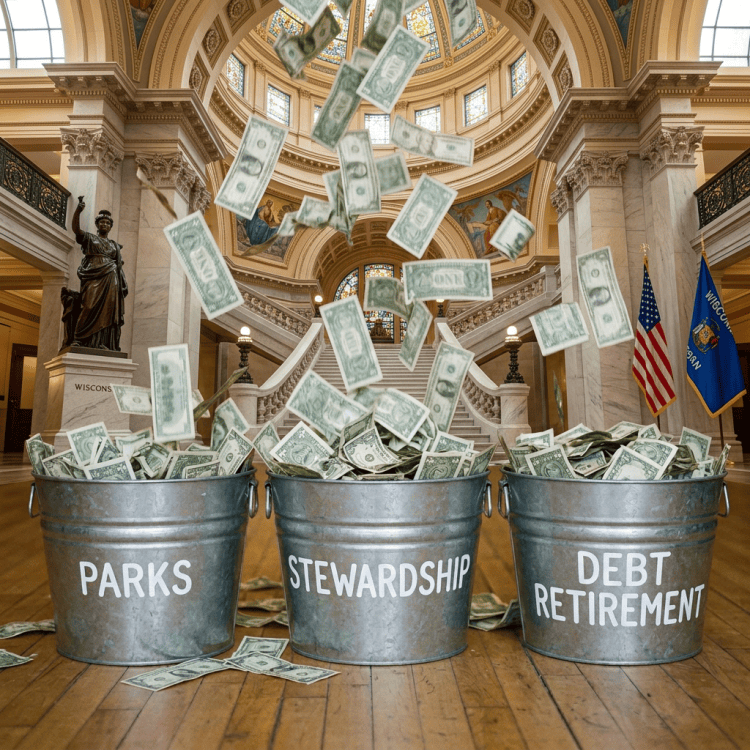
Put $1 billion toward state parks. Our parks and natural areas have an estimated $1.3 billion in deferred maintenance. That’s everything from deteriorating roads and trails to failing waste treatment facilities at campgrounds. Parks are important for tourism, but they’re mostly enjoyed by state residents.
Put $500 million into a renewed Stewardship Fund. This fund which buys land for parks, trails and natural areas, lapsed at the end of June because Democrats and Republicans couldn’t agree on a way forward. Why the Democrats simply didn’t take the annual $30 million or so that the Republicans offered and improve on that number once they had control of the Legislature (perhaps as early as next year) is beyond me. Nonetheless, paying cash is a better way to go. Stewardship has been a bonding program, but by spending cash for land we’d save about $260 million in interest.
Use $1.5 billion to pay off existing debt. This would save an estimated $60 million a year in interest payments and about $450 million over several years.
Because all of these are one-time or capital expenditures we would create no long-term annual general fund commitments and so there’s no worry about a structural deficit. That was the excuse Senate Democrats and some Republicans (including Tom Tiffany) used to kill a surplus spending plan proposed by Gov. Tony Evers, Speaker Robin Vos and Senate Majority Leader Devin LeMahieu.
I suspect that the real reason Democrats voted against it was that they want to shovel even more money into public schools without demanding any accountability. And the real reason Tiffany opposed it was that he wanted to be able to promise that he’d send it all back to taxpayers, which he has. Underlying both Democrats’ and Tiffany’s positions was a desire to spend the money themselves.
Sending a big chunk of the surplus to public schools is a bad idea for two reasons. First, that really does create an ongoing annual expenditure which could lead to structural deficits. And second, this has been the bane of Democratic politicians for years. They just want to send gobs of money to schools without demanding any reforms or measures of improvement.
Tiffany’s plan to just send the money back to taxpayers has appeal because, after all, it is our money. But $3 billion doesn’t go as far as you might think. We’d each get about $1,000 if the money were just sent back to every taxpayer equally, without accounting for actual taxes paid. That $1,000 is nothing to dismiss, but at a time when inflation is a concern, stimulating the economy is likely to make that a little worse. And, when you weigh that against the $700 million in interest payments that would be saved by supplanting debt (also taxpayer money) this plan looks more responsible to me. Moreover, the investments in parks and trails should provide some additional indirect revenues from tourism.
In any event, candidates for Governor and the Legislature should be discussing what they plan to do with the surplus and in some detail.
 Yellow Stripes & Dead Armadillos
Why should we be shoveling more money into parks and trails without demanding better results? I’m guessing Wisconsin spends far more on parks than it did 30 years ago and yet kids are less active and more obese than ever. Why are you defending the outdoor recreation status quo, Dave?
LikeLike
Adjusted for inflation we’re spending a lot less on parks than we have in the past. Under Scott Walker, the general fund support for parks was fully eliminated. They depend now entirely on user fees. And park usage is up, not down. If anything an aging population uses parks more as they have more time for it. I’m not aware of any public concern about the management of our parks while Wisconsin’s public school test scores have lagged national averages. This is especially true in Madison, where every school referendum has passed for the last two decades. Schools, at least in communities where referenda have passed, are well-funded without corresponding results. A final note. I’m proposing a billion dollars for park and trail infrastructure — statewide. In Madison alone we’re spending $509 million on school building upgrades and on new school buildings — some of which are only 50% full now without any projection for future growth.
LikeLike