One of my summer projects was to do some ideological remodelling. I ripped my convictions down to the studs and then rebuilt them. But I left the foundation in place. I never questioned being a moderate. The question was whether I wanted to build back as a nonpartisan, moderate Democrat or a conservative independent.
So, I did quite a bit of reading and thinking and, of course, writing. One article I read, by E.J. Dionne, a long-time establishment liberal commentator, served to enhance my questioning about whether I should still think of myself as a Democrat. In a piece he wrote for the New York Times in July – which I generally agreed with – he had this thought-provoking line:
“(Tom) Suozzi Democrats (moderates) and A.O.C. Democrats (the hard-left) alike want more progressive taxation; universal access to affordable health insurance, child care and housing; enhanced worker rights; climate action; and civil rights and voting rights.”
Dionne was attempting to cover the breadth of acceptable Democratic thought. But I’m not fully inside of even that big tent.
With the top one percent of earners paying 40% of federal income taxes, I think our tax system is plenty progressive and I fear that even more income redistribution will only serve to slow wealth creation and make us all poorer.
I would like health insurance to be more affordable, but wanting it to be “universal” implies something like Medicare For All, which, in my view, is simply too expensive and could lead to a government-run system which will be even less efficient and much less innovative.
I realize that child care is expensive, but I don’t think that’s the government’s responsibility. Rather, it’s on parents to take that cost into account before deciding to have children.
I’m for more affordable housing, which can be accomplished directly by lowering property taxes and reducing government regulations, but not through direct taxpayer subsidies.
I do support more climate action, so there I just flatly agree with Democrats, though the Green New Deal is just a Christmas tree for every bauble that the hard-left desires.
Not only do I disagree that we need to strengthen civil rights laws, but I think Democrats have gone way too far with affirmative action and DEI programs (even Alexandria Ocasio Cortez has now called woke “crazy”) and so I welcome the recent resets back to core principles of non-discrimination as opposed to “equity.”
And despite Trump’s attacks on voting rights, so far we’re fine. Democrats’ criticisms of some changes in Georgia a few years ago as “Jim Crow 2.0” were ludicrous, as the rules there are more liberal than they are in New York.
Questions I’ll ask about any proposal for a new or expanded government program are: How will we pay for this? What might be the impact on the national debt, which now exceeds $40 trillion? And is this something the government should be doing in the first place?
So, if I’m even more conservative than what passes for the most moderate Democrat, then am I really one?
After a summer of considering that question, here are my conclusions.
American v. European Conservatism
In America, “conservative” means adhering to our founding documents, the Declaration of Independence and the Constitution. That contrasts with European conservatism (practiced by Trump and MAGA) which wants to establish a blood and soil nationalism, which never really existed here and which is deeply un-American..
Ironically then, true conservatives in America adhere to liberal, even radical, beliefs compared to European or MAGA conservatives. That’s because the Declaration and the Constitution fully reject monarchy, church, and blood and soil patriotism. Instead, those documents are founded on the then-radial belief that all people are equal, that everyone is born with natural rights that can only be protected – not created – by government, that governments serve the people and exist only to uphold those rights, and that reason, not superstition or emotion, should rule.
All of this is based on the central tenet of Enlightenment philosophy: the state of nature. In the state of nature we are all totally free individuals. We can do what we please. The problem soon becomes obvious. What if I’m free to kill you or take your property? To address that issue we create government through a social contract. But the central point is that we are born with basic freedom to do what we want as individuals and we only enter into the social contract out of necessity. And crucially, we give up some of our freedom only in the interests of protecting our individual rights to life and property.
This was a radical idea in 1776 because at the time, even in limited monarchies, the idea was that those who govern do so by the consent of God. No consent of the governed was required. Even in England, which had limited the powers of the king over a century earlier, those limits were imposed by other landed royalty. Your average serf still had little say and few rights.
America Was Founded on Anti-Populism
The Founders also had a complicated view of democracy. They were scholars, informed by the experiences of ancient Greece and Rome. History taught them that unchecked democracy, ironically enough. led inevitably to democracy’s demise. Eventually, the people would turn to a dictator.
So, their greatest fear was that democracy could actually lead to new forms of tyranny with a majority stepping in for kings and churches. They feared the mob, what today we would call populism. So, they established a constitutional democracy, not a pure one.
Populism, whether practiced by left or right, is fundamentally about who you hate, who you blame for your lot in life, who you want to scapegoat. Populists believe that self-determination is mostly or entirely a myth and that instead we are the victims of oppressors. For the left that’s the “one percent”. For the right it’s migrants or intellectuals.
But in any event, populism runs directly counter to the Founders’ vision because it denies the fundamental truth underlying everything: that we are, in the state of nature, individuals in charge of our own destiny. So, in a very profound sense, populism is un-American.
Moreover, populism is about the passions of the moment, again something the Founders wanted to quell. Populism is a way of politics that is tailor made for the demagogue and huckster. Huey Long, Father Coughlin, Joe McCarthy, George Wallace and Donald Trump are all populists.
“Fighting Bob” La Follette was an exception, but in his day he thought of himself and his Progressive movement as moderates, standing between socialists on his left and Stand Pat Republicans and Democrats on his right. He didn’t want to overthrow the Founders’ system; he wanted to reform, and ultimately, save it.
Today’s populists, true to the worries of the Founders, want to blow everything up. They have contempt for the Founders’ system for a very good reason: they see it standing in the way of the rapid, dramatic change they want. And they’re right about that. Our system is designed to move slowly. It is intentionally hard to make a law because the Founders did not want us to rely too heavily on government. They wanted individuals to have maximum freedom – which meant the opportunity to succeed by whatever definition they chose, but it also meant the risk of failure. Because they don’t believe in individual human agency, populists neither credit success nor accept failure. They see the government as the great rescuer and society as responsible for everything.
Hard left and hard right populists come together in two ways. They want a massive welfare state and an isolationist foreign policy. Both are bad ideas.
Taking People As They Are
Unlike the ancients, the Founders did not believe in the perfectability of men. Instead, they built their system on the assumption that people would be self-interested.
That didn’t mean that they thought no civic virtue was needed. Rather, they believed that citizens needed a sound education so that they could appreciate Enlightenment values – primarily the value of reason. Because it is reason that makes us human. We share many things in common with animals, but animals cannot reason. And it was reason that led them to the conclusion that men had fundamental rights to life, liberty and the pursuit (though not the promise) of happiness. While they may have from time to time referred to those rights as God-given, they did not literally mean that. Instead, they meant that these rights were fundamental, that people were born with them and that they could not be conferred or taken away by any church, king or government.
The Founders viewed religion as a sort of short cut to provide the national character that would support freedom. But they believed that it could also be dangerous, which is why they wanted no official religion. Rather, they wanted to encourage a range of Protestant sects, with tolerance for Catholics, Jews and Muslims.
So, government is a necessary evil. We need it only to create the orderly society in which people can go about their own pursuits. The Founders wanted to shake off monarchies and churches as governing bodies, but they also did not want the tyranny of majorities. Any action by a government, even one that is popularly elected, is coercive and limits the freedom of the individual. That’s why even majorities must be restrained.
The trouble, of course, is deciding in today’s society where that government intrusion into our lives should end. I sit here in my condominium. The streets outside are paved, maintained, swept and plowed by the government. The stop lights that keep cars from crashing into one another are maintained by the government. There is a speed limit imposed and sometimes enforced by the government. When people drive too fast a police officer, employed by the government, has the power to stop them and issue them a ticket. If they want to fight that ticket they must appear in a court created by the government. The buildings on the other side of my street could only be torn down with the approval of the government and then replaced only by new buildings as tall as the government allows.

And yet, here I sit, a supporter of smaller government, and also a supporter of every one of those government powers. So, where do I draw the line? When do government rules and taxpayer supported services become too much, too burdensome, out of bounds for a conservative?
I think the classical answer would be: The line is crossed when governments assume that they can change human nature. The Founders believed that human nature was fixed. It could not be changed.
The difference between conservatives and progressives is that conservatives look for places where government has gone too far, while progressives look for new things government might do. In that sense, I am now a conservative.
I believe in personal agency, while acknowledging that one’s circumstances matter. I believe in the free market, while acknowledging that an unfettered market will lead to some outcomes that I don’t want and, so, reluctantly I support some government regulation. I support child labor laws and regulations on air and water pollution. I support rules governing safe food and drug production. I support laws requiring seat belts and air bags in cars. There are lots of government actions that I support. And yet, my working assumption is that any new tax or regulation is not to be embraced, but resisted and questioned. It should have to clear a high bar for approval. I am not looking to expand government into new realms.
Why Unity is Overrated
We keep hearing about the need to come together as a nation. But America is all about the churn. In the rare historical moments when we have been united, it hasn’t all been pretty. We were united during the First World War and we crushed descent. Milwaukee’s chosen congressman, Viktor Burger, was refused his seat in Congress simply because he opposed America’s entry into the war. We were united again during WW II and we locked up loyal Asian Americans simply for being Asian Americans. Those who want America to be united are mostly pursuing a fool’s errand, but they should also be careful what they wish for.
And let’s hear it for the churn. There is really no such thing as “settled law” in America. America is a project, not a steady state. We are constantly debating what it means to be free, what the pursuit of life, liberty and happiness really means and how equality actually plays out in everyday American life. Those questions will never be settled.
In fact, one of the reasons that oligarchies and strong men are able to rule in many parts of the world – like Russia and China – is because those cultures actually favor the security provided by strong rulers and they are discomforted by the uncertainty and chaos of democracy and individualism. Being an American comes with the necessity to be able to surf along with disagreement, uncertainty and shifting sand beneath our feet. We should not want the security and certainty that comes with Big Brother.
But that means that we need to develop the skills to be able to ride with the tide, to adjust to new realities while staying rooted in natural law. The fundamentals are individualism and reason.
Calm Reason
What the Founders wanted was a system that tamed the passions and which elevated reason. That is a tall order. And it has only gotten harder with the advent of social media.
Social discourse was once mostly filtered by newspapers (not always immune from fanning flames themselves in the interests of selling more papers) and water cooler conversations. People faced each other in settings apart from politics (sometimes literally the office water cooler) and might chat about current events. It’s hard to be rude to a coworker while standing four feet apart. It’s hard not to at least listen to their perspective. And it’s hard not to place that perspective inside of all the other things you know about that person apart from politics.
What’s awful about social media (and why I never interact with it) is that it is the antithesis of all those things. You never have to meet anyone in the flesh. You never have to put their views in the context of the whole person. And you can be as rude and dismissive as you want. Social media once held the potential to create great bonds of understanding across oceans. Instead, it has served to hyper-charge every negative human trait.
But, that aside, even people who pride themselves on their detachment are subject to unfounded panic. This is a particularly strong affliction among liberals who say they insist on “evidence based” arguments. Let me offer some examples.
The population bomb. It never went off. In 1968 its author predicted food rationing even in developed countries by the 1980s. In fact, none of the dire predictions in that book came to pass.
“Jim Crow 2.0.” Efforts to impose some new rules in Georgia an a few other places were hardly anything like Jim Crow. In fact, the voting rules in Georgia are more liberal than they are in New York.
The “gutting” of the Voting Rights Act. No such thing happened. Poll taxes and literacy tests were not reinstated. Rather a bizarre interpretation of the 1964 Act that came two decades later was revisited by this Supreme Court. That 1980’s interpretation required the gerrymandering of majority minority districts under the rather insulting assumption that all black people vote alike. It was good that that was overturned.
The AI jobs scare. So far, artificial intelligence’s impact on jobs has been minimal. And even if there is some impact, that’s nothing new. Key punch operating jobs were once plentiful. They went away and more jobs were created in other areas.
The COVID lockdowns. This may be the most damaging of all because it is an echo and a strong reinforcement of Vietnam and Watergate. Those events shook public confidence in the federal government to the core. In the early 1960’s 77% of the public trusted the feds to do the right thing most of the time. Today it’s 20-some percent. Experts demanded lockdowns that resulted in far worse problems than they avoided.
So, panic and emotionalism is bad on the left, but it’s not as if the right is immune. “Death panels,” the scapegoating of immigrants for crime, the notion that crime itself is rampant when it is at its lowest point in decades and countless bizarre conspiracy theories (child molesting pizza parlors) are all examples.
To make matters still more complicated, during the periods in this country when reason seemed to have its most currency we made some of our worst mistakes. The early decades of the 20th century were the height of confidence in scientific management and experts. Eugenics and forced sterilizations were widely supported among these progressives.
But that does not change the fact that reason has done us so much more good than harm. And it is good to remind ourselves that reason should be self-correcting. Unlike religion, mysticism or emotionalism, reason is not about what we believe but about what we can demonstrate to be true. When new facts emerge, so should our conclusions. Like America itself, reason is a process, not a steady state.
The Process is More Important Than the Outcome
Here’s how a bill becomes a law: slowly, if at all. That’s by design and it’s as it should be. I do not want law-making to be efficient, though I do want government to be efficient in the administration of the laws, which is quite another matter.
There is, especially on the left, a desire to do things like eliminate the Senate filibuster on the grounds that “the stakes are too high” to allow it to prevent the passage of some magic bullet legislation that will eliminate the left’s latest hair-on-fire “existential threat” to god knows what.
What they fail to appreciate is that clearing the hurdles for their crucially important bill will, some day, clear the way for the same sort of extreme legislation coming from the other side.
Moreover, all of these attempts to “streamline” the legislative process start with the assumption that every problem can be solved with a massive new government program. And when these programs fail, the answer is always that it was never “fully funded.”
It has now become accepted that Presidents will seek an end run on the legislative process to enact the “crucial reforms” that will fight the “existential threat.” Nobody has done more of this than Donald Trump, though Joe Biden and Barack Obama were no slouches either. Biden’s unilateral forgiveness of billions of dollars in student loan debt was an especially egregious example. Even Nancy Pelosi once said that he didn’t have the power to do it and that the power of the purse was housed in Congress.
The Senate as a whole and its filibuster in particular, as well as the Electoral College and the courts, serve as breaks on raw passion and absolute majority rule. These processes, at the very least, slow things down and provide the chance for more deliberation. And often they result in the death of legislation. Since I’m skeptical of government’s ability to solve problems, I think that’s usually a good thing.
The Founders did not believe in pure democracy. That’s why they installed so many circuit breakers. The filibuster was a later addition, but it’s in the spirit of the original plan. That’s because government actions are by their very nature coercive. I can’t parse out the items in my tax bill that I object to and give myself a discount. I can’t choose not to follow a new regulation that applies to me.
Capitalism Has Been Spectacularly Successful
The free market is like a giant super computer. Every day in America alone millions of consumers make billions of personal decisions that, in the long-run, drive prices down and quality up. Millions of investors make decisions that support innovation and productivity – or they pay the price when they don’t. The notion that government or any kind of central planning could possibly do better is just beneath serious consideration. Witness those spectacularly successful Soviet five-year plans.
I will anticipate an objection from my liberal friends right here. Yes, the system doesn’t work when there is no moral hazard. But in the case of the 2008 housing bubble melt down it was the government that intervened to prop up investors and save them from that very moral hazard. They didn’t have to do both. Businesses did have to be propped up to prevent a complete collapse (some really were too big to fail), but individuals who abused the system should have been allowed to fail, to go bankrupt if necessary, to suffer very tough consequences for their irresponsible actions.
Capitalism is an economic system that flows naturally from a train of philosophical thought. We are individuals first with natural rights to do as we please. We set up governments only because if everyone did as they pleased we could be killed or have our property taken from us. So governments exist to restrict individual freedom only to the extent that it protects our lives and property. Anything beyond that should be met with skepticism.
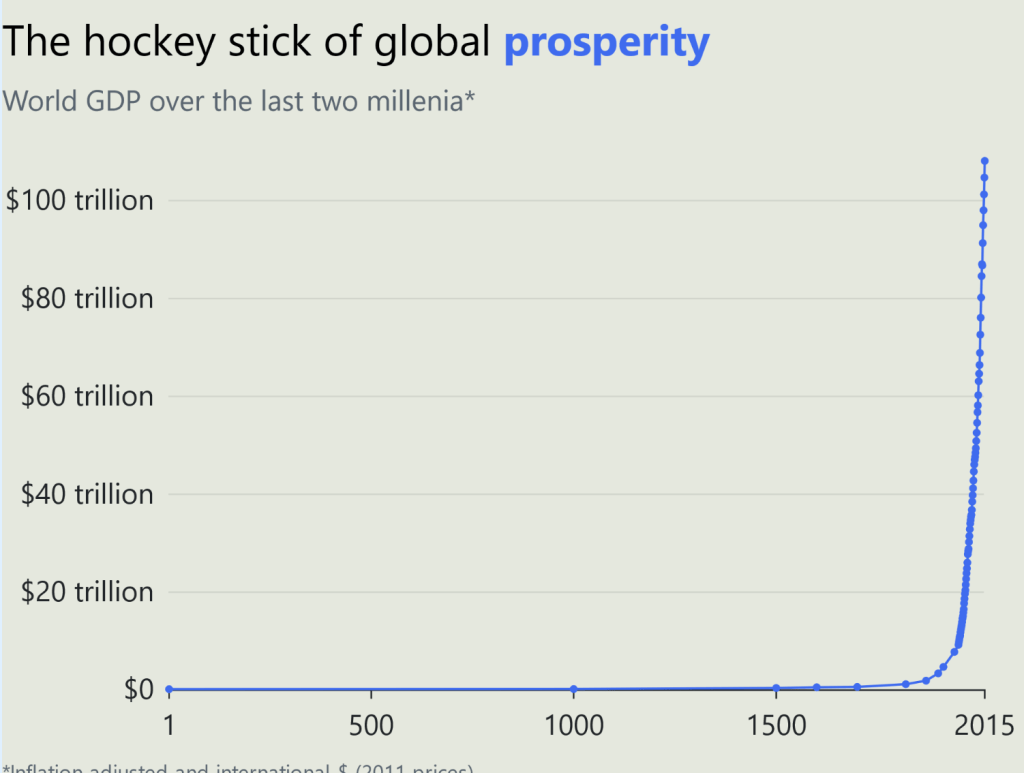
Once we shook off the tyranny of the crown and church and empowered individuals to acquire wealth, prosperity exploded. For almost all of human history conditions of mass poverty went unchanged until the mid 19th century. Then everything got better. And fast.
The graph below illustrates what happened. For thousands of years human beings lived in essentially the same grinding poverty and the prevailing ideology was that this was ordained by God. Any reward would be provided in an afterlife. But in the mid-19th century there was an explosion of wealth. That was due to the unleashing of individualism and with it capitalism (a term, by the way, invented by Karl Marx and intended as an insult). Suddenly, thanks to Enlightenment ideas, the productivity and inventiveness and ambition of millions of individuals was allowed to flourish. And as a result everything got better rapidly.
Moreover, the pace of improvement has accelerated. Consider this observation from the Wall Street Journal from this summer:
“Consider extreme poverty, long defined as living on less than $1 a day, adjusted for inflation and purchasing power. In 1950, more than half of humanity was that poor (using the 1985 dollar as the benchmark). Today the share is 7.6%, the lowest ever recorded. Average schooling has almost tripled, from 3.2 years to nearly nine. Electricity access has soared. Problems remain, but the gains have been spectacular.”

Here’s another example. First published in 1909, the Harvard Classics are a series of books recommended by Dr. Charles W. Eliot. Eliot was the president of Harvard University, and he said a liberal education could be had by spending 15 minutes a day reading from a collection of books that fit on a five-foot length of bookshelf. The other day I acquired the whole thing… on my e-reader… for all of $1.99. So, I now carry around what was once defined as everything you would need for a full liberal education. It was essentially free. And I carry it around in what amounts to a thin folder.
Now, I understand that humankind has learned things that even Charles Eliot might concede need to be added to his five feet of truth. My point is that knowledge is more accessible than ever before — both in terms of dollar cost and through technology. And that is thanks to capitalism and everything that made capitalism possible.
The prosperity we take for granted today is very recent and it is the direct result of the freedoms that come under attack from today’s hard-left. Much of those attacks are made on social media platforms that only exist because of the revolution made possible by the very systems they now want to destroy.
The Stockholm Syndrome
But what about Sweden?
Modern day advocates for socialism in America want to ignore the experiences of the Soviet Union or of Venezuela and instead focus on places like Sweden. They argue that the U.S. could have Sweden’s robust social safety net by simply taxing the rich at higher rates. This is simply false. Sweden achieves its cradle-to-grave benefits by taxing the middle class. Their tax system is actually far less progressive than ours.
The average worker in Sweden pays 41% of his earnings in taxes compared to 30% for the average American worker. In addition, there is a general 25% sales tax in Sweden (12.5% on food) compared to 0 to 10% in the U.S.
Medicare for All, a version of socialized medicine, would cost an estimated $30 trillion over ten years. Sen. Elizabeth Warren’s version of a wealth tax would generate $4 trillion over a decade, leaving $26 trillion to be paid for by someone other than the one percent. You see the problem.
And Sweden’s welfare state comes at another very high cost. The result of their extraordinarily high taxes is a less productive economy. Sweden’s per capita GDP is about $70,000 compared to around $94,000 in the U.S.
So, Scandinavian and Western European countries have made a fundamental policy choice to have very high middle class taxes in exchange for a very robust social safety net. Of course we could choose a bigger safety net too, but the argument that we could finance that on the backs of the rich is simply untrue.
Why We Should Have Higher Federal Taxes
You might think it strange that one who argues that every dollar extracted from the private economy represents a little less freedom would argue for higher taxes. But I do think that our Federal taxes should be higher for everyone. (This does not apply to state and local taxes since those governments cannot run a deficit.)
The reason is that we need to allow the market to work. And the market cannot work when we hide the cost of government through borrowing. The Federal debt recently passed $40 trillion. We are living in a fantasy world where more public benefits can be had without higher taxes. If taxpayers felt the pain of higher spending for everything from defense to social programs they would demand greater efficiency.
Related to the discussion above regarding Sweden, perhaps taxpayers would accept much higher taxes in exchange for vastly expanded programs like Medicare for All. But I suspect most Americans would reject that because we simply have a different (and I think better) political culture. We value personal freedom and the ability for individuals to have relatively more discretion over what they earn than other Western democracies do. Good for us.
Cyclical Or Linear History
Plato believed that history was cyclical. Times of relative freedom and openness gave way to periods of oppression and darkness. His project was to break the cycle and sustain the better times for the long-run. His idea was to find ways to perpetuate virtue among leaders, to essentially improve human nature.
But starting with the revolutions of the late 18th century, modern thinkers started to believe in a linear history of improvement. And, in fact, historians now talk about a “hockey stick” graph (see above) which shows virtually no improvement in the daily lives of average people until the mid nineteenth century. Then everything explodes in a positive direction thanks, not to the perfection of human beings, but to greater freedom for individuals to reach their own potential which resulted in capitalism, the industrial revolution and the rise of rational thought over superstition. Even Karl Marx thought that capitalism was just a necessary phase toward a better time, the end of history.
Now, for the last decade and a half, the rise of far right populism has led some to conclude that Plato was right after all. We seem to be retreating to a new Dark Ages where superstitions, most in the form of wild conspiracy theories, are reasserting themselves on a massive scale. Science is on the ropes as is the rule of law. Basically, the Enlightenment and everything it made possible, is under attack.
Trump, MAGA, Brexit and so many related forms of political cancer can no longer be dismissed as bumps in the road of continued progress. They may very well mean the dawn of a new political ice age.
There are no policies that can reverse this. Democrats and liberals think the answer is another big government program – Medicare for All, the Green New Deal, a big increase in the minimum wage, etc. They never stop to ask themselves why, when they have so many proposals that would benefit Trump voters, they remain Trump voters. The reason is that MAGA World doesn’t care about –- or in most cases isn’t even aware of — policy. It’s not a movement based on rational argument. It’s all about what people feel.
MAGA World is incensed. It feels disrespected, condescended to, ignored and mocked by a vague establishment. That doesn’t go just for liberals and Democrats but also for the traditional conservative establishment in the Republican Party. Their sense was that the fix was in and there wasn’t any real difference between party establishments. They were all parasites, feeding off of their labor. Hence the Trump-Sanders supporters.. MAGA will support anybody who will just blow up the current system.
This sort of nihilism now has its answer on the left. The Democratic Socialists also want to destroy the whole system – replace capitalism with some form of socialism, eliminate or at least heavily restrict private property and destroy the checks and balances that curb a pure (and destructive) democracy..
All of which is to suggest that the progressive faith in continuous improvement has been shaken. It may now be a question of just how far we retreat into the dark and how we might slow the regression. The one-time force against that regression was the old Republican Party, which once kept reminding us of the intentions of the Founders. That is now gone and so there is little in the way of institutional muscle to pull us back to first principles.
Things Fall Apart
Gravity is real. So is aging. Life can be thought of as expending energy to make order out of a world that prefers chaos. Then you run out of energy and you die.
What’s true in the physical world is true in politics. Things are always falling apart. Coalitions shift, allies drift apart, facts change the arguments. Most of the work of politics is in keeping things together. Legislative caucasus have whips for a reason.
To be an American is to not only accept that reality, but to revel in it because it’s the source of our freedom. Vladimir Putin is the latest example of a culture that stubbornly wants to fight nature. Many Russians want the strong man who will protect them and who will hold things together by sheer force. That is unfortunate, but it is very Russian.
America is great in part because it is built on a more honest acceptance of natural reality. Things fray and decay and they need to be rebuilt – constantly. There is no steady state, no real settled law. The only thing that is eternally true is human nature, which can be neither improved nor made any worse than it is. We will not eliminate self-interest. The genius of the Founders was that they found a way to harness self-interest for a broader public good.
Roots of the Current Distress
With so many things improving and with life objectively much better than it has ever been in human history, why do so many people just want to blow up the very institutions that have provided these benefits?
I will suggest two reasons: a lack of perspective and the victory of progressive thought.
The lack of perspective is obvious and doesn’t require much explanation. None of us were around in 1850 before the Industrial Revolution. In fact, few of us were around in 1933 to experience the Great Depression and not many in 1942 to witness the most deadly war in world history. And a world without computing technology available at our finger tips to almost everyone and which is much more powerful then what was available to send a man to the moon in 1969 is inconceivable. We take it for granted.
The other problem – progressive thought – requires a little more explanation because most of us would assume that this would lead to, well, progress. So, let me explain why I think just the opposite is true.
Progressives view the world in a quasi-Marxist way. Everything is inevitable and subject to iron laws. Individuals have no real agency. Your fate is dictated by your class, your race, your gender.
So, when anything bad happens you can blame it on the political and economic system. Nothing is your fault and there’s nothing you can do within that rotten system. Moreover, if you’re on the left, you can blame “the one percent.” Afterall, if no one is responsible for their failures, nobody can take credit for their success. The rich are, by definition, undeserving.
If you’re on the right you blame immigrants. Leftists punch up and the right punches down, but the point is to punch at somebody and never to consider your own responsibility for your circumstances. So the obvious answer is to destroy the system and replace it with… something else. Until recently, nobody was ever very clear about what that better system is. That changed this summer when the Democratic Socialists of America published their manifesto. Their system would have no Senate and no independent judiciary or executive and therefore no checks and balances. It would eliminate capitalism right along with police and jails. God help us.
Stacked up against the tides of history, what the vast majority of Americans have to complain about now is but a gentle wave on a sunny afternoon at the beach. Inflation is slightly higher than optimal. There’s some worry about a new technology, artificial intelligence, that might upset labor markets but in a way that pales in comparison to earlier technological advances. In the end it’s much more likely to create more wealth and more jobs than it destroys. Climate change is a real problem, but one that we’ve managed modestly well to date. There’s probably a technological fix on the horizon. Mass migration into the U.S. has been pretty well cut off by Trump — certainly an accomplishment, but one that he has achieved in an unnecessarily brutal and inhumane way.
The top current issue – the cost of living – is especially interesting because it is mostly the result of government itself. The answer is not new government programs, but for the government to simply undo its mistakes. Chief among these are Trump’s tariffs and his senseless war with Iran. Repealing the tariffs and ending the war would drive prices down quickly.
Sure, there are some real problems. There always will be. But it’s not the Black Death. It’s not the Great Depression. It’s not WW I or WW II. You would not know this if you watched much Fox News or MSNOW – but unfortunately, you wouldn’t gain that perspective by consuming virtually any other news outlet either. Panic and the overstatement of real problems attracts eye balls and clicks.
I don’t see much hope on the horizon because it would take a mass enlightenment. Hundreds of millions, if not billions, of people across the globe would have to wake up and realize that: One, from the long-run perspective things are good and rapidly improving. Two, capitalism is not a zero sum game. All of our lives are improved when wealth is created. Three, your relative economic status compared to Elon Musk is meaningless. What matters is the access you have to life’s basics and to advanced technology and knowledge. Four, you are primarily responsible for your own lot in life. If you’ve been successful it’s okay to enjoy that and perhaps to help others through voluntary associations. If you’re struggling, you need to figure out how to do better. And five, the world is not filled with oppressors and victims and you are neither of those things.
Meaning is a Personal Responsibility
One of the answers often offered to explain the current uneasiness is that people lack a sense of purpose in their lives. The argument goes that religiosity is waning and capitalism doesn’t feed the soul. Blood and soil nationalism and socialism, on the other hand, provide great national (or international) projects. They allow people to feel that they’re part of a great movement that transcends them and that will carry on beyond them.
For myself, I don’t believe in any sort of personal god or in an afterlife. But I don’t think it’s the government’s responsibility or that of politics or society or the culture to fill the void. The search for meaning is a highly individualistic personal pursuit, if you want to engage in it at all.
For me that pursuit is a waste of time, a fool’s errand. We cannot possibly know the answers to life’s ultimate questions. The most honest answer to these is simply: how should I know?
But that doesn’t stop people from making up answers, which would be fine in itself if that is found to be comforting. The trouble comes when people confuse their comforting fiction with hard reality and then insist that anybody who doesn’t take the fiction as truth is wrong or worse. On balance, I agree with the Founders that religion is rather dangerous if it becomes too powerful, though it can be useful as a short cut to the kind of national character that supports personal freedom.
To a man, the Founders were not Christians. They were deists. They believed in some impersonal force that set the universe moving and then walked away. They most definitely did not believe in a personal god with oddly human flaws while also being all-knowing and infallible and who had a tailor made plan for them and who they could talk to and be answered. They did not think prayers would be answered and so they didn’t waste their time praying. George Washington did not own a Bible and no clergy were summoned to his bedside as he lay dying.
I’m not sure that I would even go so far as to be deist. I don’t necessarily buy into even the impersonal force, much less the personal god. But again, the honest, reasonable answer is that I simply don’t know and can’t know. After all, Albert Einstein was not an atheist, so who am I to claim that atheism is the answer?
What I do know, thanks in part to Einstein, is that I am an extremely short-lived piece of dust. The universe is 14 billion years old. We live in an unexceptional galaxy, revolving around an unexceptional star, which is one of billions in our galaxy alone — and there are two trillion galaxies. I am one of 117 billion people who have lived on this one little planet. That puts things is some perspective.
So, emphatically not founded on any religion, America is a nation that treats individuals with respect. We are not children who need a simple faith or a national cause to give our lives meaning. Rather we are free to choose as adults. We can work to find meaning in something or, as in my case, we can simply accept the idea that if life does have any purpose, that purpose is unknowable.
My fundamental point is to get back to first principles. We are first and primarily individuals. We can choose to be members of groups, including religions. But the search for meaning through religions that claim to be the only true faith or through blood and soil nationalism or through forced associations like socialism take us no place that we should want to go. Our freedom is protected when we remind ourselves that nobody has the answers to ultimate questions.
The Value of Stuff
A wise woman once observed that we are living in a material world and consequently she considered herself a material person.
My Madison neighborhood is filled with people who eschew materialism from their million dollar houses. It’s fashionable, especially among liberals, academics and Unitarians (which usually describes the same person), to look down upon strivers and consumerism.

It makes more sense to be honest and to embrace it. The truth is that the acquisition of things often makes me happy and improves my life. I’m happy that I’m able to afford this Apple computer (and I’m happy for the inventors and for the technology and for the centuries of burning of fossil fuels that makes this possible). I’m happy that my wife and I were able to afford a cabin on a lake in the North Woods where I do much of my writing. Most summer mornings I take my yoga mat out to our dock to rise above all that materialism. (But I really like the setting that we acquired.)
I could go on and on. Of course, a person can get carried away and buy too much stuff, but if we practice “all things in moderation,” stuff is good. And there is meaning in what we acquire.
Take clothes. Happily (in about 95% of all cases) we all wear them. We can be fashion obsessed or we can say that we don’t care, but intentional or not, what we wear is an expression of who we are. My clothes tell people that I cared about fashion in 1985, but I also know the value of a dollar, and I’ll adopt a new look when these duds wear out. My point is that our consumer choices are deeply intwined with who we are, whether we want them to be or not. They are not trivial or shallow and they should not be denigrated.
The notion that we need to have disdain for consumerism is dishonest and hypocritical, as it is mostly practiced by affluent liberals. One of the most grating bumper stickers I’ve seen, usually on a Prius, reads, “Live simply so that others may simply live.”
That’s a ludicrous point of view if you stop to give it a moment’s thought. How is my denying myself a newer (I only buy used) car going to help the poor? When I buy a newer car that means down the line a brand new car is produced to replace it. The new car employs tens of thousands of people all over the globe to build it and to fill the supply and transportation chains to support it. And, of course, that’s just one example of the thousands of purchases I make each year. A better bumper sticker would read, “Buy stuff so that others might prosper.”
I find a lot more meaning and fulfillment in the tangible things around me than I do in the airy world of “spirituality.”
Moreover, the American experience of wealth is quite different than it is in Europe. American fortunes are seldom enduring and the stuff that the very rich in America accumulate over their lifetimes usually ends up benefiting the public. Of the 400 richest families in 1900, only two are still on that same list today. Unlike Europe, our one percent is not the same people for generations. Rather, fortunes are built in one generation and then dispersed or given away shortly thereafter.
And the family fortunes that went away often benefited the public spectacularly. Thomas Jefferson’s personal library seeded the Library of Congress, though Jefferson actually sold his collection to the government. More straightforward examples of philanthropy include U.S. Steel founder Andrew Carnegie who said that, “a man who dies rich dies disgraced.” He used his fortune to build over 5,000 local libraries, among other gifts. Carnegie’s partner, Henry Clay Frick gave his entire incomparable art collection and his Fifth Avenue mansion to the City of New York. It now houses the Frick Gallery. J.P. Morgan donated his extensive art collection to the Metropolitan Museum of Art. These and other titans of industry also gave heavily to colleges and universities.
And it won’t stop there. Bill Gates of Microsoft and Judith Faulkner of Epic plan to give away their entire estates.
As John Steele Gordon wrote in his excellent book, An Empire of Wealth, “By the turn of the twentieth century, the United States was as great a cultural and intellectual power as it was an economic one, largely thanks to the often poorly educated men who are remembered today as the robber barons.”
This notion that the accumulation of wealth, and with it the acquisition of things while one is alive, is such a scourge needs reexamination. Let’s stop the war on stuff. Most of us find real meaning and self-expression in the acquisition of things. And those of us who acquire the most valuable stuff tend to will it to the public domain.
Why I Don’t Want To Be Inspired By My Leaders
While we’re searching for meaning we should not look to the President to tell us what our lives are supposed to be about.
There’s an old saying that, ‘Democrats want to fall in love while Republicans fall in line.’ That’s less true today as the Republican Party has become a cult of one man. Trump followers simply love the man and would follow him off a cliff, and metaphorically they often do just that. But generally speaking, almost all voters these days are focussed on the office of the President as some sort of Great Father who is expected to solve all of their problems.
Presidential libraries, once centers for a President’s papers and for historical study, are now simply monuments to a man’s ego. Neither Barack Obama’s new library nor the recently completed library for Teddy Roosevelt contain a scrap of either man’s papers. Trump, not surprisingly, plans a sort of Disney library, complete with luxury hotel and, who knows, maybe a golf course. No doubt all covered in gold paint. Very classy.
What I would like to see is a less powerful and much less celebrity sort of presidency. More Calvin Coolidge and Dwight Eisenhower and less Jack Kennedy and Donald Trump. We should look to our Presidents for restraint. We should want to elect people who first ask if they actually have the power to do something and then ask if it’s government’s proper role to do it at all, before acting.
One positive thing we could take from Trump’s time in office is the lesson that we should not look to the Oval Office for a hero, a role model or a spiritual leader. That sets up even the best person (see Carter, Jimmy) for failure. Moreover, the search for heroes is not worthy of adults. We are all individuals, responsible for finding our own way in life. We should know by now that nobody’s without flaws. It’s up to each one of us to navigate life on our own. Sure, I suppose we can take lessons or inspiration from someone here or there who managed an isolated event well or overcame a challenge, but that’s quite different from canonizing anyone.
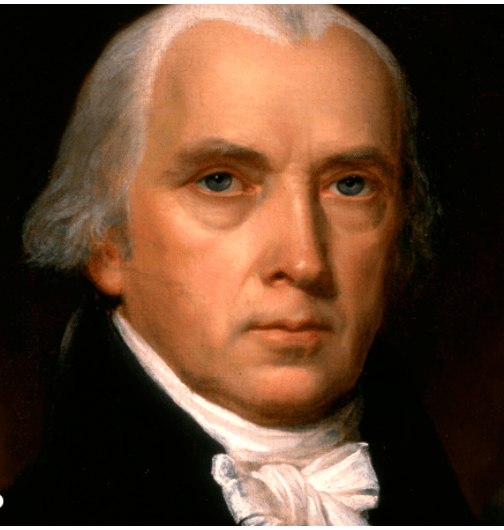
We see this kind of thing play out in the controversies over naming buildings and other landmarks. Here in Madison the school board recently renamed James Madison Memorial High School after Vel Phillips. Madison was a brilliant man who was the architect of our Constitution and who was the leading co-conspirator in creating the United States of America out of a ragtag collection of colonies that had won hard-fought independence but had little interest in becoming one nation.
But, in the hands of the hard-left, Madison went from being a great man who owned slaves to a slave owner (and what else do you need to know?). Phillips, by comparison, accomplished very little in her career, aside from the fact that she was the first black woman to graduate from the UW Law School as well as achieving some other firsts. That’s all well and good and certainly it deserves some kind of recognition — you don’t get to be the first black woman in these powerful institutions without some grit — but to put her in the same class as James Madison isn’t justified by an honest comparison of their contributions. Yet, we replaced Madison with Phillips simply because she was a black woman and he owned slaves. If anything illustrates the folly of putting anybody on a pedestal it’s this.
Free Versus Compelled Associations
I don’t think of myself as a joiner. But actually I’m a member of a deer camp, a Sheepshead group and a book club. I pay dues to my local northwoods radio station WXPR, to Trout Unlimited and to the Duck Lake Riparian Association.
The WXPR contribution will serve to illustrate my point. I may be the only public radio listener in the land who supported ending federal funding for it. National Public Radio used to run a regular announcement proclaiming that it was funded in part by the Corporation for Public Broadcasting (mercifully now disbanded), which they described as “a private corporation funded by the American people.”
I always thought that was a curious statement. When they said “funded by the American people” they meant tax dollars. So, how can something funded by tax dollars be private? And why on earth should taxpayers want it to be? But the folks at NPR thought that was a great idea. Get public dollars without having to answer to the public.
The problem was that the CPB was essentially compelling contributions from people who didn’t necessarily want to be a member. And, in fact, most of NPR’s programming is of no interest to most of the public and would be offensive to their values if they ever tuned in.
Now, I find virtually all of NPR’s programming and some of WXPR’s to be heavily biased toward a liberal, even Marxist, point of view. But I send money voluntarily to WXPR, knowing that some of it goes to buy NPR programming that I find objectionable, because on balance I like listening to the station. Its volunteer hosted music shows and some of its local news are just great. But that’s a personal, individual decision on my part. What I objected to was being forced to contribute to NPR through the CPB. So I’m glad it’s gone.
The CPB illustration highlights why we need to be careful about going beyond the basic job of government, which is to provide for the national defense and to manage a legal system under which property rights can be protected. When I was Mayor of Madison I was always troubled by a relatively small portion of our budget that went to social service agencies. These were pretty much all membership nonprofits. Individual citizens could contribute to their cause. But then somewhere along the line, the city stepped in to provide taxpayer funding as well. That was essentially joining the group on behalf of the taxpayers – a compelled membership.
All of those groups had their executive directors, their boards and their membership lists. So, if any of them was ever questioned as to their value for taxpayers or if the overall annual increase in funding wasn’t as much as they wanted (it never was), they launched a political pressure campaign to keep or get more taxpayer money. It amounted to something like less than 5% of the city budget, but it was often the most controversial part of the annual budget process.
Now, some of those programs were worthwhile and some had some tangential relationship to city services. Neighborhood centers, for example, might be thought of as a service a municipal government might provide. But most of the rest of it had nothing at all to do with municipal government. For example, we funded a program that helped kids with the trauma of being witnesses (often to some form of domestic abuse) in the court system. A fine program, but the city didn’t run a court system, outside of municipal court which dealt mostly with parking tickets, which to hear the ticketed tell it was a terrible form of trauma in itself.
In any event, the program for children in the court system should have been funded through private contributions or perhaps by the courts themselves or maybe the county, which did manage the criminal courts. The city funded it only because somebody lobbied a previous mayor or an alder or maybe a city bureaucrat to get it in a budget. And once there, good luck on ever getting it out. You hate traumatized children, don’t you?
This is an example of the insidiousness of government involvement with private nonprofits. Unlike public broadcasting, where many if not most taxpayers would object to the content if they knew about it, the program for traumatized children would be supported by just about everybody. The question wasn’t whether the program was a good idea, but why government (or at least city government) should be funding it.
Nonetheless, once it was there it was never going to go away. While I tried to restrain funding for all of the city’s social service spending, I never tried to zero out this program or any of the others. The reason was that it wasn’t worth the investment of political capital. It would have been a hell of a fight that I would certainly have lost in the end. And, even if I succeeded, the dollar amount was a relative rounding error. It just wasn’t worth the trouble.
Multiply that story a thousand times and that’s how we get a lot more government and higher taxes than what is really needed.
Parties of Principle v. Parties of Interest
To understand this problem in more depth let’s turn to the influential 18th century political philosopher David Hume, a good friend of Benjamin Franklin. Hume wrote about the differences between parties of principle and parties of interest. Parties of interest are those that organize around their self-interests — labor unions, potato growers, oil producers, etc. Parties of principle come together around shared ideals — socialism, equity, human rights, opposition to or support for abortion, etc.
Hume warned against parties of principle because when something is a matter of principle it is almost impossible to compromise and therefore to govern.
We are finding this today in the Democratic Party and in liberal institutions like the New York Times. Both the Democrats and the Times have shifted their financial support from corporations and advertisers to many small individual donors and subscribers (and in the case of the Democrats some very big individual donors). You might think that’s a good thing, but instead what has happened is that each institution has grown more radical and extreme to match the moralistic passions of the people who pay the bills.
Parties of interest, on the other hand, see politics in mostly transactional terms. A union demands a big pay raise, but is prepared to settle for something less. A local developer wants a large tax incremental payment, but will settle for what he can get.
But liberal activists, steeped in the notion that they are fighting for something pure and right, see any retreat from their demands as a sell out. This is why, when they do achieve power, the left finds it virtually impossible to govern. It’s because actual governing requires compromise and sacred principles cannot be negotiated.
But let’s not let the hard-right off the hook in this regard. The Republican “controlled” House of Representatives is almost impossible to govern because its Freedom Caucus of extremists would run the country into a ditch before it would compromise on its principles.
I experienced this as Mayor of Madison. I got elected with support from the left, but I quickly learned that nothing I did could satisfy them and any compromise was seen as a sell out. On the other hand, the business community saw government in practical, transactional terms. If they got half a loaf they’d call it a good day’s work. I came to like the business community.
FDR and Reagan
Let me start by complimenting myself. F. Scott Fitzgerald said that the test of a first-rate intelligence is the ability to hold two opposed ideas in the mind at the same time and still retain the ability to function. So, I suppose I’m claiming to have a first-rate mind – so much evidence to the contrary.
As a rule, people who love Franklin Roosevelt hate Ronald Reagan and vice versa. I don’t. I think they were both the right men for their time and both saved the free market and the institutions and values of the Declaration and the Constitution – FDR much more dramatically so.
The Great Depression was the last of several deep lows in the brutal swings of a relatively unfettered free market – which were unnecessary because Thomas Jefferson (in his theories) and Andrew Jackson (in practice) killed a central bank. Franklin Roosevelt took criticism from his rapidly growing far left for messing with history. The socialists and communists saw his interventions for exactly what they were: saving the free market from itself. Because of his reforms, we have seen nothing like the Depression in the century since. (Milton Friedman argued that the depth of the Depression was the result of the Federal Reserve restricting the money supply and that, had they acted properly, it would have ended much sooner and without much of the permanent welfare state created by FDR.)
But after five decades, the big government that FDR put in place was clearly not a temporary measure. It grew and grew and it created a society in which temporary state assistance was no longer “the dole” but an entitlement. The New Deal programs rescued the middle class at a time of deep economic crisis. But LBJ’s Great Society sought to eliminate generational poverty in a time of robust economic growth. It didn’t work and, worse, it changed the perception of government largesse from a crisis intervention to something that was expected, even demanded. While FDR’s programs were simply designed to get an already healthy middle class back on its feet, the Great Society sought to do the virtually impossible: solve poverty among a demographic that didn’t have the tools to help itself.
This was sapping the wealth-creating energy of the market. Reagan understood that and worked to lessen the role of government in American life and to unleash the wonders of the market. In truth and in a macro sense, the overall effect was very small. Reagan slowed the growth of government and taxes but he did not reverse it. Maybe his greatest achievement was cultural. He made it okay again to want to make money. He reestablished the view that greed, for lack of a better word, is good.
Now the pendulum is swinging in the opposite direction. Youngish people today have no recollection of the 1970s and stagflation. They don’t have any experience of how an ossified welfare state can create all kinds of trouble. They know nothing of the brutality of the gulag. Thus the latest socialist craze. Young socialists have no idea what they’re in for should they be successful. So, let’s hope they don’t succeed.
Originalism
When you see folks at a MAGA rally touting their complete, even militant, devotion to the Constitution you can be pretty sure that they don’t mean every part of the Constitution, much less a devotion to the system and society that the document as a whole and interpreted in the light of the Declaration of Independence contemplates. No, what they mean when they say “the Constitution” is really just the Second Amendment — and not even all of that.
Here’s what the Second Amendment says: “A well regulated Militia, being necessary to the security of a free State, the right of the people to keep and bear Arms, shall not be infringed.”
Gun rights absolutists – along with the Supreme Court majority these days – disregard the clauses at the beginning about a well regulated militia. And yet, both most gun rights activists and a majority of the Supreme Court count themselves as originalists. They believe, as the late Justice Antonin Scalia said, in a “dead Constitution.”
So, here’s the problem. If you’re an originalist and believe that the words should be interpreted just as they were written and the only question is divining the original meaning of the authors, how can you support an absolute right to bear arms in 2026 America? After all, the last thing the Founders wanted was a standing army. They had just finished a war for independence against the best standing army in the world and they did it with a rag tag bunch of irregulars mostly carrying their own hunting rifles.
But today we have a massive professional military. One might think that, since the Founders clearly stated that the whole reason to have an armed citizenry was to muster up a militia to fight off invaders and with that necessity now long gone, it would render the rest of the amendment moot.
But that wasn’t the Founders’ only intent. They also wanted the ability to call up armed militias to put down potential slave uprisings. One could work up some moral qualms about that since the uprisings of slaves might be considered a good thing, but I won’t engage in historicism here. My point is that again one of the original reasons for the protection of the right to own a gun went away with slavery.
Interestingly, the hard-left, while usually fighting originalism, clings to it with regard to the Fourteenth Amendment’s assurance of the equal protection of the laws. The left argues that the authors of the Fourteenth Amendment wrote it to protect the rights of newly freed slaves and so it shouldn’t apply to affirmative action or diversity, equity and inclusion programs or college admissions where, it has been argued, increasingly successfully, that the words mean just what they say: you cannot discriminate based on race. And, in fact, if the authors of the amendment had meant what the left wants it to mean, why didn’t they write that the equal protection of the laws cannot be denied to freedmen or to African Americans? The reason is that those authors weren’t trying to afford a special right to any group, but to simply proclaim that no group can be denied the equal protection of the laws. They were asserting a general principle, not conveying a special benefit.
Be that as it may, my reading has given me a better understanding and some sympathy, if not total agreement, with the idea of originalism. As noted above, on any given issue originalism can fall apart. But in the big picture I see its value.
The big picture is that our Constitution is rooted in truths about human nature that are unchanging and accessible through reason. That truth is that we are all born as free individuals and that our government was established only for practical reasons — to enforce contracts, provide a criminal justice system, provide for national defense and the like. So, the built-in assumption is that any expansion of government beyond the basics will be looked at with suspicion. That is the fundamental point about Constitutional originalism and, on that score, I agree with it.
Weighing the Cost of Government
Government regulations and resources devoted to government impede markets and slow the creation of societal wealth. Every dollar taken out of the private economy reduces our freedom and saps economic vitality. It means one less dollar for investors to pump into a new venture, one less dollar for business owners to put into their concerns and one less dollar for consumers to use to vote for products and services in the massive natural super computer that is the marketplace.
And yet we need some amount of government to assist in creating that wealth. We need laws and courts to enforce them so that entrepreneurs and investors can have some level of assurance that their inventions and ideas won’t be stolen and that other actors will make good on their promises. Something has to be the referee and the ultimate enforcer of contracts and that entity is the government.
Then, of course, we need protection for our lives and property. That means courts, prosecutors and police. And we need protection from threats that come from beyond our borders, so we need a military.
With our lives and property secure, government might stop there. But we find that the free market, as powerful a wealth producer as it is, is not without flaws. Left to its own devices, it might treat the air we all breathe and the water we all drink as sewers. So we need some environmental regulations. The market might also exploit child labor and throw workers into exploitative and dangerous working conditions. So we need some labor laws.
But as we allow government to build out from its basic purpose of protecting individual rights to life and property, we risk it meddling in our own lives – we put at risk the very freedom to live our own lives and do with our own property as we please.
And so it comes down – not to simplistic ideologies – but to a somewhat tedious and endless task of weights and measures. Most of us are neither libertarians nor socialists. We recognize the need for some government, but we don’t want government running our lives or stifling the free market that creates societal wealth. So, the never-ending debate is about how much government we need to have.
The Practical Question: How Much Government Do We Want?
There was a time (actually, most of my life) when I thought government had all the answers. Whatever the malady was, I thought a program could be designed to solve it.
I no longer think that. But I also don’t go so far as to believe that every answer is in the free market either. The market, left to its own devices, won’t necessarily respect values that are broadly held in society. That’s why we need laws to regulate child labor and air and water pollution. The market will also go through natural cycles and its down cycles can throw people into levels of poverty that we find unacceptable. Government needs to intervene with both relief measures and monetary policies to ease the suffering caused by the downsides of the business cycle. To some extent, capitalism needs to accept some regulation or the result will be no capitalism at all.
So, I believe it’s government’s job to sand off the market’s rough edges. But we can go too far. We can have too much government. Socialism is essentially about forcing everyone to share equally in a shrinking pie.
One case study in my way of thinking is the controversy around transgender women (formerly men with the bone and muscle structure of men) participating in women’s sports. Some states have passed laws prohibiting it while others have enacted legislation saying it can’t be prohibited. The Supreme Court recently upheld states’ rights to prohibit it. But my take is that no level of government should be doing any legislating around this issue. It doesn’t rise to the level of government action. Let the NCAA and local and state athletic governing bodies, like the WIAA, sort this out. Whether for or against it, government action is an overreach.
I’m clear in my own mind on where the government should be on that transgender sports issue – out of the picture entirely. But let’s take a trickier case: child day care.
There’s no question that for many middle class families child care is expensive while child care workers are not often well compensated. The public policy argument for a child care subsidy is that there is a public interest in early childhood education and, in fact, in encouraging child bearing in itself as we are an aging society.

There was a time not so long ago when that would have been enough for me. Of course I would support a generous program of child care subsidies, including direct payments to providers. I might still support something like that today, but before I would I’d have a lot of questions.
First and foremost among those questions is this one: is this a proper role for government and if so, government at what level? If government’s primary role is simply to provide the framework in which individuals can flourish and fail, isn’t this rather far afield from that?
And related to that, here are some very hard questions that many liberals will be appalled by, but let me ask them anyway. Isn’t there any personal responsibility on the part of parents to take all this into account before they have children? And if they go ahead with child-rearing intentionally or just through circumstances, isn’t the care of the child now their primary responsibility? If it means one parent needs to stay home with the child and the result is that the family needs to cut back in other areas – say, live in a smaller house or in a less desirable neighborhood or drive an older car – aren’t those tough personal choices that they should make before demanding a subsidy from the taxpayers? And, in fact, if the societal goal is healthy children and successful adults, wouldn’t it be better for the child to be cared for at home by its parent anyway? So, maybe counterintuitively for liberals, wouldn’t the lack of a subsidy actually do a better job of meeting a societal goal, which is healthy kids?
Then there are concerns related to the more or less inevitable tendencies inherent in government programs. Child care subsidies will need to be administered by a bureaucracy and bureaucracies never die. They grow and they fight to expand their own influence to make themselves even more indispensable and their jobs safe. So you can expect an ever growing list of regulations. There will be all kinds of rules around qualifications for child care workers, maximum class sizes, wages and benefits, food programs, potential toxic substances around the classroom, etc. Eventually there will be a transportation program like those yellow school buses only much more expensive as we’ll need to have child seats. It will never end. And all of it will increase the cost of child care.
But because those costs won’t be paid by the direct beneficiaries – the parents – no one will have an incentive to question costs. And should some legislator have the temerity to do so they will be quickly tarred as heartless and anti-child. This tarring will come from the child care industrial complex that will spring up as a result of all that taxpayer money.
Now, after all those considerations, if you still want to provide a government subsidy for child care, then the conservative policy preference might be for a refundable tax credit. And, in fact, such a credit was proposed by then Sen. Mitt Romney. It eventually was embraced by Democrats, who were in the majority at the time, and a $300 per child per month credit was enacted as part of one of the Democrats’ big beautiful COVID spending bills. (It eventually sunsetted under the Republicans and Democrats expected to benefit from the political fallout, but curiously, there was none.)
In any event, the tax credit was a much better idea than a direct payment to providers because it essentially let the market work. Parents could use the money for child care or other expenses related to the child or to buy groceries or pay the rent or buy a new car or go to Vegas. Liberals don’t usually like this sort of thing because some people won’t spend the money as intended by them. But that’s just life, and harnessing the power of the market is a far better alternative than everything that would go wrong if you paid providers directly.
My own solution would be a hybrid: child care vouchers. The money wouldn’t go directly to the parents, but the parents would decide what provider to direct it to, just like school choice vouchers. In fact, a universal voucher system might be a good idea for all K-12 education.
That’s just one example, but it illustrates how I now evaluate policy. I no longer have blind faith that another government program is the solution to every problem or even a good idea in most cases. In fact, I start from the assumption that it’s not and then work back from there. The burden of proof for me has switched from those who oppose the next government program to those who support it.
The questions are: One, is this a real problem or one ginned up by those who would benefit from a solution? Two, if it is a real issue then why can’t the private sector solve it? Three, if this requires a government response, how can we make that response as temporary and low-cost as possible? And four, how can we avoid this from becoming another entitlement?
And, incidentally, these are mostly the very same questions asked by Milwaukee’s successful “sewer” Socialist Mayor Dan Hoan in his book City Government. Hoan, the most popular and longest-serving Socialist in American government, believed that, before he could advance other Socialist causes, he had to first prove that Socialists could run government honestly and efficiently.
I’m not an extremist. I’m not a libertarian. I won’t just say no. But I will ask why, how much it will cost, how we will pay for it, and what about the inevitable unintended consequences?
The Value and Limits of Merit
Near the core of the American system is the notion that people will get ahead based on merit – their own personal discipline, hard work, native intelligence or wise choices. Bill Clinton summed it up: “If you work hard and play by the rules you should get ahead in America.”
But of course the system isn’t perfect because we are not born with equal capabilities or into families with equal resources. A child born to a law partner and a teacher is going to have big advantages over a kid born to a black single mother with a high school education.
But that reality does not obliterate the whole concept of merit. How you play the hand you’re dealt matters. There are trust fund kids who squander their opportunities and end up in an endless cycle of expensive rehab facilities. There are people like Milwaukee County Executive David Crowley, born to a black single mom, who might be the next governor of Wisconsin. Barack Obama had an absent father and a largely distracted mother. Wisconsin’s Sen. Tammy Baldwin came from a similarly complicated and challenging family life.
Like all things, merit is not one thing. It neither explains everything nor is it an empty concept. But, on balance, it is an extremely valuable concept and one that is, more often than not, an important part of a successful culture and economy.
The Problem of Success in an Interdependent Society
“If you own a business, you didn’t create that.” So said Barack Obama during a debate in 2012. It was the dumbest thing this very smart man ever said, but if you place it in the context of his long answer on how we’re all connected through community, it is really just an unfortunate overwrought sentence in an otherwise valid statement.
Obama’s point was that businesses are successful in part because they hire employees educated in public schools, move their products along public highways, etc. It’s not a crazy idea, but my trouble with Obama’s argument is two-fold.
First, it’s part of a broad progressive project to discount personal effort and initiative. That’s very destructive on both ends. If you work hard and build something great, how demoralizing is it to hear that you don’t deserve any credit? How many potential entrepreneurs might be discouraged from even starting down that path? And for those who aren’t trying to improve their lot in life, why is it a good thing to suggest that their lack of effort isn’t really their fault?
Second, Obama’s point is simply wrong. We all benefit from public expenditures. It’s in the background. It’s a blank canvas that we can paint on in any way we want. So, yes, Jeff Bezos’ trucks and Elon Musk’s Teslas drive on public streets. But we all have access to those same streets.. What Bezos and Musk did with that resource was to make it infinitely more valuable. Their personal foibles and their politics aren’t relevant to my point. They used public resources available to us all to create something that consumers want and, in the big picture, make us all wealthier, if you assume a broad definition of wealth.
And if your argument is that they should pay for the privilege, well, they are. The top 1% of earners pays 40% of federal income taxes.
The Problem of Unearned Status
So, the idea that nobody deserves credit for their success in the marketplace is easily dispatched. But there is another attack on merit that deserves to be taken seriously. It’s the idea that a growing part of the upper middle class and wealthy simply inherit their advantages through no effort of their own. Now, part of that argument is valid and part is not, so let me separate them out.
There are those on the left who would say that simply growing up in a household with middle class values and income is somehow an unfair advantage. We know that the greatest predictor of success is an intact, two-parent family in which those parents delayed having children until they were on the road to economic security. We also know that their kids will be successful in school if they’re surrounded by love, attention, conversation and books.
These are values we should encourage. It is a great advantage, but it is not unfair. It’s the result of good decisions, delayed gratification, personal discipline and a certain amount of selflessness. And if those traits are passed on from generation to generation the benefits can accumulate over time. Nothing wrong with that. In fact, that’s great.
But there is another kind of built-in, inherited advantage on which the left has a valid point. It’s best illustrated by the Trump family. Donald Trump grew up in a wealthy household. He was given an Ivy League education and kept out of Vietnam by bogus bone spurs concocted by a doctor paid for by his father. He started his business with a million dollar gift from his father, but his father gave him no other human gifts. He grew up arrogant, entitled, self-obsessed and callous. During his career he cheated partners (and cheated on partners), workers and creditors. He lied like the rest of us breath. And he passed all of those traits on to his children, who now benefit lavishly from the public office he is bilking. His latest billion dollar scam is crypto, which is literally selling air. There’s nothing there except the perception of value. He and his family made billions while his “investors” lost their shirts.
Say what you want about Musk and Bezos, but they actually created real products and services that are being enjoyed by and, dare I say it, have even improved the lives of millions, if not billions, of people.
But there are, of course, a few million less dramatic examples of the Trump family experience. There are kids who get their ticket punched into Ivy League schools because of legacy admissions and then live off trust funds. That in itself isn’t so much the problem. The real problem is when they lack merit and yet take up space in lucrative and powerful positions, thus freezing out others who worked hard and are demonstrably more competent. This is bad for the whole system, not just because it produces justified resentment, but because it means important institutions are not always led by the best and the brightest.
A good example of this kind of thing is Alex Lasry. Lasry’s father is a Wall Street hedge fund billionaire who bought the Milwaukee Bucks. Alex got an internship in the Obama White House because his father was a major donor to the campaign. Then his dad set him up as an “executive” with the team, though his duties were never described. Then the Lasry’s, with little connection to Wisconsin, decided it would be cool to have a United States Senator in the family. So, Alex ran for a seat from Wisconsin using family money in an attempt to – there’s no other way to describe it – buy the seat. Thankfully, he lost, but then again so did the ultimate nominee, Mandela Barnes.
Now, Alex is said to be a nice enough guy. He is not Donald Trump, Jr. But the notion that he somehow deserved to represent Wisconsin in the U.S. Senate without so much as running for city council or state Assembly first is an affront. He felt entitled simply based on his father’s wealth and his father accumulated that wealth not like Musk and Bezos by creating useful things, but simply by trading paper on Wall Street. Now, this is in fact a real problem with our system because it amounts essentially to the very kind of undeserving royalty that our country was founded in opposition to.
It’s not a new problem. In fact, John Stuart Mill decried inheritance for this very reason back in the nineteenth century. But any solution might be worse than the disease. An important part of freedom is the freedom to transfer your wealth to your offspring. Afterall, it’s your money, not the government’s. (Yet, as noted above, this is far less a problem in the U.S. than it is in Europe. Most family fortunes in America go away over time.)
One thing we could do, as a matter of public policy, is to find ways to increase the number of portals to success. Too much power for this is given to Ivy League schools. Strengthening state schools and reducing the need for college altogether would be helpful.
The Tragedy of the Elites
In a sense, the opposite of populism is rule by “elites.” But elite is a troublesome word. It conjures up a certain arrogance, condescension and paternalism.
Yet, the American Founders wanted a modified form of rule by elites. They did not want populism. They did not want pure democracy. They wanted democratic impulses, which are often emotional and ill-advised in the long-run, to be tempered and filtered through institutions that essentially provide a dispassionate overlay on democracy. That’s why we have the Electoral College (which has not worked out as planned); it’s why we did not have direct election of Senators until the early twentieth century; and it’s why we have the courts, especially the Supreme Court, which is supposed to uphold the Constitution and, more importantly, the north star principles in the Declaration of Independence, even when that means striking down popular laws.
But here’s the crucial point. If our system is designed to give more weight to elites then we have to have the right kind of elites. These people have to have been steeped in the principles on which this country was founded. They need to value reason. They need to be able to keep their passions in check. They need to be able to make decisions based on foundational principles even when that runs counter to their own interests. They cannot be the kind of grifters that the Trumps are or the kind of entitled opportunists like the Lasry’s.
The Founders’ radical departure from the classic thinkers was that they did not believe in the perfectability of mankind. In fact, they took self-interest, pettiness and resentment as a given. That’s why they created a system of checks and balances under which the institutional jealousies between the executive, the Congress and the courts all work to keep power at bay. That system is breaking down now because the Republican Congress, far from defending its own turf, will only ask this President if he would like fries with his order.
I am always amazed when, at the end of a Congress or a legislative session, there are press reports about the number of bills passed – as if a higher number is better. In fact, our system is designed to be inefficient. It’s supposed to be hard to pass a law. I am not comforted when many bills become laws because I am not reassured by more government.
But, while the Founders took human smallness as a given, they also realized that they needed a certain level of virtue among those in power. Donald Trump is the unfortunate example of what can go wrong when that’s not the case. The fact that Trump is the product of the country’s elite universities – as is Stephen Miller, Steve Bannon, Pete Hegseth, J.D. Vance and so many others – indicates how far we’ve strayed from the Founders’ vision.
None of these people is steeped in the virtue of self-restraint. None of them would pull back from an ounce of potential power in deference to the Constitution or the Declaration. In fact, in Trump’s case, it’s doubtful that he has any significant familiarity with what’s actually in either document.
And things are little better on the hard-left. There, the Constitution and Declaration have been declared by intellectual elites to be anachronisms or even worse, merely the product of “dead white men” who owned slaves. They too want checks and balances to be wiped away and with it the intentional slowness of government to address what they see as injustices. They want unchecked majority rule in cases where a majority supports a new massive entitlement program but they want unquestioned elite rule when it comes to social issues that are unpopular with the uneducated masses. The Democratic Socialists of America platform specifically calls for eliminating the Senate altogether and making the President and Supreme Court answerable to Congress.
Neither right nor left respects the virtues of modesty, humility and self-discipline. Instead, they want to “fight” for the policy they believe is a moral imperative while rolling over any process that gets in the way. They fail to understand that the process is the point because it’s the Founders’ systems that ultimately protect our personal freedom. They fail to understand that unchecked rule by themselves today can be answered by equally unfettered rule by their opposites tomorrow.
So, when I think about a “ruling class” or of “elites” I most definitely do not mean people who went to select universities or people who went to college at all, necessarily. In fact, if we were doing elementary school education right (and we’re not) someone who graduated the eighth grade should have the basic understanding of our system to give them the tools to hold elective office when they come of age.
And of course I don’t mean people with a certain level of income or wealth. Rather, I mean that we should want to have people in elected positions of power who have, through their education, experiences and reflection, developed a sense of their place in the governing system. And who therefore understand that their place is not to be The Great Leader, but rather the modest public servant who always looks back to our founding documents for guidance and restraint, who will ask if a new government action is really needed and, if so, how it can be as limited as possible.
The Virtues (and Necessity) of Being Inconsistent
One of the books I read this summer was the 1962 conservative cult classic Capitalism and Freedom by Milton Friedman. It stimulated a lot of productive thought and much of the book was bold and challenging — when it wasn’t just outright batshit crazy.
Friedman lived in a world of pure theory (at least he did in 1962) and so he applied the theory of mostly (not entirely) unfettered capitalism to every problem. That led him to some indefensible conclusions which he doggedly defended nonetheless.
A case in point is open housing laws. He claimed to be against both discrimination and laws that prevented it. His point was that the cure was worse than the disease and that the free market would eventually get around to solving the problems on its own. He likened racial discrimination to “tastes”. One might have a taste for those with red hair and a distaste for those with black skin. Same thing, logically, Friedman argued.
In the long-run landlords were cheating themselves by limiting the market for their properties, so eventually those who remained stubbornly racist would go out of business and be replaced by smarter property owners who widened their customer base, not out of altruism but out of the desire to make more money.
In theory maybe he was right. But in the real world, well, he wasn’t living in it. Friedman’s theories existed in a sterile intellectual laboratory where everyone acted in their own economic self-interests, the balance of power was equally split between producers and consumers and knowledge was perfect among all players. But that world simply doesn’t exist anywhere.
Fair housing laws were necessary precisely because the market wasn’t working and the market wasn’t working because people don’t always act in their own economic self-interests, they do collude to fix prices and policies and knowledge among either producers or consumers is far from perfect. As a result, black renters were severely limited in their choices and, so, those who would rent to them had something near a monopoly. They could charge what they wanted for a slum. It was a classic market failure that demanded that the government step in to break up what amounted to a cartel.
My point is that absolute, clean, pure and logical ideological consistency leads one to madness. What works is pragmatism. Use the free market as the basic engine but trim its sails where it goes off track. The market, left to its own devices, won’t always reflect the broader values in society at any given time — or won’t reflect them on a timeline that society finds acceptable. So sometimes intervention is necessary or at least desirable.
Because the free market is a natural reflection of inalienable human rights it demands respect. But, just as democracy can only be preserved when it isn’t in its purest form, capitalism can only be maintained when it accepts some limits.
It turns out that a foolish consistency isn’t just the hobgoblin of small minds. It can also be a trap fallen into by brilliant ones.
Where To Go From Here
If there was still a party of John McCain and Mitt Romney, of George Will and David Brooks, I’d probably join it. But that’s gone, perhaps forever. If I want to keep identifying with a party I have only two viable choices: the hard-right, blood and soil populist Republicans or the increasingly socialistic, populist Democrats.
I’ll stay with the Democrats only because, while Never Trump Republicans lost their battle long ago, Never Socialist Democrats still have a foothold in their party, though perhaps a fleeting one. I don’t like the trajectory and some day I might leave the party altogether, but for now I’ll stick around and see what happens.
But perhaps I’m not a moderate Democrat anymore. Maybe I’m an even rarer bird: a conservative Democrat. I’ll have to think about that label some more before I adopt it. The trouble is that it would be misunderstood by virtually everyone. I’m conservative in the sense that I’m actually a classical liberal. I believe in limited government and maximum personal freedom and personal responsibility. But that makes me socially quite liberal in many ways. I’m in favor of reproductive rights, gay marriage and acceptance and nondiscrimination in all cases. I believe that minorities (all kinds of minorities from transgender people to Nazis) need to be protected from over-bearing majorities. I fear the mob mentality. In fact, the paradox of hard-left populists is that they want maximum majority rule (provided it’s the right majority) along with maximum minority rights (provided it’s the right minority). They can’t have both.
Today, with our distorted view of what a conservative is, those true conservative ideas would be thought to be inconsistent when they’re actually perfectly consistent with a conservative sensibility.
Of course I don’t have to identify with either party. I could think of myself as an independent. And some day I might. Just as there are Never Trump Republicans, I am now a Never Socialist Democrat. And just as the Never Trumpers eventually lost their party entirely and many became independents, it feels more likely than not that we will lose our party to the hard-left.
That would put me in an awkward place. I had vowed never to vote for any Republican – even one I might have agreed with – simply because I wanted to do nothing to strengthen the party of Trump. So, what if someday I decide the same about the Democrats — that I will vote for no candidate that strengthens the party of socialism? Do I just not vote in partisan elections? Maybe that would be the best thing because my one true enemy is populism and if both parties are populist then a vote for neither is the best thing I could do for my country.
But for now that wouldn’t be honest. The problem for me is that proclaiming yourself to be independent implies that you’re giving both parties an equal shot at your vote every time out. I’m not. I’m inclined to vote for Democrats, now mostly because my revulsion to blood and soil nationalism exceeds my disdain for socialism and, more importantly, because all is not yet lost among the Democrats. Though I fear that’s not long in coming, for now I’ll stay and do what I can to bolster the moderate cause.
T.S. Eliot wrote:
We shall not cease from exploration
And the end of all our exploring
Will be to arrive where we started
And know the place for the first time.
That’s the upshot of how I spent my summer. For all my reading and thinking and writing I find myself only a click away from where I was when I started. It turned out that I didn’t do much remodelling on the house at all. But the foundation is stronger than ever.
A Bibliography
Here are some works that influenced this writing.
The Conservative Sensibility by George Will.
Buckley by Sam Tanenhaus.
Capitalism and Freedom by Milton Friedman.
The Greatest Sentence Ever Written by Walter Isaacson.
The Quartet by Joseph Ellis.
Enlightenment Now by Stephen Pinker.
Suicide of the West by Jonah Goldberg.
The Coddling of the American Mind by Greg Lukianoff and Jonathan Haidt.
An Empire of Wealth by John Steele Gordon.
Astrophysics for People in a Hurry by Neil deGrasse Tyson.
The Essential Scholars Series by the Fraser Institute.


This was an amazing read and one I’ll undertake again, I suspect, as I copied and pasted into a document I saved. I found myself in agreement with 99% of your shared thoughts, which surprised me a little. I doubt this will be shared in the Isthmus which is their loss. I’m a little jealous of you, someone who can challenge himself to expand his learning. Playing a lot of bridge is the most challenging thing I’m doing these days.
LikeLike
Jeepers, you bolted out of your hiatus at warp speed.
That said, while some folks point to Sweden as Heaven on Earth, it has ~TWICE the billionaires, per capita, as the good ol’ U.S. of A.
Eugenics? It was an effort to regulate reproduction and the population which wasn’t restricted to a certain segment of humanity. A strong case can be made that they were far more diabolically hateful, bigoted, discriminatory, elitist, classist, and racist over a far greater spectrum than any fringe group of White Supremacists or the Ante-Bellum South.
Why? Because they sought a Greater Good with the approval of their own consciences.
At the turn of the 20th century, the newly minted (currently gargantuan) BIG GOVERNMENT Administrative State was coming off a clear victory of disabling the Corporate Trusts. A goal achieved no longer motivates and, feeling their oats, what next? Hey, howse about improving humanity?
Natural selection improved society over time, but a glacially slow pace; could our betters jump start that with “Scientific Selection?”
Flora-n-fauna are improved by selective breeding, Why not similarly…er…craft better humans? Heck, what could possibly go wrong, am I right?
Anywho, the U.W. Madison (Class of ’79 GO BADGERS!) was in the thick of the Eugenics craze; selective breeding, forced castrations & sterilizations, work camps, elimination of “INFERIORS” ad infinitum ad nauseum, Eugenics had everything nascent totalitarians could want, and then some.
U.W. academics Charles Van Hise, Edward Ross, John R. Commons, and “Progressive Political Economist and Social Gospel Advocate” Richard T. Ely were of…um…similar mindset; all but Ross would be considered for a Bucky Mt. Rushmore.
A burning question remains: Have their books, awards, scholarships, plaques, buildings, their memories, been the subject of any hand-wringing or cancelling?
And Van Hise Elementary School suffers no well-earned ignominy while Van Hise Hall remains on campus.
LikeLike
TLDR so I asked AI to summarize it into a haiku. The result is magnificent:
Reason guides freedom
Let markets breathe, then trim their sails
Stand firm on first principles
LikeLike
Check out “A Conflict of Visions” by Thomas Sowell.
LikeLike
You are right that European countries have higher taxes on the middle class and that simply taxing the rich is likely not enough to achieve that level of welfare state.
One key difference is that taxing the rich in the U.S. goes further because there is far more wealth at the top here.
But you can’t simply assert that Americans are richer than Swedes because our social safety net is slimmer. There are plenty of cases where the opposite is true. Norwegians are wealthier than Americans. New Yorkers are richer than Mississippians.
What I’d be interested in seeing you grapple with in a future article is why the richest nation on Earth is also so much more dangerous and so much less healthy than other industrialized countries.
LikeLike
A problem with your initial analysis is that it’s resting on incomplete facts.
LikeLike
Enjoyed the read, I took a parallel but slightly different path and arrived at similar conclusions. I prefer calling it limited government over small government though. One minor note of caution is the overuse of the word “populism”. Yes the Trumpian race baiting form is awful but far too often things are called “populism” that are just responsive governance. Anyway, glad you got your book published and will pre order soon. Looking forward to reading it!
LikeLike