What an interesting mess this has become.
My guess is that if the surplus spending deal, cobbled together by Gov. Tony Evers, Speaker Robin Vos and Senate Majority Leader Devin LeMahieu, had been introduced a year ago it would have easily passed. But last night it went down in the Senate and is, at least for now, dead.
Essentially, the Democrats killed it. All the Democrats on the Joint Finance Committee voted against it, most of the Dems in the Assembly did the same and then all the Democratic Senators voted ‘no.’ When three Republican Senators joined them, it was over.
It’s hard to see how this can be rearranged in a way that could clear the Senate now. Evers, Vos and LeMahieu are all lame ducks and so have no real political leverage. That’s why I think, had they advanced the very same compromise before they announced their retirements, this would have passed.
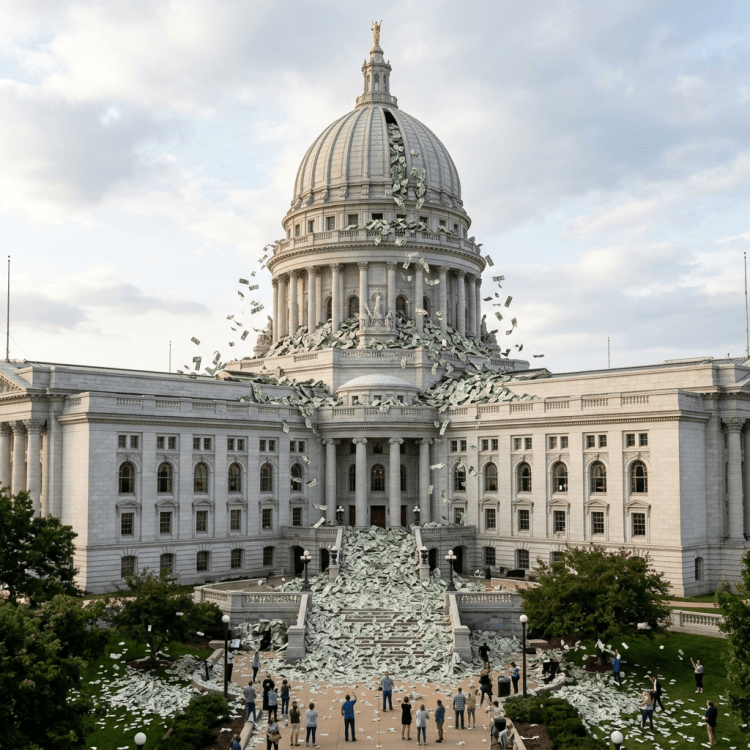
It would have passed because it did seem to be a decent compromise between the two main competing interests — Democrats want more money to go to public schools while Republicans want more to go back to taxpayers. The deal sent $300 million to schools for special education, freeing up those dollars for other purposes. So, for all intents and purposes, it was money that districts could spend for whatever they wanted. Then there was another $300 million for general school aids. That’s essentially pass through property tax relief money, but it still benefits the schools because it takes pressure off the need to go to local referendums. It’s guaranteed money as opposed to rolling the dice with the voters.
The bill also sent back $850 million to income taxpayers in the form of refunds up to $600 for married couples. There was another $50 million in pass through property tax relief, this time through the tech schools. And taxes on tips and overtime would have been eliminated.
So, all-in-all, it wasn’t a horrible plan. And, given the need to compromise between a liberal Democratic governor and a conservative Legislature, it seemed reasonable.
But there’s the rub. Legislative Democrats believe that next year they may well control not just the governor’s office but also at least the Senate and possibly the Assembly. They’re salivating at the prospect of writing their own ticket. And that essentially means even more no-strings-attached money for public schools. Moreover, since the odds that Republicans will win back the governor’s seat and retain control of both houses appear slim right now, they figure they can’t be worse off in any event.
Now, I think the last thing we should do is pour even more money into a failing public school system while demanding no reforms or improvement in return. Yet, as a political strategy, what the Dems did makes sense.
Aside from politics, there were some public policy reasons to oppose the compromise.
- The overtime and tip tax breaks make no sense. There’s nothing about that income that’s any different from any other income. It’s pure pandering. And we should be expanding tax bases and lowering rates. Narrowing the base only puts more pressure on everybody else.
- The compromise spends one-time money on ongoing obligations. The Legislative Fiscal Bureau projected that it would blow a billion dollar or more hole in the next budget. That’s a mess Evers, Vos and LeManhieu wouldn’t be around to clean up, but Democrats, who hope to be responsible for the entire budget next time, would be.
- Some of the money that is being spent here isn’t even in the bank yet. The surplus is projected for the end of this biennium, which doesn’t happen until June, 2027. Stuff can go wrong. See Trump, Donald.
- The school aid formulas need a good, close look and this deal would have simply poured more money into the same questionable system.
So, in the final analysis, it was probably just as well that this went down. What to do with the surplus can now become a genuine and substantive policy debate into the fall.
My own view is that it should go to pay off debt. That’s the most responsible thing to do with one-time money and it guarantees substantial savings through interest payments that don’t happen. It’s also as politically sexy as an episode of the Golden Girls. There is no interest group — not WEAC, not the Club for Growth — that cares about paying off debt. And there are probably bankers who would oppose it.
So, come January we’re likely to have something like $2.5 billion sitting around just begging to be spent. Let’s keep asking gubernatorial and legislative candidates what they plan to do with our money. Because it would be such a pleasant relief to have an election that was about something other than Donald Trump.


I think the feeling that the Gov’s office is a lock, is misplaced. What happens when Mandela, or some other terribly woke candidate (Hong, Rodriguez, etc.) gets the nomination. As a moderate, I want to lean left in the fall (as I think most do because of Trump), but if it’s a choice between Tiffany and a very far-left candidate, I won’t be the least bit surprised when Tiffany pulls out a win. Then the Dems can sit around and do what we always do, complain and focus on extreme and highly partisan issues. You’d think we would have learned something from the last election!
LikeLike
Maybe. I still think there’s a good chance that Dems are in a very practical mood and may nominate someone who can win in the fall.
LikeLike
“I think the last thing we should do is pour even more money into a failing public school system.”
Failing? Really? Do you think the median middle class parent in Green Bay or Wausau is deeply dissatisfied with their kids’ schools? I would bet they’re perfectly content with them.
LikeLike
i think you’re right. But the overall numbers are terrible. In Madison we trail the state average in every test score, our truancy rates are sky high, our recovery from COVID trails the national and state average and our racial achievement gap — which is yawning — hasn’t budged despite more than two decades of obsessing over it. The reason those average middle class families don’t care is that their kids are doing fine.They can silo up into AP and honors classes and get a good education. So, you raise a legitimate question: who are our schools failing?
LikeLike
Calling it “the racial achievement gap” ensures it will never budge. Maybe call it something else? Some suggestions:
Adopt any of these reframes and you realize the schools have little power to change the root causes.
This reframing can’t happen in Madison. There are too many entrenched interests that depend on it being a “racial achievement gap”.
LikeLike
Fair point. I think we’ve been focussed on the wrong root cause of the problem. It’s not race. It’s families that don’t or can’t prepare their kids for school and help in the education process.
LikeLike
And if the Democrats do not get control of all three, (senate, assembly, governor), what happens then? Blame game.
LikeLike