In support of last week’s Supreme Court decision on the Voting Rights Act, I’m tempted to run the image below and just drop the mic.
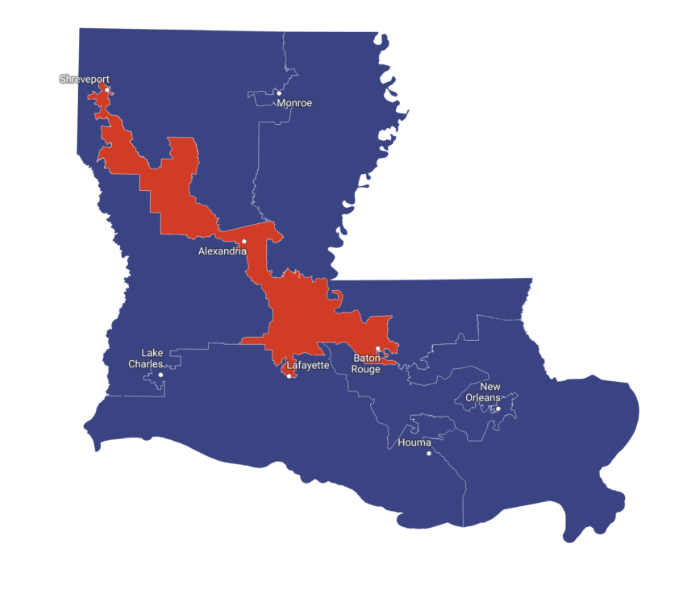
The red area above is Louisiana’s Sixth Congressional District and the one that was struck down by the Court. It is the very definition of a gerrymander, which was a term coined to describe districts drawn in 1812 by Massachusetts Gov. Elbridge Gerry that looked like salamanders.
The district exists because a lower court ruled that Louisiana hadn’t created enough majority Black districts. In order to create another one, the legislature drew this snaking district which connects Black communities.
This, of course, is a gerrymander for purposes of racial representation, but gerrymanders are most commonly used for partisan purposes. In fact, here in Wisconsin, after the 2010 census the Republicans committed what many believe to be the most severe partisan gerrymander anywhere in the country and perhaps in American history.
One of the ironies of last week’s SCOTUS ruling is that the Court had previously ruled that it wouldn’t touch extreme partisan gerrymanders because, while troubling, they couldn’t be defined. I strongly disagreed with that ruling (they’re actually easily defined), but I think this latest decision makes sense, which like so many other issues, puts me in political no man’s land.
Democrats have blasted both rulings while Republicans like them both. Those of us who regret the first and cheer the second could hold a convention in a closet.
I like the ruling against racial gerrymanders for a bunch of reasons. First, I agree with the Court majority that they aren’t necessary. Currently, 63 of the 435 members of the House are Black. That’s 14% which matches the overall Black population perfectly. The number has steadily increased since the Voting Rights Act was passed in 1965.
But the VRA didn’t envision creating racially gerrymandered districts. Rather, it sought to tear down barriers to Black voting, like poll taxes and literacy tests. The VRA sought to create a level playing field. But things took a turn in the 1980’s when a federal court ruled that some innocuous language in the VRA saying that people should have a chance to vote for the candidate of their choice actually meant that Black voters should have a chance to elect Black candidates, as if race is all that mattered.
That unfortunate ruling was at the start of a few decades where the whole concept of civil rights took a wrong turn. Affirmative action, which was also about leveling the field and fighting discrimination, morphed into Diversity, Equity and Inclusion programs that promoted active discrimination to make up for past discrimination. When we moved away from the principle of fighting racial discrimination and toward the notion that discrimination was okay, and even necessary, we lost vast swaths of the American public. It was a horrible mistake that this ruling, in addition to a broader backlash against DEI, starts to correct.
Opponents of the ruling claim that it could result in the loss of as many as 15 Black House seats. We’ll see, though I suspect they’re overstating the case because the number of Black Republican representatives is likely to keep increasing. One of those Black Republicans is Josh Williams, who represents a white-majority lower house district in Ohio. “The idea that Black Americans need special districts carved out just for them is complete nonsense,” Williams posted on social media, noting that he was currently running for Congress in a district that is also majority-white. “It’s a violation of the law and blatantly unconstitutional.”
And let’s be honest about this. If Williams were to gain a House seat for Black Americans, liberals would not cheer. The same applies to Justices Clarence Thomas and Amy Coney Barrett. Thomas gets no credit for being Black and Barrett none for being a woman because they are conservatives. Democrats would be glad to see them replaced by white men, so long as they were liberal white men. The hypocrisy here is just so obvious.
But here’s a twist you may not have thought about. It could be a blessing in disguise for Democrats.
Something people forget is that when Wisconsin Republicans, under pressure from the state Supreme Court, adopted Democratic Gov. Tony Evers’ maps, some of the ‘no’ votes came from Black Milwaukee Democrats. They were unhappy because they saw that the maps, while helping their party pick up seats, also diluted some Black districts. The upshot was that some of those new districts favoring Democrats might not necessarily deliver Black Democrats.
That’s exactly what Virginia Democrats did when they gerrymandered four more blue districts into existence before that map was struck down by the state’s Supreme Court. To quote a story in the Wall Street Journal:
The proposal (the pro-Dem gerrymander) maintains one distinctly Black-influence district while dispersing Black voters among other districts,” Phillip Thompson, executive director of the National Black Nonpartisan Redistricting Organization, wrote for the Virginia Mercury in March. He defines a “black-influence district” as one that is at least 40% black, and the new map would have brought the Fourth District just below that threshold.
What’s more, “Richmond, Petersburg, Southside, and other predominantly Black communities were not combined into a district specifically designed to increase Black representation or create a viable opportunity for a third congressional seat for a Black candidate,” Mr. Thompson wrote. “Instead, Black voters from these areas were dispersed across multiple districts, . . . which may solidify Democratic support but are not necessarily structured to enhance Black political influence.”
Because blue states no longer have to maintain Black majority seats by packing those voters into a few districts, they can split them up, creating more Democratic leaning districts. So, I get why Black Democrats might object. But since white liberals tend to want to support Black candidates, I wouldn’t be so sure that this will actually result in fewer Black representatives.
That’s my theory, but of course, nobody knows what all this will mean for the partisan makeup of Congress or state legislatures going forward. In fact, we might not be able to appreciate the full impact until after the 2030 census and the redistrictings that will follow. But it’s entirely possible that for every red state that wants to use this ruling to create fewer Black (read, Democratic) districts, a blue state will use it to spread out Black votes, creating more Democratic seats.
The bottom line is that it’s way too early to declare this a big victory for Republicans or even to claim with much confidence that it will reduce the number of Black representatives. And, if it makes us consider voters as individuals with a simple right to vote, rather than as faceless members of a bloc that votes all the same, so much the better. Now, that would be true progress.
 Yellow Stripes & Dead Armadillos
A lot to unpack and clarify in this one, on a complex subject. I’ll try to be as brief as I can and I can’t cover everything. But I do appreciate the attention paid to this decision.
[1]: “But the VRA didn’t envision creating racially gerrymandered districts. Rather, it sought to tear down barriers to Black voting, like poll taxes and literacy tests. The VRA sought to create a level playing field. But things took a turn in the 1980’s when a federal court ruled that some innocuous language in the VRA saying that people should have a chance to vote for the candidate of their choice actually meant that Black voters should have a chance to elect Black candidates, as if race is all that mattered.”
[2]: “One of the ironies of last week’s SCOTUS ruling is that the Court had previously ruled that it wouldn’t touch extreme partisan gerrymanders because, while troubling, they couldn’t be defined. I strongly disagreed with that ruling (they’re actually easily defined), but I think this latest decision makes sense, which like so many other issues, puts me in political no man’s land.”
[3]: “First, I agree with the Court majority that they aren’t necessary. Currently, 63 of the 435 members of the House are Black. That’s 14% which matches the overall Black population perfectly. The number has steadily increased since the Voting Rights Act was passed in 1965.”
[4] “Something people forget is that when Wisconsin Republicans, under pressure from the state Supreme Court, adopted Democratic Gov. Tony Evers’ maps, some of the ‘no’ votes came from Black Milwaukee Democrats. They were unhappy because they saw that the maps, while helping their party pick up seats, also diluted some Black districts.”
[5] “And, if it makes us consider voters as individuals with a simple right to vote, rather than as faceless members of a bloc that votes all the same, so much the better. Now, that would be true progress.”
Finally, I should also note that the vote dilution claims under the VRA were not easy to meet. The evidence presented in district courts is staggering, the district court opinion in Callais was over 100 page long. One of the factors that plaintiffs needed to meet was to show actual racial polarization. That is, they needed to show that whites voted as a bloc to defeat minority-preferred candidates. In other words, that the group suing was politically cohesive not just racially cohesive. Your post seems to undervalue these criteria. The VRA didn’t just allow districts to be drawn because minorities lived there, as your post suggests. They had to show they were racially AND political cohesive AND had been routinely denied representation.
LikeLike
Ok. So, look. Any other site have anybody who writes a response like this? I think not. I’m not saying that my blog DESERVED this level of insight. I’m just saying that.. well… yeah, I am, in an indirect way, taking credit for it. So sue me.
LikeLike
Ha, well you have carved out quite the little corner of the internet.
For those who hate spindly, non-compact districts, avert your eyes from Tennessee. (Sorry couldn’t find a still image of a side by side. but the video should start at the correct point) https://youtu.be/vji_dJCPXg8?si=ZVknNg16y8QEHjPp&t=21
Or you can use the slider 1/2 down this AP article: https://apnews.com/article/redistricting-congress-voting-rights-trump-33d3a24a63aeb1a0b3702d362e1325c9
LikeLike