Chris Taylor will be the next Wisconsin Supreme Court justice. The political stars just align that way. But she won’t do it with my vote. Nor will I vote for the conservative on offer, Maria Lazar.
The system isn’t giving me a choice I want. I want to vote for a respected lawyer or judge, one found to be qualified by the state Bar Association and one who can provide testimonials to their fairness, judicial temperament and knowledge of the law provided by those who practice with or before them. I want to have no clue whatsoever as to how that candidate might come down on abortion or Act 10 or any other issue that might come before the court.
Instead, I’ve got a choice between two candidates endorsed by one party or the other and supported by the trailing flotsam of interest groups that follow them. The candidates all but come out and tell me exactly how they’ll vote on hot button issues.
A pox on both those houses. I’m going to write in David Souter, the moderate and modest late SCOTUS justice who wasn’t easy to predict on any given issue. This will be my small — and admittedly ineffectual — protest against my choices.
In fact, I don’t want this choice at all. Justices should not be selected through elections because the office just doesn’t lend itself to electoral politics. According to a recent Marquette poll, the vast majority of voters want to know where Supreme Court candidates stand on specific issues. That’s because the public doesn’t understand the role of the courts. Especially in these awful polarized times, the public can’t distinguish between a gubernatorial or legislative candidate — candidates for offices that make policy — and judicial candidates who aren’t supposed to make any policies. Voters want to know who’s with them in their tribe. But justices shouldn’t have tribes.
That’s why Wisconsin should join the majority of states and the federal government in appointing justices to its top court.
That’s not a perfect system either (see Alito, Samual), but the other day the U.S. Supreme Court notched some more evidence on behalf of my argument. Two liberal justices — Elena Kagan and Sonia Sotomayor — joined the conservatives in striking down a Colorado law that banned “conversion therapy.” Conversion therapy is talk therapy aimed at treating gender dysphoria. It has become a hot potato because transgender activists don’t see gender dysphoria as a condition to be treated but rather as an identity to be celebrated.
I’m not sure what it is. But it’s always been pretty clear that talk therapy that seeks to align a person’s head with their physical gender is a form of speech protected by the First Amendment, whether it’s wrong-headed or not. You would expect conservatives to look at it that way because they’re generally skeptical of the whole transgender movement.
But this stuff is sacred among liberals. It’s absolute religion on the left that once a kid decides he’s a she then so she is, and anybody who says otherwise is a horrible bigot. And that even — maybe especially — applies to parents who should know their kid better than anyone. Rush to surgery to change the child’s gender forever? That’s a right! Get the kid some talk therapy to see how real this thing is? That’s child abuse and should be illegal! Parents shouldn’t even have that option.
So for liberals such as Kegan and Sotomayor to see the obvious and overriding free speech issue (liberals used to care a lot about free speech) as trumping gender ideology is just something that elected liberals could never do. These liberal justices can do it because they were appointed for life. They can ignore their tribe when they conclude that their tribe is wrong about the law.
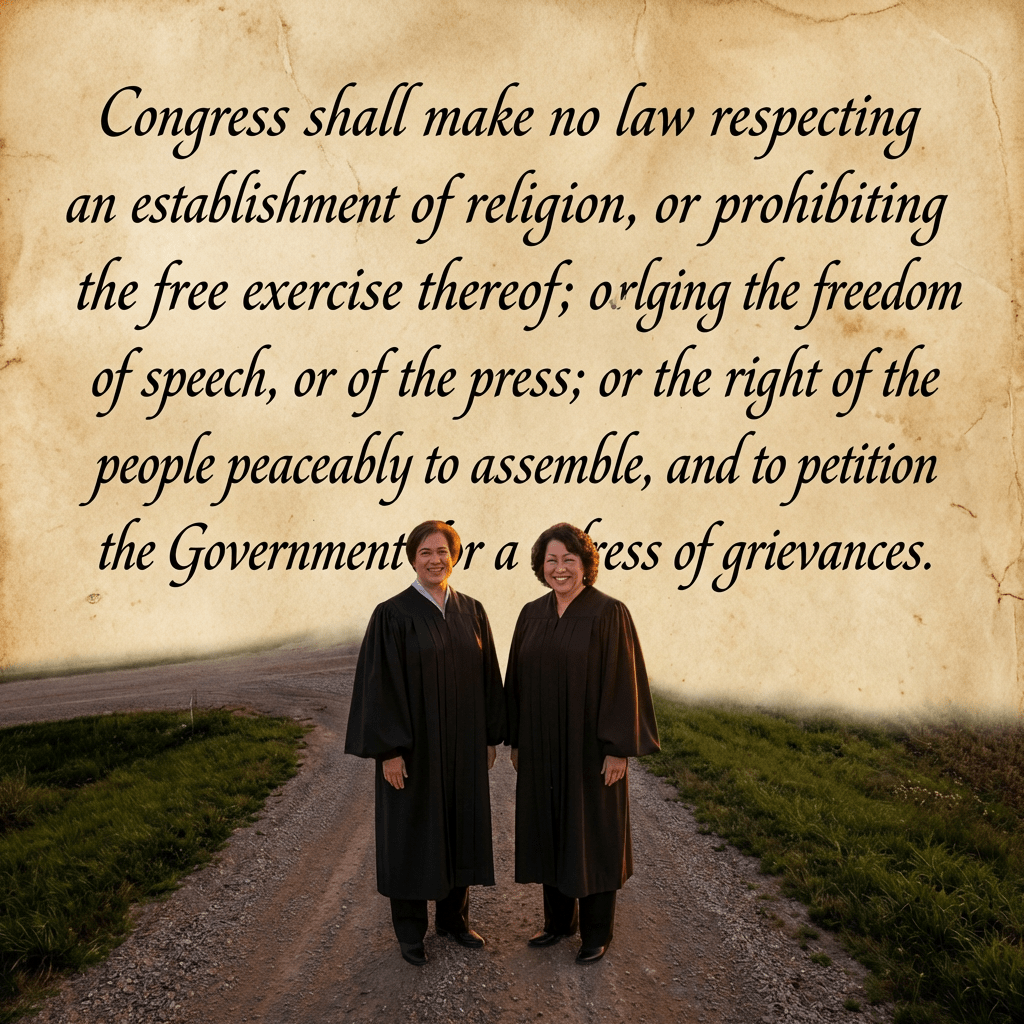
Of course it doesn’t always happen this way. But you can find more examples of liberals breaking with their own side’s policy orthodoxy and conservatives doing the same on the appointed U.S. Supreme Court than you can on the elected Wisconsin court.
Kegan’s and Sotomayor’s votes on this issue are the latest in growing evidence that appointing high courts is the better way to go.
And one final note. This case is another example of the sad fall of the ACLU. I was once a proud member of the group that once fought for the First Amendment, no matter the case. But the ACLU has been taken over by hard-left identity politics ideologues and so it wasn’t on the side of free speech here, even in a case where two liberal justices saw it so clearly. The ACLU once stood for the principle of free speech, regardless of who didn’t like it. Now it has become just another hack hard-left interest group. Pathetic.
 Yellow Stripes & Dead Armadillos
“This case is another example of the sad fall of the ACLU. I was once a proud member of the group that once fought for the First Amendment, no matter the case.”
If the A.C.L.U. has lost Dave Cieslewicz…
LikeLike
Be wary anytime you’re a “proud” member of anything. Things change. FIRE is probably the best free speech organization there is.. for now.
I’m reminded of the “deprogrammers” from the 70’s who would kidnap kids who fell into cults (Moonies, etc). Seems like those cults were just a societal phase. Now we have social contagions. The lawsuits over the “gender affirming care” centers are going to be massive over the next couple decades.
Our judicial system is a joke. Checks and balances were always bound to fall apart due to the human element.
LikeLike
”Our judicial system is a joke. Checks and balances were always bound to fall apart due to the human element.”
Agreed that it’s a joke. Disagree it’s because of things that are inherently human. People in power go to great lengths to convince the public that certain things are the way they are because of “human nature.” That propaganda solidifies the existing power structure.
Note that anytime a group of people try to organize themselves in any way that deviates from how the dominant culture defines “human nature,” the dominant culture will not just leave these people alone. If they were so sure of their classification of humans, they could let these social groups fail on their own. Instead, the dominant culture actively attacks these people. This illustrates much of what we need to know about the lies that are put forward about what it means to be human.
LikeLike
Heh the people in power don’t even acknowledge it. I get it from people like Ray Dalio and Lyn Alden and … history.
LikeLike
Sure, conversion therapy is protected speech.
It’s “gender dysphoria,” not dysphasia. And conversion therapy is historically far more commonly aimed at “curing” gay people, not transgender people. Parents send their kids to camps that teach them to pray away the gay.
LikeLike
I wrote “dysphoria” and the program “corrected” it to dysphasia.
If parents wanted to send their kids to a camp to pray away the gay, I’d say that was a poor choice. But it’s not my choice. And it’s not the government’s place to prevent it.
LikeLike
“Rush to surgery to change the child’s gender forever? That’s a right! Get the kid some talk therapy to see how real this thing is? That’s child abuse and should be illegal!“
Jack Marshall (ethicsalarms.com) “(I)f this dispute doesn’t prove for all time that progressives are remarkably skilled at holding opposing beliefs in their heads without feeling any discomfort, nothing will.
“The Left is fighting like honey badgers to allow school personnel to talk kids into thinking they are girls trapped in boys’ bodies or vice-versa, resulting in life-wrenching hormone treatments and surgery, BUT INSIST THAT CONVERSION THERAPY FOR GAYS MUST BE BANNED AS HARMFUL.” (bolds/caps/italics mine)
LikeLike