Here’s a paradox. Democrats are likely to win the April Wisconsin Supreme Court race easily and then take the majority in the state Senate, retain the governor’s office and pick up the Third Congressional District seat in the fall. And yet, with all that potential winning, the party is less popular than Luke Fickell.
This data point was an important nugget buried in the extensive Marquette poll which came out the other day. Frankly Charles (for extra credit, find the obscure pun buried within that phrase), I missed it, but it was brought to my attention by an alert reader. Here’s the table from the poll:
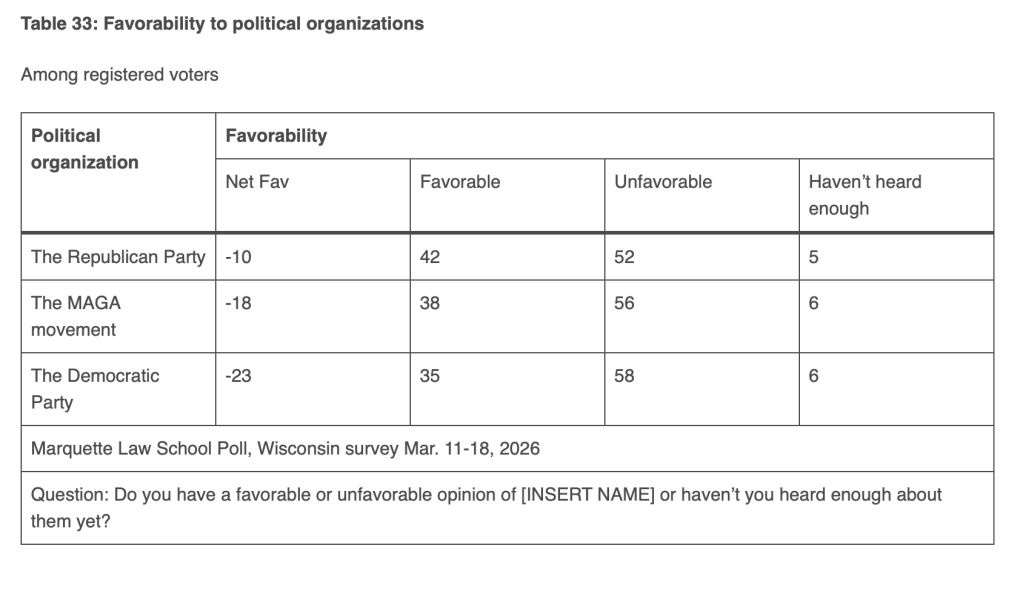
You read that right. The Republicans, who are about to get trounced, have a net favorability reading of -10. MAGA (read Trump), whose policies from immigration to tariffs all polled highly negative, has a net favorability of -18. And the Democrats, who should run the table at election time, are the most unpopular of all at -23.
Moreover, this particular poll question wasn’t specific to Wisconsin. At the national level, the GOP controls everything and even in our state they control the legislature. So, if people aren’t happy about things (and they aren’t) you’d expect them to blame the party in control. At -10 maybe they do blame the Republicans. But still, why do they blame the virtually powerless Democrats even more?
Of course, I don’t know the answers to these questions. But I’m a blogger, which means having no answers doesn’t even slow me down from providing them anyway.
Let’s start with the easiest explanation. It’s the lesser of two evils theory. Voters may have a highly negative view of the Democratic Party in the abstract, but they’re going to vote on the tangible issues before them. They won’t vote for any kind of positive Democratic program; they’ll simply register their unhappiness with the way things are.
But what I really want to explore today is the self-loathing theory. Those bad numbers for the Democrats are largely self-inflicted. While strong majorities of Republicans have a positive view of the Republican Party, there’s a surprising number of Democrats who aren’t all that keen on their own party. Here are some results from a Pew Research poll taken last fall:
Democrats are much more likely than Republicans to have negative feelings about their own party. This largely accounts for the more negative views of the Democratic Party among the overall public.
- Two-thirds of Democrats say they are frustrated with the Democratic Party. Fewer than half of Republicans (40%) say the same of the GOP.
- Three-in-ten Democrats also say their own party makes them feel angry. Just 19% of Republicans say the same of their own party.
Democrats also are much less likely than Republicans to feel hopeful and proud when thinking about their party.
- Half of Democrats say their party makes them feel hopeful, compared with 69% of Republicans who say the same of the GOP.
- Just 29% of Democrats say the Democratic Party makes them feel proud; 52% of Republicans say their party evokes feelings of pride.
Now, there’s a couple of ways to look at this. Is it moderate Democrats like me who are frustrated with a party they see as having gone off the rails on cultural issues — the Rahm Emanuel argument that his party is perceived as “weak, woke and whiney”? Or is it liberal Democrats frustrated that their party isn’t going far enough on policy and isn’t fighting hard enough for those policies?
It’s obviously some of both, but I suspect it’s more about the latter. I don’t have a lot of evidence for that conclusion except for another finding in the recent Marquette poll. It’s the two hardest left candidates who are leading the field for the party’s gubernatorial nomination. Francesca Hong and Mandela Barnes have a combined 25% while the other five candidates combined post only 10%.
You may argue that that’s only because Barnes has high name recognition left over from his 2022 U.S. Senate run and that Hong is spending every dime she raises on social media campaigns. Maybe. But it’s hard for me to imagine that candidates who are at 14% and 11% in March in a field of seven won’t be plenty viable in August. Part of the explanation for these numbers has to be hard-left Democratic voters who want candidates who excite them.
Let me jump in right here to make it clear that I’m a moderate with Rahm. I wish this frustration within my own party could be mostly explained by people like me who think we need to get off the social issues and the Socialism and focus back on mainstream, middle class values. But what I wish and what is probably true are often separate things.
But here’s what’s true for sure. My party is more unpopular than it has ever been and it’s not like people are falling all over themselves to join up with the GOP either. More people identify as independents than ever before. Overwhelmingly, the cost of living — identified in different ways — is the top issue on people’s minds.
So, when Democrats take back some measure of power this fall we have to keep that in mind and be humble. We will have no mandate for any particular policies and certainly no mandate for obscure social causes or for Socialism.
In fact in the Marquette poll not a single social issue turned up — not transgender issues, not race, not gender, none of that. Regardless of the internal dynamics within the party, the only thing that will give Democrats some hope of maintaining and growing the advantage they’ll pick up in November is sensible, stable, nuts-and-bolts, middle-of-the road policies mostly focussed on the economy and the cost of living.
 Yellow Stripes & Dead Armadillos
We have to love life more than them.
LikeLike