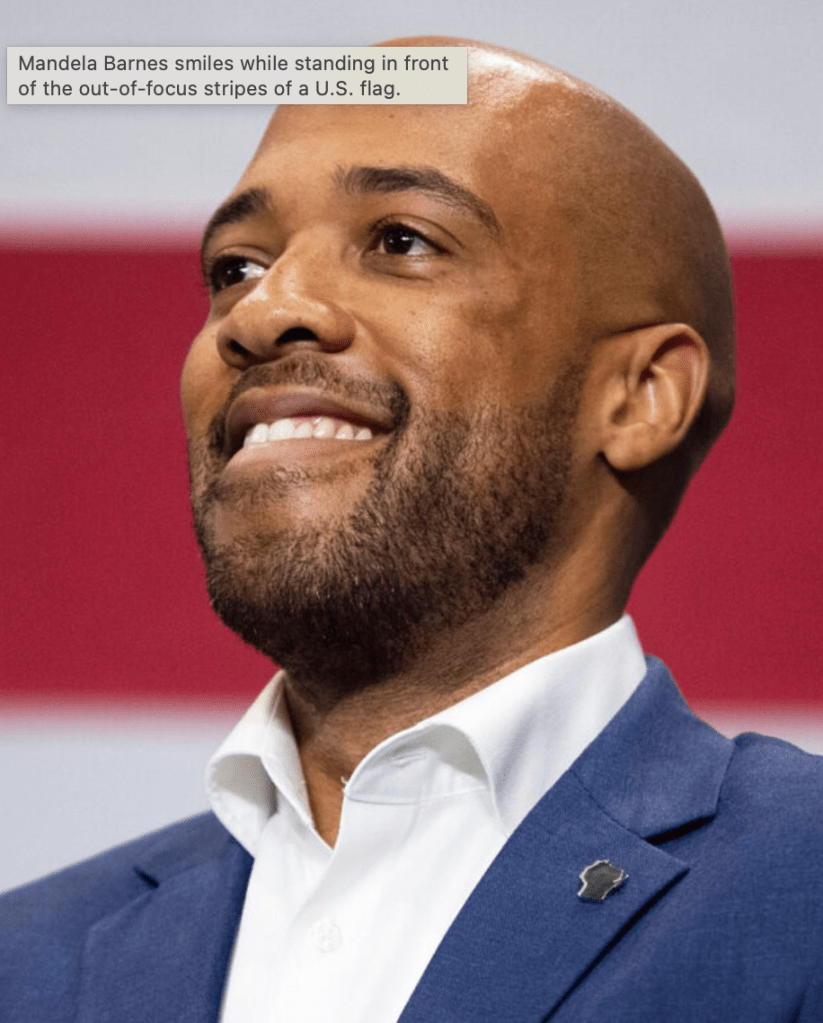
Mandela Barnes has hit on a good issue, even if he did so in a clumsy sort of way.
Last week, the Democratic gubernatorial candidate said that he would only appoint Public Service Commission members who would pledge never to increase utility rates.
That specific proposal is a bad idea because sometimes rate increases are justified, just as the price of any other product sometimes needs to go up due to the cost of materials or labor. But it’s possible that Barnes’ understood that, but made this proposal anyway to bring attention to an important issue.
Utility rates in Wisconsin are increasing at a rate faster than the regional average and they are currently the second highest among 12 states in the central region. Add that to big increases in property taxes and you’ve got two big issues among the many items that make up the uber-issue of affordability — and two that government can actually impact.
So give Barnes credit for being the first candidate to identify the problem.
Now, those who study utility policy piled on Barnes’ specific proposal as being impractical. In a story in the Milwaukee Journal Sentinel, Manny Teodoro, a UW Madison professor of public policy said, “That’s a terrible idea. The whole point of having a regulatory commission governing utility rates is that it’s supposed to be a technocratic process, It’s supposed to be a decision based on an evaluation by the commissioners as to whether rate increases are necessary to ensure system safety, reliability and quality.”
Maybe so, but from a political perspective, Barnes got us talking about it in a way that a less dramatic proposal might not have. Campaigns are not policy symposia, people.
But here’s a better idea, and one that I’ve been touting for years. A candidate could pledge to appoint only retired judges to the PSC. One of the reasons that rates are so high is the revolving door between utilities and PSC regulators. The most egregious example of that is Rebecca Valcq. Gov. Tony Evers appointed her to be the PSC Chair, even though she had spent her entire career as a regulatory lawyer for WE Energies, the state’s largest utility. And then, after she left the PSC she went straight back to work for the utilities. Today she’s president of Alliant Energy.
In a story on Wisconsin Public Radio, Karlee Weinmann, the research and communications manager at the Energy and Policy Institute, said the situation raises questions about whether a utility would want to hire or put in leadership positions a regulator that they felt “regulated them very rigorously.”
“That’s the concern, when we see this revolving door pattern, that regulators may be affected in their work by their assessment of their future opportunities,” Weinmann said. “It’s very fair for people to be concerned about the dynamic that the revolving door tradition in Wisconsin creates for regulators during their time on the commission.”
Indeed, in her years on the PSC, Valcq was careful to do nothing to upset her once and future employers. She got good grades for encouraging transitions away from fossil fuels, but utilities were already doing that. When it came to rate increases she was hardly a thorn in their side. Most egregiously, she was an unapologetic advocate for ATC’s massive Cardinal-Hickory power line, when she should have recused herself on that issue. Her former employer, WE, is the majority stakeholder in ATC.
And this sort of thing is bipartisan. Ellen Nowak, a Scott Walker appointee, left the PSC to join ATC — but only after, like Valcq, voting for ATC’s big project. And there are lots of other examples. In fact, even the current PSC Chair, Summer Strand, previously worked for a large engineering firm with utility company contracts. Where do you suppose she’ll end up when she leaves the commission?
So, of course, when utilities want rate hikes and commissioners are thinking about their next job, what do you suppose crosses their mind? Hint: it’s not the impact on customers.
The transparently ridiculous argument for the revolving door is that utility regulation is so complex that it requires the specialized knowledge that you can only get in the industry. Actually, the PSC has excellent staff that can provide the necessary analysis. The job is really quasi-judicial. Being a commissioner is much like being a judge: evaluating evidence and weighing that against policy and law. So, that’s why retired judges would make great PSC commissioners. Of course, they don’t have to be retired, but if you appoint someone who is late in his career, the chances that he’ll be thinking about his next job are much reduced.
Another idea would be to propose a law that would prohibit commissioners from taking a job with any entity that they had regulated for, say, five years after they left the commission. But that may run into legal challenges and, anyway, it would require the Legislature to act. Promising to appoint only retired judges is something a governor could do all on his own.
Mandela Barnes is onto something here. His solution might not be quite on target, but other candidates should join the debate with their own ideas.
 Yellow Stripes & Dead Armadillos
Francesca Hong will propose to make all energy free.
Checkmate.
LikeLike