It’s pretty much over now. After seven years of legal battles, the Enbridge pipeline, known as Line 5, is finally under construction.
It’s a tragedy, but not for the reasons those who fought it think it is. In fact, it’s an environmental tragedy created by environmentalists.
This is an issue that at least tangentially connects my homes in Madison and Watersmeet, Michigan. I heat my cabin with propane, most likely supplied through Line 5. And, despite the fact that the line is a couple of hundred miles away and closing it would have no impact on the cost of energy here, when I walk my liberal Madison neighborhood I see lawn signs calling for the line to be shut down. The legal fight against the line is being led by Madison-based Midwest Environmental Advocates, and I assume much of MEA’s funding comes from Madison area members.
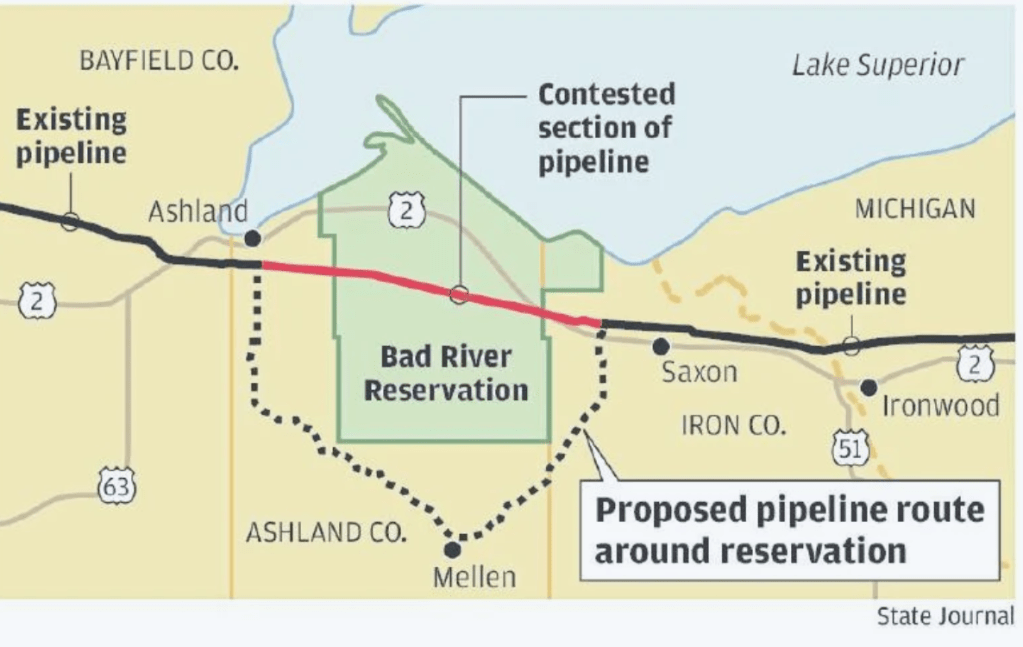
This whole thing was always going to be a fool’s errand. Environmental groups and the Bad River tribe wanted to kill a 645-mile long pipeline over a disputed 12-mile section through tribal lands south of Ashland. Anybody could see that there was no way that any court or regulatory body was going to shut down a pipeline feeding a daily 23 million gallons of oil and natural gas to refineries in Ohio, Michigan and Ontario over this issue.
Here’s a quick recap of this folly. In 2019, a coalition of environmental groups led by Midwest Environmental Advocates and the Bad River tribe, sued in Federal court to get the pipeline removed from tribal land, which it had crossed since 1953. The court agreed and ordered the line removed by June of 2026.
But then the same groups went to court and fought every regulatory step to stop the 41-mile reroute around the reservation as well. In other words, they were against both the problem and its solution. They were clear about their motive. It wasn’t so much about the safety of the line. No matter what Enbridge proposed to make it safer, they’d be against it. Instead, their goal was to kill the line entirely to fight fossil-fuel induced climate change.
Now, I’m no climate denier and I’m all for moving away from fossil fuels to renewables. But shutting down this one pipeline was never going to help accomplish any of that. The only thing it would have done is increase energy costs for those who could least afford it. Some 65% of propane used in the economically depressed Upper Peninsula comes from this pipeline. If it went away, everybody wouldn’t have suddenly popped for thousands of dollars in solar panels. They would have been stuck buying propane from someplace else at higher prices.
What’s needed is what we’ve been doing — even despite the senseless pro-oil and coal policies of the Trump administration. Greenhouse gas emissions in the U.S. are down 20% from 2005 levels, despite the fact that our economy is about 50% bigger. Solar and wind are now cheaper than fossil fuels. Trump can try to bring back dirty energy all he wants, but the fundamentals have changed. We’re not going back.
All of which is to say that shutting down one pipeline, even if it were in the cards, would have had no noticeable impact. The answer isn’t to shut off supply of fossil fuels. The answer is to continue the steady, rapid conversion to renewable energy.
Moreover, it’s not even a sure thing that killing the pipeline would have ended the movement of oil and gas through the same corridor. If the market justified it, the stuff would have just been shipped via tanker, rails or trucks — all probably more risky than a pipeline.
Enbridge will probably end up spending around $500 million on construction of the reroute plus all the money they will have spent on lawyers fighting the legal battles thrown up by environmentalists and the tribe. And of course most of that cost will end up trickling down to end users.
But what if environmentalists and the tribe had taken a different tack? What if they had used their leverage to get Enbridge to spend some of that money on making the line safer through the tribal lands and anywhere else where the line needed to be improved? What if they had gotten the company to pay a hefty lease to the tribe, which it could have used to improve life for tribal members in any number of ways? What if they could have convinced Enbridge to fund a program to convert homes in the region from propane to electricity produced by renewables?
Instead they’ve now forced the replacement of 12 miles of pipeline risk with 41 miles of risk at a monumental cost that will be passed on to customers.
Environmentalists still hold out hope to shut down the line at another spot. The line flows under the Straits of Mackinac where ship anchors have hit it a few times, though none resulted in oil spills. In response, Enbridge wants to encase the line at an expense of roughly $500 million, about the same as the Bad River reroute. Of course, environmentalists oppose that as well, again opposing both the problem and its solution just as in the Bad River case. And the result will be the same. They will lose, Enbridge will win. Oil and gas will continue to flow and customers will pick up the cost. Meanwhile, we’ll continue to transition toward renewable energy at the same pace.
It’s all such a waste.


If you like this one Dave, you’ll love the lawsuit placed by a California based NGO to stop a datacenter in Syracuse NY. The people of Syracuse want the DC and all the externalities that come with it.
The public is in the dark about NGO lawfare.
LikeLike
I am from that area, (Bayfield county) part of the pipeline runs just to the north of the family farm. I cut hay, and plowed right over the pipeline. never gave it a second thought.
LikeLike