The American left defines itself by what it’s against.
Don’t knock it. Being against Donald Trump has been a godsend. There’s no need to deal with its own deep unpopularity, to abandon any of its eccentric causes or to develop any kind of sensible, centrist agenda for positive change. Just not be Trump. It works!
The latest thing the left is against is artificial intelligence and, more specifically, data centers. Bernie Sanders has proposed a national moratorium on data centers and, locally, Madison Mayor Satya Rhodes-Conway has proposed the same — never mind that there are several of these things already here and nobody has even noticed.
Both Sanders and Rhodes-Conway make essentially the same argument: technology and the market must slow way down and move at the speed of government. Sanders says that “democracy” needs time to “catch up,” while Rhodes-Conway claims that city zoning needs time to adapt. You can bet that, if either one succeeds, their proposed moratorium will be extended ad infinitum.
Now, there are some reasons for legitimate concern. Big data centers, which are being built or proposed all over the country, demand a lot of resources. They take up a lot of land, water, and especially energy. Utility costs, especially in Wisconsin, are already a concern and these things will almost certainly make prices higher in the short-term.
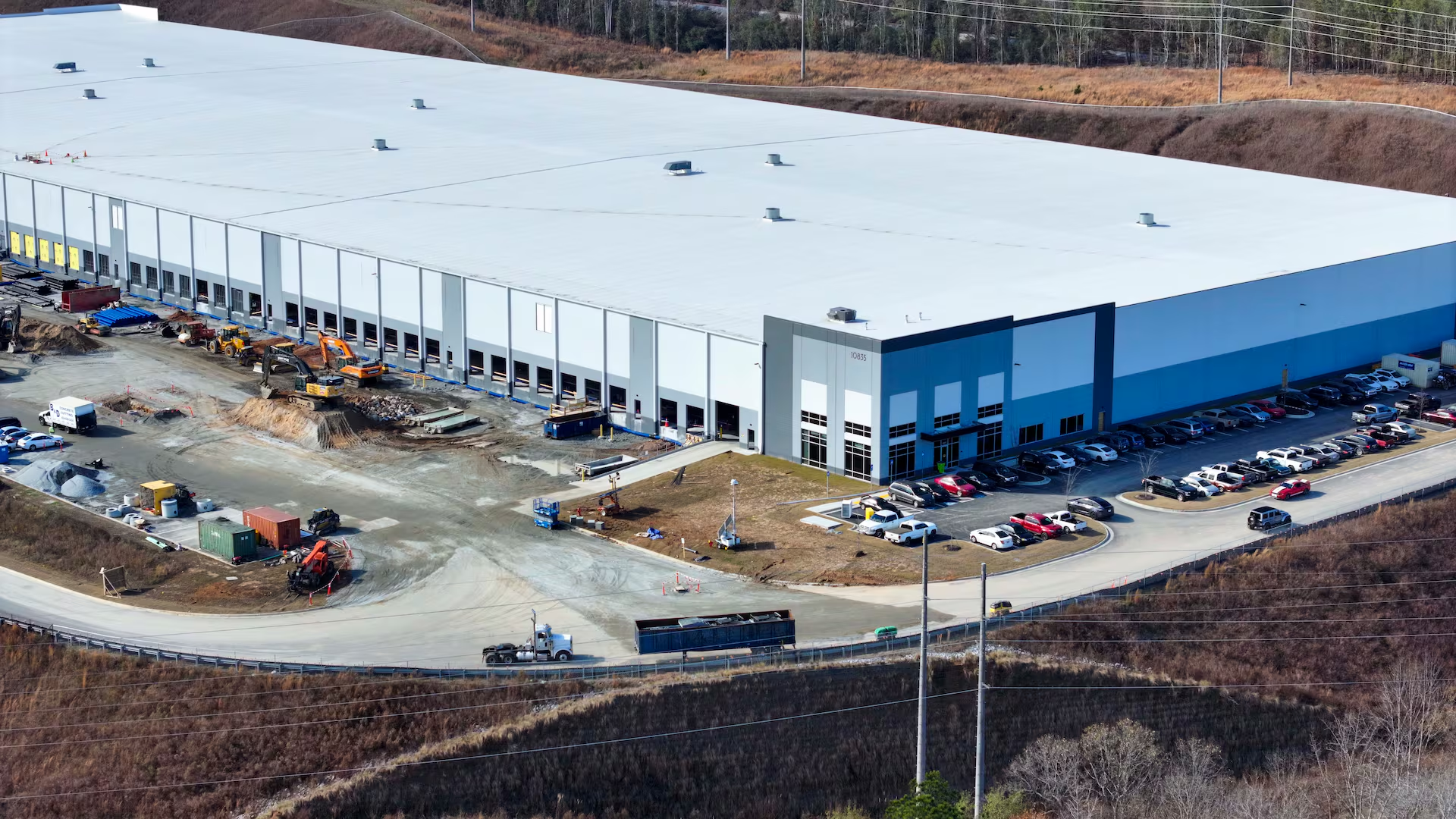
But it’s foolish to try to stand in the way of this technology. AI is here and it’s growing rapidly. It has some unknowns and some potential downsides — which the left is obsessing over — and a lot of very substantial upsides — which the left is ignoring.
The left focusses on the downsides because the jobs that might be threatened or changed are mostly held by liberals — people who work on screens or with ideas. The left is not particularly concerned about another burgeoning technology — self-driving vehicles — because that only impacts truck drivers and they don’t generally have college degrees. Too bad for them. They should have gone to Harvard.
This is much like the divide over illegal immigration. The left is fine with it because it doesn’t threaten them. If those were comparative literature professors streaming across the border they’d have a different view.
As for the upsides, well, I asked Google, and of course, Google generated an answer from AI. Here’s what it said:
“Healthcare & Medicine
- Diagnostics: Analyzing medical images (X-rays, MRIs) to detect diseases like cancer earlier and more accurately.
- Drug Discovery: Identifying patterns in vast datasets to accelerate finding new treatments.
- Personalized Medicine: Tailoring treatments based on individual genetic data.
Business & Finance
- Automation: Handling repetitive tasks, automating reports, and managing inventory.
- Analytics: Processing big data for market trends, customer behavior, and predictive maintenance.
- Cybersecurity: Detecting threats, anomalies, and responding to breaches in real-time.
- HR: Skill-matching resumes, automating candidate communication.
Transportation & Logistics
- Autonomous Vehicles: Self-driving cars, drones, and robotic warehouse management.
- Traffic Management: Optimizing flow, reducing congestion.
- Supply Chain: Predicting demand, optimizing routes, and reducing waste.
Creative & Content
- Content Generation: Creating marketing copy, code, music, and images.
- Video Editing: Automating tasks in media production.
Public Sector & Environment
- Disaster Response: Predicting and mitigating climate impacts, early warning systems.
- Agriculture: Monitoring crop health, optimizing yields, pest detection.
- Public Safety: Assisting in crime solving, enhancing security.
Everyday Life
- Digital Assistants: Siri, Alexa, Google Assistant.
- Personalization: Product recommendations on shopping sites, personalized news feeds.
- Education: Personalized learning, tutoring.”
As a writer, I use AI a lot now. In fact, it’s hard to avoid it. It’s an easy and fast way to group data points and help me make an argument. Now and then it generates an answer that is clearly false or suspicious and then I need to track down the errors. And, sure, when I’m researching a field that I know little about there’s a chance that I won’t detect some mistake. In that case I probably have enough readers with wide enough experience to catch the problem.
But even as a writer — an occupation that sees itself threatened by AI — I see it as a big net advantage. AI makes me a better writer. It’s an assistant, not a replacement or a boss.
Luddites have always claimed that the latest technology means the end of life as we know it. And, in fact, most technology does come with a downside. Fossil fuels caused climate change and now we’ve got to deal with that, but I wouldn’t want to live in a world before fossil fuels were burned. Smart phones, tablets and the internet have resulted in shorter attention spans and a fractured media landscape in which we can retreat to our own worlds, but I wouldn’t want to go back to a time in which the IBM Selectric was the last word in word processing. Jet travel and airline deregulation have combined to create a hectic and largely unpleasant air travel experience that contributes to climate change to boot. But I’ll take it as long as I can get to see my relatives in California in four hours.
My point is that any major technological advance comes with tradeoffs, but the upsides almost always far outweigh the downsides. The trouble is that it’s human nature to quickly start taking the advantages as a given, while focussing on the costs.
AI and its supporting data centers are no different. Sure, there are downsides. But we’re not going to stop AI, nor should we. In fact, moratoriums are like spitting on a railroad track. Better to have a national policy that overrides a patchwork of state and local laws. So, let’s figure out how best to make it work for us and stop trying to stop the unstoppable.
 Yellow Stripes & Dead Armadillos
Damn Dave, you are just beating the crap out of the strawmen these days…
Concerns about AI are not a “left” thing. Until recently, it was an Elon Musk and Sam Altman thing. OpenAI was founded as a nonprofit for the express purpose of trying to develop AI ethically. And of course that’s a mission that Altman has since abandoned in favor of developing personalized porn and other important innovations that future generations are owed.
Also, most of the opposition I’ve seen to autonomous vehicles has come from the left.
When you say the “left,” who exactly are you describing?
LikeLike
I’m describing Bernie Sanders and Satya Rhodes-Conway. As far as I know, the proposals for moratoria are all coming from the left while the proposals to have a national policy — including some ability for local governments to have a say on things like data center locations, water and land use — are coming from the center-right. Here in Madison, those ideas for a national policy are championed by people like center-right commentator Tom Still and local tech investor John Neis. Neither of those guys is hard-left or right. Unfortunately, a proposal like that is also coming from the Trump administration, so it’s not like I’m all in on that either.
LikeLike
Your lead in title is not necessarily true. To be fair there is more downside risk than you’re fleshing out in your argument and even some of the people pushing for more A.I. admit this. Also, I’m not saying A.I./data centers should/could be “stopped” but who do you expect to vote for liberals after they fail to protect their remaining constituents jobs? Arguing everyone should lose their job in the name of “progress” (similar to “free” trade arguments) is not exactly a winner.
LikeLike
“the upsides almost always far outweigh the downsides”
Would you say that applies to social media? What about laptops in classrooms?
I’ll quote Scott Galloway on this one: It’s the job of these billionaire CEOs to push quickly, but it is government’s job to regulate. The former is doing its job, the latter is AWOL.
LikeLike
Yeah, I don’t know about social media. Though I would say that most people use it to keep in touch with friends and relatives about the normal stuff that’s going on in their lives. I know that when my parents were alive they used it for that purpose and it improved their lives. As for laptops, I don’t know if they’re good in classrooms or not, but they’re certainly positive in general. I’m typing this on one right now as it rests on my dog’s back while she sleeps. C’mon. What’s not great about that?
LikeLike
You’re wrong that the moratoria proposed will be infinite. In this case, the face-value claim is likely the true one: we need to get zoning codes and regulations up to speed before more of these are built. The AI industry has billions of dollars burning a hole in their pocket, ready to spend, and they will move forward with these centers faster than government can adapt – if we let them.
I think State-level regulation is the most appropriate, but I bet you Rs in WI will not let the current bill on the topic (AB722) see the light of day. And don’t hold your breath for national legislation – even if it happens, it’ll be the big money donors getting their way. So, local government has to step up.
There are legitimate, extremely impactful downsides to the enormous resource extraction of these centers, our utility rates will almost certainly go up because of them, they will employ close to zero local workers after construction is complete, and once built, the rich property owners will have a vested right to continue to operate for eternity… BUT-WOKE-LEFT-BOOGEYMAN!! Let the rich corporation do as they want! Surely their sales pitch is true, an AI utopia is around the corner if only we get out of the way!
LikeLike
Simply put… we don’t know if AI will be a net positive or negative.
I often think about the Alphago documentary which is almost 10 years old now. The Deepmind AI makes some puzzling moves along the way to running through one of the best Go players in the world. Moves that no human would have made. Were they mistakes or not? And therein lies the problem.
What if an AI had access to all climate data and came back with a counterpoint to your ideas about climate change (or any other complex system)? Chances are you would disregard it…. the AI is hallucinating again. Certainly those people making money off the climate change ideology would disregard it.
For the big issues human behavior will always override the objective truths that AI might find.
LikeLike
The premise of this post reflects an incomplete picture of how both AI and climate change actually work. The deep understanding of climate change has to do with physics, specifically radiation transfer in the atmosphere, that is not going to be overturned by some clever algorithm. Some 200 years ago Joseph Fourier already knew that the Earth was far warmer than it should be based on the heat from the Sun and the Earth’s core. You can see the evidence of that physics in the spectroscopic measurement of the outgoing long wavelength radiation. Which couples directly into the rising deep ocean heat content. As well as the fact that the stratosphere is cooling while the troposphere is warming. Where AI might come in handy is in improving the attribution of extreme events, increasing the understanding of feedbacks and tipping points, as well as refining weather predictions.
What is far more likely to happen than AI overturning “ideas about climate change” is that AI would simply verify the physics-based knowledge that humans have collected over the past 200 years. And still there would be those whose ideological predilections would prevent them from believing the result.
LikeLike