I won’t be the first writer to observe that the roles have been switched. In the 1960’s and 1970’s it was the left that saw our institutions as corrupt tools of oppression. Now it’s the hard-right.
This makes sense if you think about it. It’s those without power who are most likely to see powerful institutions as a bad thing. So, fifty years ago when the left was made up of mostly young people without power, they saw their parents’ generation lording it over them — sending them off to a senseless war (though it made sense to those waging it) in Vietnam and enforcing all kinds of outdated social and cultural norms, like gender-segregated dormitories.
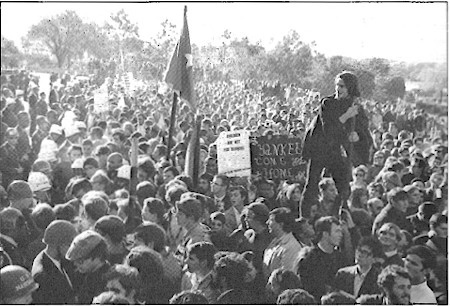
But five decades later it’s the old left (literally and metaphorically) who now run those institutions. Affluent, college-educated Baby Boomer liberals see most institutions as just fine because they see people like them running these things. To use a horrible phrase loved by the hard-left, our leaders “look like them” — if maybe a little less long in the tooth.
And now it’s the right who sees itself as the put-upon outsiders — never mind that they soon will control all three branches of the U.S. government. I’ve long argued that the hard-right overperforms in politics because it’s losing everywhere else — in the media, in Hollywood, in business and most definitely in academia. I think there’s something to the now-cliched idea that, during the pandemic, parents overheard what was being taught to their kids, and they didn’t like it.
I find myself, not all that surprisingly, somewhere in the middle on this. I’m basically an institutionalist. I like American democracy, I like a sensibly regulated free market. As a rule, taken as a whole, the whole package works pretty well for me, so why wouldn’t I be satisfied with it?
But I need to keep these things in mind. For one thing, I have a college degree. For another, for most of my career I worked in government jobs and that means two things. First, I enjoy a comfortable pension and second, I had a high degree of confidence that I could play a role in shaping key institutions — state and local government, in my case. I saw where my taxes went and I generally thought they were going to good works. And, let’s face it, it didn’t hurt that some of those dollars were going to me in my salary and benefits.
But — and here’s the stuff that puts me in the middle on this question of institutions — I can also see how the current meritocracy is flawed. I think it’s clear that we overvalue a college degree. That’s just not necessary for the vast majority of jobs. And, we way overvalue a college degree from a handful of elite institutions.
And I really do think that there is a cultural elite with minority — and sometimes bizarre — views on an array of social issues that dominates the media and entertainment. Moreover, that kind of thing is so pervasive and it has had real power over people’s lives– though things like DEI programs — that I can see why many people would react so strongly against it. It’s not that I think, for example, that transgender people should be discriminated against (I very much believe the opposite), but I don’t think we should be required to change our whole language (“they”) to accommodate them.
But in Trump and the larger hard-right populist movement that he is a part of, we see a desire to just burn it all down. In truth, we need to reform meritocracy, but advancement based on merit is a good thing. We do place too much value on higher education, but education is a good thing. DEI programs have gone too far in many cases, but that doesn’t mean there still isn’t discrimination to be rooted out. Hollywood is insufferably woke, but that doesn’t mean that greater diversity in roles and points of view in productions isn’t needed.
It’s not surprising that, on a site dedicated to moderate middle ways, I would plead for reforms to what I believe to be solid institutions as opposed to destroying them and starting over. That’s also in part because Trump and his minions offer nothing positive. Famously, they wanted to eliminate Obamacare without having anything to replace it. But they’re like that on everything. Their plans only go so far as razing the buildings. They have no redevelopment proposals of their own. So, if they succeed, we’re likely to be left with a lot of garbage-strewn vacant lots.
I can’t accept the hard-right, blow-it-all-to-kingdom-come answer. But I also think that the hard-left needs to accept its share of responsibility for the overreach that produced that reaction. Don’t trust anyone over 70.
 Yellow Stripes & Dead Armadillos
Agree in general but a couple nits to pick:
“I’ve long argued that the hard-right overperforms in politics because it’s losing everywhere else — in the media, in Hollywood, in business and most definitely in academia.”
C’mon, the right ain’t losing in “business.” Big biz backed Trump bigly in this election and its influence on the Democratic Party has been to push it to the right. What *is* true, however, is that in the past decade big business has given lip service to certain culturally liberal causes (DEI, ESG etc) that has played nicely into the conservative victimhood narrative. But they’re obviously not pushing for high taxes and stronger unions!
As for the media … what remains of the legacy media (NYT, network TV, NPR) is certainly liberal-leaning, but the right has its own media ecosystem that is frankly much bigger. The biggest cable news network, the biggest local TV news chain (Sinclair), the biggest podcasts, Wall Street Journal, talk radio, and now … Twitter!
LikeLike
I’m not data scientist but, I’m my lifetime (60s bebe), seems like things swing from left to right in about 20 year intervals, loosely, of course. But, who knows, strap on your seatbelt, were in for a wild ride! 😎
LikeLike