I’m against racism. But I am most definitely not an “anti-racist.” As a matter of fact, I’m quite anti-anti-racism.
I’ve held that view for a few years and I’ve written about it here and in other places with some frequency. But let’s face it, nobody much cares. YSDA is a lightly read site in the Midwest, followed by a small, sturdy group of brilliant and discerning readers. It’s exclusive company we’re in here, people.
But a lot of people do care about major news outlets. like the self-proclaimed paper of record, the venerable old New York Times. And, of course, the Times is not just that, but also the epicenter of elite liberal thought in America.
So, to have one of its stable of liberal columnists take on Ibram X. Kendi, the father of “anti-racism” and to do so with gusto is a big deal. The writer here is Pamela Paul, who used to edit the paper’s influential Book Review and so is deeply familiar with his work.
In an October 5th column, Paul takes down Kendi. She writes: “Many major universities, corporations, nonprofit groups and influential donors thought buying into Kendi’s strident, simplistic formula — that racism is the cause of all racial disparities and that anyone who disagrees is a racist — could eradicate racial strife and absolve them of any role they may have played in it. This reductionist line of thinking runs squarely against the enlightened principles on which many of those institutions were founded — free inquiry, freedom of speech, a diversity of perspectives. As one Boston University professor wrote last week in The Wall Street Journal, that academia backs Kendi’s mission amounts to a “violation of scholarly ideals and liberal principles,” ones that betray “the norms necessary for intellectual life and human flourishing.””
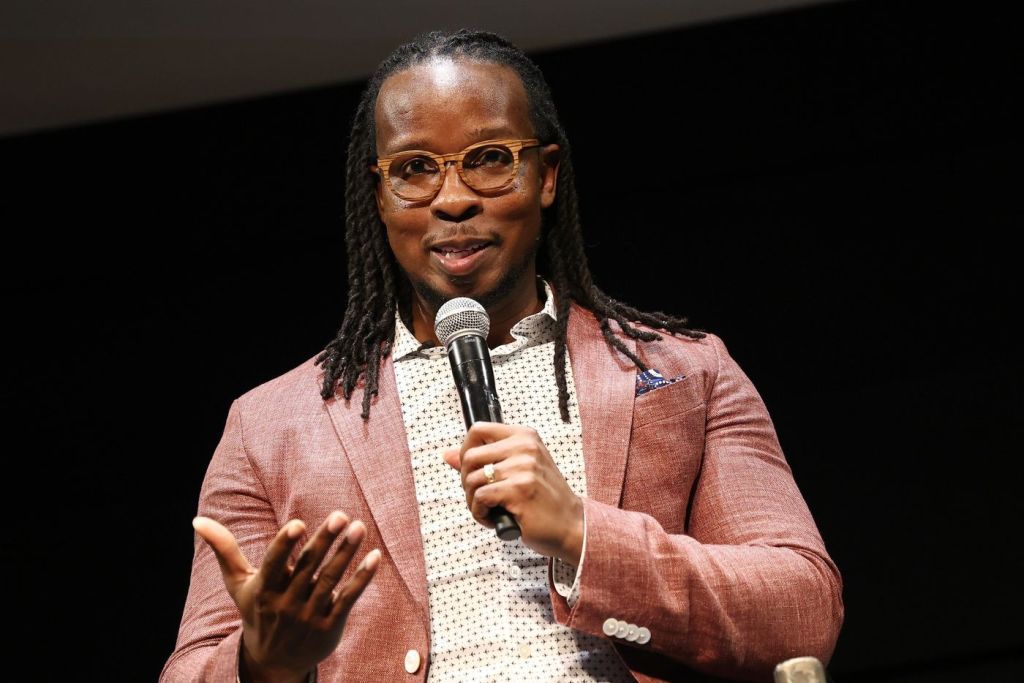
She’s not alone. The opening to criticize Kendi is the recent revelation that he mismanaged his Center for Anti-Racist Research at Boston University. Turns out he can’t account for how $55 million was used. Unfortunately, as Paul points out, the reaction on much of the left is to be angry at Kendi for keeping bad books, not for his real crime of writing bad books.
But Kendi was wrong from the start and the fawning over him that came from academia and much of the media and corporate America is shameful and embarrassing.
Let’s review some of Kendi’s pronouncements.
“The only remedy to past discrimination is present discrimination. The only remedy to present discrimination is future discrimination.”
This is probably Kendi’s most famous and most obnoxious quote — and he sets a high bar. This runs smack in the face of our (well, at least my) most cherished classically liberal views. The enemy is discrimination itself. You can’t fix a wrong by employing the same wrong. And, by the way, who gets to decide when we’ve discriminated enough to set things right? Our goal should be a color blind society, not one that employs discrimination based on race in any form.
“The opposite of racist isn’t ‘not racist.’ It is ‘anti-racist.’ What’s the difference? One endorses either the idea of a racial hierarchy as a racist, or racial equality as an anti-racist. One either believes problems are rooted in groups of people, as a racist, or locates the roots of problems in power and policies, as an anti-racist. One either allows racial inequities to persevere, as a racist, or confronts racial inequities, as an anti-racist. There is no in-between safe space of ‘not racist.”
Well, I don’t buy that. What Kendi is promoting here is endless witch hunts in which anybody who isn’t sufficiently strident by his lights is a racist. Statements like this opened the door to all manner of cancellations of people and ideas that Kendi and his followers just didn’t like. This sentiment is fundamentally anti-liberal.
“To love capitalism is to love racism. To love racism is to love capitalism. The conjoined twins are two sides of the same destructive body. . . . Capitalism is essentially racist; racism is essentially capitalist. They were birthed together from the same unnatural causes, and they shall one day die together from unnatural causes. Or racial capitalism will live into another epoch of theft and rapacious inequality, especially if activists naively fight the conjoined twins independently, as if they are not the same.”
I couldn’t disagree more strongly. Capitalism does just the opposite of what Kendi claims. In its purest, best form it strips away everything that’s not relevant to making money and being productive — including race distinctions. Capitalism elevates merit and competence and, if you let it, it will obliterate things that are irrelevant like skin color and gender.
“If a policy is leading to racial injustice, it doesn’t really matter if the policymaker intended for that policy to lead to racial injustice. If an idea is suggesting that white people are superior, it doesn’t really matter if the expressor of that idea intended for that idea to connote white superiority.”
Wrong. Intentions matter a great deal. The upshot of Kendi’s notion is that perfectly well-intentioned people have become demonized for saying perfectly innocuous things. In fact, my first essay on this whole subject of anti-racism came almost three years ago when a member of a Madison committee made the innocent statement, “God bless George Floyd.” She simply meant that Floyd’s death had triggered a deeper understanding of persistent issues of race in America. But two members of the committee resigned in a huff and basically quoted Kendi in saying that her good intentions counted for nothing. She was treating Floyd’s death as something that helped white people understand their own inherent racism. Yes, in fact, that’s exactly the upshot of what she said. But her intentions were good and to demonize her makes good people just throw up their hands, or worse, just say nothing.
Paul summarizes Kendi’s argument in his second book, How to be an Anti-Racist: “In this book he made clear that to explore reasons other than racism for racial inequities, whether economic, social or cultural, is to promote anti-Black policies.”
This goes to the core of what’s wrong with the hard-left: an eagerness to see every success as just a matter of “privilege” and every failure as caused by “systemic racism.” The idea is to degrade individual and family responsibility for anything — either positive or negative — and to see us all as just powerless pawns in a massive system that is fundamentally racist. I think that’s just a basic misreading of the world. Of course everyone starts out with a set of advantages or disadvantages, but what’s important is how we play the hand we’re dealt.
The United States should establish a Department of Antiracism with “disciplinary tools to wield over and against policymakers and public officials who do not voluntarily change their racist policy and ideas.”
So.,. the idea here is that some bureaucrats can cancel policies — and apparently policymakers — they deem as not sufficiently anti-racist? Kendi is familiar with the Constitution, yes?
As Paul writes, Kendi’s books became not just book club conversation starters, but handed-down truth. True discussion, questioning or criticism of Kendi’s ideas was strictly prohibited or at least heavily discouraged. Within the academy that was especially egregious since questioning, “sifting and winnowing” as it were, is supposed to at the very heart of those institutions.
As Paul writes near the end of her piece, “Contra Kendi, there are conscientious people who advocate racial neutrality over racial discrimination. It isn’t necessarily naïve or wrong to believe that most Americans aren’t racist. To believe that white supremacists exist in this country but that white supremacy is not the dominant characteristic of America in 2023 is also an acceptable position.”
To the vast majority of Americans those words aren’t in the least bit controversial. But for her to write them in the pages of the New York Times took courage.
Kendi’s mismanagement of funds has created an opening to end the Jacobin terror that his work has inspired. That serious people ever took Kendi’s ideas seriously is just astonishing to me. Obscure moderate liberals like me have been questioning “anti-racism” for years. But when he is criticized by a certified liberal writing from the very heart of the liberal establishment a worm has turned. Let’s hope this is another big step in the rejection of the anti-liberalism of Ibram X. Kendi.
 Yellow Stripes & Dead Armadillos
Is the tide turning? See Coleman Hughes’ battle to get his TED talk on color blindness published. https://www.youtube.com/watch?v=KKZlb-MdzKo
LikeLike
“racism is the cause of all racial disparities”
Those who attack Kendi do a lot of dancing around this idea in their quest to both not say racist things and argue against the quote.
If racial disparities are not due to racism, the only other potential cause is the people themselves. If a people are themselves causing their own disparate outcomes, it logically follows that these people are themselves inferior.
Let the dance begin, feel free to enlighten me. Why is racism not the cause of all racial disparities?
LikeLike
No, I don’t think that’s true. If you look at the racial achievement gap in schools, for example, a strong case can be made that that’s due primarily to the disproportionate number of single parent Black families. That, in turn, is due to slavery and a history of racism since then. But the key point is that we’re chasing our tail if we attribute the gap to racism in the current system, when in fact most of it is due to racism through history. It’s still racism, but it’s important in terms of how we tackle the problem.
LikeLike
Sure, so attribute it to historical racism. Now what?
To say racism no longer has ANY impact is a pretty big stretch – and that’s the crowd you’re throwing your weight behind with this anti-anti-racism crusade. Saying racism suddenly evaporated is putting your head in the sand.
LikeLiked by 1 person
I never said it suddenly evaporated. I’ve said it doesn’t explain 100% of everything, which is Kendi’s contention.
LikeLike
The bell curve of outcomes for one racial group is shifted left when compared to another. So if racism (historic, current) is the cause of X% of the observed disparate outcomes, Y% is because of something else. What is the cause of the Y%?
Often anti-anti-racists say it’s the culture or behaviors of the racial group. In other words, they say there are intrinsic factors within the people that make up this racial group where, even absent extrinsic racism, they make decisions that result in negative outcomes more than other racial groups.
This literally means that their race is intrinsically inferior.
Because I reject the theory that there are intrinsically inferior and superior races, I am forced to attribute 100% of the observed disparities to extrinsic factors, which all essentially boil down to racism. I don’t know of any other logical explanation.
Even if I took the position that it is 100% due to racism, but with a caveat that it is only historical and not current, it still demands action of some sort if we have any sense of justice or compassion.
LikeLiked by 1 person
I agree on your last point, but the cause matters in terms of what we believe needs to be done. I’d say the answer is to do what we can to strengthen two-parent families of all races, ideally where the parents are in committed, legally married relationships. I think all the emphasis in the Madison schools on race isn’t achieving results because it’s not addressing the fundamental problem.
LikeLike
“This literally means that their race is intrinsically inferior.”
This literally doesn’t mean that at all.
I think you are missing the fact that culture is ephermal. All racial groups have had their ups and downs throughout history. Heck you could liken it to theoretical physicists who have gone to the dead end of string theory for 50 years. These are not intrinsically inferior people.
Add politics to the mix where it’s more important to get votes vs really helping people and the whole mess gets dragged out longer.
You are also ignoring short vs long term incentives. Negative outcomes are largely just long term, not short term. That’s largely just a human condition. Americans would not be so fat and ill if they could feel their arteries hardening with every bite of that cheeseburger.
It’s convenient for you to call it white supremacy but it’s more accurately deferred gratification supremacy, exemplified more by Asians and Indians in the USA today.
LikeLike
To OneEye
“All racial groups have had their ups and downs throughout history….Add politics to the mix…”
Yes. Those things point to extrinsic factors acting on races/peoples. Extrinsic factors such as racism or any other similar power dynamic. If a people are “having a down period” I think we should be honest about why.
“That’s largely just a human condition… ignoring short vs long term incentives… it’s more accurately deferred gratification supremacy”
Yes, this is in all humans. But if particular racial groups are ignoring long term incentives more than others, why? Is it intrinsic to their selves, or because of extrinsic social power or environmental dynamics? You cite US Asian immigrants. I do not believe Asians are intrinsically disposed to delayed gratification. If those that are in the US more frequently demonstrate that trait it is because of extrinsic social factors, or perhaps those that immigrate are not a random representation of all Asians. I would theorize that after a few generations the decedents of those immigrants will have average outcomes like any other US citizen (except for wherever impacts racism and other social power dynamics have on them).
What I’m trying to demonstrate is that people should not go around saying racism or other social power dynamics don’t exist or don’t impact people or don’t matter and then walk away without confronting the logical conclusions of those statements.
The resultant logical conclusion is not “some people are just better than others” as people so often try to weasel out with. Of course that’s true. The resultant logical conclusion is “some races/ethnicities/cultures/nations of people are naturally better than others”. All the anti-anti-racists are avoiding this logic because it is associated with some of the most vile acts in human history. So they just pretend their statements don’t lead to this conclusion, dance around it, and attack the messenger (like Kendi) when confronted…
I will give our host Dave credit for potentially working towards a more honest approach: acknowledging that racism exists and impacts people, but trying to frame the subject in terms of realistic tactics. Perhaps the current anti-racist approach is not (at this time) politically viable, and thus not as effective as it could be. That’s a far different argument than “racism is not the cause of all racial disparities”.
LikeLike
Rollie,
“The resultant logical conclusion is “some races/ethnicities/cultures/nations of people are naturally better than others” ”
That is your logical conclusion, not mine.
You assume racial/power dynamics are the main drivers. I think human psychology has a lot to do with it, and historical ebbs and flows add another layer. I think cultures that value delayed gratification come out of hard times. I mean really hard times.
I don’t know why anyone would do it otherwise.
“White culture” no longer values delayed gratification. You can see it so obviously in our credit card bills and national debt. We are living on the fumes of past generations. Hard times are ahead of us.
I mentioned Asians and Indians TODAY. That will change. As I said, culture is ephemeral. Seems we agree on that.
Now that being said, are all races equal? Hardly. Skin color is the most obvious difference. Dark skin is an advantage at the equator but a disadvantage in Scandanavia. Thank you Evolution. If you agree on that it would make sense that other physical adaptations would have taken place…even amongst the different populations residing near the equator.
Are there mental differences? I don’t know. That’s taboo isn’t it? Probably best to let brave scientists look into that very quietly.
Please try to remember the adage “If all you have is a hammer everything looks like a nail”. I’ve had lots of hammers in my life and no doubt are carrying some now. I reserve the right to throw them away if a better tool comes along.
LikeLike
As Thomas Sowell has pointed out numerous times, the breakdown of the black family during the last 60 years does not correlate to the legacy of slavery. How is black teenage motherhood, or 70% of black families today headed by a single parent related to slavery? The change has occurred since the welfare reforms of the 1960s that pushed out black fathers.
LikeLike
I do agree that our government policy discourages marriage among low income people. I experienced this myself – if my wife and I were not married we would have received much more government financial assistance when we had our first child. It is not economically smart for a low income couple to be married when they have children.
I would push back on the idea that these fathers are absent. They may not be married, but I don’t think there is accurate data regarding the presence of fathers in low income children’s lives. I see a whole lot of fathers with kids in my low income neighborhood.
LikeLike
Actually, a new book on this very topic has just come out, The Two-Parent Privilege by economist Melissa Kearney. I’ll review it when I’m done reading it, but her research shows that single parent households have skyrocketed in the last 40 years, that they are not simply unmarried couples having children but living together, that the single parents are overwhelmingly mothers, that their incomes are low and that all of this is more prevalent in the Black community.
LikeLike
Someone just needs to tell you what a rational, and cogent, column this was. (Delete this if you like, I just thought you should be told.)
LikeLike
Can we talk about cultural differences that may contribute to ongoing issues with different groups of people? My personal experience and observations show me that many of the behavioral problems and learning issues in schools can be attributed to the approaches in parenting and the parents expectations toward their own children and the learning environment. Getting to school on time every day is important. Respecting teachers is important. Doing your work and being supported by your parents in doing the work during school is important. I also hate how leaning on racism is actually a scape goat for bad behavior and actually seems to me to hold people back. Just shoot for the best outcome and deal with any obstacles that come your way today, because most people have your back and will not tolerate discriminatory behavior towards anyone. So go forward. Quit looking back.
Also, using getting benefits as a reason not to be married, is well, bad. How about instead of leaning on benefits, going to college, getting a decent job, not having children until you have said good job.
LikeLike