It’s Labor Day Weekend when politicians and the media will spend 72 hours missing the point.
The point is that labor is not synonymous with unions, a fact that you could easily miss with all the coverage of union Labor Day picnics. Consider these facts provided by the Bureau of Labor Statistics:
- Only 10% of American workers are union members.
- That’s down by half since 1983 when one-in-five workers belonged to a union.
- Only 6% of private sector employees is in a union.
- A third of all public sector employees are unionized.
- The image of union members that persists is a guy in a hard hat or a coal miner, but the reality is cop, a firefighter or a teacher. Those are the most prominent unionized occupations.
- While union membership has grown in recent years, it hasn’t kept up with the general growth in the labor force, so its relative part of the labor force is in decline.

In the long sweep of history unions were a good thing. But they just aren’t nearly as important as they used to be and there’s no reason to think that they will reemerge as powerhouses, despite what may be happening at your local Starbucks.
I think the biggest challenge we have in America, and much of the world, is the cultural, economic and political disconnect between blue collar workers and professionals. And that comes down to education. More than ever, the split is between those of us with college degrees and those without. Holding a college diploma is a more reliable way of predicting how you’ll vote than income. A truck driver making $100,000 is more likely to vote for a Republican than a teacher earning $60,000. (Though, as a rule, union members earn more than nonunion employees.)
Doing something to lift up blue collar workers and to address their legitimate frustrations in a world not made for them and run by people who don’t look like them is job one for America. And with widespread “right to work” laws now in place and with their part of the workforce in long-term decline even before that, there’s no reason to think that unions will play much of a roll in addressing the problem. So, focussing on unions as if they might be a big part of the answer is a distraction from the real task at hand.
I continue to think that the best answer is a reform movement within the Democratic Party that focusses on moderation, especially on social issues, and emphasizes middle class values, like reward for hard work. And, actually, some unions, especially teachers unions, are pulling the party in exactly the opposite direction.
Happy Labor Day. We’ll see you back here on Tuesday.
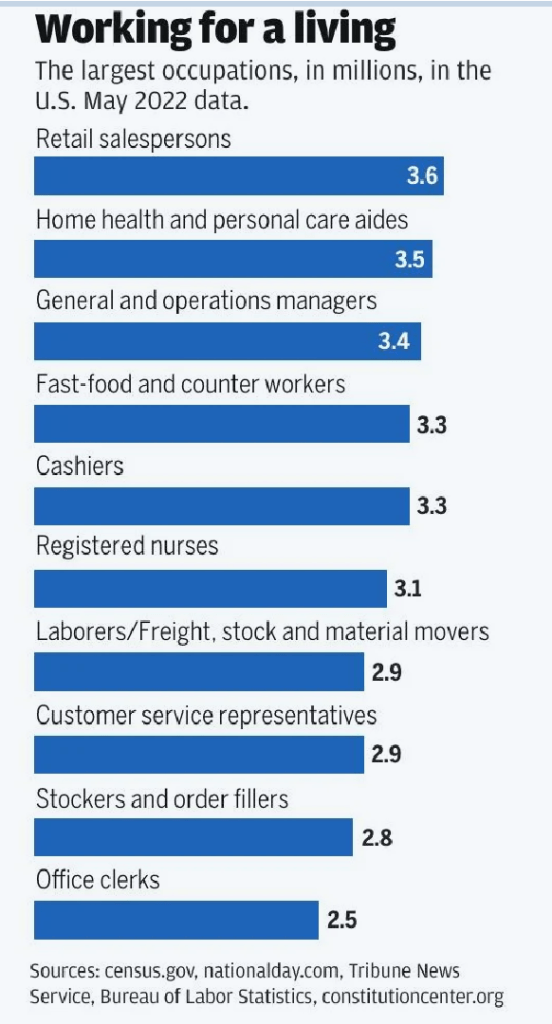
Postscript. Here’s what the American workforce looks like today. It’s not hard hats and head lamps.
 Yellow Stripes & Dead Armadillos
Have a good weekend, Dave, and enjoy the holiday.
Re: your statement about blue collar workers’ world “…run by people who don’t look like them…”, do you mean white men? Old white men? Men and women who dress differently? Are you talking about business owners or politicians? Please be more explicit in your descriptions.
Also, when you make a statement such as teachers’ unions pulling the party in the “opposite direction “, would you please back that up with facts or references.
Generalized statements are easy to disregard.
Thanks for your blog.
LikeLike
The reference to “don’t look like them” was intended to be a jab at the hard-left, which uses that phrase often. But it is true that most people who get to positions of power get there via a college degree. They “don’t look like them” in the broader sense that they don’t share their experiences and challenges. I didn’t literally mean appearance. Teachers unions generally have moved quite far to the left on social issues. The union in Madison supported removing cops from high schools, despite a steady stream of high school shootings across the country. Their opposition to opening schools during COVID was highly unpopular and resulted in learning deficits that may never be made up.
LikeLike
I’d like to hear your opinions on what Democrats (leaning whichever way), or unions, or whatever or whomever, should or could do about issues rather than just saying they are wrong. I would like to read your solutions in addition to criticisms.
LikeLike
That’s a fair request, though I think I have done that. I’ve written many times that I think the best solution is a moderate movement within the Democratic Party to put forward our own candidates in Democratic primaries — but pledging to support whatever Democrat emerges. On issues I’ve written that Democrats should emphasize traditional values of hard work, fairness, opposition to discrimination, etc. But above all they should talk about these basic values more than specific policies. Nobody reads a ten point plan.
LikeLike
You can’t get through Labor Day Weekend without taking time to listen to this from the Poet of the Common Man – the late and great Merle Haggard: https://www.google.com/search?q=youtube+working+man+blues&sca_esv=562189215&sxsrf=AB5stBiAnmPc95wZnjec_NPFQ7rXASsltQ%3A1693662714213&source=hp&ei=-j3zZLK-CrWrptQP3duc-AE&iflsig=AD69kcEAAAAAZPNMCiEdykh_g5IpP5qZnxfHdM2kvBvm&oq=You+Tube+workin+man+&gs_lp=Egdnd3Mtd2l6IhRZb3UgVHViZSB3b3JraW4gbWFuICoCCAAyBxAAGA0YgAQyBxAAGA0YgAQyBxAAGA0YgAQyBxAuGA0YgAQyBhAAGBYYHjIGEAAYFhgeMgYQABgWGB4yBhAAGBYYHjIGEAAYFhgeMggQABgWGB4YCkjESVCWDFioNHABeACQAQCYAV6gAfYKqgECMjC4AQHIAQD4AQGoAgrCAgcQIxjqAhgnwgINEC4YxwEYrwEY6gIYJ8ICBxAuGOoCGCfCAhEQLhiDARjHARixAxjRAxiABMICERAuGIAEGLEDGIMBGMcBGNEDwgILEAAYgAQYsQMYgwHCAgsQLhiKBRixAxiDAcICCxAuGIAEGLEDGIMBwgIIEC4YgAQYsQPCAgsQABiKBRixAxiDAcICBRAAGIAEwgIIEAAYgAQYsQPCAhAQLhiABBixAxjHARjRAxgKwgIIEAAYgAQYyQPCAggQABiKBRiSA8ICBxAAGIAEGArCAhAQLhjHARixAxjRAxiABBgKwgIKEAAYgAQYsQMYCsICCxAuGIMBGLEDGIAEwgIFEC4YgATCAgYQABgeGA3CAggQABgeGA0YCsICCBAAGAgYHhgNwgIIEAAYigUYhgM&sclient=gws-wiz#fpstate=ive&vld=cid:097bd76a,vid:_XZSohlyFFY
LikeLike
So true. Also, try Dave Alvin’s Gary Indiana 1959. https://www.youtube.com/watch?v=lB_3v_JfJWA
LikeLike
You’re right that the labor movement is a shadow of its former self, but why is that something we should accept? Was it also inevitable that CEOs went from making dozens of times more than their employees made to hundreds of times more?
This reminds me of those who point to the decline of public transit in America as simply evidence of the public’s choice, when in fact it is simply a (IMO) misguided policy decision (zoning, highway building, defunding transit) driven by those who benefit from car dependence (automakers, road-builders, oil industry).
Unions were a big part of connecting the values of “hard work, fairness, opposition to discrimination” that you extol. Indeed, unions, which played a crucial role in the civil rights movement, have historically served as important forces against identity-based division, in the workplace and in society.
I think the Democratic Party could learn a lot by talking to those with experience getting large diverse (politically, culturally, racially) groups of people to act collectively. Just look at the tremendous role the Culinary Union has played in shaping Nevada politics. Their success organizing and mobilizing blue collar employees in the gaming industry should be a template for connecting with people who, you correctly note, progressives don’t know how to talk to.
LikeLike
A few points in reply.
I don’t WANT unions to be insignificant, but I can’t see how they get back in the game. Union membership has been on a steady decline for forty years and so-called “right to work” laws make it even harder for them to fight back. Maybe unions (even at 6% of the private sector workforce) do still have some positive influence on wages, but I think that’s largely confined to their category. So, when UPS workers win a big raise that puts pressure on other shipping companies to match them, but beyond that, I don’t know.
Unions were a mixed bag when it came to broader progressive movements. Walter Reuther notwithstanding, remember the hard hats beating up anti-war protesters in the early 70s? Maybe not an official union action, but they were probably all union members. I assume the Chicago cops in 1968 were union members. I’m pretty sure Derick Chauvin was a union member. And Jimmy Hoffa was no progressive. RFK fought union corruption and ties to organized crime.
I used to agree with you on mass transit, but now I’ve come around to the view that Americans just like cars. I don’t think Congress and Ike shoved the Interstate Highway Act down the throats of a public desperate to keep their trains, buses and street cars. Mass transit is a good thing, but I don’t think the strategy of making other options (driving) more expensive or difficult is popular.
LikeLike
On September 3 at 10:30am in a response to Marena Kehl, you wrote:
“…. Democrats should emphasize traditional values of hard work, fairness, opposition to discrimination, etc. But above all they should talk about these basic values more than specific policies. Nobody reads a ten point plan.”
I read ten point plans.
Both Democrats and Republicans claim to be in favor of hard work, fairness, and opposition to discrimination. They also both say they’re in favor of jobs, education, health care, saving social security, draining the swamp, etc. The problem is that Democrats and Republicans actually mean entirely different things when they say these things.
I want to know what specific policies candidates are going to promote/implement. IMO, vague talk about values and generalities about what they’re in favor of are pretty meaningless because on the surface many candidates say a lot of the same things. I want to know (specifically), what they plan to do about it.
LikeLike
I appreciate the fact that you do care about details. But I don’t think your average voter — especially in a presidential year — will ever hear those details. They form generalized impressions.
LikeLike