My father grew up in South Bend, Indiana. In 1968, when I was nine-years old, we were in South Bend visiting my grandparents for Easter. Bobby Kennedy was in town as well.
RFK was there because the Indiana primary was less than a month away and his political future depended on the result. The Monday after Easter is Dyngus Day — a largely Polish Catholic holiday marking the end of lent. For some reason, Wisconsin Catholics don’t generally celebrate that day, but it was a huge deal in South Bend. And, since he was Catholic himself, I remember Bobby’s campaigning in South Bend being a big deal in my family, though not one without controversy.
My father liked Bobby, but his Uncle Kelly was an unapologetic racist and outspoken bigot, He had a description of Kennedy that we will forgo here. I remember my grandfather, a pharmacist who owned a drug store, as the kind of decent, careful man who avoided controversy as much as he could and sought to quell it when he couldn’t. I don’t know what he thought about Kennedy. My guess is that he voted for him.
Kennedy’s appearances in Indiana that month were electric, as they were in much of the country. He was actually pulled from a convertible during a parade in downtown Gary. In places like South Bend, it helped that he was joined on the stump by his brother-in-law, Prince Stanslaw Radziwill, a real Polish prince, who spoke to the crowd in Polish. And earlier that April he had delivered those heart-wrenching and eloquent spontaneous remarks in Indianapolis on the night Martin Luther King was murdered. But he was in Indianapolis only because he was campaigning in the state’s primary.
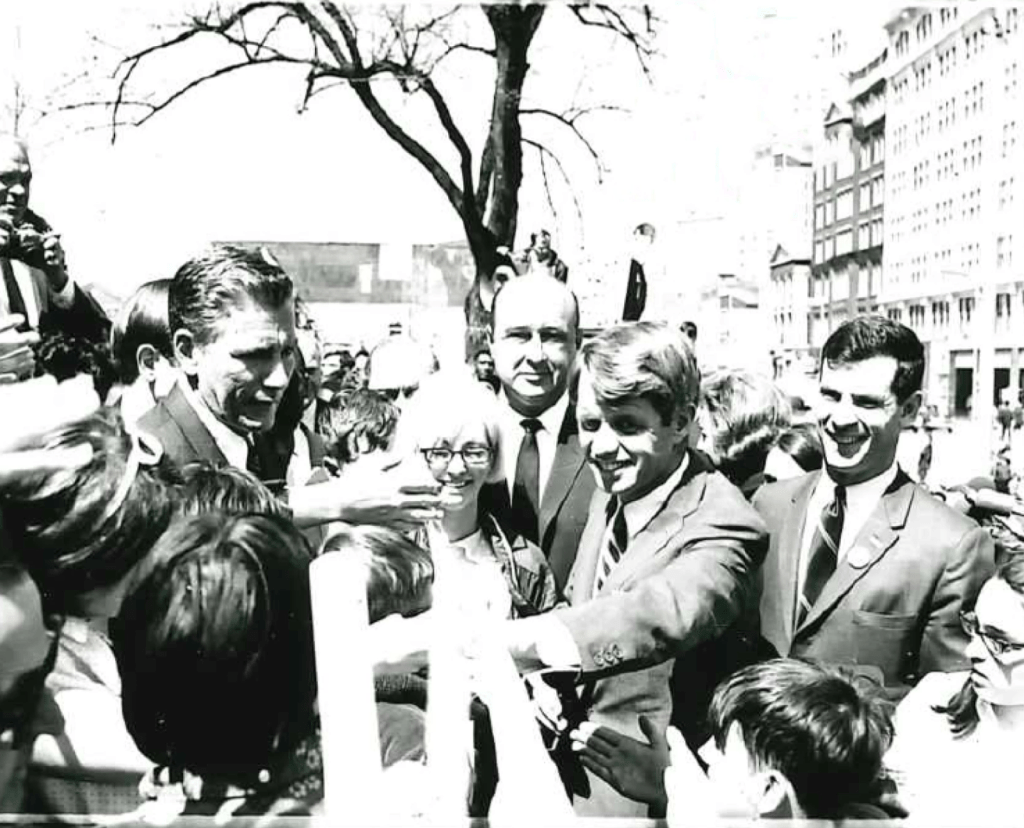
Indiana was important because, since he got into the race late, he couldn’t qualify for the early primaries that year — including Wisconsin’s. Indiana was his first test. And it was a big one. It had places like Gary and parts of South Bend and Indianapolis with large numbers of Black voters. It had relatively liberal college kids at Notre Dame (where he got a huge, enthusiastic response) and other schools. But then it also had conservative farmers and small town businessmen and, unfortunately, too many old-time racist Democrats like my dad’s uncle.
And yet he won. In fact, he won six of eight Congressional districts. He won in Gary and Hammond and in South Bend and Mishawaka and he won those places with both Black and blue collar white voters. For all I know, maybe even Uncle Kelly voted for him, setting aside his bigotry to vote for a fellow Catholic and a guy who had the good sense to bring along a Polish relative to Dyngus Day.
That was the magic of Bobby Kennedy. On a certain level, he just didn’t seem to give a damn. Two days after he announced for the presidency that March he had a previously scheduled speech at the University of Kansas, a very conservative campus. So he got on a regular commercial flight and flew out there to give a talk before what he knew would be a hostile audience.
And this is part of what he said:
And if we seem powerless to stop this growing division between Americans, who at least confront one another, there are millions more living in the hidden places, whose names and faces are completely unknown – but I have seen these other Americans – I have seen children in Mississippi starving, their bodies so crippled from hunger and their minds have been so destroyed for their whole life that they will have no future. I have seen children in Mississippi – here in the United States – with a gross national product of $800 billion dollars – I have seen children in the Delta area of Mississippi with distended stomachs, whose faces are covered with sores from starvation, and we haven’t developed a policy so we can get enough food so that they can live, so that their children, so that their lives are not destroyed, I don’t think that’s acceptable in the United States of America and I think we need a change.
I have seen Indians living on their bare and meager reservations, with no jobs, with an unemployment rate of 80 percent, and with so little hope for the future, so little hope for the future that for young people, for young men and women in their teens, the greatest cause of death amongst them is suicide.
That they end their lives by killing themselves – I don’t think that we have to accept that – for the first American, for this minority here in the United States. If young boys and girls are so filled with despair when they are going to high school and feel that their lives are so hopeless and that nobody’s going to care for them, nobody’s going to be involved with them, and nobody’s going to bother with them, that they either hang themselves, shoot themselves or kill themselves – I don’t think that’s acceptable and I think the United States of America – I think the American people, I think we can do much, much better. And I run for the presidency because of that, I run for the presidency because I have seen proud men in the hills of Appalachia, who wish only to work in dignity, but they cannot, for the mines are closed and their jobs are gone and no one – neither industry, nor labor, nor government – has cared enough to help.
I think we here in this country, with the unselfish spirit that exists in the United States of America, I think we can do better here also.
I have seen the people of the black ghetto, listening to ever greater promises of equality and of justice, as they sit in the same decaying schools and huddled in the same filthy rooms – without heat – warding off the cold and warding off the rats.
If we believe that we, as Americans, are bound together by a common concern for each other, then an urgent national priority is upon us. We must begin to end the disgrace of this other America.
Look folks, I don’t believe adults should have heroes. That’s an immature view of the world. And Bobby Kennedy was plenty flawed. He was close to Joe McCarthy and helped in his witch hunts. As his campaign manager, he flat out lied about his brother’s Addison’s Disease, the treatment for which could cloud the judgement of a man who would have his finger on the nuclear button during the height of the Cold War. There’s plenty of evidence that he colluded to steal the 1960 election from Richard Nixon through ballot stuffing in Illinois and Texas. And he had no business being the Attorney General of the United States with his brother as president. In that role, he looked the other way while JFK opened himself to blackmail through his reckless behavior with young women, one of which he shared with a mafia boss. And he authorized the wire taps of MLK, in part because he saw King as a political thorn in his brother’s side.
But then he said what I’ve quoted above. He would go to places like Kansas and talk about poverty in urban America. And he would go to urban America and talk about the plight of farmers. That’s what I mean by not giving a damn. He told people what he thought they needed to hear, not necessarily what they wanted to be told.
The day after Dyngus Day, Kennedy visited the Pine Ridge Indian Reservation in South Dakota. There were virtually no votes there and it took a full day away from valuable time in Indiana where the primary was still three weeks away. No campaign consultant would have told him that this was a good investment of his time. He didn’t give a damn.
So every year, the day after Easter, I think of that visit as a kid to South Bend and of Bobby Kennedy. And these days I think about historic figures and how we often demand purity and how quickly we kick them to the curb when they turn out to be flawed, sometimes deeply so. And, ya know, stealing an election is a pretty serious flaw.
So, that’s why I don’t have heroes. They’ll break your heart. But I still think the world would be a better place today if Bobby Kennedy had taken a different turn as he walked through the kitchen at the Ambassador Hotel that June.
Happy Dyngus Day.
 Yellow Stripes & Dead Armadillos