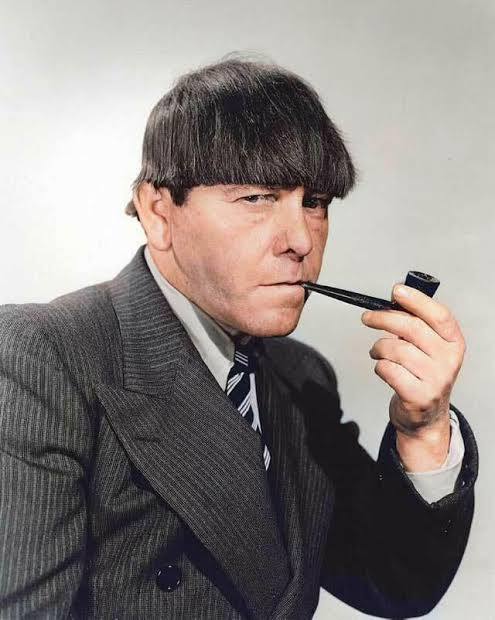
Okay, so I understand that I am required to gush over everything Ken Burns does. I may not so much as even mention his Moe Howard hair cut. The man’s a genius and who am I to raise so much as a dust speck of dissent?
And yet… if I could just offer one little criticism… Anybody else find his stuff a little, well, slow?
I tried to watch Burns’ latest masterpiece on the Revolutionary War. But after I slogged through two episodes over four nights — having fallen asleep midway through each episode — I put the project on pause. I’ll get back to it and finish it. I will. I really want to see how all of this turns out, after all. I mean, doesn’t everybody want to know who won?
Silicon Valley billionaires are spending some of their billions trying to figure out how to live forever, when the answer is right there on their local PBS station. Just line up all the Burns’ documentaries and start binging. This will have two results. You’ll feel like your life will never end and you’ll stop wanting to live forever, or even much longer.
Burns has a unique talent. He can cram a century of history into what seems like a millennium. “Mr. Burns arrived for dinner at seven PM and left a week later, though when he departed I heard the clock strike only nine bells.” — Mary Chestnut.
As I watched Burns’ The American Revolution I started to feel that defunding PBS wasn’t enough. I wanted them to pay me.
But here’s the thing. I thought Burns got one thing so very right that it more than compensates for the pain of having to actually watch his stuff. He was able to capture the right tone, the right balance in how we talk about America.
For the last couple of decades we’ve been in an escalating cultural war and our history is nearly at the center of it. Liberals have always wanted to be more honest and complete in the telling of our history. I was in that camp. But then it became fashionable on the left to push a more radical retelling. The low point of all that was the New York Times’ lamentable “1619 Project” which sought nothing less than to redefine the American founding not in 1776 and freedom but in 1619 (when the first slaves arrived here) and slavery. The Times even published free study guides for teachers.
I found that outrageous, wrong and deeply offensive. I don’t know whether any of the protesters who tore down the statue of Hans Christian Heg in the Capital park in the summer of 2020 were aware of the Times’ project, but it was an act consistent with its theme. Heg gave his life to end slavery, but that wasn’t enough. We had to tear down the very definition of what it is to be an American. We had to see ourselves as “settler colonialists” and “oppressors.” A UW Madison professor even penned a column in which he said that one day we would all be grateful for what those protesters had done.
So, when the right in general and Donald Trump in particular pushed back against all this, I wasn’t all that opposed. In fact, I cheered a little bit. But then, of course, Trump went too far. He sought to erase every suggestion that maybe this wasn’t the greatest, most tolerant, most benevolent nation on earth.
I believe, like I think most Americans do, that we are a great nation, but with serious flaws. We make outrageous and wonderful promises and then fail to live up to them. We move in fits and starts. We start a civil war over what our own president insists is about preserving the Union and not about slavery. Then, after a couple of bloody years, Lincoln concedes that it now is about slavery after all. Then we abolish that awful institution and begin Reconstruction in earnest. There’s progress for a decade or so, but then we tire of the project and Jim Crow appears, for all intents and purposes reestablishing involuntary servitude. It takes us another century to get around to dismantling that and you can make a case that it hasn’t been entirely dismantled yet — though we’ve made much more progress than the hard-left wants to acknowledge.
America has always been about living up to its promises. To point out that we’ve fallen short is not just necessary, but patriotic. We can’t ever get it right if we never allow ourselves to understand that we’ve gotten it wrong.
But we also can’t get it right if we abandon the promises themselves, if we become so cynical as to believe that America’s very founding was based on a lie. So, in my view, both the hard-left and the hard-right have gone too far, the former in telling us that we have nothing to live up to and the latter by telling us we’ve already lived up to it. The idea of America is a work in progress, not a settled fact.
And this is what Burns’ has accomplished in his telling of the Revolution. The founders are not portrayed as spotless and disinterested champions of human rights. He shows them for what they were: real estate speculators and slave holders who had some personal interests in the kind of government they created. But he also makes clear that some of them were painfully aware of their hypocrisy as it related to human rights and the institution of slavery. They were learned, they studied history and philosophy. Some of them were remarkably self-aware. They took human beings for what they are and fashioned a government that did not rely on human goodness, but rather counted on the pursuit of self-interest to keep power in check.
For all its flaws, it seems to me that that system has worked better than any other for the last two and a half centuries. I understand why some of us, whose experience suggests that promises of freedom and equality are hollow, might think otherwise. But the answer is not to abandon the promises, but to keep insisting that we keep them. Now, Trump is our system’s worst stress test since the Civil War itself, but I’m starting to feel more optimistic that we’ll survive him too.
Burns may be tedious in his production, but he’s given us a roadmap on how to write the American narrative honestly, while salvaging an ability to be proud of our country, as we mark 250 years as a nation. This is the kind of thing that deserves its own teachers guide. This is how to think about America in the 21st Century.
With luck, maybe we’re only half-way through the story. I’m eager to get back to it. I want to know how it all turns out.
 Yellow Stripes & Dead Armadillos