The Edmund Fitzgerald began to sink in June, 1958. Today, November 10th, only marks the 50th anniversary of the actual sinking in 1975.
That’s one conclusion you could reach after reading a new recounting of the tragedy, Wrecked: the Edmund Fitzgerald and the Sinking of the American Economy, by Tom Nelson with Jerald Podair.
Nelson is a long-time Wisconsin pol. He was majority leader of the Assembly in 2009-2010 and since 2011 he has served as the county executive of Outagamie County. In 2022 he ran for the Democratic nomination to take on Republican Sen. Ron Johnson, losing to Mandela Barnes in the primary. In 2021 he released One Day Stronger: How One Union Local Saved a Mill and Changed an Industry — and What It Means for American Manufacturing.
Both One Day Stronger and Wrecked explore the same theme: how broader economic trends were behind one dramatic event. And in both books Nelson pulls no punches with his liberal populist interpretations.
He makes a good case that the Fitzgerald’s fate was decided long before it ran into an early winter storm in eastern Lake Superior in 1975. In fact, by the time the ship was launched on June 7, 1958 its fate may have already been sealed. Nelson writes that its owner, Northwestern Mutual Life Insurance Company of Milwaukee, cut corners during its construction. Specifically, some of the welding was done quick and dirty, which could have led to structural weaknesses that spelled disaster a couple of decades later.
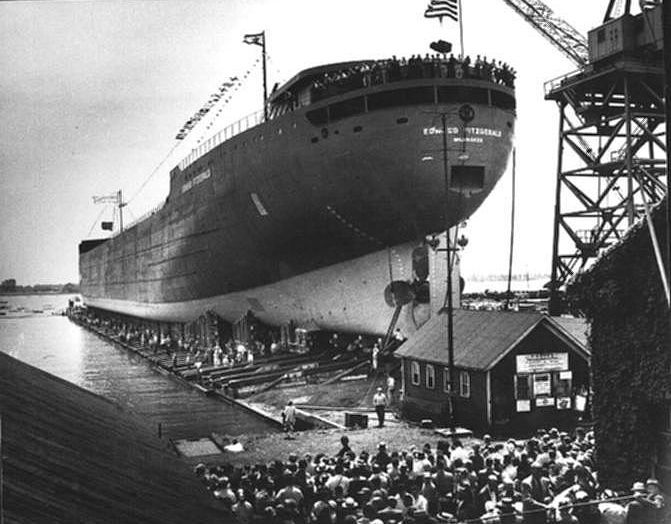
Then Nelson documents how the ship was poorly maintained while its captains were pressured to make faster runs with heavier loads and later into the season. All in all, it’s a story of how the capitalist system’s demand for profits put the safety of sailors at risk. And the Coast Guard, the government entity charged with regulating everything from ship construction to its daily operation, had a cozy relationship with the industry, causing it to look the other way when the ship owners or operators tried to save a buck at the expense of safe operation.
To top it off the ship’s owners employed a team of lawyers to shift blame and pay out as little as possible to the survivors of the 29 men killed that night.
But Nelson’s book isn’t just an economic treatise. He covers the actual sinking in one harrowing chapter and he sprinkles the book with stories of his encounters with the relatives of those 29 crew members as he researched his book almost a half century later. And there are mini-biographies of the colorful characters who hunted for the wreck or hunted for reasons for the sinking or fought in courts of law for just compensation for the families of the dead. Nelson does a nice job of putting a human face on what might otherwise be a cold economic cause and effect rendering of events.
In his closing chapter Nelson writes that one reason he wrote the book is to make the case that the men of the Fitzgerald were “not just poor souls who took one too many trips in the worst sailing season of the year in a vessel that wasn’t up to snuff.” Instead, he says that he wants to remind readers that these men were heroes, transporting the raw material that made much of the Midwest industrial economy possible.
“They were the reason there was enough steel to build the giant paper machines that my classmates’ fathers worked on in Kaukauna or Combined Locks, Wisconsin,” he wrote, neatly bridging his two books.
There are dozens of books on the Fitz and at least one iconic song about it. But I’m not aware of another book that so convincingly puts the tragedy in the broader context of the American economy.
And there’s one more contribution that those sailors made. Before November 1975 the sinking of big boats on the Great Lakes was not all that unusual, with a ship in the class of the Fitzgerald going down every several years. But since then there have not been any sinkings of large ships on the lakes. That’s in large part due to safety improvements put in place in the wake of this tragedy.
In many ways the 29 men who went down with their ship 50 years ago this week did not die in vain. But the question Nelson leaves us with is whether there were any lessons learned for the broader American economy.
Nelson’s book is available from Michigan State University Press. It can be ordered on their website or through Amazon or, better yet, ask your local bookstore to get you a copy.
A version of this piece originally appeared in Isthmus.
 Yellow Stripes & Dead Armadillos
I knew the family, and met one of the crew members of the Fitzgearld. so this hit close to home, remember seeing the Sheriff’s car in front of their house the next day. talked to the widow some time later on. so yes, it hit close to home. knew his kids somewhat also.
LikeLike