I took the summer off to finish a book. The book is “finished,” sort of. It’s now in the final stages of consideration by the publisher. No contract yet. I’ll tell you more about it when the ink is dry, but because there’s still more work to do on it, these posts are unlikely to resume their daily rhythm for a while.
Beyond that I had a pretty good summer. I read a lot. More accurately I mostly listened to a couple of very long audio books. An author’s dream customer, I bought both the electronic and audio editions and toggled back and forth, listening to the books on my long drives back and forth between Watersmeet and Madison and before I fell asleep and then reading them the rest of the time. I find I absorb more when I read instead of listen, but it’s a human advance akin to sliced bread to have the easy option of doing both.
The books in question are “Mark Twain” by Ron Chernow, weighing in at 1,200 pages, and “Buckley: The Life and the Revolution that Changed America” by Sam Tanenhouse, which tipped the scales at a mere 1,000 pages. I also snuck in a novel, “Settle Down,” by Madison author Ritt Dietz and the latest tome on what’s wrong with the Democrats, “Abundance,” by Ezra Klein and Dereck Thompson as well as a new book on the Edmund Fitzgerald, “Wrecked,” which comes just in time for the 50th anniversary of the gales of November that made that good ship and true a bone to be chewed. That last one is by the politician-writer Tom Nelson, who is also the county executive in Outagamie County and a recent candidate for U.S. Senate. Lawrence University professor Jerald Podair is his coauthor.
A sensible person could ask why anybody needs 1,200 pages on Twain or 1,000 on Buckley, but I actually never lost interest in either book. I suppose that was because they were both about writers. I’m always fascinated to learn how different writers work — where they write, how long they write each day, how they motivate themselves to begin and all that. Now, that same sensible person might ask why I consumed a total of 2,200 pages to learn what was contained in probably the equivalent of maybe 50 pages. The rest of those books were about other stuff, like the surprisingly shaky finances of both men. Nonetheless, I enjoyed both books for reasons I’m not required to explain, even to myself.
“Abundance” was a Bill Kraus Book Club assignment, which from the sound of it (I couldn’t make it to Jonathan Barry’s farm) nearly brought the participants to blows. I would have taken up arms with the pro-abundance side. I thought Klein and Thompson aired some issues we really have to deal with as Democrats — we’re the party of government and yet there are too many examples of how crummy we are at governing. But apparently, the Republicans in the group will cut my party no slack even when it’s owning up to its own shortcomings, while the true liberals took issue with the books’ premises.
Deitz’ novel would be especially interesting to anybody who lives or has lived in Madison. It’s a coming of age story — a recent college grad trying to figure out where to go next, whether to “settle” for the cozy limitations of a Midwest college town or strike out (and risk striking out) to a bigger city. The twist is that it includes an overlay of southern charm (or southern not so charming) as our protagonist is a son of the South who finds himself in Madison for reasons other than attending the UW.
Nelson’s book on the Fitzgerald sinking links that event to a labor and industrial policy (or lack thereof) history of the mid to late twentieth century. The government let Northwestern Mutual, the owner of the ship, cut corners in its construction and maintenance while the company that managed its operation pushed for maximum payloads and fast run times. Nelson argues that if unions and workers rights were stronger the church bell would never have had to ring at all, much less 29 times.
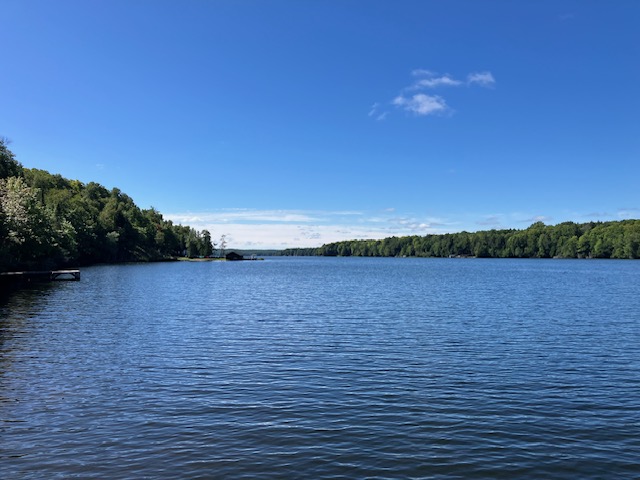
When I didn’t have my nose or ears in a book, I played some golf (and recorded some helpful golf videos), did some biking, kayaked around the lake, worked on some jigsaw puzzles, listened to the Brewers’ epic season and, sure enough, got to work on a new book — this one’s about the need for a new, organized moderate wing of the Democratic Party.
Finally, while I did get the urge now and then to fire off a blog I quickly got over it. I liked taking some time away. I especially liked reinstating the seasons. Being out of work (I hate the word “retired” so much that I prefer “unemployed”) can create a bland sameness. You forget what day of the week it is. You lose that glorious feeling of Friday afternoon. A day in July is no different from a day in January, save for 40 or 50 degrees. It felt good to reestablish the concept of summer vacation with the anticipation (and slight dread) of digging out the long pants and heading back to the office after Labor Day. I think I’ll keep this up in years to come because I’ve found that summer isn’t as sweet when Labor Day doesn’t mean a change of routine.
So, I’m back and, for those of you who are returning with me, it’s good to see you again. I hope you also had a good summer. Let’s crack the books and start doodling on those fresh notebooks.
 Yellow Stripes & Dead Armadillos
We are all so glad that your break went so well.
My Chernow audio book for the summer has been Washington.
Ken Streit
Get Outlook for iOShttps://aka.ms/o0ukef
LikeLike
“A day in July is no different from a day in January, save for 40 or 50 degrees. It felt good to reestablish the concept of summer vacation with the anticipation (and slight dread) of digging out the long pants and heading back to the office after Labor Day.”
Are you sure you spent the summer in Wisconsin and not some social democratic dystopia where people actually take month-long summer vacations?
LikeLike
welcome back!
LikeLike
Good to have you back, slacker.
LikeLike
Welcome back! Among our summer reads was “Friday Night Lights” a helluva tale (which happened to be true.)
LikeLike
You came back!?!
I will take it easy on you for a few months, let you get your “sea legs” back. Not really much happening anyway.
LikeLike
Your “helpful golf videos” are some of the best stuff on YouTube!!! I would heartily recommend them to all avid golfers, occasional golfers, and even those who have never swung a golf stick in their lives!
LikeLike