It’s Memorial Day, so let’s do some reflecting on war. Here’s my key reflection: the most dangerous thing we face right now may be the passing of the WW II generation. Here’s why.
Let’s start with some good news. Despite the awful things happening in Gaza and Ukraine, overall since WW II we have lived in one of the most peaceful eras in human history. The chart below, provided by Our World Data, shows the number of soldiers killed (it doesn’t count civilians killed directly or as the result of starvation or diseases or policies, like the Holocaust) in wars going back to 1800. What you notice is that before WW I there were a lot of wars and the bigger ones were in Europe, but they didn’t usually kill a lot of people compared to what was to come.
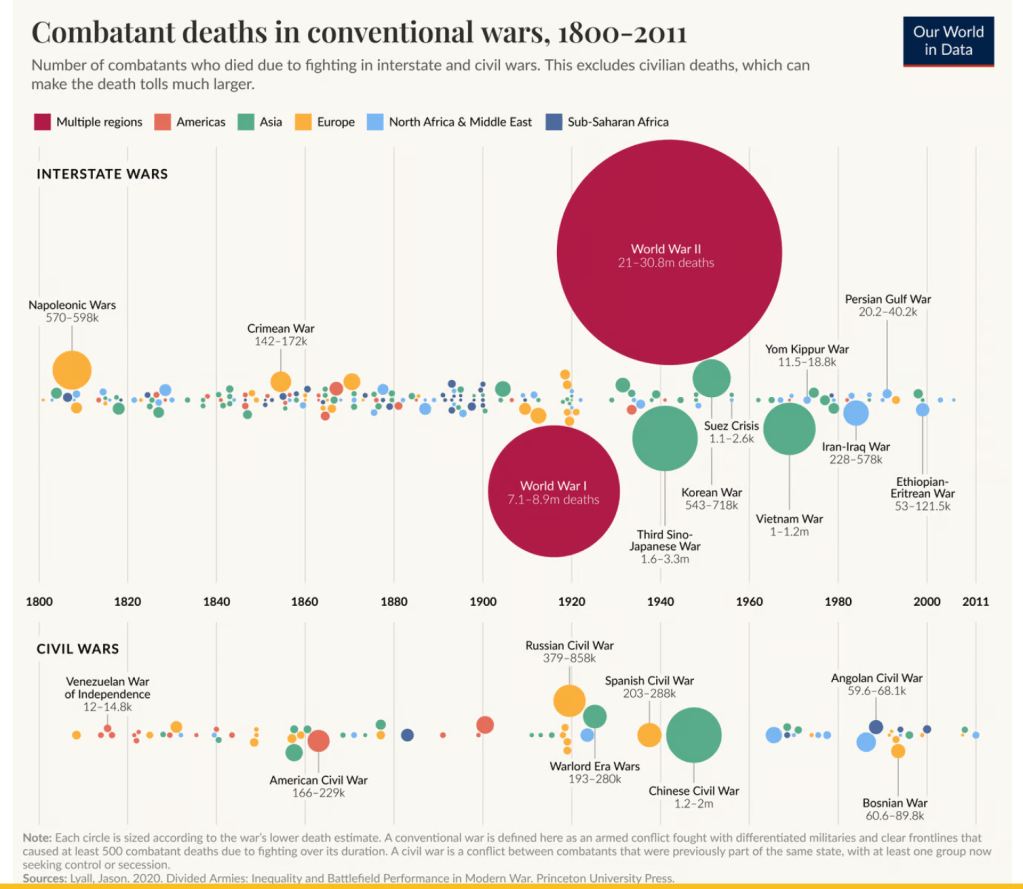
What was to come was cataclysmic. In WW I around 8 million soldiers were killed while twenty years later more than 21 million were killed in WW II. But since then wars have been less deadly and frequent.
One conclusion is that, while every war is filled with tragedy, humanity overall is becoming less prone to conflict. But another read of the data might suggest that we’ve actually been living in the shadow of the two great wars. It could be that the cataclysm of WW II, which ended with the use of two nuclear weapons, was so powerful that it forced us to create mechanisms, like the United Nations, that were fairly successful in staving off conflicts that led to wider wars.
Or it could have been dumb luck. It could have been that the overriding conflict of the post war era was the ideological one between the West and Communism. What saved us was not a turn toward peacefulness but rather the possession of nuclear weapons that created a balance of terror.
In either case though, it was memory that saved us. Millions of people who had personal experience with the horrors of WW II vowed to not let it happen again. They did that either directly as policy makers or as common citizens who refused to support candidates and policies that might recreate a conflagration.
But now that generation is all but gone. We are fast approaching a point where virtually no one has personal memories of WW II. And what does that mean for the future?
As we take a day out to remember those who died for our country, let’s also do some thinking about how we can prevent more deaths to come.
 Yellow Stripes & Dead Armadillos