It was one of the more remarkable things I’ve read in awhile. I read it over several times in context just to make sure I wasn’t missing something. It was in a story in the New York Times about how diversity, equity and inclusion statements have become litmus tests for hiring at some universities.
Professor Brian Soucek, a UC – Davis law school professor, told the Times that ideological diversity is not the point of DEI. “It’s our job to make sure people of all identities flourish here,” he said. “It’s not our job to make sure that all viewpoints flourish.”
Thank you, professor, for your candor and clarity. That’s the clearest statement I’ve seen about this issue. Soucek is saying that what matters above all else is identity — a person’s skin color or gender identity. It would be fine with him — in fact, it would be preferable — if he had a classroom full of students of diverse races and gender identities all of whom thought exactly the same way, all of whom adhered closely and with sufficient enthusiasm to the latest fashions in liberal orthodoxy.
The Times story went on to document the travails of a respected psychology professor who wanted to take a job at UCLA. A liberal himself, he wrote the mandatory DEI statement which passed muster with the gatekeepers. But then somebody discovered that in his podcast, years ago, the prof had twice questioned the efficacy of DEI statements. His point was that they had become performative and not all that meaningful. That was enough. Grad students were outraged. They sent a letter with demands. The administration caved. The prof got cancelled.
And that’s not unusual. In fact, at Cal Berkeley it has been standard practice to read the DEI statements first when evaluating candidates for faculty jobs. Any candidate who didn’t demonstrate sufficient loyalty to the dogma was cast aside. Actual academic qualifications weren’t even looked at if the DEI statement wasn’t convincing enough.
In an essay last week New York Times columnist Ross Douthat put this in context, He wrote: “The counterargument is that diversity is an apolitical concept — who could be against it? But imagine that nearly half of America’s large universities, in response to ideological pressure groups, began asking job candidates to produce a statement affirming American patriotism — just as an apolitical concept, folks, something we can all agree is good. And then further imagine that it became clear that some answers — “I think dissent is patriotic,” or even “I love America because it’s a nation of immigrants” — were often penalized as insufficiently patriotically correct. Most liberals would regard this as rank McCarthyism.”
Soucek and his colleagues have elevated the trivial over the profound. I’m one of those old fashioned liberals (circa 2010) who believe we should be obliterating discrimination and distinctions based on race, gender, disability or anything else that isn’t relevant. I’m for a society based on personal merit, not group grievance. That was once the liberal view. Now a person could be guillotined (metaphorically, but it’s early) over those kinds of statements.
Today, it’s not what you know. It’s not how well you can construct a rational argument. It’s not the content of your character. What matters is what you look like. That’s literally the ideology that has taken hold, not just on college campuses, but in much of American culture. The ubiquitous phrase “looks like me” sums it up nicely.
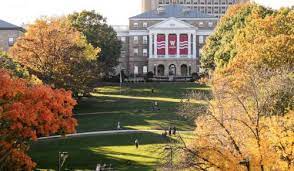
Here at the UW I don’t think things are as nuts as they are in California. System President Jay Rothman has ordered that DEI statements in faculty hiring may not be mandatory. I suspect that that doesn’t go far enough and that he should order that they may not be used at all, but it’s a start.
And legislative Republicans have cut the UW budget by over $30 million and told them they can get it back when they eliminate DEI programs. I appreciate that pushback, but I don’t support it only because it’s a blunt instrument. DEI is a collection of all kinds of programs. Would you want to eliminate programs that help veterans experiencing episodes of PTSD or that help students with disabilities navigate campus?
On the other hand ripping out the circuitry of Critical Race Theory would be an excellent project. What I’d suggest is a Legislative Audit Bureau study of DEI programs. Learn as much as we can about what programs it encompasses and then eliminate only what’s truly offensive.
I’m hopeful that all this crazy stuff might be just a fashion that will subside when the next generation decides that the Enlightenment is cool again because the previous generation hated it or was ignorant of it. They’ll become classical liberals because it irritates their parents. And, in fact, woke may be in retreat already, as Douthat points out in the first part of his column.
Enlightenment values and ideas are enduring. I have hope that the same goes for the time honored tradition of arguing with your elders.
 Yellow Stripes & Dead Armadillos
You may get away with those policies in education and government, but I suspect there may be a growing, if unstated, backlash. Who will want to hire or fund someone who promotes their skin color or gender fluidity, or who insists on signaling their virtuosity? You saw the reaction to Bud Light. Next thing you know, we’ll re-elect Trump.
LikeLike