It’s pretty simple.
To see how simple it is let’s take this short quiz. When the issue is abortion Democrats win. If the issue becomes affirmative action they’ll lose. If you’re a Democrat which issue do you want to emphasize?
If you answered affirmative action, we’re into social promotion here at YSDA so you get another try.
Being pro-choice is popular. A recent Pew Research poll found that 69% of Americans support the right to abortion in the first trimester, the highest percentage ever recorded in the Pew poll.
Affirmative action is unpopular. Only 26% of Americans support using race as a factor in admissions to public universities while 74% oppose it. In fact only 40% of Democrats support that.
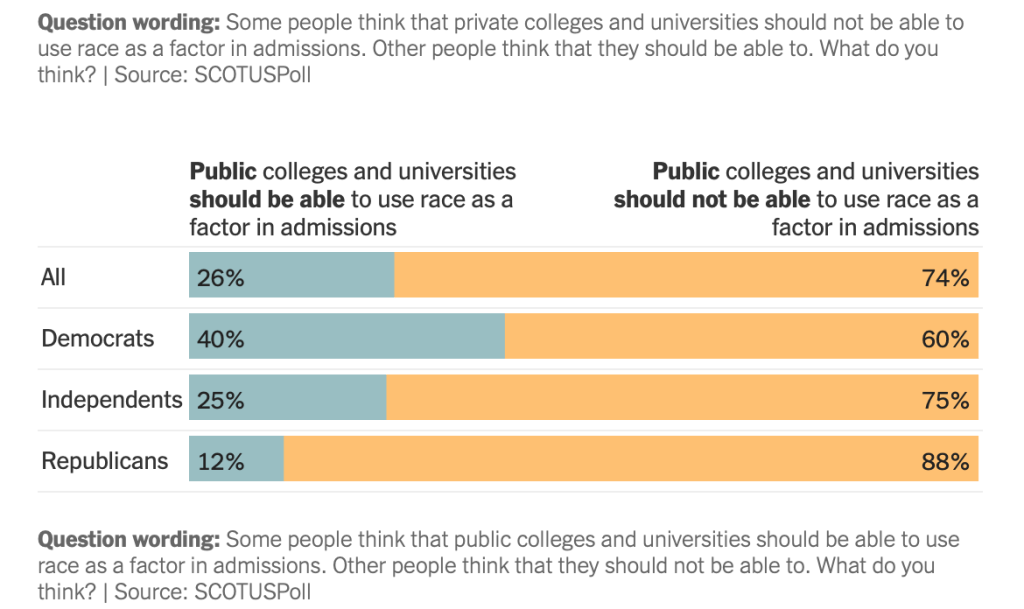
So the great danger for my party after the Supreme Court’s predictable decision striking down race-based affirmative action in college admissions is that they won’t be able to shut up about it.
Given where Democratic elites (but not the party rank and file — 60% of Democrats oppose this) are at, I understand that they will need to wail and moan for awhile. That’s not great, but it’s okay just so long as they let it fade. The very last thing Democrats should want to do is to keep harping on this issue. That will only succeed in making the 2024 election cycle about affirmative action instead of abortion.
And, my God, there is nothing Republicans would like better because not only are they getting creamed on the abortion issue, but their base is driving them to double down on the most extreme positions. At their convention last month Wisconsin Republicans voted to endorse the 1849 abortion law with no exceptions for rape or incest. And their presidential candidates feel they must go hard right. Mike Pence led the way by calling for a national ban after 15 weeks and, for good measure, he added that that should only be the start.
So, when these guys are hanging themselves, why on earth do we want to cut the rope for them?
That’s the politics of the issue. For a discussion of the merits I recommend this PBS News Hour interview with Richard Kahlenberg, a scholar at Georgetown. His interview, which was done on the day the ruling was announced, begins as 12:20 on the video. His basic point is that the Court’s ruling is a victory for economic diversity. He points out that over 70% of the Black and Hispanic students at Harvard come from the richest 20% of Black and Hispanic families. So, while there is racial diversity under race-based affirmative action, there is very little economic diversity. Basically, the current policy produces a homogeneous group of privileged kids who happen to have different skin colors, and what’s so great about that?
Democrats used to be the party of the middle and working classes. Let’s be that again. We should do what 60% of Democrats want: Support this ruling and focus back on abortion. That’s impossible of course because elite party leaders, who are obsessed with race, won’t have it. But if they can’t support the ruling it shouldn’t be too much to ask that they be smart enough to let it go after a time so that the party can keep the abortion issue front and center.
If you’d rather not access the video of the Kahlenberg interview, here’s a transcript.
GEOFF BENNETT: For a different perspective, we turn now to author and nonresident scholar at Georgetown Richard Kahlenberg.
He served as an expert witness for the plaintiffs in both cases and has long made the argument for what he calls the pitfalls of race-based affirmative action.
Thanks for being with us.
You have described this ruling as a step forward for the country.
In what ways?
RICHARD KAHLENBERG, Georgetown University: Well, I think this is a victory for low-income and working-class students of all races.

So Harvard and the University of North Carolina currently bring together fairly well-off students, economically well-off students, of all races, which is much better than an all-white, overwhelmingly privileged group, but they don’t seek the socioeconomic diversity.
So, 71 percent of the students at Harvard who are underrepresented minorities, black, Hispanic, and Native American, come from the richest one-fifth of the black, Hispanic, and Native American populations nationally, and the white and Asian students are even richer.
So you have essentially 15 times as many rich students as low-income students at both Harvard and the University of North Carolina.
And what experience in states where affirmative action has been — race-based affirmative action has been banned suggests is that universities won’t just give up on racial diversity.
And, to their credit, they will find new ways to promote racial diversity.
And I think what we will see is that they will do the hard work of recruiting working-class students, providing them with financial aid, to make sure that the universities remain racially diverse and will become much more economically diverse as a result.
GEOFF BENNETT: Looking at the data though, accounting for an applicant’s economic status does not work as well to racially diversify a student body as including some form of consideration of race in the admissions process, which is to say that it does not remedy the thing that affirmative action was established to resolve,which is discrimination based on race.
So how do you account for that?
RICHARD KAHLENBERG: Well, I have a different reading of the data.
So, in the Harvard and UNC cases, we ran models on what would happen if you stopped using race and instead provided a break to economically disadvantaged students and got rid of some of the unfair preferences for legacy applicants, for children of faculty, children of donors.
And you were able to produce robust levels of racial and ethnic diversity, much more economic diversity.
And we see in states where affirmative action was discontinued, that,in seven of the 10, they were able to get as much Black, Hispanic representation as they had in the past using race.
There are a couple of outliers, University of California, Berkeley, UCLA, University of Michigan.
But, in recent years, UCLA and U.C.
Berkeley have admitted their most diverse classes in 30 years, according to the universities themselves.
So, the amicus briefs, in some cases, tried to make the case that they hadn’t done well.
In fact, they have done quite well.
GEOFF BENNETT: You mentioned legacy admissions.
We just heard the president of the University of Michigan say that schools should look at – – should look at that process.
How should colleges and universities rethink this issue of legacy admissions, in light of the Supreme Court striking down affirmative action in college admissions policies?
RICHARD KAHLENBERG: Yes, well, I edited a book back in 2010 called “Affirmative Action for the Rich” about legacy preferences.
I think they’re very, very, very difficult to justify under any circumstances, but especially, today, after the U.S. Supreme Court’s ruling on the use of race, I think it becomes even less defensible to use legacy preferences.
GEOFF BENNETT: The White House, I’m told, had been preparing for this outcome today.
And President Biden today, beyond criticizing the ruling, suggested that schools keep open the door of opportunity, and he offered an alternative path.
JOE BIDEN: What I propose for consideration is a new standard, where colleges take into account the adversity a student has overcome when selecting among qualified applicants.
Let’s be clear: Under this new standard, just as was true under the earlier standard, students first have to be qualified applicants.
They need the GPA and test scores to meet the school’s standards.
GEOFF BENNETT: So, the president says, once that standard is met, adversity should be considered.
Is that a suitable alternative, in your view?
RICHARD KAHLENBERG: Absolutely.
And I’m glad that President Biden made those remarks.
My contention is that a conservative U.S. Supreme Court decision today will, paradoxically, lead to a set of liberal public policy initiatives that make the system fair, that provide a break to economically disadvantaged students.
And the use of race has always been highly controversial in American politics, and the initiatives that were put forth in a number of states almost always passed, the anti-race-based affirmative action initiatives.
By contrast, there is strong public support for giving a preference in admissions to economically disadvantaged students and also for a number of the other important policies, getting rid of legacy preferences, increasing the number of community college students who transfer.
What’s important is to make sure that we find ways to reflect the realities of race in this country, the history of racial oppression by considering things like the wealth of an applicant, because a low-wealth applicant who overcomes odds and does well, despite the obstacles, deserves a leg up.
And those will disproportionately be Black and Hispanic students, given the enormous wealth gap in — by race and ethnicity in America.
GEOFF BENNETT: Richard Kahlenberg is an author and nonresident scholar at Georgetown University.
Thanks so much for your perspectives.
We appreciate it.
RICHARD KAHLENBERG: Thank you.
 Yellow Stripes & Dead Armadillos