Twice in two weeks Democratic and Republican leaders have been able to work out big budget deals. Last week Pres. Joe Biden and House Speaker Kevin McCarthy came to an agreement that avoided a damaging default on our nation’s debt and yesterday Gov. Tony Evers worked out a deal with Republican leaders that would provide historic aid increases to local governments.
To quote Biden from another context, this is a big (freakin’) deal. (We’re a family site here at YSDA.)
The agreement between Evers, Speaker Robin Vos and Senate Majority Leader Devin LaMehieu might seem like inside baseball to a lot of folks, but it means that your local police and fire protection and other services could be improved and it means that your local public and charter schools and voucher programs will have more resources. Most communities will get a 20% increase in shared revenues and schools will get another billion dollars. And the shared revenue increase will be tied to the state sales tax, so as revenues from that increase so will aids to local governments.
The major snag had been Vos’ insistence that a sales tax increase for Milwaukee and Milwaukee County must be approved by voters in a referendum. Both Evers and LaMehieu opposed that idea because they thought that a referendum asking voters to increase their taxes to pay for public employee pensions (which is why the tax is necessary) would be dead on arrival. (Note: they would have been right.) In the end Vos backed down and agreed to require a super majority of the Milwaukee Common Council and the Milwaukee County Board instead.
There’s more and you can read about the details here, but what I want to focus on this morning is the process and the politics at the state level. Ever since Evers’ reelection last November there’s been a change in tone from Vos. The edge has come off most of his criticism of the Governor and he’s been more willing to negotiate. Let me correct that. He’s been willing to negotiate. In previous budgets he simply rejected everything coming from Evers and passed a new budget without so much as talking to him.
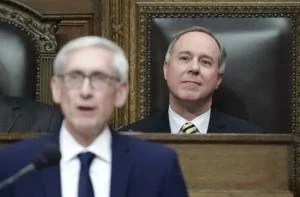
What accounts for the change? Damned if I know.
But since that’s an unsatisfying way to end an essay, let me enter the realm of wild speculation. There’s no love lost between Vos and the hard-right Trumpy parts of his party. Trump and Michael Gableman endorsed his primary opponent last August. After Vos narrowly prevailed it seemed as if he felt liberated. He fired Gableman and ended his circus of an “investigation” into voter fraud. He’s mostly silent about Trump, but he has made statements about the party needing to move on from him. He also took away her committee chairmanship from election denier Rep. Janel Brandtjen and expelled her from closed caucus meetings.
Even after those shots at the hard-right Vos was never threatened with a challenge to his speakership. What didn’t kill him made him stronger. So, maybe he’s just feeling empowered to make compromises with Evers, not worrying about the pushback from his right. And maybe he’s discovered that it’s fun and rewarding to actually govern and make public policy.
Another possibility is that it’s about the state Supreme Court. With a liberal majority coming in August, Vos knows that his gerry-mandered majority is about to go away. He might be positioning his party for the long game where moderation and compromise will be more important in a state that is once again competitive.
A third guess is that Vos, who has already set a record for longevity in the Speaker’s chair, is thinking about his legacy. In all that time leading the Assembly I can’t think of single piece of significant state policy that Vos has been responsible for. He’s been masterful at opposing Evers and managing an ever more hard-right caucus, but what’s he actually done?
And of course the last explanation is that he simply wants to end the endless battles, set aside the vitriol and get down to the work of doing what’s best for the state in the long-run. Well, okay, but the first three possibilities seem credible, don’t they?
Have a nice weekend.
 Yellow Stripes & Dead Armadillos
I wonder if it has anything to do with the predicted red wave that hasn’t happened in the last few elections. Or the fact that the GOP talks about municipalities taking care of themselves, AND public safety. How could he possibly argue that kind of spending? Plus, could it be that the reasonable guys (Evers, Biden, even McCarthy!) are setting a good example? People might start expecting that!
LikeLike
Conceptually I like the idea of shared revenue having a dedicated funding source. However, this isn’t new money coming into state coffers that is then being distributed to counties, cities, villages, and towns. All they’re doing is diverting 20% of state sales tax revenue. Presumably, that money was used for funding other programs in the past. What I want to know is what other programs will ultimately be cut in order to divert money to shared revenue. In the short run, maybe not much as they have a large surplus to work with. But a lot of that current surplus is due to one time sources. Once that runs out, what are they going to cut? I’m going to hold off celebrating until we know the answer to that question. I know this comment doesn’t necessarily address your primary focus on what’s up with Vos, but I still think it’s an important question.
LikeLike
Yes. I’ve had the same thought. There has to be a Fiscal Bureau paper that touches on this. I’ll look into it some more.
LikeLike